
Управління тепловим режимом · Технічний посібник
Air-to-Air Heat Exchanger Selection for an Electrical Cabinet
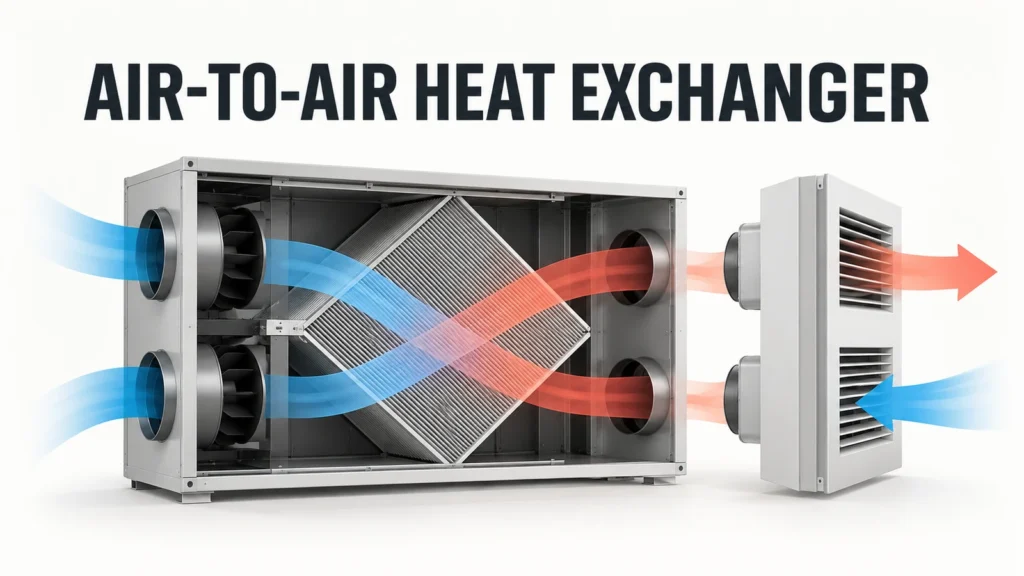
An air-to-air heat exchanger can remove cabinet heat while keeping the inside and outside air streams separate. That makes it a useful architecture to investigate when the surrounding air is cooler than the permitted cabinet interior and the enclosure should not rely on an open filter-fan path. It is not a refrigeration unit. The actual heat removal depends on the temperature difference, the chosen exchanger and the cabinet's airflow and heat-load conditions. A selection made from cabinet size alone can miss the thermal problem entirely.
This article is a method-level selection guide, not a claim that RITOKS currently publishes a particular heat-exchanger model. RITOKS does publish Кондиціонери для закритих приміщень та Вентилятори для охолодження шаф as separate thermal-management families. Their product numbers and performance must not be imported into a heat-exchanger proposal. The buyer should request an exact heat-exchanger model and manufacturer performance data before a purchasing or installation decision.
| Input to define | What it resolves |
|---|---|
| Internal heat loss | The heat the exchanger must carry out during the design case |
| Maximum ambient and allowed interior temperature | Whether the temperature difference can support air-to-air heat transfer |
| Cabinet layout and mounting surface | Internal circulation, cutout and service feasibility |
| Environment and seal requirement | External contamination, maintenance and installed enclosure integrity |
Confirm That the Thermal Principle Fits
The first gate is the intended temperature relationship. Rittal's air/air heat-exchanger technical catalog states that ambient air must be below the required enclosure internal temperature. The temperature difference is decisive for how much heat can be dissipated. If a cabinet must be cooler than surrounding air during its critical operating period, a conventional air-to-air exchanger cannot create that result by itself. That is a cooling-method mismatch, not an invitation to select a larger fan.
Do not stop at a nominal room temperature. Record the highest expected ambient during the actual duty cycle, including building ventilation changes, nearby process heat and seasonal conditions. The allowable internal temperature should come from the installed components and the cabinet design, not from an arbitrary thermostat number. A narrow difference between the two temperatures may leave too little transfer capacity, even though the mathematical condition “ambient is lower” is technically met. The exact unit's performance curve decides whether the remaining margin is adequate.

The thermal input should represent electrical losses occurring inside the enclosure. Request dissipation data for drives, supplies, transformers, contactors, electronics and other devices under their real operating conditions. A component's electrical input or output power is not necessarily its cabinet heat loss. Note simultaneous loads, duty cycles and any solar or external radiant heat. If data are estimated, mark the assumptions and assign an engineer to review them. An optimistic load estimate can undermine any later product comparison.
Understand the Two Air Circuits
An air-to-air heat exchanger has an internal air circuit and an external ambient-air circuit separated by a transfer surface in its intended design. The internal stream moves cabinet air past the surface and back into the enclosure. The external stream carries heat away without being directed through the cabinet interior. Rittal's climate-control product explanation distinguishes this arrangement from a filter fan that exchanges cabinet air with ambient air. The principle is useful where dust ingress is a concern, but the exact installed sealing outcome remains a cabinet-level question.
Air path details matter. Check whether internal circulation reaches heat-producing components or short-circuits between intake and discharge. Similarly, external air must be able to enter and leave the exchanger without recirculating hot exhaust against a nearby wall. Manufacturer clearances and mounting instructions control these conditions. A photograph of a module mounted on a cabinet is not enough to establish the correct cutout, orientation or service space for a different product.
The word “separate” should not be stretched into a universal ingress-protection claim. The exchanger housing, gasket, cutout, cable entries, doors and any other ventilation openings all affect the final enclosure. Confirm the required installed IP or other environmental performance from exact product instructions and panel construction. An existing cabinet with open filter-fan cutouts may need a separate approved redesign before it can be evaluated as a closed-air-circuit enclosure.
Read Heat-Transfer Ratings at the Design Point
Heat-exchanger datasheets may state a specific heat-transfer performance as watts per kelvin or as output under a specified internal-versus-external temperature difference. Such numbers are not electrical power consumption and are not automatically equivalent to an air conditioner's cooling-capacity label. Ask the supplier to provide the capacity at the project's actual design temperatures and operating conditions. The manufacturer's curves or selection software should show how performance changes as the temperature difference narrows.
Do not take a performance value from a neighboring model, a different fan supply or a third-party product and assign it to the proposed unit. The cabinet's effective air circulation, obstruction, mounting and ambient airflow can also affect realized performance. If the stated output is measured under a particular test standard or configuration, record that condition in the comparison table. A useful quote should show the exact model, rating basis and margin against the documented heat loss rather than only a family name.
Electrical consumption is another separate line. Fans and controls may require a supply even though the unit does not use a compressor. Verify voltage, frequency, running power, controls, alarm contacts and any temperature setpoint according to the proposed order code. Do not describe an exchanger as passive or maintenance-free unless its exact design supports that statement. A selection that neglects fan power or cabinet supply availability may fail procurement despite acceptable heat transfer.
Check Cabinet Geometry and Component Layout
Before requesting a product, provide enclosure height, width, depth, wall material, door configuration and installation location. Mark internal equipment that blocks air movement, service access or the proposed cutout. A door-mounted unit changes hinge loading and cable movement; a side-mounted unit needs wall clearance and structural support. A roof unit faces a different air path and moisture exposure. These are engineering choices tied to the actual cabinet, not generic properties of “heat exchanger” in a category name.
The exchanger should not discharge directly into a sensitive component or pull from a stagnant corner. Identify zones of high heat density and the location of temperature sensors. Local hot spots can exceed component limits even when a cabinet-average temperature appears satisfactory. The installer may need to change equipment placement or use approved air-management measures, but a blog cannot prescribe a universal baffle or cutout. Ask the supplier and panel designer to review a dimensioned layout.
Maintenance access should be planned before ordering. External air passages can collect dust or oil even if the cabinet interior remains separated. Confirm cleaning intervals and access from the actual installed position. A unit placed tightly against another cabinet may be impossible to service. Likewise, confirm replacement access for fans and controls if the exact unit uses them. These details determine long-term availability, not just ease of initial installation.
Compare Alternatives Without Conflating Them
A cabinet filter fan may be simpler where ambient air can be admitted and the environmental requirement permits it. Its installed airflow depends on filters, exhaust grilles and pressure losses; it does not preserve a sealed internal circuit. An enclosure air conditioner is an active cooling option when the interior must be managed under hotter ambient conditions within its documented rating. The heat exchanger occupies a different decision space: separate air streams and a useful cooler ambient.
An air-to-water exchanger is yet another method, dependent on an available water circuit and its own environmental and maintenance design. Do not call it air-to-air simply because a cabinet has a heat-exchanger panel. Equally, a general building HVAC room setpoint is not a cabinet product rating. The comparison should begin with the same cabinet heat-loss schedule and desired internal condition, then eliminate methods that cannot meet the thermal or enclosure requirement before cost comparison.
If an existing air conditioner is being replaced, its installed capacity label cannot be converted directly into an exchanger rating. The refrigeration unit may have maintained a lower internal temperature than the surrounding room. An exchanger cannot reproduce that result just because both are enclosure-mounted modules. Review historical cabinet temperature measurements, maximum ambient and operating loads, then assess the replacement method from first principles.
Prepare an Exact-Model RFQ
Supply a dimensioned cabinet drawing, internal heat-loss estimate, ambient-temperature envelope, maximum permitted component or internal-air temperature, mounting preference, supply voltage and environmental requirement. State whether the enclosure currently has filters, vents, open cutouts or other paths that affect the closed-circuit assumption. Ask for the exact exchanger model, performance curve at the design temperature difference, internal and external airflow requirements, supply/control details, cutout drawing, sealing method and service clearance.
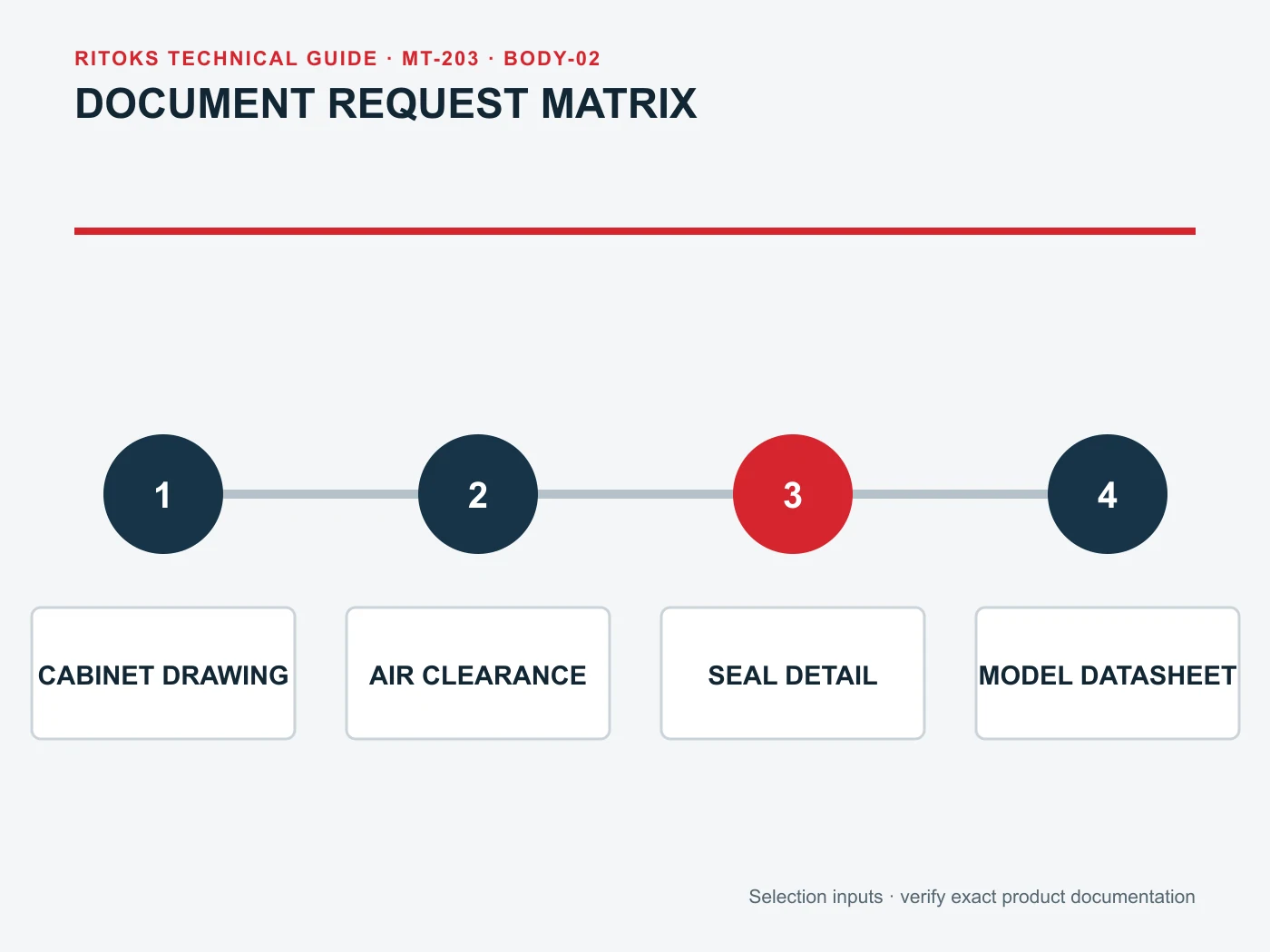
Request the supplier to identify assumptions and unresolved inputs in writing. If heat-loss data are uncertain, ask what additional measurement or calculation would be needed. If the highest ambient approaches or exceeds the allowable internal temperature, record air-to-air as unsuitable under that condition and evaluate a different cooling architecture. A documented stop decision is better than a plausible-looking purchase that cannot meet the physical temperature condition.
Цей RITOKS contact route can receive a thermal-management inquiry, but this draft does not assert heat-exchanger product availability. A buyer seeking a published RITOKS option should review the existing air-conditioner and cooling-fan families separately. Any new exchanger proposal would need its own exact model, source rights, technical data and product-page validation.
Selection Summary
Select an air-to-air heat exchanger only after confirming a cooler ambient, a quantified cabinet heat load, an allowable internal temperature and a plausible exact-unit capacity at their difference. Check the two air circuits, installed enclosure integrity, internal distribution, external clearance and maintenance access. The form factor alone does not prove cooling performance or environmental suitability.
Where these conditions are not met, stop the air-to-air selection rather than substituting an unsupported rating. Enclosure air conditioners and filter fans solve different cases and require their own exact-model review. The strongest RFQ makes method suitability and product availability two separate, explicit questions.
Source notes
- Rittal air/air heat-exchanger technical catalog: ambient-below-interior and temperature-difference principle.
- Rittal climate-control overview: separate air circuits compared with ventilation.
- Pfannenberg thermal-management selection guide: method selection based on ambient conditions.
- RITOKS Thermal Management: adjacent published families; no exact air-to-air model established in this package.