
Power Distribution Components · Technical Explainer
Battery Connector Current Ratings Depend on the Cable and Ambient
Review the connection condition, not just the current label
A storage-system bill of materials lists a battery connector with a source-rated current and a cable size. The designer still needs to establish whether the complete selected connection supports the intended continuous duty in its actual environment. The headline is not a temperature-rise result for every harness layout or mating configuration.
Battery connector current derating and cable temperature rise should be reviewed together through exact-configuration evidence. Identify the mating pair, termination, specified conductor and local operating conditions before interpreting a rating or curve. Contact size, cable cross-section and continuous current capacity are different quantities; none can replace the others as proof.
This guide gives storage-system electrical designers a thermal-evidence worksheet for a connector inquiry. It does not calculate a permitted current, select a cable for an installation or prescribe termination torque. Its deliverable is a traceable match between the proposed connection and the supporting temperature-rise or derating evidence.
Preserve what the RTX-ESC public listing actually states
Цей RITOKS RTX-ESC battery storage connector family identifies RTX-ESC8-200-50-R as a red right-angle plug with an 8 mm contact, a 200 A source-rated current and a 50 mm² cable size. It also states that the receptacle is selected separately. Keep those configuration facts together rather than presenting the current label as an all-installations continuous rating.
The contact dimension identifies one aspect of the construction. It does not establish permitted conductor substitution, thermal class or the performance of an unspecified receptacle. A pictured companion part is not evidence that the complete mating pair is included or approved for the proposed duty.
Request the actual plug and receptacle references, mating/keying confirmation and applicable termination documents. If the selected receptacle or conductor differs from the configuration used for the supporting test, identify the difference before using that test as acceptance evidence. Do not infer interchangeability from a similar appearance or matching headline current.
The product page does not supply a connector-specific derating curve for every installation. That gap belongs in the inquiry. It does not authorize an invented reduction factor, and it does not prove the connector is unsuitable without examining the required application and available exact-model documents.
Ask what cable and ambient the evidence represents
Phoenix Contact's official explanation of connector derating curves shows why conductor cross-section and ambient conditions matter when interpreting current capacity. Its examples concern its own connector products. Their curve values, test reduction factor and temperature examples are not RTX-ESC specifications.
For the selected battery connection, ask which conductor and test environment support the manufacturer's stated current or curve. Retain the conductor description supplied by the manufacturer rather than reducing it to a cross-section alone. Where insulation, conductor construction or preparation is relevant to the evidence, request those details without assuming a universal cable substitution rule.
Identify the ambient location used in the project record. A room reading, a cabinet reading and the local environment near the connection are not automatically the same evidence. Label the measurement or design basis and ask whether it corresponds to the manufacturer's curve conditions.
Do not apply another product's example to fill a missing curve. Even if the general cable-and-ambient principle is relevant, a numerical limit still needs evidence for the selected connection. This article gives no permitted RTX-ESC current at an assumed ambient or cable size.
Read a curve as a scoped document
When a supplier provides a derating or temperature-rise document, retain its title, revision and exact tested configuration. Identify what the axes represent, which conductor belongs to each curve and what conditions qualify the result. A detached plot image is insufficient if its legend and scope are missing.
Distinguish ambient temperature, measured temperature rise and any stated temperature limit. They answer different questions and must keep their original units and definitions. Do not label a temperature-rise result as the ambient allowance or replace an absolute-temperature condition with a rise figure.
Also ask whether the document reports a measured test relationship or a published permitted-current relationship. Preserve the manufacturer's interpretation rather than applying an extra reduction or removing one already incorporated. No universal safety factor or curve-processing formula is supplied here.
If the proposed condition lies outside the documented range, request an applicable assessment. Do not extend the curve by eye, declare a nominal point universally continuous or extrapolate a larger cable into an unbounded current allowance. The unresolved condition should remain unresolved in the selection record.
Keep continuous and changing duty separately documented
Define the electrical duty the project needs to support. Continuous current and a brief event cannot be treated as the same condition simply because their peak current is identical. Request the manufacturer's applicable continuous and transient-duty evidence where those distinctions matter.
Do not derive a permitted short-duration overload from a continuous label. Conversely, a reported short event does not establish acceptable continuous performance. Keep the current history and the relevant manufacturer conditions with the request, and avoid inventing a pulse duration or duty-cycle limit.
Where the duty changes during charge, discharge or another operating state, identify the actual current convention and duration information available. The record should describe the project requirement, not assume an undocumented operating profile. This article provides no storage-system current schedule or assumed thermal recovery time.
A test report must be interpreted within the conditions it actually evaluated. A statement that a connection was tested does not prove every enclosure layout, neighboring circuit or repeated operating pattern. Request clarification of the declared test scope rather than claiming unobserved performance.
Build a thermal-evidence match record
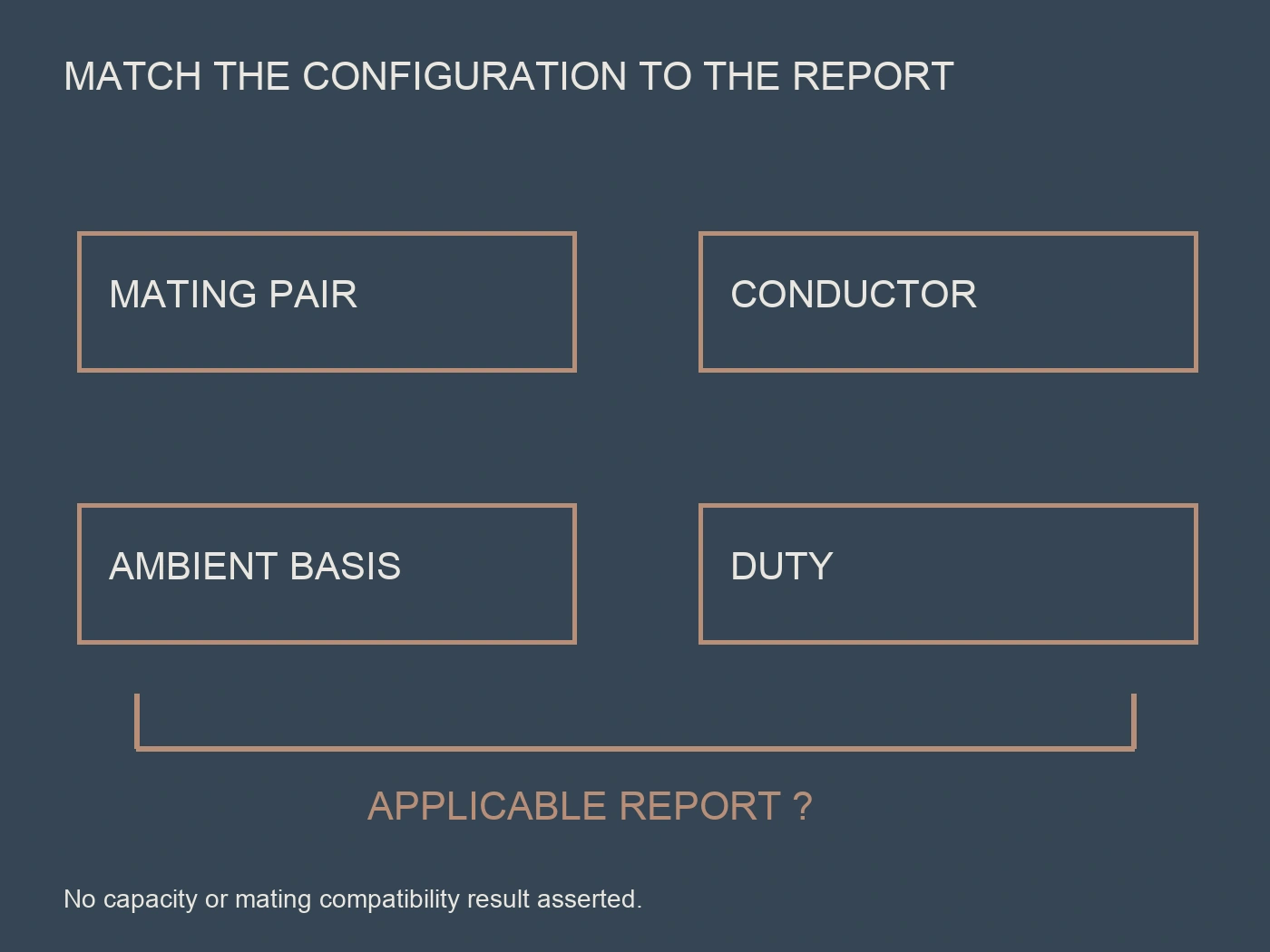
The following original worksheet keeps product identity and thermal evidence connected. It is not an installation instruction or a claim that each listed item has already been supplied for RTX-ESC. A missing field becomes a specific question for the manufacturer and responsible designer.
| Поле для відгуку | Proposed configuration | Supporting evidence to retain |
|---|---|---|
| Mating pair | Exact plug and receptacle references | Declared compatibility and tested pair |
| Contact and termination | Selected contact and termination construction | Applicable termination documentation |
| Диригент | Specified conductor and cable description | Conductor associated with the rating or curve |
| Навколишнє середовище | Defined local operating condition | Manufacturer ambient and test scope |
| Електричне навантаження | Continuous and changing-current requirements | Applicable current/duration evidence |
| Thermal result | Required interpretation and limits | Curve or report with axes, legend and revision |
| Контекст встановлення | Relevant enclosure and neighboring conditions | Assessment of applicability to the proposal |
| Незавершені питання | Differences and unavailable records | Named request and responsible reviewer |
Consider a documentary review where the plug reference matches the quotation but the mating receptacle remains unspecified. Retain the plug's source rating, yet leave complete-pair thermal acceptance open. The missing receptacle is not a clerical detail that can be resolved by copying the plug's current label.
In another example, the same connector reference is proposed for a revised cabinet arrangement. Identify the changed environment and request confirmation of evidence applicability. An unchanged part number does not establish that the earlier thermal review covers the new arrangement.
Separate termination acceptance from continuous-duty acceptance
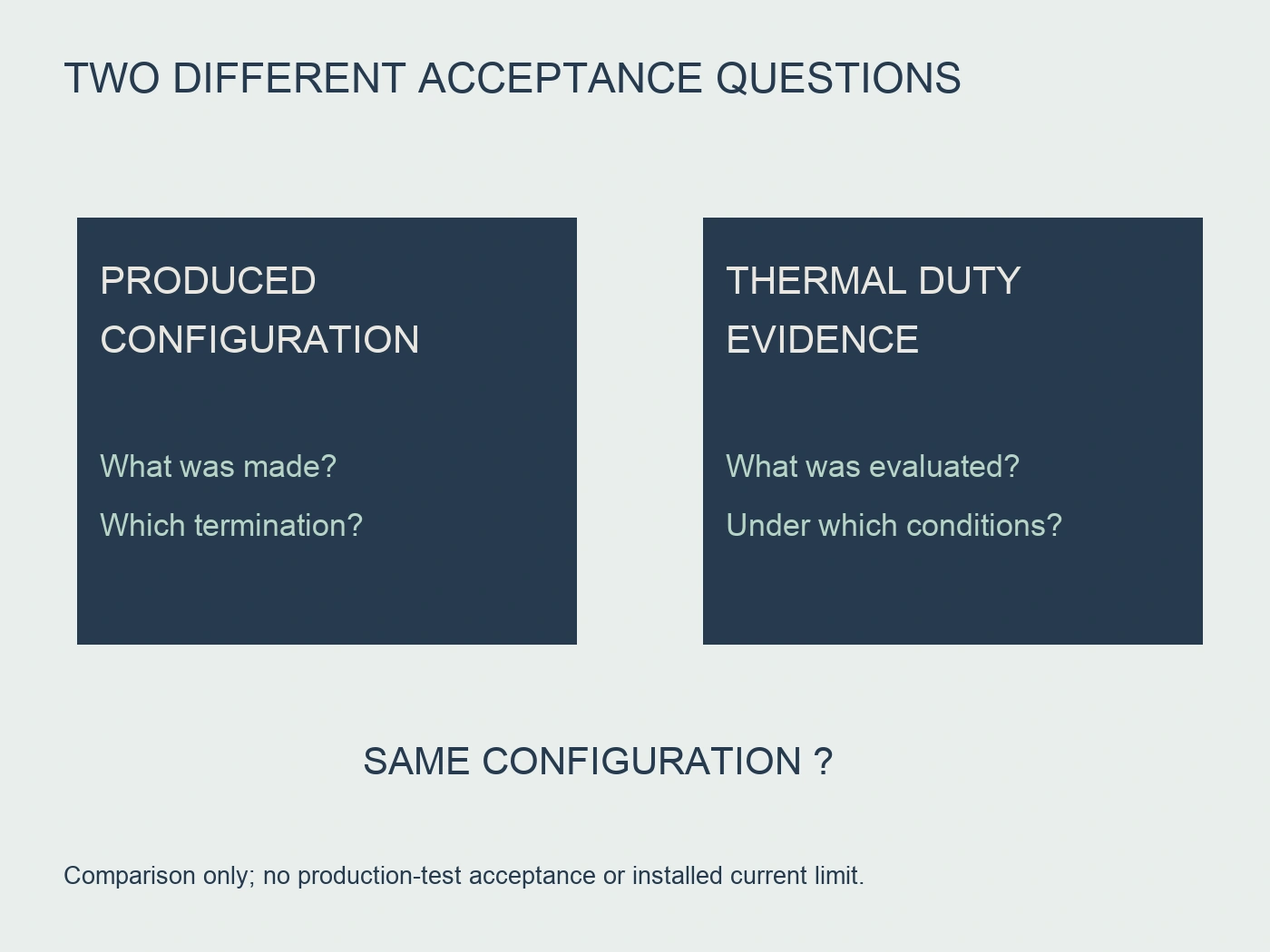
A manufacturing record can establish what cable and termination were produced. That is useful traceability, but it is not automatically a thermal rating for the installed duty. Keep termination acceptance and the continuous-current evidence as distinct records, even when they refer to the same assembly.
Likewise, a dimensional check can confirm a specified contact or mating geometry without proving current capacity in the project environment. Contact size, mounting clearance and keying address different requirements from temperature rise. Do not turn successful mechanical fit into an electrical-duty acceptance claim.
Use the exact manufacturer's termination process and applicable qualified production documentation. This article supplies no generic crimp dimensions, tool setting, tightening torque or wiring route. A convenient generic value would not resolve the selected configuration's evidence requirement.
If a supplier changes the receptacle, contact or cable construction, record the change against both the manufacturing and thermal review. Do not silently retain earlier acceptance after the configuration it described has changed. Ask which supporting evidence remains applicable and which must be reassessed.
Keep the configuration identifier on the drawing, quotation and supporting report consistent. If one document names a complete pair while another names only the plug, note the difference instead of treating them as identical assemblies. The reviewer should be able to trace the proposed connection to the evidence without reconstructing an undocumented parts substitution.
Where a report is supplied for a neighboring reference, ask the manufacturer to state its applicability to the selected configuration. Similar contact diameter or a matching current headline is not that statement. Until the relationship is supported, preserve the report as background information rather than accepted evidence for the actual assembly.
Send the supplier a configuration-specific question
Provide the RTX-ESC reference, proposed mating receptacle and conductor description with the intended duty and defined environment. Request the applicable rating conditions, temperature-rise evidence or derating curve, including the exact tested connection and document revision. Identify where the project differs from those conditions.
Close the record with a supported interpretation or an explicit unresolved item. The useful conclusion is not that one current label fits every harness, but that the selected connection and its evidence match the proposal. That preserves the difference between an 8 mm contact, a specified cable and a continuous-duty assessment without inventing a thermal limit or an installation rule.
Source notes
Sources inspected 1 October 2026. Worksheet and review cases are original documentary tools. No Phoenix Contact curve numbers, reduction factors or temperature limits are assigned to RTX-ESC; no continuous or transient current is calculated.
- RITOKS RTX-ESC: exact listed plug reference and configuration, source-rated current and separately selected receptacle; no universal installed thermal result.
- Phoenix Contact derating guidance: manufacturer-specific example showing cable and ambient significance. This is principle evidence, not a numerical battery-connector selection curve.