
Solid State Relays for Electronic Switching · Technical Explainer
PCB-Mount SSR Thermal Design: Checking Board and Ambient Limits
Quick Answer
PCB-mount SSR thermal design requires evidence for the exact relay, load, board and local ambient conditions. A published current rating or operating temperature range is not a board-level thermal approval. Request the manufacturer's derating conditions and recommended mounting information, then have the responsible engineer define verification for the actual assembly.
A control board can meet its schematic requirements while its thermal evidence remains incomplete. The relay may sit beside another heat source, inside an enclosure with restricted airflow, or on a board different from the manufacturer's reference arrangement. A purchasing comparison based only on package size and current rating does not address those differences.
This guide organizes PCB mount SSR thermal derating and board layout questions into a usable engineering handoff. It does not supply a universal copper area, trace width, component spacing or heat-sink recipe. Those values require product-specific documentation and an application assessment.
Separate the Relay Rating from Board Approval
The thermal question is not simply whether the selected SSR is rated above the load current. It is whether the exact current-rating conditions apply to the proposed board and its operating environment. Record the reference conditions alongside the rating before treating two products as interchangeable.
Omron explains that an SSR's output on-state voltage drop produces heat and that increasing ambient temperature reduces usable load current. That is a general selection principle, not a thermal curve for an unrelated product. It does not establish a safe case temperature or an allowable board current for your assembly. (Omron, n.d., FAQ02106)
Panasonic's SSR cautions illustrate why board conditions matter: its guidance discusses reference mounting conditions, ambient temperature, neighboring components and product-dependent spacing. The numerical examples belong to the products covered by that guidance. They are not default limits for another manufacturer's PCB relay. (Panasonic Industry, n.d.)
Use the following distinction when collecting evidence. An entry in a catalog is useful, but its purpose must remain clear.
| Information supplied | What it helps establish | What still requires confirmation |
|---|---|---|
| Exact model and revision | Identity of the relay being assessed | Whether all accompanying documents cover that model |
| Published load-current entry | Starting point for product comparison | Reference ambient, mounting conditions and derating |
| Operating temperature range | A listed environmental range | Allowable load current throughout that range |
| Mechanical dimensions | Package fit in the assembly | Approved footprint, spacing and thermal arrangement |
| Switching description | Intended output behavior | Thermal suitability for the actual load and duty |
Do not collapse these fields into one approval mark. A mechanical fit can be confirmed while thermal acceptance remains open. Likewise, a missing public curve is an evidence gap, not proof that the relay is unusable.
Define Local Ambient Before Requesting Derating
An ambient value is useful only when its location and operating condition are defined. Start with the environment surrounding the SSR in the assembled equipment, not an unrelated room-temperature reading. The engineering record should identify what the stated ambient represents and how it relates to the manufacturer's rating conditions.
Make a board-level condition map. Locate the SSR, nearby power components, enclosure boundaries, ventilation paths and any cooling arrangement. Identify the operating combinations that the engineer expects to create demanding local conditions. This is a planning record, not a claim that those conditions have already been measured.
Omron's broader SSR guidance treats output heating and the thermal environment as selection considerations. Its panel-mounted examples also show the importance of knowing the relevant ambient and operating conditions. Their heat-sink arrangements and measurement locations must not be copied directly into a PCB-mount design. (Omron, n.d., Further Information)
For an RFQ, separate a specified condition from a result. Write “local ambient to be defined for the assembled controller,” not “thermal test passed,” when no assessment exists. Record the responsible engineer's proposed verification method and acceptance criteria before asking the supplier to respond against them.
If the enclosure or ventilation design is still changing, identify that dependency. A supplier response based on an earlier enclosure is not automatically valid for the revised assembly. The point is to keep the thermal conclusion connected to the hardware that will actually be built.
Review Copper, Spacing and Neighboring Heat Separately
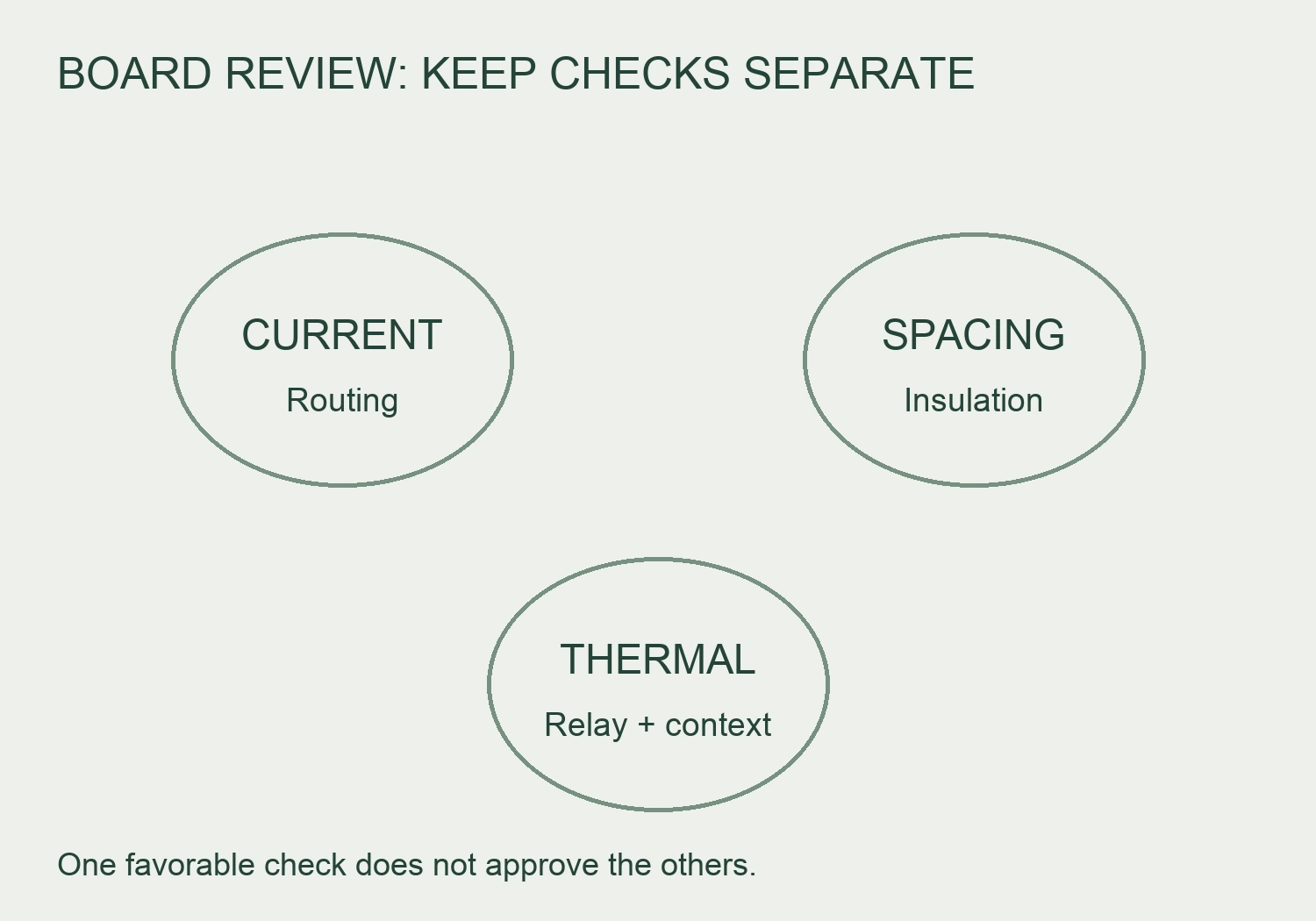
Board layout review should distinguish load-current routing, the relay's thermal mounting requirements and electrical insulation needs. One accepted trace-current calculation does not approve the SSR temperature. Conversely, an acceptable thermal assessment does not establish clearance or creepage compliance. Assign these checks separately rather than allowing one favorable result to stand for all three.
Board copper and footprint
Request an exact-family footprint drawing and any manufacturer-recommended mounting arrangement. Ask whether the current rating assumes a particular reference PCB or other stated installation conditions. Where a documented copper arrangement is relevant, retain its layer structure, dimensions and document revision with the assessment.
Do not invent a minimum copper area when the manufacturer has not provided one. The engineer may need to assess the proposed arrangement, but a locally selected design value must be labeled as an engineering decision, not presented as an SSR manufacturer's specification. Keep the board's current-carrying evaluation available as a separate supporting record.
Spacing and neighboring components
Review both electrical spacing and the physical relationship to nearby heat sources. Panasonic cautions that neighboring components can affect SSR temperature. This supports checking the surrounding assembly, but it does not provide a universal separation distance for your relay. (Panasonic Industry, n.d.)
The layout handoff should show which neighboring components are relevant and which operating states need review. Include board orientation and ventilation assumptions where they affect the proposed assessment. Avoid annotating an arbitrary gap as “safe spacing” without identifying whether it is an electrical requirement, a mechanical allowance or a thermal design decision.
Assembly conditions
Manufacturing information belongs in the same document set, but it answers a different question. Panasonic provides PCB-mount soldering cautions for its products. Use that as a reason to request exact-family assembly limits, not as permission to apply Panasonic's soldering parameters to another relay. (Panasonic Industry, n.d.)
Retain the assembly process reference separately from service thermal evidence. A soldering-process approval is not proof of satisfactory temperature under the intended load. This distinction helps prevent an otherwise complete manufacturing release from hiding an unresolved operating-condition review.
Record Load Duty Without Assuming Automatic Relief
A duty description needs more detail than “intermittent.” Give the engineer the expected on and off sequence, load behavior, control pattern and combinations with other active loads. Do not assume that a lower duty automatically permits a higher current or removes the need for exact-family derating information.
An operating sequence is an input to thermal assessment, not its conclusion. The responsible engineer must decide which sequences and conditions need verification and what evidence will support acceptance. The procurement team can help by preserving the requested operating description and checking whether the supplier's answer addresses it.
Keep load type and output behavior in the request as well. Confirm the specific relay variant rather than inferring switching behavior from a family name. This guide does not provide startup-current allowances or repetitive-overload limits; those need their own applicable evidence.
When the supplier replies with a general current rating, ask which duty and mounting conditions it covers. If the reply does not address the proposed board, record that limitation explicitly. An unanswered question should not disappear simply because the quotation has arrived.
Build a Board-Level Thermal Evidence Register
The useful deliverable is a register linking each unresolved question to a document or an assigned engineering action. Keep the exact SSR variant, PCB revision and enclosure revision at the top. Then record what is known, what remains open and who can close each item.
| Предмет огляду | Evidence or decision to request | Suggested owner |
|---|---|---|
| Rated-current conditions | Exact-model rating conditions and applicable derating curve | Supplier and component engineer |
| Board mounting | Footprint and relevant reference-board or mounting details | Supplier and PCB engineer |
| Copper and routing | Current-carrying assessment and any applicable mounting requirements | PCB engineer |
| Neighboring heat | Relevant components, operating combinations and local-condition review | Hardware engineer |
| Load sequence | Defined operating duty and load behavior | System engineer |
| Перевірка | Safe method, measurement definitions and pass criteria | Responsible engineering team |
| Release decision | Acceptance tied to the assessed hardware and document revisions | Design-release owner |
These ownership labels are a proposed workflow, not a certification scheme. A smaller team can combine responsibilities, but it should still retain separate evidence for the different decisions.
Use explicit statuses such as “supplier document requested,” “engineering assessment pending” or “accepted for recorded configuration.” Avoid a generic “checked” field when the actual conclusion is conditional. If a board change affects an assumption, return the relevant register item to review rather than assuming the previous approval follows automatically.

Apply the Register to XSSR-P2 Selection
Опубліковані XSSR-P2 PCB-mount AC solid-state relay family is a relevant commercial starting point for this architecture. Its listing identifies a PCB through-hole, dual-row family and model options. Use the exact selected variant in the engineering request rather than treating the family page as a board-design approval.
The available exact-family evidence does not specify heat-sinking and load-derating requirements. It also does not establish a temperature derating curve, recommended board copper arrangement or an approved thermal result for your assembly. Those gaps should remain visible in the register until applicable documentation or engineering assessment addresses them.
Do not reinterpret an ambiguous electrical field as a verified loss parameter. In particular, the listing's “Breakover Voltage” entry is not used here as a measured on-state voltage drop. It cannot support a loss calculation merely because it has a voltage unit. Similarly, a published operating temperature range does not establish full-current operation throughout that range.
For a useful inquiry, send the chosen variant, board drawing revision, enclosure context and intended load sequence together. Ask for applicable thermal and mounting documentation. The response may clarify suitability, identify conditions or leave questions unresolved; none of those outcomes should be invented in advance.
Questions to Resolve Before Design Release
Use this short checklist to confirm that the register can support a decision:
- Does every rating document identify the selected model or clearly establish its applicability?
- Are the reference mounting and ambient conditions recorded alongside the current rating?
- Are electrical spacing, load-current routing and relay thermal acceptance treated as separate checks?
- Does the load description include the operating sequence and relevant simultaneous loads?
- Is the proposed verification tied to the actual board and enclosure revisions?
- Are unresolved supplier answers clearly marked, with an owner and next action?
- Does the final acceptance state its scope instead of implying approval for every future layout?
The checklist does not replace a thermal assessment. It prevents procurement and design records from implying that an assessment exists when the supporting work has not been completed.
Часті запитання
Can I use the maximum listed current at any listed operating temperature?
Not from those two entries alone. Request the current-rating conditions and applicable derating information. The operating temperature range and the allowable current at a particular mounting condition are different pieces of evidence.
Will adding more PCB copper make the SSR suitable?
That cannot be concluded without an applicable mounting recommendation or engineering assessment. Copper arrangement, current routing, package installation and local conditions need to be reviewed together. An arbitrary copper-area rule is not an exact-family thermal specification.
Can a panel-mount SSR heat-sink calculation approve a PCB relay?
No. Its mounting arrangement and supporting thermal data must be applicable to the selected device. General thermal reasoning can help frame questions, but a baseplate or external heat-sink example does not approve a different PCB package and board layout.
Does missing public thermal data mean I must reject the relay?
Not automatically. It means the available public evidence does not close the application question. Request applicable documentation and let the responsible engineering team decide what further assessment is needed before release.
Conclusion
PCB-mount SSR thermal design is a configuration-specific evidence task. Separate the relay rating from approval of the board, local environment and operating duty. Keep copper routing, insulation requirements, neighboring heat and manufacturing conditions visible as distinct checks.
For XSSR-P2, begin with the exact published family and selected variant, then request the missing applicable thermal and mounting information. Preserve unresolved items instead of substituting another vendor's numerical examples. A clear register gives purchasing a useful inquiry and gives engineering an identifiable decision to make for the actual assembly.
Література
- Panasonic Industry. (n.d.). Solid State Relay: Cautions for use. PCB mounting and use guidance.
- Omron. (n.d.). FAQ02106. SSR heat generation and ambient-temperature guidance.
- Omron. (n.d.). Further Information for Solid-state Relays. SSR selection and thermal context.