
Smart Rack PDUs for Data Center Power Management · Technical Explainer
Switched PDU Startup Sequencing for Equipment with High Inrush
Quick answer
A switched PDU outlet startup sequence should satisfy two separate requirements: equipment must start in a useful order, and every affected electrical path must remain suitable for its load. Start with device dependencies, then confirm the exact PDU's sequencing behavior and the loads' startup evidence. A delay setting alone does not qualify a relay, outlet, PDU input or upstream protective device.
For a rack integrator, the practical deliverable is a sequence register with readiness criteria and an electrical review attached to it. It is not a list of universal delay values. Separate startup after power restoration from a commanded all-on operation and an individual reboot. Those events may use different settings or logic in the selected PDU.
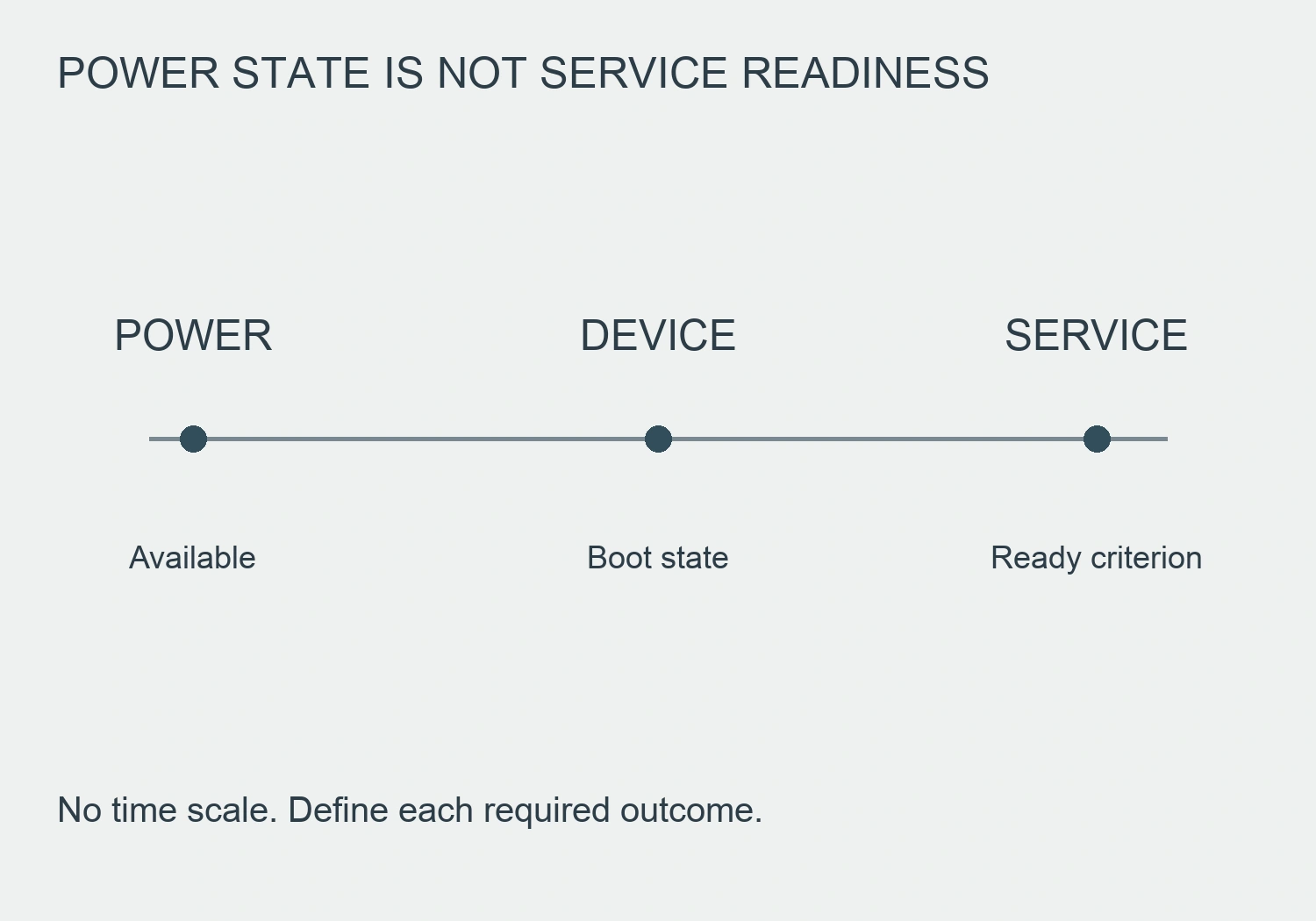
An outlet reporting ON also does not establish that its connected device has completed booting or that a dependent application can use it. The project needs a defined readiness condition, not an assumption that power availability and service availability mean the same thing.
Confirm that the PDU actually supports the required sequence
Monitoring and switching are different capabilities. Before developing a startup plan, identify which outlets can be controlled, which events invoke a sequence, and whether the feature operates on individual outlets or groups. Obtain that information for the exact hardware, software and ordered configuration rather than relying on the word “smart.”
Цей RITOKS P-series smart rack PDU illustrates the distinction. Its public platform description separates PA aggregate monitoring and PB per-outlet monitoring from PC and PD variants with per-outlet switching and sequencing. PC has aggregate monitoring, while PD has per-outlet monitoring. Neither PA nor PB should be selected on the assumption that monitoring supplies outlet control. The final configuration still requires confirmation.
Цей RITOKS Expert Power Control 8035 outlet-switched rack PDU lists eight individually controlled outlets and outlet metering. That is a commercial starting point, not proof that a particular order code has every desired startup setting. Ask for the corresponding configuration and documentation before committing the sequence plan.
GUDE's official 8035 family information describes power-restoration startup settings and delays alongside remote reboot functions. Its support page discusses per-port cold-start delays. Raritan also describes configurable power-on sequencing for individual outlets or groups. These manufacturer examples establish that sequencing features exist, but they do not establish identical behavior across these platforms or validate the delivered RITOKS configuration. Consult the applicable manufacturer's documentation for the selected unit.
Separate the three startup events
Treat power return, commanded startup and reboot as separate acceptance scenarios. A working sequence in one scenario does not prove the same timing or outlet state in another. The buyer should request an event-specific description that identifies the initial state, affected outlets, order, delay behavior and final state.
Power restoration after an interruption
A cold-start plan addresses what happens when the PDU receives power again. Establish whether an outlet restores a remembered state, starts in a configured state or follows a startup sequence. Record what happens to equipment that was intentionally OFF before the interruption. Do not silently turn an operational preference into a requirement to energize everything.
Commanded all-on or group startup
An operator action that turns on several outlets may not invoke the same logic as power restoration. Ask whether the selected command respects startup settings or handles its targets differently. A group name is not evidence that its members are electrically suitable to start together. The group requires its own load and dependency review.
Individual or group reboot
A remote reboot has an interruption phase as well as a restart phase. Confirm the intended targets and whether dependent equipment remains powered during the operation. The reboot plan should state what counts as successful recovery. An outlet returning to ON is a power-control result; a controller reconnecting to its required service is a separate operational result.
Build the dependency plan before choosing delays
List what each device needs before it can provide its intended function. The predecessor might be a network service, a controller, a storage resource or another project-specific dependency. Establish the relationship from equipment and application requirements, not from socket position. Some loads may be independent; others may need an external service that the PDU cannot assess.
The following register is an original planning template. Its example roles are illustrative, not a tested installation or approved operating sequence. Populate the fields using the actual rack design. Keep electrical evidence separate from application readiness so that neither approval can substitute for the other.
| Proposed equipment role | Required predecessor | Readiness condition to define | Proposed startup group | Evidence and responsible owner |
|---|---|---|---|---|
| Network access device | Project-specific upstream service, if required | Required connectivity available | Assign after review | Equipment requirements; network owner |
| Control or management device | Required network or service | Defined management function available | Assign after review | Application requirements; controls owner |
| Dependent processing equipment | Required control, storage or network resource | Required application function available | Assign after review | System requirements; application owner |
| Independent auxiliary load | None unless its documentation specifies one | Its own required operating state | Assign after review | Load documentation; equipment owner |
Record the selected outlet and exact device against each row in the project's working copy. Include the source and revision of the dependency requirement. If two teams disagree about what “ready” means, settle that before issuing a delay table. Otherwise, identical timing settings can produce different interpretations of whether startup succeeded.
A fixed-delay feature represents elapsed time. Unless the exact supported implementation demonstrates otherwise, do not describe it as a readiness-aware controller. If a required service can take longer than the accepted delay, the design needs an approved way to handle that condition. The article's register identifies the question; it does not prescribe a control architecture.
Review electrical suitability independently
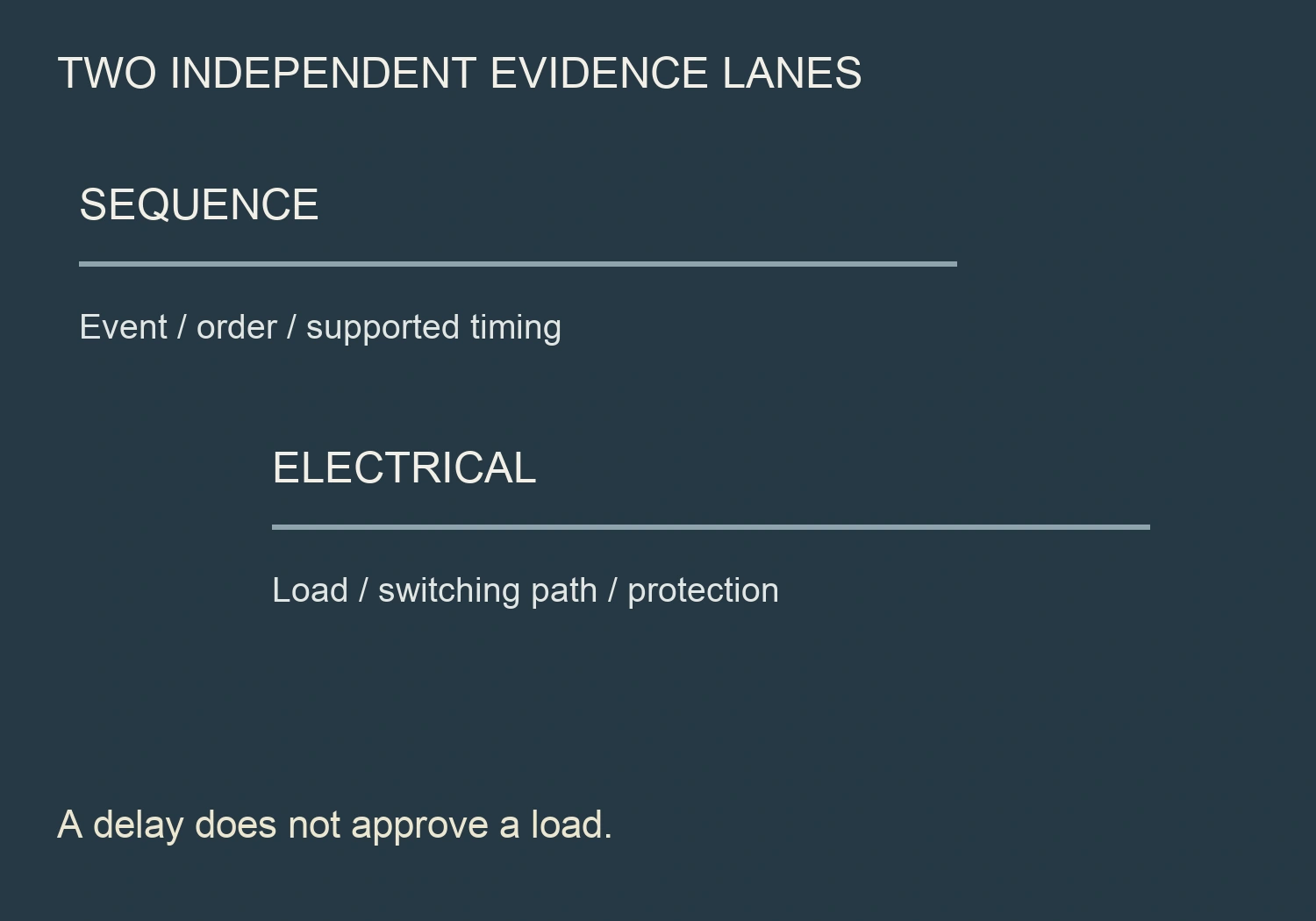
Sequencing may reduce overlap between equipment startup demands, but it does not automatically reduce the demand of an individual load. Each outlet's switching path still requires qualification for the connected equipment. Review input and distribution constraints as well as outlet and relay constraints; a suitable order cannot correct an unsuitable electrical configuration.
Raritan's power-control feature discussion connects sequencing with reducing combined inrush and nuisance-trip risk. Treat that as a potential design benefit, not a guarantee that a sequence will prevent protective operation. The actual loads, their startup behavior and the installed protection remain project-specific evidence requirements.
Request startup information that distinguishes a transient demand from sustained operation. A single steady-state current value cannot answer every startup question. Likewise, a peak number without its duration, conditions and applicable measurement context may be insufficient for the engineer's review. Do not add unrelated published peak values and present the sum as an observed rack waveform.
| Предмет огляду | Докази, які слід вимагати | What it does not prove by itself |
|---|---|---|
| Individual equipment startup | Applicable startup current information and conditions | Suitability of the selected outlet or relay |
| Outlet switching path | Exact switching-load limits and applicable conditions | Suitability of other outlets or the entire branch |
| PDU configuration | Ordered input, distribution and outlet specifications | Compatibility with every proposed startup group |
| Захист на вході | Applicable protective arrangement and engineering assessment | That a selected delay prevents all trips |
| Sustained rack operation | Project load assessment under intended operating conditions | That startup overlap is acceptable |
| Sequence behavior | Exact event, order and timing documentation | Device or application readiness |
The assessment belongs to a qualified engineer using the actual project evidence. Leave unresolved fields open rather than converting a family name, marketing description or nominal rating into an approval. This is a procurement and design-review framework, not a procedure for changing wiring, bypassing protection or testing an energized rack.
Turn the review into an event-specific sequence register
Only after the dependency and electrical reviews should the buyer finalize the proposed order and timing. Maintain separate entries for each relevant startup event. Include the affected outlets, required initial and final states, configured order, proposed delay, readiness criterion, electrical review reference and responsible approver.
Consider an illustrative rack with a network device, a management controller and dependent processing equipment. The proposed order might follow those dependencies, but that order is not yet an approved delay plan. The network readiness requirement needs a definition, the controller's dependency needs confirmation, and each equipment load needs suitable switching-path evidence. Grouping independent loads is an option to evaluate, not a default shortcut.
Suppose the selected PDU supports fixed delays but no confirmed feedback from the required network service. A completed delay would demonstrate only that the configured time elapsed. It would not show that the service became available. The project team must decide how it will recognize and handle failure to meet the readiness requirement before accepting the startup arrangement.
Keep proposed settings and approved settings visibly distinct. For every unresolved row, identify whether the missing information concerns the PDU feature, the load's electrical behavior or the system dependency. That makes a supplier response actionable: a missing switching-load qualification cannot be closed by sending a screenshot of a delay setting.
Define acceptance without promising a no-trip result
Acceptance should answer whether the selected configuration performs the agreed events and satisfies the project's separately reviewed requirements. Record the actual configuration and the applicable evidence, with clear boundaries around what was assessed. Do not describe a successful startup observation as proof that every possible outage or recovery condition has been covered.
The project can define representative scenarios for engineering review, including relevant power-restoration states, commanded startup and reboot scope. Any validation method must be established by the responsible team under its approved procedures. This guide does not specify live testing steps, protection changes or an acceptable transient-current threshold.
Document exceptions as carefully as the successful sequence. Examples include an unavailable prerequisite service, a device remaining intentionally OFF, or a reboot target not returning to the required operational state. State who handles the exception and what evidence closes it. A repeatable handover gives operators an understood recovery plan rather than only a saved PDU configuration.
Поширені запитання
Does every smart PDU support outlet sequencing?
No. Monitoring and switching are separate functions. The P-series public architecture describes monitoring-only PA and PB platforms and switching-capable PC and PD platforms. Confirm the actual ordered configuration and supported event behavior before treating sequencing as available.
Is a longer delay always better for high-inrush equipment?
No universal delay follows from the phrase high inrush. Timing must relate to the actual startup demands, dependency requirements and supported control behavior. A longer delay does not by itself qualify an individual switching path or resolve a sustained load problem.
Can an outlet ON indication confirm that equipment is ready?
Not by itself. It indicates an outlet state, not necessarily successful device boot, connectivity or application availability. Define readiness from the system requirement and confirm whether the selected implementation can observe it or only apply a fixed delay.
Can one sequence be used for power return and remote reboot?
Only if the selected implementation and project review establish the required behavior for both events. Power restoration, commanded startup and reboot have different initial conditions and scopes. Record them separately even when some approved settings happen to be identical.
Conclusion
Plan switched PDU startup sequencing around verified dependencies and separately qualified electrical loads. First select a configuration that supports the required control, then define each startup event, its order and its readiness criteria. Resolve the electrical evidence before approving timing settings.
The useful handover is an event-specific register tied to actual equipment, documented PDU behavior and responsible reviewers. It should show what remains unresolved as well as what has been accepted. That approach gives a rack buyer a clear basis for comparing proposals without turning sequencing into an unsupported promise of safe switching, service readiness or trip-free recovery.
Література
- GUDE. (n.d.). Expert Power Control 8035. Official product-family information.
- GUDE. (n.d.). Support PDU. Official support information.
- Raritan. (n.d.). PDU remote power control. Official sequencing feature information.