
Smart Rack PDUs for Data Center Power Management · Technical Explainer
Can Aggregate PDU Readings Be Used to Allocate Equipment Energy?
Quick answer
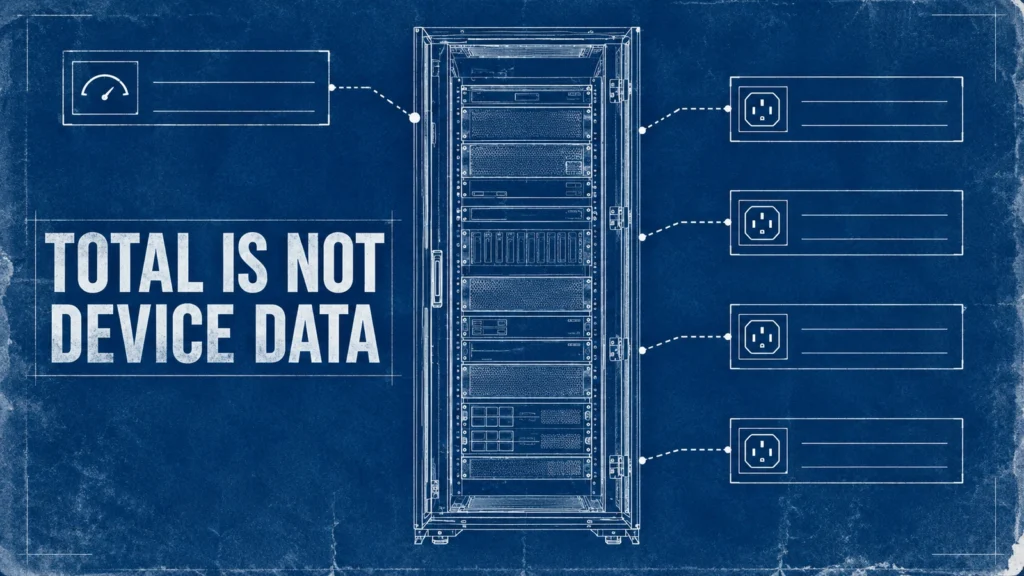
An aggregate PDU energy reading measures its documented measurement boundary, not the individual contribution of every attached device. You can use a rack total in an agreed allocation model, but the allocated shares remain estimates unless suitable device-level evidence establishes them. Equal division does not turn a total into separate measurements.
Per-outlet energy data can support a more specific equipment record when the outlet-to-device mapping is accurate and every relevant supply path is included. It still needs a defined time interval, meter scope and applicable accuracy evidence. No ordinary PDU is declared suitable for legally regulated billing simply because it displays energy. Accuracy at light load is a separate question; see PDU meter accuracy at low loads.
Choose the method from the decision you need to support: rack planning, internal allocation, equipment comparison or contractual charging. These objectives can require different evidence and should not be merged under a general “energy monitoring” label.
Define the measurement boundary first
Start with what is actually measured. A reading may belong to an inlet, branch, outlet or another defined group. The label should identify that boundary alongside the electrical quantity and units.
| Available information | Defensible use | Boundary to preserve |
|---|---|---|
| Aggregate energy for a defined interval | Total at the documented PDU boundary | No separate equipment shares measured |
| Aggregate active power snapshot | Load observation at that time | Not the same as interval energy |
| Per-outlet energy | Outlet-level interval record | Equipment identity requires a mapping |
| Assigned percentage of a total | Agreed estimation or allocation | Percentage is not a meter reading |
| Equipment reading across all supply paths | Device-level review within the defined scope | Accuracy and completeness still need evidence |
Raritan's official specification for the identified PX4-5551WA-E7M26V2 lists metering at input, branch and output-receptacle levels separately. That illustrates why granularity is a specified function rather than a property implied by “intelligent PDU.” It establishes nothing about the metering capability of another PDU. Raritan, PX4-5551WA-E7M26V2 technical specifications.
Ask what the reading includes and excludes. A reported outlet sum and an inlet reading may describe different boundaries. Do not call their difference a device's consumption without understanding the measurement arrangement and applicable evidence.
Keep estimated allocation distinct from measurement
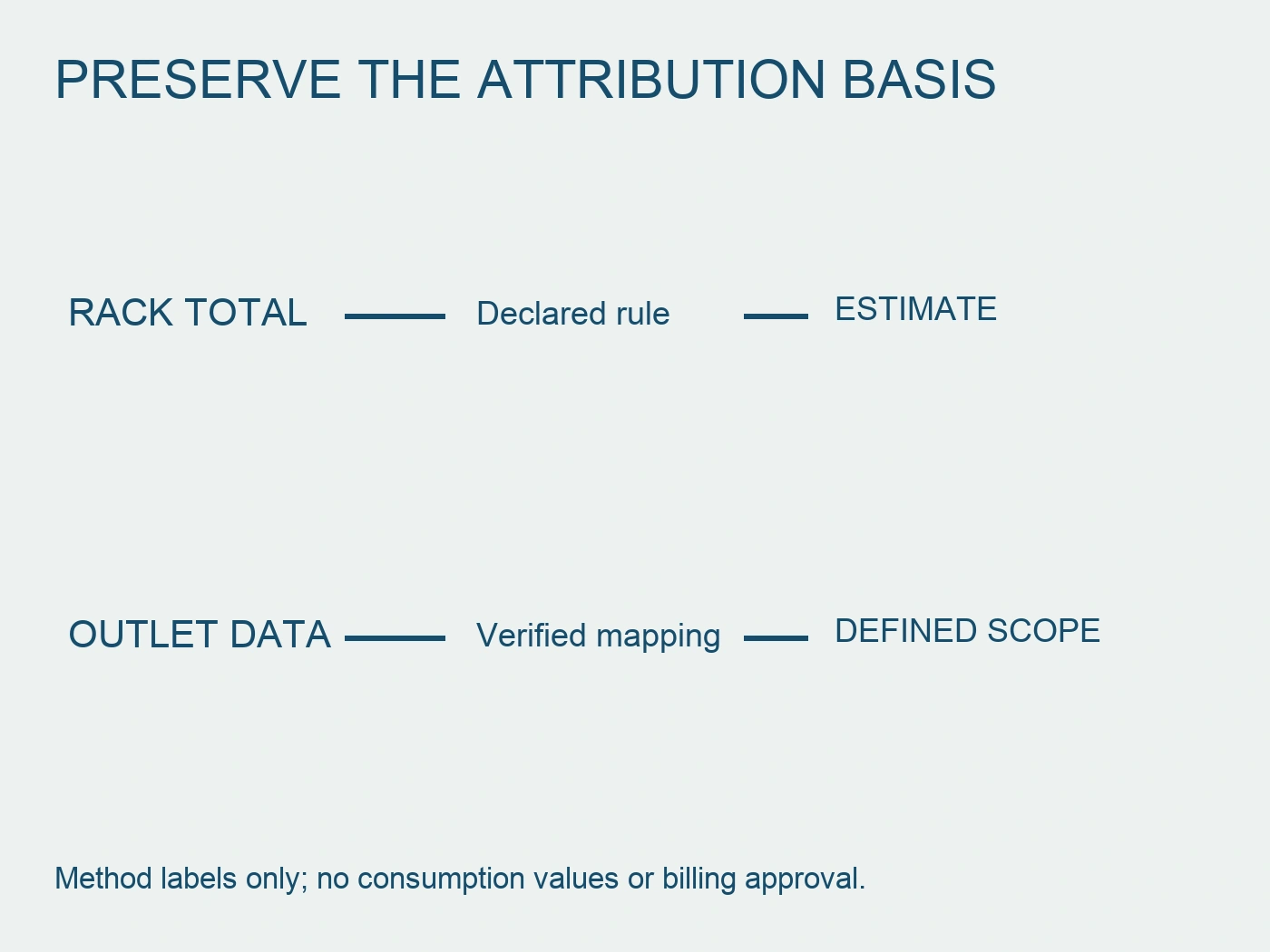
An aggregate total can be distributed using a declared rule, such as an agreed share of a rack's measured energy. That may be useful for internal budgeting, but it is an allocation method. Label the result accordingly.
Write the rule before calculating. Identify its inputs, the reporting interval, responsible owner and the conditions requiring review. An estimate based on equipment labels or a fixed percentage can diverge from actual usage when workloads or equipment change. The record should make that limitation visible.
Do not assign equal shares merely because the outlets are identical. Different devices can have different operating patterns, and an unused outlet does not consume a hypothetical equal portion. Likewise, an equipment's maximum power label is not its measured energy over the selected period.
If a contractual process accepts an estimation method, retain the agreed method and approval. That agreement does not itself improve meter accuracy or create device-level measurements. Technical measurement scope and commercial allocation policy should remain separate fields in the report.
Map each outlet to the actual equipment
Per-outlet readings become useful equipment evidence only when the outlet record matches the connected device. Retain the PDU identity, physical outlet identifier, equipment asset identifier and effective date of the mapping. A name entered into a management interface should be checked against the installed connection.
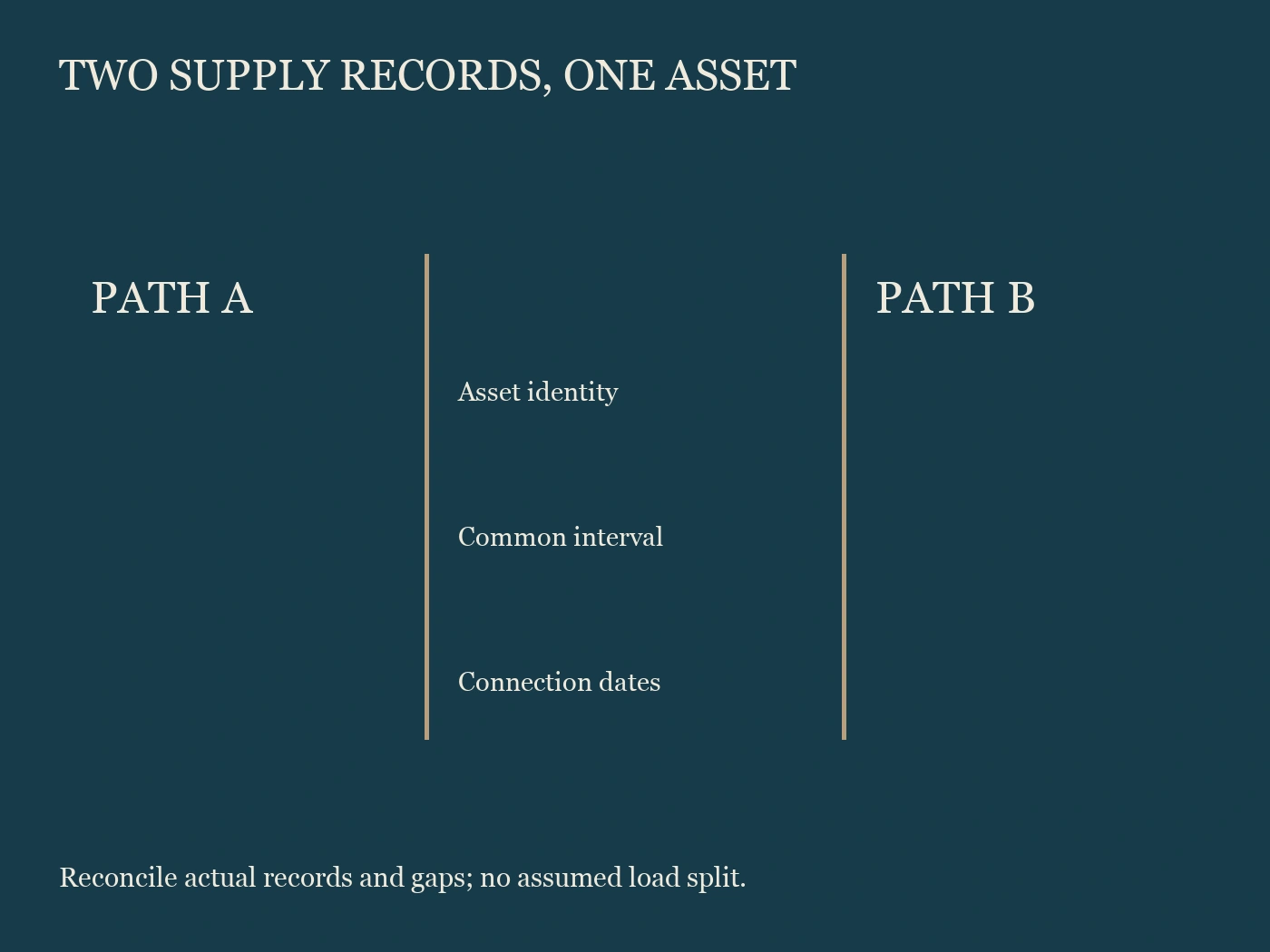
One device can have more than one power cord. If it draws from multiple PDUs, a reading from only one supply path does not establish its complete energy use. Conversely, if an outlet feeds multiple devices through another distribution arrangement, the outlet value does not distinguish those downstream devices.
Record wiring changes when they occur. An energy report for a month may span several mappings if equipment was moved or replaced. A current rack photograph cannot automatically describe every connection during the whole period.
Do not infer a device's power split from redundant-supply labels. The actual load sharing and operating state require appropriate evidence. For an equipment-level report, include the relevant measured paths or explicitly state that only a partial path is represented.
The mapping need not become a complicated new system. A controlled connection schedule can be sufficient when it accurately identifies the physical arrangement, dates and responsible changes. Choose the smallest record that preserves the actual attribution.
Read the RITOKS platform functions accurately
Cái RITOKS P Series smart rack PDU family distinguishes its management platforms. PA provides aggregate monitoring; PB adds per-outlet monitoring. PC combines aggregate monitoring with outlet switching, while PD combines per-outlet monitoring and switching. The platform name does not fix every electrical configuration.
That distinction matters for energy allocation. Switching an individual outlet is not proof of measuring its energy. A PC configuration should not be treated as a PB or PD measurement arrangement simply because individual loads can be controlled.
Cái Monitored PDU 5.0 family identifies per-outlet energy monitoring without claiming outlet switching. Confirm the exact order code and remote interface before specifying the data collection method.
Cái local-display metered PDU family documents voltage, current and load display with its stated communication option. Its public page does not establish per-outlet energy measurement or measurement accuracy. Do not assume those functions from the word “metered.”
For an enquiry, describe the allocation objective, required measurement boundary, equipment connection arrangement and reporting interval. Ask for the exact quantity definitions, granularity, data interface and accuracy conditions, rather than request an unspecified smart PDU.
Align energy records with the reporting interval
Energy and power answer different questions. An active-power reading describes a rate at the relevant time; an energy record describes accumulation over an interval. A single power snapshot cannot describe an entire period of changing equipment activity without an additional estimation assumption.
If cumulative energy counters are used, identify the initial and final readings and any reset, replacement or data discontinuity. Preserve the time basis and units. A counter beginning halfway through the reporting period should not be presented as a full-period total.
For multiple PDUs or supply paths, align their reporting intervals. Differences in collection time, missing records or a changed connection map can undermine comparison even when each value appears plausible individually. Note those limitations instead of hiding them inside a total.
Also distinguish a local display value from data available to the management platform. The exact interface documentation should establish which quantities can be retrieved and how their identifiers are mapped. A protocol label alone does not establish every desired field.
Do not infer billing qualification from a display
Before using data for contractual charging, identify the applicable requirements with the responsible commercial and compliance reviewers. A technical product page is not a legal determination of what metering arrangement may be used in a particular jurisdiction or contract.
Request model-specific accuracy and verification evidence appropriate to the intended use. Display resolution, an energy field or a general “billing-grade” marketing label should not replace review of the actual scope and conditions. Do not transfer another manufacturer's approval or accuracy claim to a RITOKS platform.
For internal energy management, state the practical quality objective as well. A planning estimate may tolerate limitations that would be unacceptable for a detailed device comparison. Choosing a method requires knowing how the result will be used, not always buying the most elaborate platform.
The record should therefore state both its measurement basis and decision basis. “Estimated internal allocation from rack total” is clearer than “measured equipment energy” when no equipment-level measurement exists.
Use a conditional allocation example
Consider a fictional rack with several devices and an aggregate energy total. The team proposes dividing the total equally to produce an equipment report. The calculation can produce assigned shares, but it does not establish that the devices consumed equal energy.
If an agreed internal allocation is the objective, retain the rule and label the report as an estimate. If actual device comparison is required, obtain appropriate per-outlet or device evidence and map every relevant supply path. Where the equipment has two cords, include both paths or state the partial scope.
Suppose outlet data become available but a device was moved during the reporting period. The reviewer should split or otherwise address the interval using the actual mapping record, not assign the entire counter change to the currently connected device. This fictional example provides no billing approval or accuracy result for a RITOKS product.
Build a traceable allocation record
| Record item | Detail to retain | Claim it permits |
|---|---|---|
| Mục tiêu | Planning, internal allocation or other reviewed use | Intended decision is explicit |
| Measurement scope | Inlet, branch or specific outlet | Reading boundary is identified |
| Equipment map | Assets, outlets and supply paths | Attribution has a physical basis |
| Interval | Start/end times and counter states | Period is defined |
| Data limitations | Gaps, resets or changed mappings | Incomplete evidence stays visible |
| Estimation method | Rule, inputs and agreed assumptions | Assigned shares remain labelled estimates |
| Accuracy basis | Exact-model applicable evidence | No imported accuracy promise |
| Review disposition | Approved use and remaining limitation | Conclusion matches available evidence |
Keep the source records alongside the calculated output. This lets a later reviewer reconstruct the allocation after a PDU replacement or equipment move without pretending the current wiring has always existed.
Câu hỏi thường gặp
Can aggregate energy be divided among devices?
It can be allocated through a declared method, but the shares are estimates unless supported by suitable device-level evidence. Do not label equal division as individual measurement.
Does outlet switching mean outlet metering?
No. They are separate functions. P Series PC and PB illustrate different combinations; confirm the required platform and exact configuration.
Is one outlet reading enough for a dual-cord device?
Not for its complete consumption when another supply path contributes. Include the relevant paths or label the partial measurement scope.
Does a PDU energy display establish billing eligibility?
No eligibility is established here. Review exact-model evidence and applicable commercial and compliance requirements for the intended use.
Tài liệu tham khảo
- Raritan. (2025, October 23). PX4-5551WA-E7M26V2 technical specifications. Measurement-level feature definitions. Retrieved October 3, 2026. https://cdn.raritan.com/product-selector/pdus/PX4-5551WA-E7M26V2/PX4-5551WA-E7M26V2-spec.pdf
- RITOKS. (n.d.). P Series smart rack PDU. Published platform boundaries, checked October 3, 2026. https://ritoks.com/products/p-series-smart-rack-pdu/
- RITOKS. (n.d.). Monitored PDU 5.0 with outlet-level metering. Checked October 3, 2026. https://ritoks.com/products/monitored-pdu-5-0-with-outlet-level-metering/
- RITOKS. (n.d.). PDU giá đỡ có đồng hồ đo hiển thị tại chỗ. Checked October 3, 2026. https://ritoks.com/products/local-display-metered-rack-pdu-16a-63a/