
AC Power Protection · Technical Explainer
Planning RCD Circuit Groups Around Equipment Leakage Current

Quick answer
Plan RCD circuit groups from the equipment's documented or measured normal leakage, the operating combinations expected on site, and the protection requirements of the installation. Do not divide equipment by a fixed number of computers, luminaires or power supplies. Two groups with the same appliance count can present very different residual-current conditions.
The practical output is a leakage-budget register tied to each protection boundary. It should identify the evidence behind every entry, distinguish steady operation from startup events, and preserve room for uncertainty and approved expansion. A competent designer must also verify RCD type, sensitivity, upstream coordination and circuit suitability. A low estimated leakage total alone does not approve the protection design or demonstrate that the equipment is safe.
Define what the budget is counting
Normal leakage associated with equipment filters is not the same as normal load current. Hager's circuit-protection FAQ describes standing leakage from electronic equipment and explains why an installation operating near an RCD's response region may experience unwanted trips following a disturbance. It also identifies deteriorated insulation as a possible source of leakage. Therefore, an observed residual current should not automatically be classified as healthy filter current.
Use the device's rated residual operating current, IΔn, when discussing its residual-current function. Its rated current, In, describes a different duty. A circuit group can satisfy its load-current requirements and still require attention to residual-current accumulation. Conversely, a small leakage budget does not establish conductor capacity, overload protection or short-circuit coordination.
Identify whether an equipment figure refers to protective-conductor current, touch current, an installed residual-current measurement or another declared test quantity. Do not combine differently defined values as though their measurement boundaries and conditions were identical. Ask the equipment manufacturer to clarify the quantity when the datasheet only says “leakage.”
The planning register should distinguish documented normal behavior from unexplained measurements requiring fault investigation. An unexpected increase or an unknown current path belongs in the unresolved column, not in a larger allowance labelled normal operation.
Establish the protection boundaries first
Start from the single-line diagram and circuit schedule. Mark which equipment belongs downstream of each RCCB group or individual RCBO, then identify any upstream residual-current protection. The relevant quantity is the residual current presented at that boundary, not simply the total equipment inventory in a room.
Individual RCBOs can divide downstream groups, but they do not erase the contribution of those circuits to a shared upstream RCD. Schneider's coordination guidance explicitly requires upstream RCCB settings to consider downstream earth-leakage currents and treats selectivity as a separate coordination question.
Label the intended boundaries before collecting readings. A measurement attributed to a final circuit cannot be used as a whole-board total without knowing what else is included. Similarly, a board-level reading should not be assigned to one appliance simply because that appliance was operating when the reading was taken.
If circuit ownership is uncertain, resolve that issue before relying on the budget. This workflow assumes the intended line and return paths have been established. It is not a method for dismissing a crossed neutral or another wiring defect as cumulative normal leakage.
Request equipment data that describes actual operating states
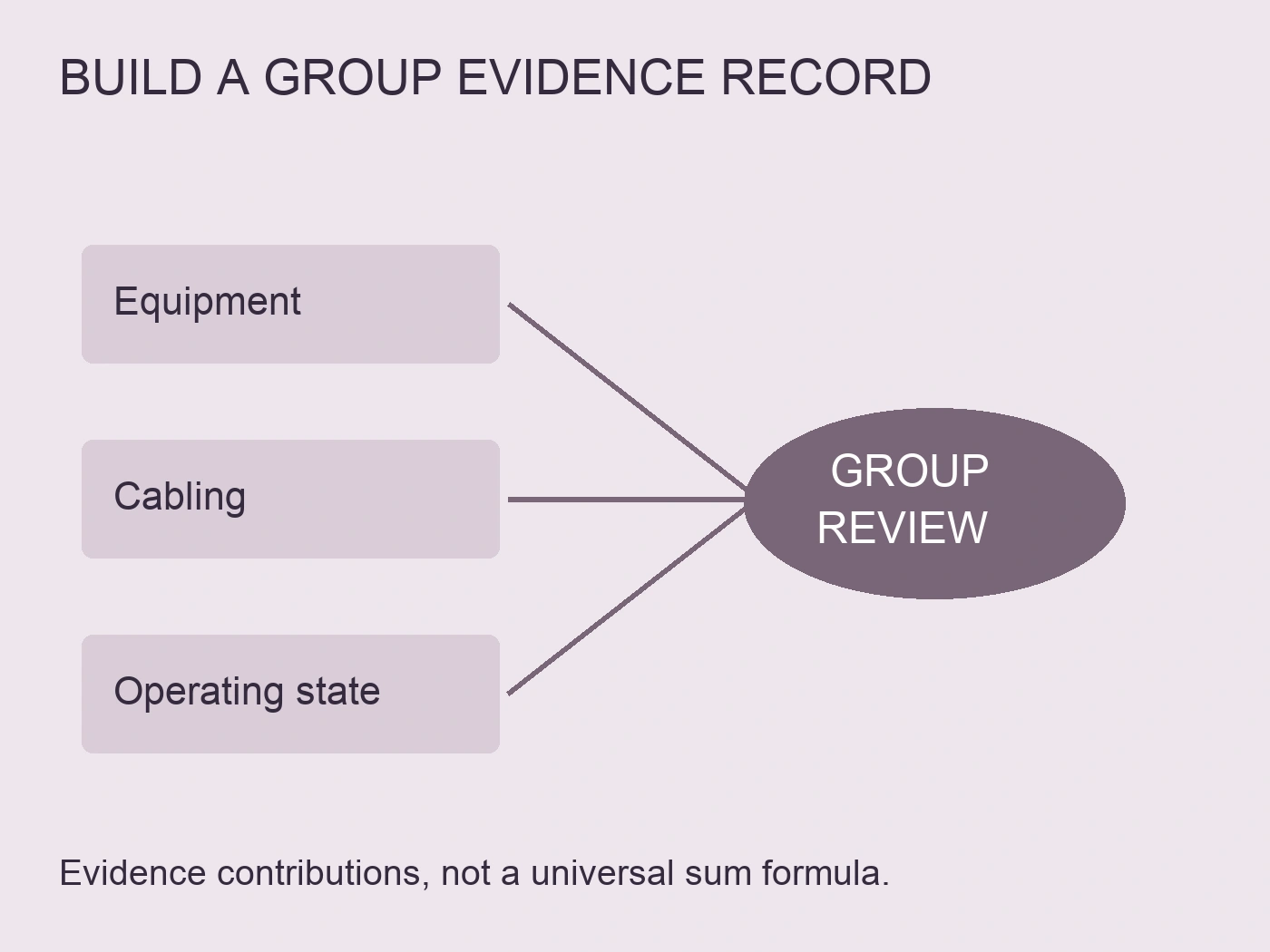
Ask suppliers for the leakage-related information for the exact equipment configuration, supply conditions and operating modes. A declaration for one power supply is not necessarily a value for a cabinet containing several supplies, filters and accessories. Identify the boundary covered by the declaration and avoid counting the same component twice.
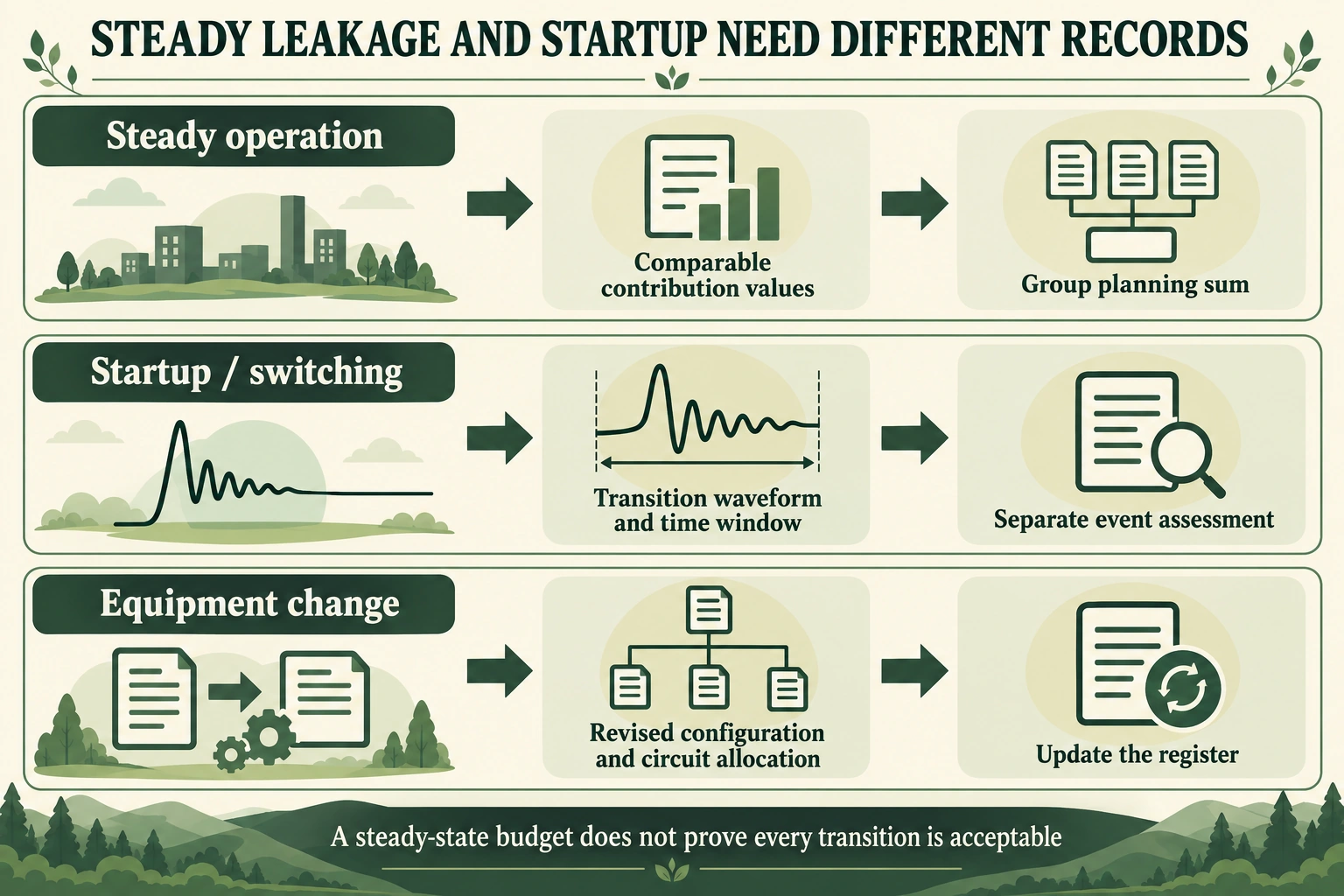
Record standby, normal duty, maximum simultaneous operation and any relevant transition states. For a production area, the worst useful scenario may differ from the highest connected load. Equipment that draws little load current can still contribute leakage, and equipment that starts together can create an event not represented by a steady-state figure.
Where a manufacturer supplies an upper bound, retain it as an upper bound rather than converting it into an expected average. Where only a typical value is available, record that limitation. Do not create a precise design total from typical entries while silently treating variation as zero.
Collect information about waveform and frequency characteristics where relevant to the equipment. Residual-current type selection must address the actual application; merely allocating additional current margin does not make an unsuitable RCD type appropriate. Keep this technical review distinct from the arithmetic budget.
Build a traceable leakage-budget register
The following structure is an original planning aid. It is not a standard-prescribed test form or a replacement for installation verification.
| Register field | Required entry | Review question |
|---|---|---|
| Asset and configuration | Exact equipment reference, fitted options and quantity | Does the entry describe what will actually be installed? |
| Protection boundary | Final circuit, group RCD and any upstream RCD | Which devices see this contribution? |
| Current definition | Declared quantity, units and measurement boundary | Are entries comparable before aggregation? |
| Operating condition | Supply condition, mode and simultaneously operating assets | Does the figure represent the planned scenario? |
| Evidence status | Manufacturer limit, typical declaration or site measurement | What uncertainty remains in the value? |
| Transition behavior | Documented startup or switching information, if available | Is a steady-state figure being mistaken for an event assessment? |
| Review allocation | Included contribution, uncertainty and approved future allowance | What was reserved, and by whom? |
Keep supporting datasheets and measurement records linked to their entries. If several identical assets are proposed, check that the declared configuration really is identical before applying a quantity multiplier. Similar names do not establish equal filter arrangements or leakage behavior.
An unknown entry must remain unknown. A blank datasheet field is not evidence of zero leakage. Either obtain the required information, arrange suitable investigation or retain the grouping decision as conditional. This is especially important when a proposed extension uses most of the remaining planning allowance.
Use measurements with a defined scope
Existing facilities may need measurements to establish how the installed equipment behaves. Specify the asset state, circuit boundary, instrument, relevant measurement capability and conditions in the record. The professional responsible for the survey chooses the appropriate method and safety arrangements; this article does not instruct personnel to open an energized board or improvise test leads.
Do not confuse an ordinary load-current channel with a suitable leakage measurement. Schneider's PM8000 FAQ illustrates why the measurement arrangement matters: its calculated residual channel requires the specified current inputs, otherwise unmeasured current can enter the apparent residual result. That is an example from a particular meter, not a claim that any power meter can provide a usable leakage survey.
Record which conductors and current paths are represented in the chosen measurement. Also record the time window and whether the result represents stable operation or an event. A single quiet-period reading may not describe production startup, an overnight equipment cycle or a maintenance configuration.
Where declared and measured values differ, investigate the scope before selecting the smaller number. The measurement may cover a different equipment state; the declaration may be a limit rather than an expected value. Keep both records until their relationship is understood.
Turn the register into grouping decisions
For a hypothetical screening exercise, assume four identical assets each have a configuration-specific upper-bound contribution of 0.8 mA, a cabinet contributes 1.2 mA and the allocated cable contribution is 2.0 mA. Assume these inputs describe comparable current quantities and the same steady operating scenario, with no double counting. The planning sum is 4 × 0.8 + 1.2 + 2.0 = 6.4 mA. These invented teaching values are not typical appliance data or a measurement of an installed group.
Also assume the project designer has separately assigned an 8.0 mA steady-state screening allowance to this particular group. That allowance is hypothetical, not a standard margin, a RITOKS rating or a fraction of a named RCD setting. The filled register shows “6.4 mA screening total; 1.6 mA difference to assigned allowance; transition evidence unresolved.” The difference is an accounting result, not a guaranteed amount of additional leakage the RCD will tolerate under every waveform and operating condition.
An extension proposing two further identical 1.0 mA upper-bound contributions changes the screen to 6.4 + 2 × 1.0 = 8.4 mA, exceeding the assumed allowance by 0.4 mA. The useful response is to revise the proposed group or obtain an accepted revised assessment, not enter the new items as zero because they draw little load power. If the new items' figures describe a different leakage quantity, the arithmetic must remain conditional until the definitions are reconciled.
Subdividing the outgoing circuits may bring each new group within its own accepted allowance and improve continuity. It also adds protective devices and records to maintain, and a common upstream RCD still requires its own scenario assessment. Do not carry the reduced final-circuit totals upward as though the shared boundary lost those loads. Startup may require separate evidence even after the steady-state figures fit. The worked register therefore leads to distinct decisions about circuit allocation, upstream scope and transitions, instead of one reassuring total beside the device's nameplate.
Prepare a conservative screening total for each planned operating scenario using comparable evidence and documented assumptions. Do not claim a simple sum of unrelated scalar readings is an exact prediction of the combined residual waveform. Where frequency content or phase relationships matter, the professional assessment and representative combined measurements must address them.
Next, compare the scenario with the project's approved planning allowance. The allowance must come from the applicable requirements, manufacturer guidance and the protection design, not from the assumption that an RCD always waits until its marked IΔn to operate. Hager's FAQ explains that operation can occur below that marked value. Its guidance also uses a lower standing-leakage planning recommendation; neither statement justifies treating the full nameplate value as usable budget.
Document separate provisions for uncertainty, transitions and future expansion. An allowance is not a guarantee of uninterrupted operation, and a reserved margin is not permission to ignore an unexplained leakage source.
| Review outcome | Grouping action to consider | Evidence required before acceptance |
|---|---|---|
| Comparable steady-state entries fit the approved allowance | Retain the proposed group | Representative conditions and remaining margin documented |
| Proposed group exceeds the allowance | Reassign or subdivide circuits | Revised boundary map and assessment of affected upstream devices |
| Startup behavior is unresolved | Keep steady-state approval conditional | Relevant manufacturer information or professional event assessment |
| Leakage definition or asset configuration is unclear | Request data before committing the group | Clarified quantity and configuration-specific evidence |
| One asset has unexplained leakage growth | Investigate the asset or circuit | Fault findings rather than reclassification as normal allowance |
| New circuits alter an upstream total | Review the hierarchy, not only the new branch | Updated upstream budget and coordination evidence |
Do not solve an exceeded budget simply by raising the residual-current operating threshold. Required protection and application constraints remain controlling design inputs.
Keep service continuity in the review
Two acceptable groups may still have different operational consequences when protection operates. Identify which functions should not be lost together and which loads create relevant disturbances. Use that information alongside leakage evidence, rather than grouping solely by physical proximity or available board space.
For procurement, RITOKS provides an RTX-RCA63 Type A RCCB và một PXB2Ln-63 1P+N RCBO. They support different protection architectures. Submit the chosen configuration, circuit-group register and design requirements with an inquiry; the product names alone do not approve waveform suitability, board compatibility or upstream selectivity.
Maintain the budget after commissioning
Hand over the accepted circuit map, evidence register, assumptions and relevant verification records. State which operating scenarios were assessed and which expansion allowance was approved. Future maintenance staff need that information when equipment is added, replaced or moved.
Review the budget after changes to filters, supplies, machine options or circuit assignments. A replacement appliance with the same load power may have different leakage behavior. Preserve the previous revision so the change can be traced, rather than rewriting the original allowance without explanation.
If trips develop, compare current conditions with the accepted record and investigate the cause. Do not assume the installation remains within budget because the device count has not changed.
Tài liệu tham khảo
- Hager Australia. (n.d.). Modular circuit-protection FAQ. Relevant section: standing leakage and unwanted RCD operation. Retrieved October 2, 2026.
- Schneider Electric. (n.d.). Coordination of residual-current protective devices. Electrical Installation Guide. Retrieved October 2, 2026.
- Schneider Electric. (2017). Are the PM8000 series meters capable of measuring earth leakage current?. Product-specific example of residual-measurement input requirements. Retrieved October 2, 2026.