
Motor Protection Circuit Breakers for Three-Phase Motors · Technical Explainer
Motor Protection Breakers and Phase Loss: Check the Trip Evidence
Quick answer
Do not infer phase-loss protection from an MPCB's three poles or thermal-magnetic description. Request an explicit exact-model phase-failure sensitivity statement and its applicable response evidence. Keep that function separate from phase-voltage monitoring, current imbalance and general overload protection. Approve the motor protection scheme against the actual motor and starter arrangement.
The purchasing mistake is easy to make: an offer says "motor protection," so the buyer assumes every motor-related abnormal condition is covered. The useful question is narrower. What does the selected device detect, under which conditions does it operate, and what evidence supports that response? A family name does not answer those questions.
Schneider Electric's GV2P32 product specification expressly lists phase-failure sensitivity. That shows the kind of exact-product declaration to request. It does not establish the same function for a different MPCB, even when both devices have three poles and thermal-magnetic protection.
Separate the conditions in the protection requirement
Phase loss, phase-current imbalance and phase-voltage monitoring should appear as separate requirements when the application needs them. Describe the condition to detect and the required action before choosing hardware. A current-based protective response and a voltage-monitoring function do not become identical merely because both can lead to a motor stop.
Ask the motor designer to identify the applicable operating conditions and acceptable protection strategy. Record the motor connection, starting method and installation boundary. The review needs to know whether the requirement concerns the supply available before starting, the motor currents during operation or another defined condition. Put those distinctions on the single-line and control documentation.
Avoid using "phase protection" as an undivided checkbox in the RFQ. A supplier can answer yes while referring to a different function from the one the designer requires. State each condition plainly and ask where its response is documented. That makes missing coverage visible without inventing a threshold or trip time.
The following table is an original requirement map. It does not predict the behavior of an unverified MPCB:
| Required condition | Question to ask | Evidence boundary to retain |
|---|---|---|
| General motor overload | What overload characteristic applies to the exact device? | Motor duty, setting and stated test conditions |
| Phase-loss response | Is phase-failure sensitivity explicitly declared? | Exact variant and applicable response evidence |
| Phase-current imbalance | Is a distinct imbalance function provided? | Detection definition, response and settings |
| Supply phase-voltage condition | Is voltage monitoring required separately? | Measurement location and monitor function |
| Restart after operation | How is the device reset and restart authorized? | Approved control logic and site procedure |
Keep a requirement marked unresolved until the offered device documentation addresses it. A general overload curve can support one part of the review without proving all the other rows.
Read the exact-model declaration and response evidence
An explicit phase-failure sensitivity declaration is a starting point for review, not a complete installation approval. Check which product variant it covers, what documentation defines the response and whether the motor duty fits that scope. Keep any referenced test or characteristic tied to the exact offered device.
The GV2P32 specification identifies phase-failure sensitivity separately from its thermal-magnetic technology. That distinction is useful for an RFQ because it avoids treating architecture as the function declaration. A three-pole device may have a particular protection design, but its pole count alone is not evidence of the required phase-loss response.
Request the applicable test conditions or manufacturer response information, including the setting basis and any conditions that affect interpretation. Do not substitute an assumed instantaneous response for a documented characteristic. If the offer names a standard, ask for the model-specific declaration or evidence applicable to the required function rather than relying on a general catalogue standards list.
The review should also identify what the supplied document does not cover. A motor starter can contain an MPCB, contactor and a separate protection or monitoring relay. If a brochure describes the complete starter, establish which component provides each function. Otherwise a buyer may attribute a relay's capability to the breaker and remove the relay from the order.
Keep current-based protection separate from voltage monitoring
A protection document should explain the quantity used to make its decision. Read whether the function responds to phase currents, supply voltages or another defined input. That information helps the designer assess the application boundary; it does not justify replacing one measurement architecture with another without a review.
Schneider Electric's TeSys Giga phase-loss guide describes an electronic overload relay that evaluates phase currents against documented conditions and specifies its response and reset. This is a different protection architecture, cited as an example of explicit evidence. Its thresholds and timing must not be assigned to a thermal-magnetic MPCB.
For the offered MPCB, ask whether a separate supply monitor is part of the approved scheme. The answer depends on the required condition and where it is assessed. A purchasing article cannot decide the motor's acceptable voltage imbalance or design the monitor settings without the relevant motor and installation data.
Use the same discipline for current imbalance. If the requirement names an imbalance limit, find the exact function and definition that assess it. Do not relabel phase-failure sensitivity as continuously adjustable imbalance monitoring. The word "sensitivity" should remain tied to its documented meaning.
Connect the evidence to the starter and motor duty
The protection review should identify the motor, the starter arrangement and the selected device settings. Confirm that the manufacturer's documentation applies to that use. A component declaration does not automatically establish an acceptable starter combination or the motor's complete protection coverage.
Record motor nameplate information and the manufacturer instructions needed for selection. Include starting duty and the application conditions that the design owner considers relevant. If the protection device's location changes within the starter, review the corresponding setting and coordination requirements instead of transferring an old setting by habit.
Keep short-circuit coordination separate from the phase-loss question. A device may have explicit phase-failure sensitivity while the starter still needs its applicable fault-protection review. Conversely, a documented short-circuit combination does not prove the motor is protected against every phase-related abnormal condition. Make both references visible in the acceptance record.
An approved response also needs a clear consequence in the control circuit. Specify what event opens the motor circuit, what indication is required and how restart is authorized. Resetting a protection device should not conceal the unresolved cause of its operation. Do not turn a product's reset option into blanket approval for automatic machine restart.
Use a requirement-to-evidence acceptance sheet
The acceptance sheet should connect each required function to an exact document and an approved verification method. Keep functional evidence, wiring inspection and device identity separate. A successful mechanical operation or a test button action may demonstrate a particular mechanism without validating every protective response.
The table below is an original document-review structure. It contains no prescribed live test, fault threshold or guaranteed response:
| Acceptance item | Record to obtain | What should remain unclaimed without it |
|---|---|---|
| Offered MPCB identity | Exact frame, setting range and order reference | Coverage of another family member |
| Phase-loss function | Explicit declaration and applicable response document | Guaranteed phase-loss protection |
| Motor application fit | Approved motor/starter selection record | Complete motor protection suitability |
| Test method | Manufacturer-approved method and expected result | Validation from an improvised missing-phase test |
| Control consequence | Drawing, indication meaning and stop action | Automatic restart permission |
| Final sign-off | Reviewer, revisions and unresolved items | Approval based only on catalogue wording |
Qualified personnel should decide how verification is performed using the manufacturer's instructions and site procedures. This article does not recommend removing a live phase or exposing the motor to an abnormal condition. Where the supplier offers only documentary evidence, the design owner should determine whether it meets the project's acceptance requirements.
Save the result with the actual settings and device references. If an alternative device is later offered, review its own function declaration and response data. A similar current range or enclosure shape does not establish an unchanged protective function.
A conditional motor-panel buying example
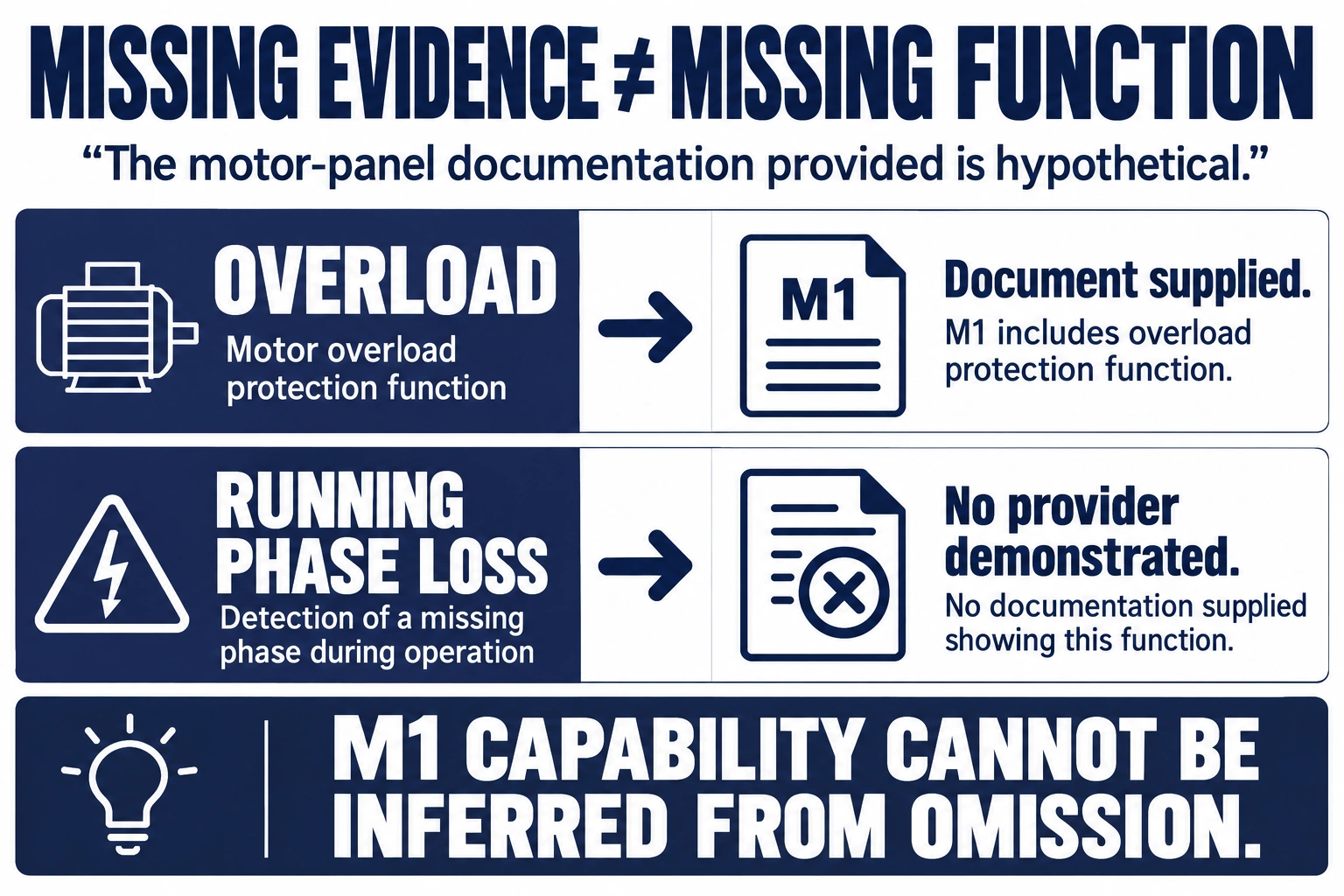
Assume a hypothetical OEM schedule requires ordinary overload protection, short-circuit protection, a documented phase-loss response during running, and assessment of a supply phase-voltage condition before starting. The offered components are labelled MPCB M1 and contactor K1. Their names are placeholders, not RITOKS variants. M1's attached sheet describes thermal overload and magnetic interruption but supplies no explicit phase-failure evidence.
The filled requirement record reads “overload: M1 document supplied, application review pending; short circuit: starter combination review pending; running phase loss: no assigned supporting component; pre-start supply condition: no monitor evidence supplied.” This does not prove that M1 lacks phase-failure sensitivity. It identifies what the quote has not demonstrated and keeps a missing statement separate from a negative product finding.
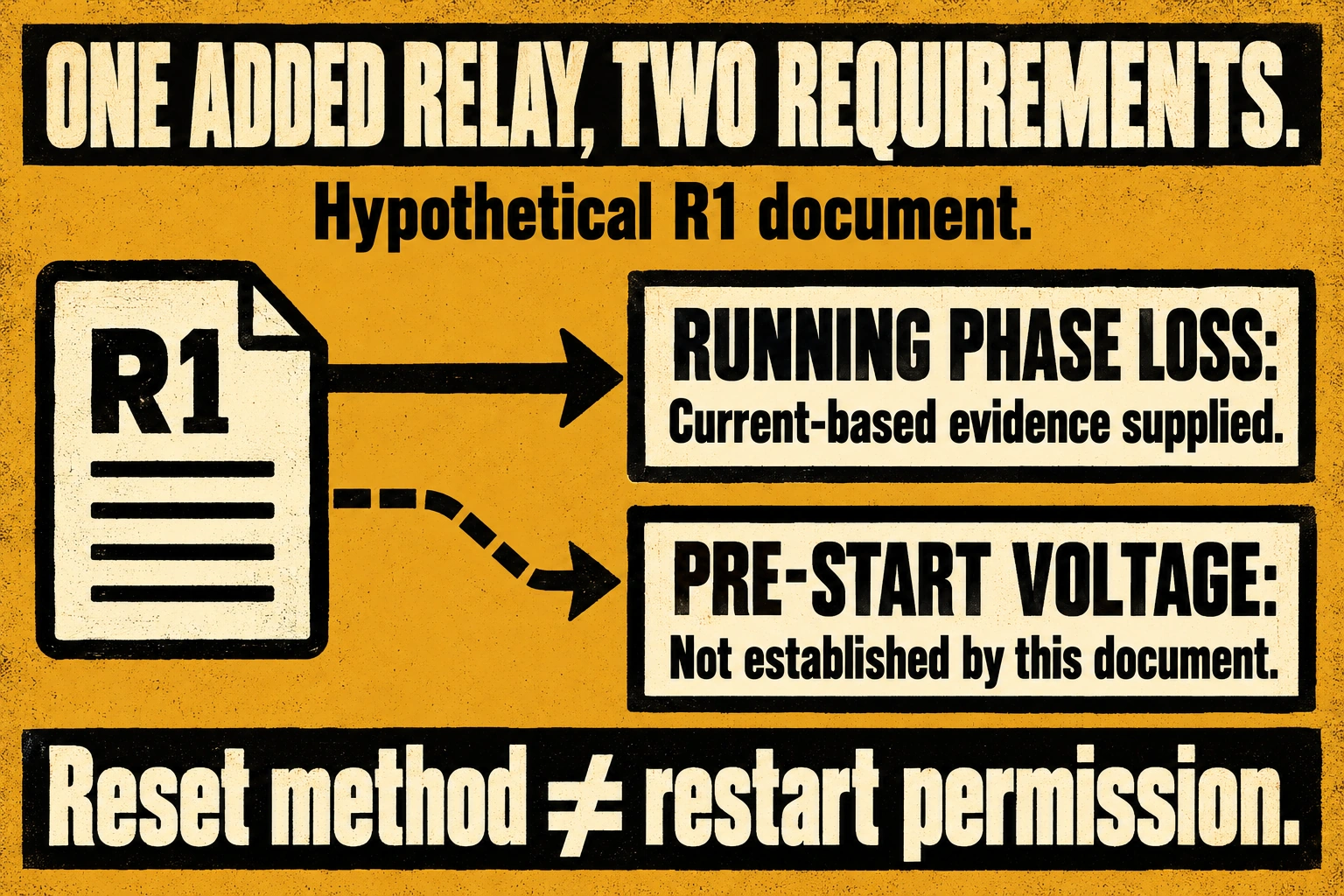
Now assume the supplier adds a relay R1 with documentation for a current-based phase-loss response during running. The record can name R1 as the proposed provider of that function, subject to the exact motor duty, response and approved starter review. The documentation still does not establish the separate pre-start voltage requirement unless its scope expressly addresses it. The designer should identify whether a supply monitor or another supported arrangement is needed, rather than importing R1's description into M1's product sheet.
This attribution affects commercial comparisons. Offer A contains only M1 and K1 with the phase-loss evidence open. Offer B contains M1, K1 and the proposed R1, with its response document attached. Removing R1 to make offer B match the cheaper component count would remove the identified evidence provider. Alternatively, an exact M1 variant with adequate documented phase-loss function could support a different scheme, but pole count and a general overload curve are not the evidence for that decision.
The accepted sheet must also identify what happens after the protection operates. A documented reset method is a component fact; permission to restart the machine belongs to the approved control and site arrangements. Keep indication, fault clearance and restart ownership visible without prescribing automatic reset or a live missing-phase demonstration. The final purchase then has a clear scope: each required condition points to a real included component and applicable documentation, with any remaining application or verification gap stated explicitly.
Confirm the GYMP7 function boundary
The RITOKS GYMP7 three-phase motor protection breaker page describes thermal overload and magnetic short-circuit protection with model-specific selection information. The reviewed public page does not provide an explicit phase-failure sensitivity declaration or a phase-loss response record. Do not add that function to an RFQ approval by inference.
Send the exact GYMP7 configuration, motor information and required phase-loss condition with the enquiry. Request applicable function evidence, response documentation and the approved starter arrangement. If voltage monitoring is also required, state it separately so the technical offer can identify its hardware and documentation.
Other motor protection breaker options need the same exact-device review. The existing MPCB trip-characteristics guide provides broader documentation context; this article adds the narrower phase-loss evidence boundary rather than assuming it has already been covered.
Approve the branch when its required conditions are matched to actual device evidence and an accepted protection scheme. Keep missing functions explicitly unresolved until the offer supplies the needed support.
參考文獻
- Schneider Electric. (n.d.). GV2P32 manual starter and protector product specification.
- Schneider Electric. (n.d.). Phase loss protection, TeSys Giga installation and user guide.
- RITOKS. (n.d.). GYMP7 三相馬達保護斷路器.