
Rack Power Distribution · Technical Explainer
Rack Power Cord Length: Balancing Routing, Voltage Drop and Service Access
Quick answer
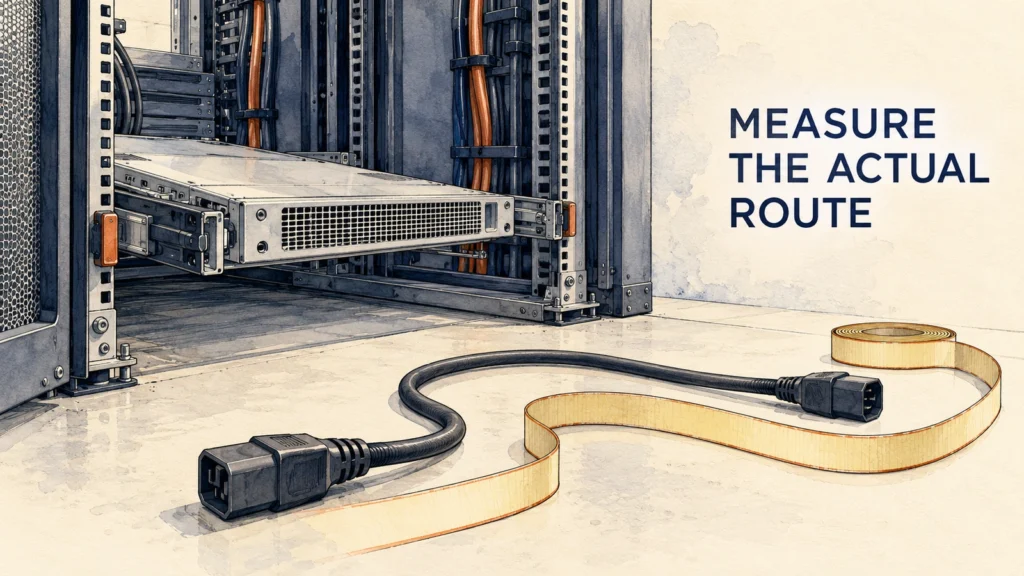
Choose a rack power cord from its installed route and required service movement, then verify the complete assembly against the electrical load. The shortest cord that reaches an inlet is not necessarily usable: it may pull against the connector when equipment moves or force an unsuitable bend. A much longer cord is not automatically better either, because its spare length still needs a permitted route and electrical review.
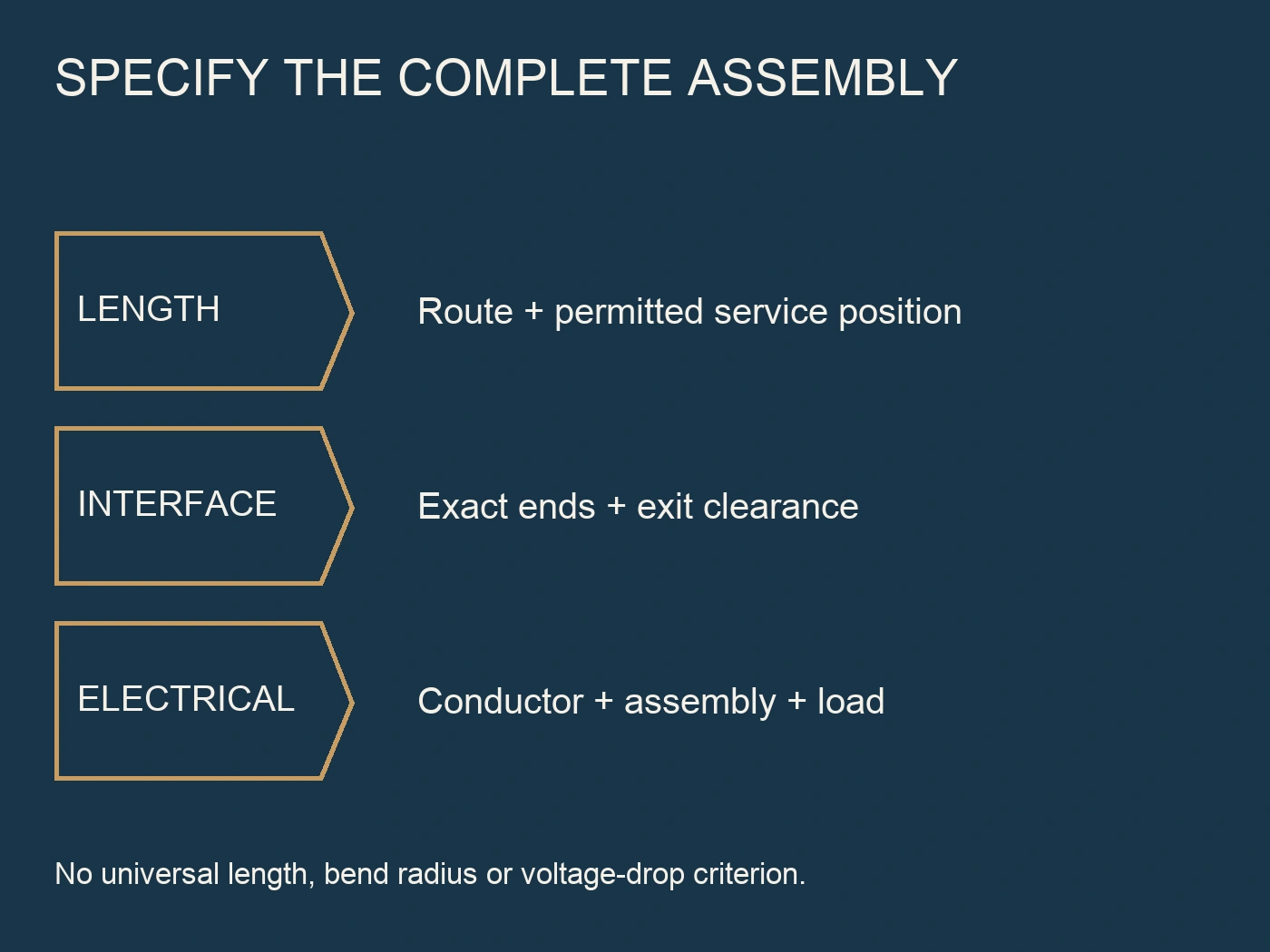
Record the connector ends, cable construction, routed distance, maintenance position and equipment input requirements together. Treat the selected length as one field in an assembly specification, not as a substitute for conductor size or rating. This guide concerns the removable cords inside a rack; selecting a PDU input plug for the building supply is a separate decision.
Measure the route rather than the straight-line gap
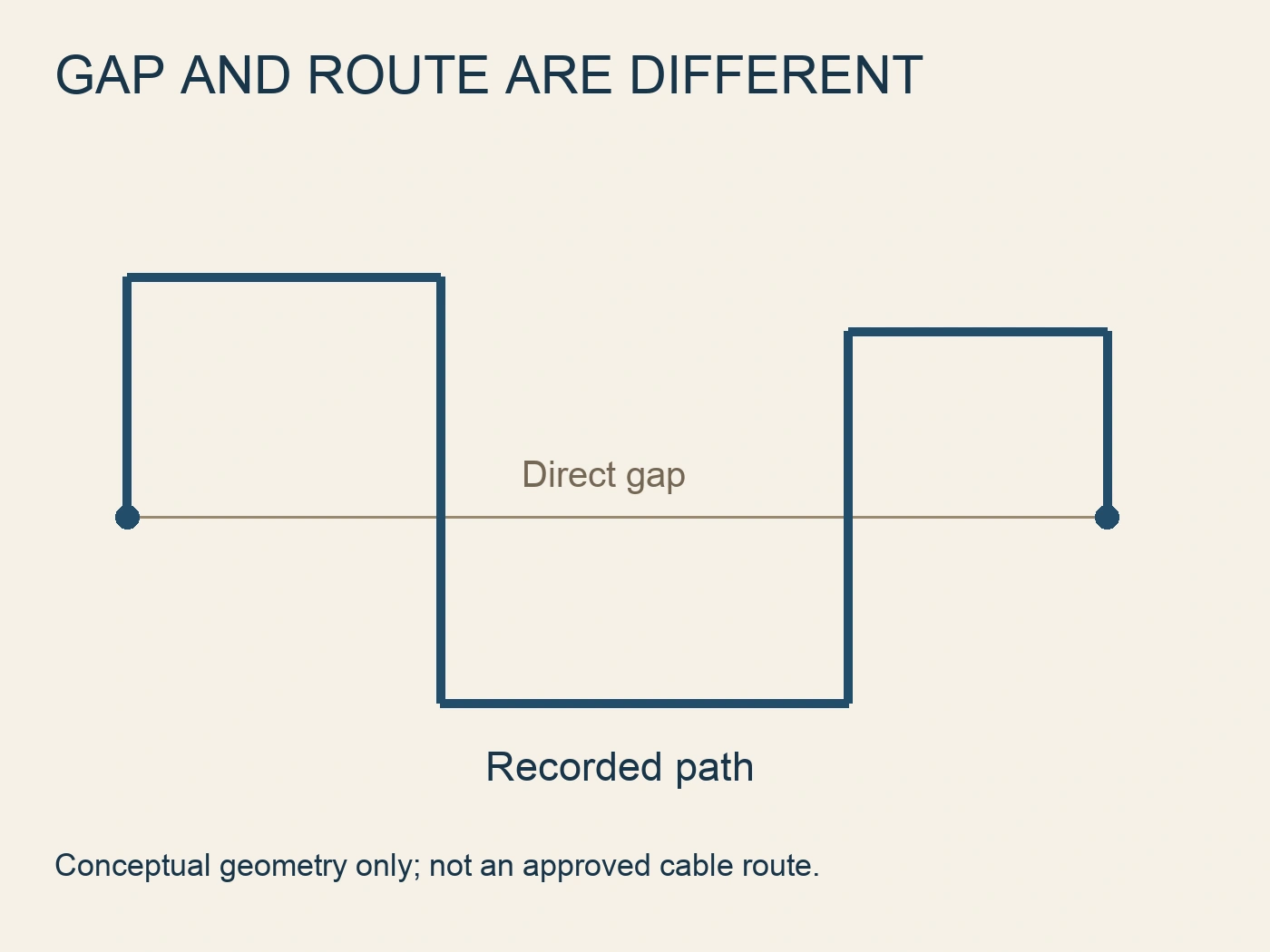
Begin with a drawing or a de-energized physical layout showing the intended PDU outlet and equipment inlet. Identify the cable-management path between them. A straight line across the rack can miss a vertical channel, a rear support or a connector exit direction that changes the required distance. Measure along the proposed route with the equipment in its normal position, not through a convenient empty space that will later contain another device.
Keep the endpoint identity on the measurement sheet. A route measured from one outlet cannot silently become the route for a different outlet or the second power supply. Outlet positions, cable exits and inlet orientation can differ. For equipment with separate feeds, label both paths so a later cable change does not obscure which supply each cord serves.
Record what was physically measured and what remains a design allowance. For example, a proposed cable arm may not yet be installed. Its path is an assumption until the actual arm and equipment instructions establish the movement envelope. This distinction lets procurement quote a candidate assembly without presenting an incomplete layout as an approved installation.
| Route record | What to enter | Why it affects the decision |
|---|---|---|
| Endpoints | Equipment identifier, inlet and PDU outlet position | Prevents reuse of a measurement for a different connection |
| Normal route | Path through the intended management channels | Captures distance that a straight-line measurement omits |
| 服務職位 | Permitted equipment movement and cable-management arrangement | Shows whether the cord must accommodate a different path |
| Connector exit | Straight or angled form and available clearance | Separates length from physical fit at each end |
| Cable constraints | Assembly instructions for bending, support and environment | Identifies limits that cannot be inferred from cord length |
| Outstanding items | Uninstalled hardware or unavailable instructions | Keeps provisional allowances visible before ordering |
This is a measurement record, not a universal installation standard. The equipment, rack and cord instructions remain the sources for allowed movement and routing. Do not invent a common bend radius for every cable merely because the assemblies share the same connector designation.
Include the service position without creating unmanaged spare cable
Decide what maintenance actually requires before adding length. A device that must be disconnected before removal has a different service sequence from equipment whose manufacturer permits a supported sliding service position. Do not assume either sequence. Record the approved procedure and the hardware that supports the cord during movement; a service loop is not permission to work on energized equipment.
Check the whole permitted path, including the return to the normal position. A cord can appear comfortable with a drawer extended but bunch up where the drawer closes. Conversely, a tidy normal-position photograph may conceal tension during movement. The purpose of the review is to identify both conditions before the length becomes a repeat purchase specification.
Give surplus length an intentional location. It should not be left as an unexplained coil occupying the same space needed for access, airflow or another cable-management component. Whether a proposed storage arrangement is permitted depends on the installation and cable instructions. A generic rule to coil every spare cord or tie it tightly to the rack would bypass those constraints.
Separate slack from retention. Slack accommodates an approved route or movement; a retention device addresses the connection using an exact compatible mechanical arrangement. More cable does not make an unsuitable retention accessory compatible, and a retention accessory does not remove the need for a suitable route. Obtain the accessory fit details for the selected connector and equipment rather than assuming that every C13 or C19 connection accepts the same device.
Review voltage drop with the actual assembly and load
Length belongs in the electrical review because conductor resistance and load current affect the voltage lost along a cable. Schneider Electric's Electrical Installation Guide identifies cable length, conductor resistance, load current and circuit conditions as calculation inputs. Its installation examples are not a universal rack-cord sizing chart, and their assumptions should not be copied into a flexible assembly without checking applicability (Schneider Electric, 2026).
For the selected cord, obtain the conductor construction and the manufacturer's relevant electrical information. Identify the equipment load basis and acceptable input conditions from the equipment documentation. Include the supply conditions at the cord's upstream connection in the project review; the cord is not the entire path from the building supply to the equipment. A satisfactory cord-only calculation cannot compensate for an unexamined upstream condition.
Avoid treating a connector name as a conductor specification. Cable size, insulation, assembly rating and applicable conditions remain separate fields. Eaton's published P004-004-BL product page, for example, lists connector ends, length, wire gauge and electrical ratings as distinct properties. That example illustrates how an assembly is specified; its values do not establish the ratings of another manufacturer's cord (Eaton, n.d.).
Where the necessary values are missing, the result is a pending selection rather than a guessed voltage-drop percentage. Ask the responsible designer to review the actual assembly and load against the project requirements. This article does not prescribe a universal maximum cord length, permissible percentage or conductor size, because those decisions need information that a route measurement alone cannot provide.
Turn the route into a complete purchasing specification
該 RTX-PWC IEC rack power cord and retention accessory family lists C13–C14 and C19–C20 assembly options, with length specified per order and conductor selection requiring confirmation. It is a relevant commercial starting point, not a statement that any available length or retention accessory has been approved for a particular rack.
Send a route record together with the electrical and interface requirements. Describe the exact ends, including any permitted angled form, and state whether the length is measured along the assembly using a particular supplier convention. Differences in how length is described can matter when clearance is limited. Resolve the convention before comparing quotations rather than adjusting it after delivery.
| Purchasing field | Evidence to request or supply | Decision it supports |
|---|---|---|
| 連接器對 | Exact inlet/outlet identities and assembly end drawings | Confirms the intended connection rather than a visual resemblance |
| Requested length | Route record, service position and length convention | Explains the ordered length and its remaining assumptions |
| Conductor and insulation | Offered cable specification and relevant conditions | Allows review beyond the connector label |
| Assembly rating | Documentation for the offered complete cord | Avoids transferring a component or another product's rating |
| Load and input conditions | Equipment documents and project load basis | Supports the electrical suitability review |
| Retention accessory | Exact fit information and installation instructions | Keeps retention compatibility separate from cable reach |
Ask suppliers to identify substitutions explicitly. An offered cord with the same endpoints but a different cable construction is not necessarily the same reviewed item. Likewise, a longer substitute changes the route and may change the electrical calculation. Record the changed fields so the designer can determine whether the previous review still applies.
A conditional review example
Consider a hypothetical rack project in which the initial cord reaches the server in its normal position but becomes taut at the documented service position. The measurement sheet shows that the original order was based on the direct endpoint gap, not the cable-management route. No conclusion about electrical suitability follows from that observation alone.
The project team identifies a longer candidate and checks its route through the actual management hardware. It asks whether the spare length has a permitted position when the equipment is closed, whether the connector exit fits, and whether the proposed retention accessory is compatible. It then requests the candidate assembly's conductor and rating documentation for the electrical review.
If those documents support the load and installation, the longer candidate can proceed through the project's approval process. If the added length is unacceptable electrically, the answer may require a different assembly or route reviewed by the responsible designer. Simply ordering the shortest replacement would leave the demonstrated service-position problem unresolved; simply ordering the longest available cord would leave the electrical and routing questions unresolved.
Keep the final route record with the accepted assembly identity. Future replacements should use that identity and the documented installation conditions, not only a remembered length. If the rack layout or equipment changes, mark the old measurement as no longer representative and review the affected path again.
常見問題
Is the shortest rack power cord always the best choice?
No. It must accommodate the approved route and maintenance arrangement without relying on connector tension or an unsuitable bend. A short cord can be appropriate when the documented path supports it, but neat appearance alone is not sufficient evidence.
Can I choose conductor size from the connector type?
No. The connector pair identifies an interface, not all properties of the complete cable assembly. Obtain the conductor, insulation and assembly rating details and review them against the actual load and installation conditions.
Does a longer cord automatically cause an unacceptable voltage drop?
No. Length is one input alongside conductor characteristics, current and circuit conditions. A longer candidate requires review, but this guide provides no universal pass/fail length. Equipment input requirements and the upstream supply conditions also matter. The same trade-off appears on the DC side of PV arrays; see PV extension cable length and connector count.
Should a retention accessory replace the service loop?
No. The two address different requirements. Any slack must serve the permitted route or movement, while retention requires an exact compatible accessory and installation method. Neither substitutes for the other, and neither authorizes energized maintenance.
參考文獻
Eaton. (n.d.). P004-004-BL product specifications. https://www.eaton.com/us/en-us/skuPage.P004-004-BL.html
Schneider Electric. (2026, August 5). Calculation of voltage drop in steady load conditions. Electrical Installation Guide. https://www.electrical-installation.org/enwiki/Calculation_of_voltage_drop_in_steady_load_conditions
RITOKS. (n.d.). RTX-PWC IEC rack power cords and retention accessories. https://ritoks.com/products/rtx-pwc-iec-rack-power-cords/