
AC Surge Protective Devices for Low-Voltage Systems · Comparison
Temporary Overvoltage vs Surges: What an AC SPD Is Tested For

Quick answer
A temporary overvoltage, TOV, is a different stress from a transient surge. An AC SPD's impulse classification does not by itself establish its TOV behaviour or regulate the load's supply voltage. Request model-specific voltage, duration, mode and outcome evidence, then distinguish continued SPD operation from acceptable device failure and protection of the connected load.
The word "surge" often appears in a fault report before anyone has identified the event. A cabinet loses equipment, the SPD indicator changes, and the buyer asks for a stronger surge protector. That sequence is a possible review scenario, not proof of a lightning event or a reason to select the next discharge-current rating.
A better starting point is to separate three questions: what happened on the supply, how the SPD behaved, and what protection the load required. Those questions have different evidence. The following method supports engineering and purchasing review; it does not authorize fault simulation, live neutral work or an installation change.
Classify the event before comparing SPD ratings
Schneider Electric distinguishes switching transients from power-frequency overvoltages associated with a changed network state, including faults and neutral-conductor breakdown. Frequency and event duration therefore matter alongside voltage magnitude. An event description that contains only "high voltage" is insufficient to select the relevant SPD evidence. Schneider Electric, overvoltage definitions.
Collect the available disturbance record through the responsible electrical professional. Identify the measurement location, conductor pair, recording method and event duration. State whether the record captures a fast waveform, a power-frequency voltage change, or only a limited-resolution trend. Do not treat every logger as if it has recorded every kind of event.
The commercial consequence is straightforward: compare products against the identified stress rather than a general sense that one offers "more protection." A discharge-current number is not a complete description of a power-frequency abnormal supply event. Conversely, a TOV outcome does not replace impulse performance evidence for the surge-protection task.
| Review question | Transient-surge evidence | TOV evidence |
|---|---|---|
| What event is being assessed? | Waveform and protected mode | Applied voltage, frequency and duration |
| Which device characteristic is relevant? | Declared impulse performance and protection level | Declared temporary-overvoltage behaviour |
| What happened to the SPD? | Documented performance under the stated impulse conditions | Operation maintained, disconnection or another declared outcome |
| What happened to the load? | Separate equipment protection assessment | Separate supply and equipment behaviour assessment |
| What supports acceptance? | Exact variant, instructions and relevant test documentation | Exact variant, test conditions and outcome documentation |
This is an original evidence-comparison aid, not a test procedure. A real event can require more than one line of investigation. Mark missing information explicitly rather than forcing an uncertain incident into whichever column has the more convenient product rating.
Keep Uc, Up and TOV declarations in separate fields
DEHN's definitions describe Uc as a maximum continuous operating voltage associated with the corresponding terminals, while Up describes a protection level established by standardized surge tests. Its TOV entry addresses a specified temporary stress and outcome. Those fields answer different questions; neither a Uc nor an Up value is a complete TOV declaration. DEHN, terms and definitions, printed pages 255 to 257.
Set up the supplier comparison with separate columns for normal service, impulse protection and temporary stress. Record the protected mode for each entry. If the catalogue presents several mode-specific values, keep them associated with the correct variant and conductor pair rather than selecting the most attractive number.
Avoid describing Uc as a precise trip setting that switches off the load. That description adds a control function the rating does not establish. Likewise, do not label Up a permitted sustained supply voltage for the protected equipment. The supplier should explain the declared characteristics in their actual product context, not reinterpret one symbol to answer every voltage-related question.
When a quotation lacks TOV data, "not supplied" is more useful than a guessed limit. Ask whether the manufacturer can provide the relevant declaration or test evidence. Do not calculate a TOV capability from the Type 1+2 label, catalogue width, component appearance or a different vendor's data sheet.
Distinguish TOV withstand from TOV safety
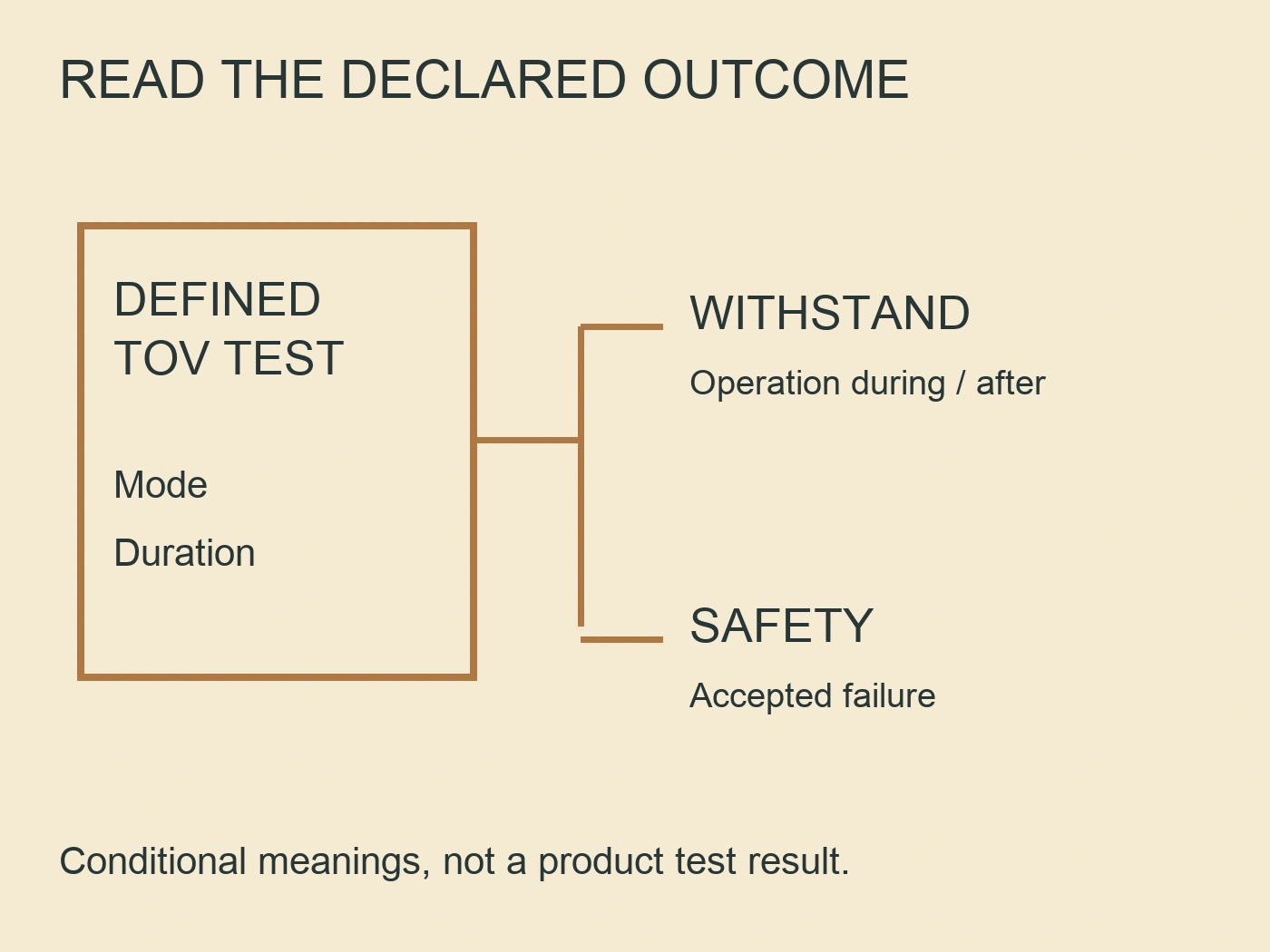
DEHN distinguishes TOV withstand, where the SPD remains operational during and after the defined stress, from TOV safety, where reliable failure can be an accepted outcome under the specified conditions. A statement about acceptable failure is therefore not a promise of continued surge protection. Read the conditions and post-event state together. DEHN, terms and definitions, printed pages 256 to 257.
For procurement, translate that distinction into an explicit outcome field. What is the declared state of the SPD during the event? What is its state after the event ends? Is replacement required, and how is loss of protection indicated? The answer should name the tested configuration, not simply repeat "TOV compliant."
Then add a separate load-state field. A documented SPD withstand outcome does not mean that the abnormal supply has been returned to the equipment's ordinary operating range. If the project requires load disconnection or another response to abnormal supply voltage, ask the designer to identify the system function that provides it and the evidence covering that function.
Do not convert the outcome table into a ranking where continued supply always wins. A production process and a sensitive instrument can have different operating priorities. The project needs a defined response, including what maintenance personnel must do after an event. Price comparison cannot settle that requirement after the purchase has already been placed.
An SPD disconnector does not necessarily interrupt the load
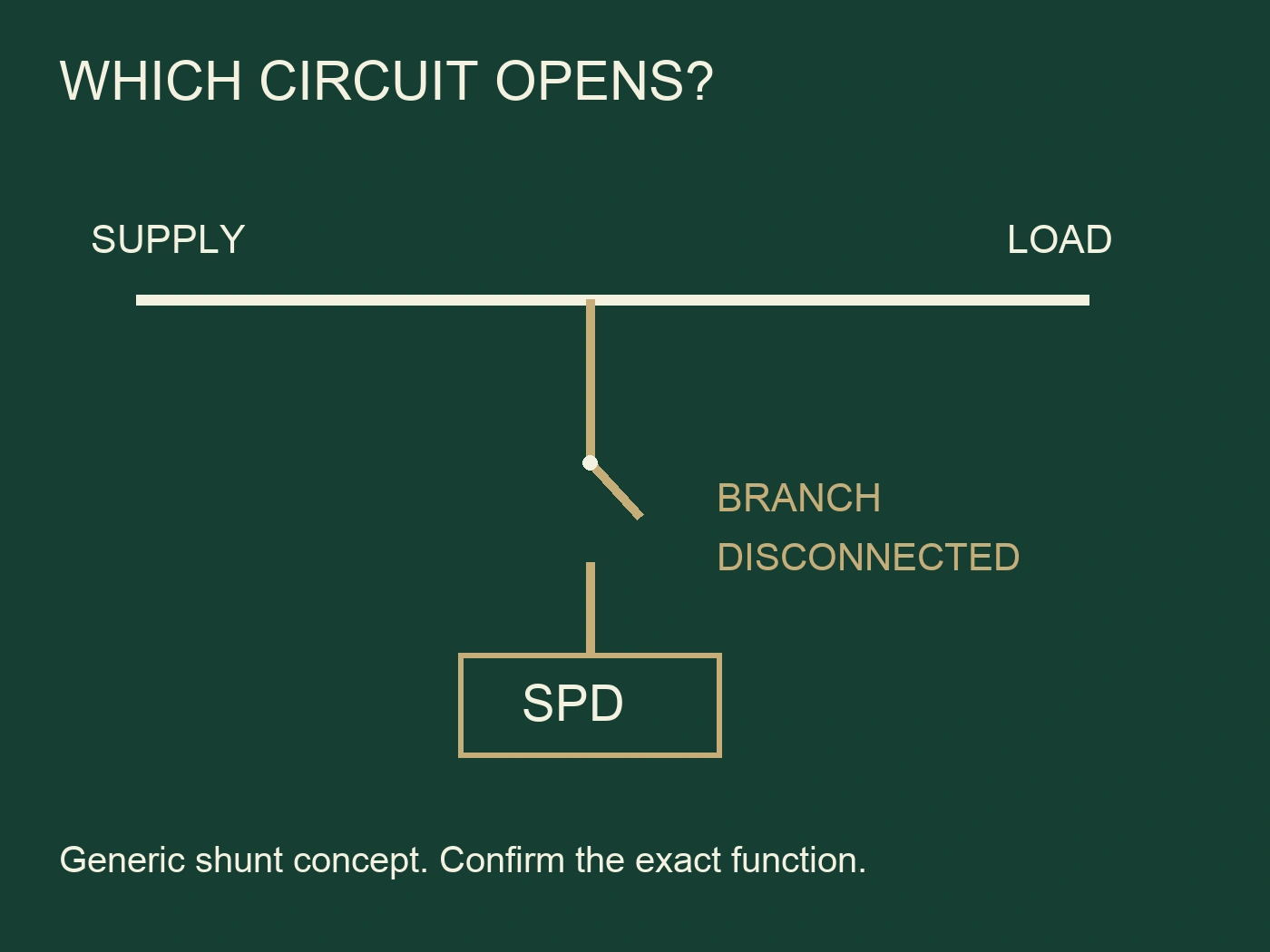
The paper TOV Effects on Surge-Protective Devices, hosted by NIST, distinguishes devices with different supply paths and observes that the disconnector in the studied shunt-connected devices separates the SPD rather than interrupting the installation's supply. It is historical research, not current certification evidence for a RITOKS model. Its safety assessment was expressly outside the study's scope. Kladar, Martzloff and Nastasi, TOV effects.
That architecture distinction creates a practical review question: which circuit actually opens when the indicated protective function operates? Request the selected device's documented function. A description of internal thermal protection cannot be assumed to mean that the outgoing load loses power.
Keep the indicator and the load's supply status separate in the maintenance record. The buyer needs to know what an indication means, whether protection is still available and which action the instructions require. A visual flag should not be reworded as proof that the equipment remained within its acceptable voltage range throughout an event.
DEHN's thermal-disconnector description also identifies an SPD-disconnection function; it does not make that element a general substitute for other installation protective functions. DEHN, terms and definitions, printed page 257. Obtain the system designer's explanation when the proposal relies on separate monitoring or disconnection equipment.
Treat a neutral fault as an investigation, not a demonstration
A neutral-conductor fault is a possible cause to investigate when records suggest power-frequency overvoltage. Schneider includes neutral breakdown in that event category, and the NIST-hosted study examined a lost-secondary-neutral scenario. Neither source makes every damaged SPD evidence of a neutral fault or provides a reason to reproduce the fault in a working installation. Schneider Electric, overvoltage definitions; Kladar, Martzloff and Nastasi, TOV effects.
An incident file should contain what is known: supply-event timestamps, available recordings, the equipment affected and the professional inspection findings. Keep the cause "under investigation" until evidence supports it. Do not build a replacement specification around an unconfirmed explanation supplied from a photograph alone.
Request any available failed-device information through an approved service process. Preserve the selected model identity, installation records and relevant indication descriptions. The purchasing team should coordinate evidence collection with the responsible professional rather than instructing staff to open a neutral, raise supply voltage or bypass a protective device to see what happens.
Replacement is a separate decision from restoring the system. A different SPD does not correct the cause of an abnormal supply condition. The designer should identify the required corrective work and the conditions for returning equipment to service. The supplier can then answer product-specific questions against that established requirement.
Build a model-specific TOV evidence request
A useful TOV request states the proposed SPD, assessed conductor pair and relevant temporary stress, then asks for the documented outcome. Keep applied voltage and duration together. Require the supplier to identify the test basis and post-event condition rather than accepting a family-level adjective such as "safe" as the complete answer.
| Requested field | Evidence to obtain | Comparison error to avoid |
|---|---|---|
| Exact configuration | Orderable variant and corresponding technical sheet | Another model's result is treated as family-wide evidence |
| Stress definition | Applied voltage, frequency, duration and assessed mode | A voltage value is supplied without a time or conductor pair |
| Test basis | Named standard or documented test method and report scope | An impulse classification is used as the TOV result |
| SPD outcome | State during and after the stated stress | Reliable failure is presented as continued operation |
| Load response | Separate system evidence where load interruption is required | Internal SPD disconnection is assumed to disconnect equipment |
| Service action | Indication meaning, replacement or other instructed action | A status flag is treated as permission to ignore the event |
The table is a document request, not an instruction to perform the tests locally. If a test report is unavailable, retain that limitation in the offer record. An engineer may need to resolve whether the supplied evidence is adequate for the intended application. Do not fill the gap with a catalogue example from another brand.
For RITOKS sourcing, request the relevant documentation for the exact GSP10-C40N Type 2 AC SPD variant or the published BR-12.5M Type 1+2 configuration. Their impulse classifications identify a different part of the review from a model-specific TOV declaration.
No numerical TOV voltage or duration limit is assigned to either family here. Keep that field unresolved until exact supporting documentation is supplied. The same applies to any claim that a selected device performs supply regulation or automatically disconnects the load: ask for the actual product and system evidence before adding the claim to an offer.
Turn two test statements into different purchasing decisions
Consider a hypothetical comparison in which two offers include TOV statements for the same explicitly defined voltage, duration, mode and test setup. No numerical conditions are assigned here, and neither offer represents a documented RITOKS test. Offer W states that the SPD remains operational during and after the specified stress. Offer S states that a defined accepted failure occurs and replacement is required. Both statements may have a place in a project, but they do not promise the same post-event availability.
For a project requiring continued surge-protection availability after that defined event, Offer W's declared outcome addresses the requirement more directly. Offer S would require the designer to account for loss of protection, indication and replacement before the system can meet the stated availability requirement. This is an outcome comparison, not a claim that W protects every connected load against the abnormal supply. The load's voltage limits and system response remain separate inputs.
For a project whose agreed response permits protective-device replacement after the event, Offer S may remain a candidate if the exact accepted-failure evidence and maintenance response meet the application requirements. The buyer should preserve that intended state in the specification rather than describing both offers simply as “TOV protected.” The price difference becomes meaningful only after the required outcome has been identified. Otherwise the quotation may compare two devices that answer different operational questions.
Change the test statement's conductor pair or duration and the comparison becomes incomplete again. A result for one defined stress cannot be treated as the same result for another. The record should say conditions differ; outcome comparison pending, rather than ranking the offers on the words withstand and safety alone. This is where the exact test scope changes the procurement decision without needing an invented universal voltage limit.
Finally, suppose either offer relies on an internal disconnector in a shunt branch while the process requirement calls for load interruption during abnormal supply. The SPD outcome does not demonstrate that load function. The system proposal needs separately documented monitoring and interruption behavior if the designer requires it. A filled review note can therefore state SPD outcome documented; post-event availability matches/does not match requirement; load response evidence missing. These are independent conclusions, and the missing load evidence remains visible even when the SPD's own declared result is acceptable.
Specify the event and the expected state
Order against a defined event class, model-specific evidence and an agreed post-event response. Keep sustained supply abnormalities out of vague "surge protection" promises. The purchasing record should state which SPD outcome is documented, which load function is required and which unresolved evidence must be closed before the proposal is accepted.
參考文獻
- Schneider Electric. (n.d.). Overvoltage definitions. Electrical Installation Guide. Retrieved October 2, 2026.
- Schneider Electric. (n.d.). The Surge Protection Device (SPD). Electrical Installation Guide. Retrieved October 2, 2026. Used for impulse-classification context, not its simplified Uc wording.
- DEHN. (2025). Catalogue: Surge Protection. Terms and Definitions, printed pages 255 to 257. Relevant pages independently inspected; no whole-catalogue review claimed.
- Kladar, D., Martzloff, F., and Nastasi, D. (n.d.). TOV Effects on Surge-Protective Devices. Historical conference paper hosted by NIST. Retrieved October 2, 2026. Not a current product certification or normative test specification.