
Technical Resources · Comparison
MPCB vs Thermal Overload Relay vs MCB: Roles and Selection Boundaries
An MCB, a motor protection circuit breaker and a thermal overload relay may appear in the same motor-control discussion, but their names do not establish identical functions or interchangeable selection rules. The required device set depends on the motor, application, control architecture and exact manufacturer coordination evidence.
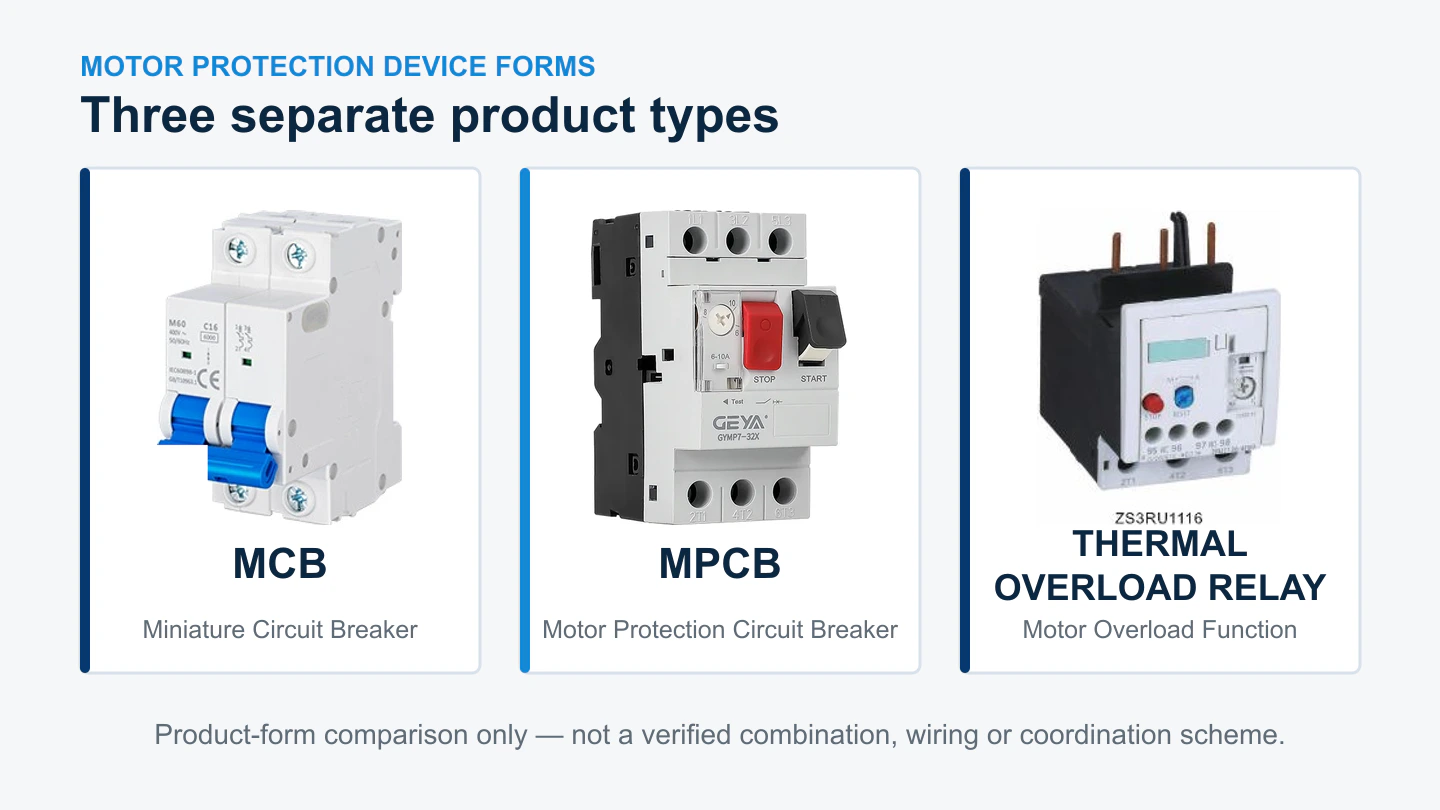
This comparison explains functional boundaries for sourcing. It is not a wiring diagram, coordination table, trip-setting instruction or approval of a particular component combination.
Functional Roles at a Glance
| Device | Evidence-supported role | What still requires exact verification |
|---|---|---|
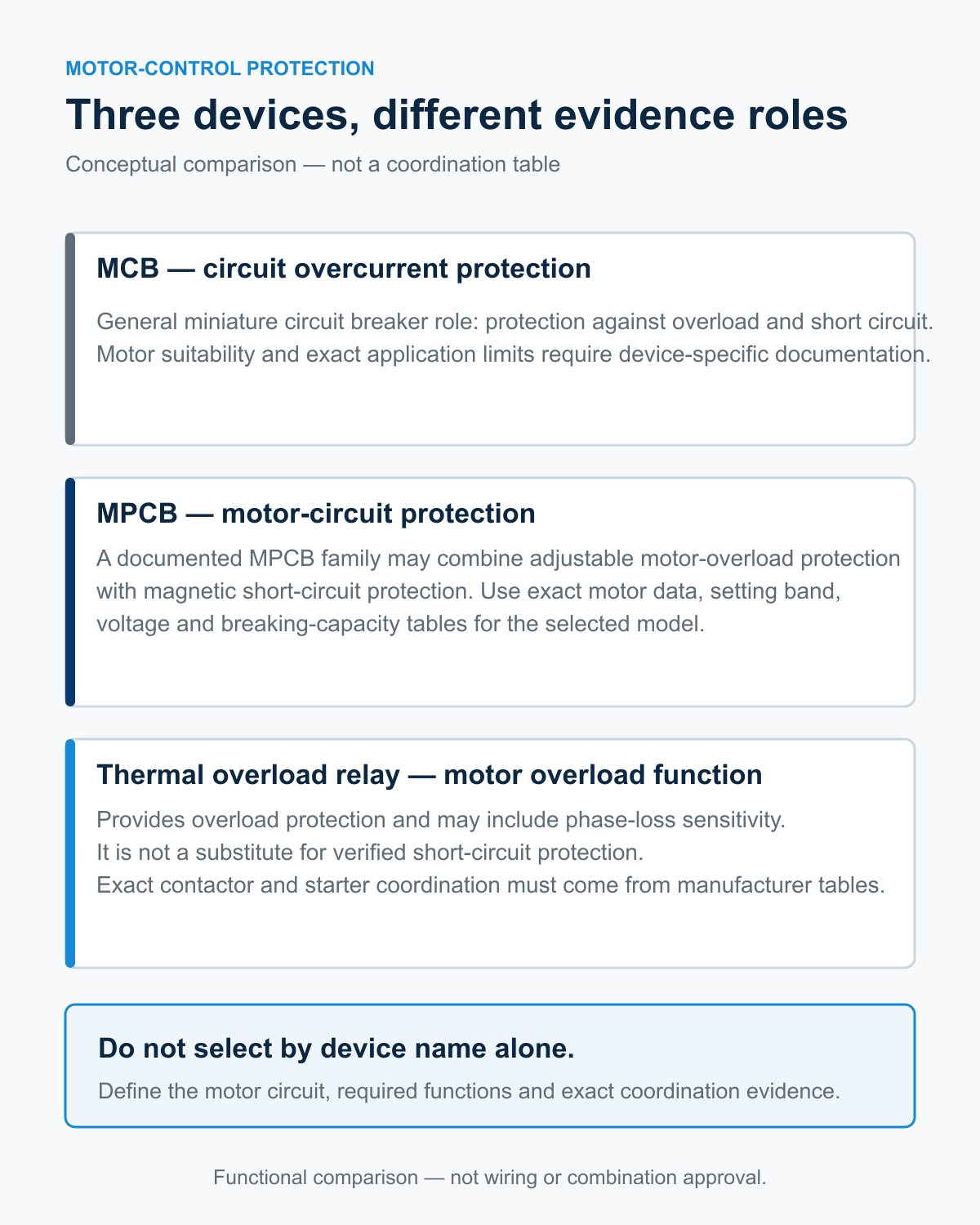
| MCB | General circuit overcurrent protection against overload and short circuit. | Motor suitability, trip curve, breaking capacity, voltage and installation rules. |
| MPCB | A documented motor-circuit breaker may combine adjustable motor-overload and magnetic short-circuit protection. | Motor data, setting band, voltage, breaking table, accessories and coordination. |
| Thermal overload relay | Motor overload protection; phase-loss sensitivity where documented. | Trip class, reset behavior, contactor mapping, mounting and upstream short-circuit protection. |
1. What an MCB Contributes
ABB describes a miniature circuit breaker as a resettable overcurrent protective device for overload and short-circuit conditions in electrical networks. That general role does not establish that any MCB is suitable for a specific motor branch circuit.
For motor work, verify the exact breaker voltage, poles, trip characteristic, breaking capacity and applicable motor-circuit rules. Existing RITOKS MCB guides retain their own curve and RFQ intent; this article does not repeat those selection rules.
2. What an MPCB Contributes
A motor protection circuit breaker is selected around motor-circuit requirements. The exact functions still come from the product record, not the family name alone.
The published GYMP7 motor protection circuit breaker family documents three-phase architecture, adjustable thermal overload protection and magnetic short-circuit protection. It covers exact model-specific adjustment bands across 0.1A to 80A. Its Icu and Ics data must stay tied to the selected frame, current band and voltage table.
Do not generalize GYMP7 ratings to every MPCB. Exact motor data, setting band, operating voltage, expected fault level and required accessories must be reviewed for the selected device.
3. What a Thermal Overload Relay Contributes
Official manufacturer documentation describes thermal overload relays as motor-protection devices for overload and phase-failure conditions. A separate overload relay does not by itself establish short-circuit protection for the motor branch circuit.
The published ZS3RU thermal overload relay family documents model-specific setting bands from 0.11A to 100A, three-phase asynchronous motor applications, overload and phase-loss protection, temperature compensation and trip indication. The available evidence does not publish its trip class, reset mode, auxiliary contacts or exact contactor mapping.
4. Keep Control and Protection Functions Separate
A contactor provides controlled switching. An overload relay provides its documented overload function. A short-circuit protective device provides its documented fault-current function. Some MPCBs integrate more than one motor-protection function, but that does not make every motor starter architecture identical.
The AC Contactor Selection Guide explains the separate power-circuit, coil and auxiliary-contact inputs. Published RITOKS examples also include the ZSLE1-D enclosed magnetic motor starter. These links show related commercial families, not confirmed compatibility.
5. Coordination Requires Exact Manufacturer Evidence
Schneider Electric motor-protection guidance separates disconnection, short-circuit protection, control and overload protection. When several devices are used, their coordination must be verified as a combination. A matching current range or brand name is not enough.
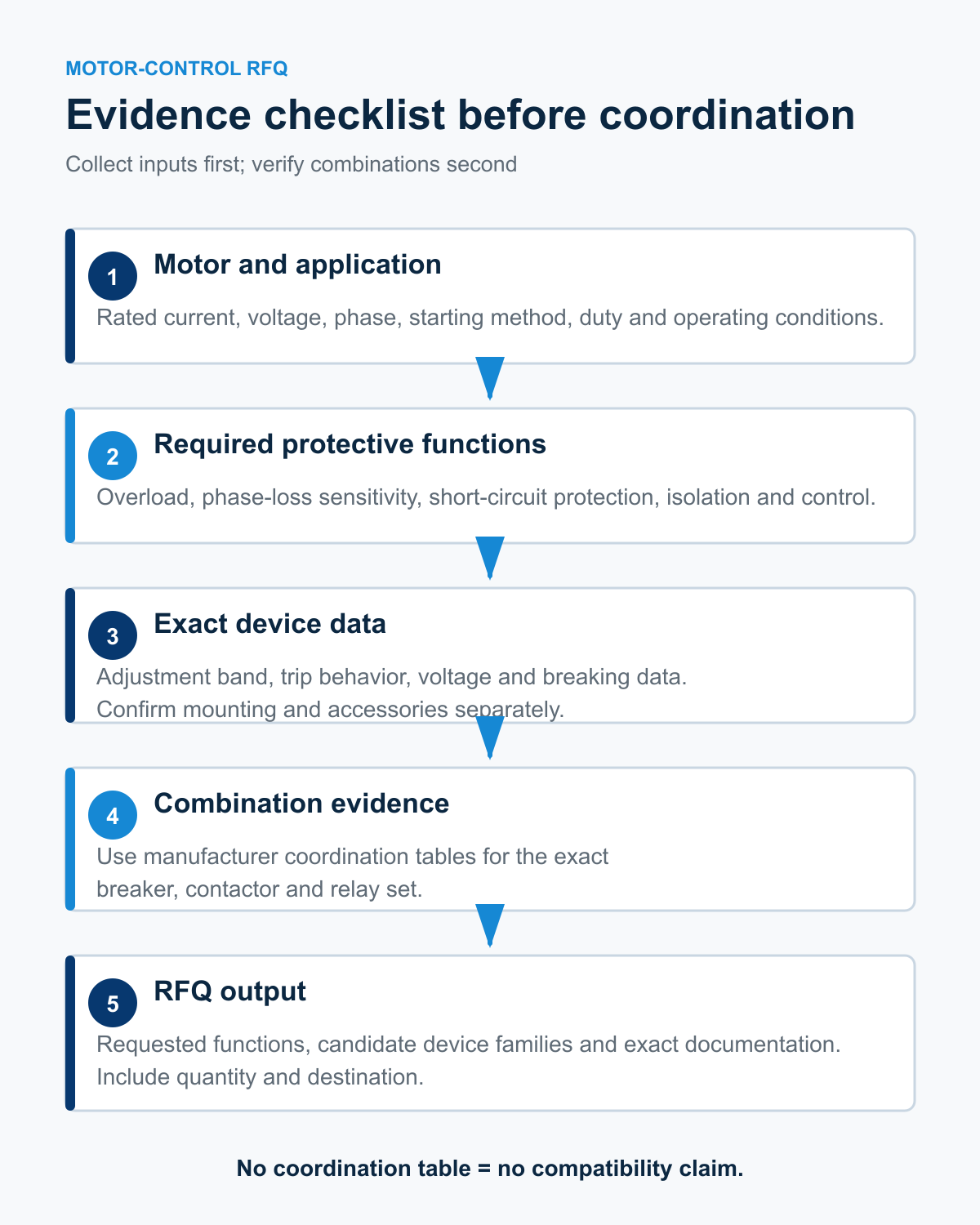
Do not publish a Type 1 or Type 2 coordination claim, breaking-capacity combination, trip setting or component substitution without the exact manufacturer coordination table for the selected breaker, contactor and relay set.
Published RITOKS Product-Family Examples
| Family | Verified public scope | Boundary |
|---|---|---|
| GYMP7 MPCB | Three-phase; adjustable 0.1-80A across model bands; thermal overload plus magnetic short-circuit protection. | Use exact model and voltage tables; no assumed accessory or starter pairing. |
| ZS3RU overload relay | 0.11-100A across model bands; overload and phase-loss protection for three-phase asynchronous motors. | Trip class, reset mode and exact contactor mapping remain unverified. |
| ZS3TF contactor | Controlled switching with model-specific duty ratings. | A contactor is not overload or short-circuit protection. |
| ZSLE1-D starter | Published enclosed magnetic motor-starter family. | Exact internal architecture and coordination must be confirmed. |
Information to Include in a Motor-Protection RFQ
- Motor rated current, voltage, phase and frequency
- Motor power and starting method
- Load duty, start frequency and operating conditions
- Required overload, phase-loss and short-circuit functions
- Required isolation and control functions
- Prospective short-circuit information
- Candidate MPCB or overload-relay setting band
- Contactor or starter requirements
- Required coordination level and exact manufacturer table
- Mounting, enclosure and accessory requirements
- Quantity, destination and required documentation
Technical References
- ABB — Miniature Circuit Breaker Application Guide — Supports the general overload and short-circuit protection role of MCBs; exact ratings remain product-specific.
- ABB — Motor Overload Protection — Supports the general overload and phase-failure protection role of thermal overload relays.
- Schneider Electric — Motor Protection Coordination Guide — Supports keeping disconnection, short-circuit protection, control and overload functions distinct and verifying combinations from coordination evidence.
Frequently Asked Questions
Is an MPCB the same as an MCB?
No. The devices can have overlapping overcurrent functions, but an MPCB is selected for documented motor-circuit requirements. Exact functions and ratings must come from the selected product documentation.
Does a thermal overload relay protect against short circuits?
Do not treat a thermal overload relay as complete short-circuit protection. Its overload function must be coordinated with the applicable short-circuit protective device.
Can I combine GYMP7 with any contactor or overload relay?
No compatibility is claimed without an exact manufacturer coordination or compatibility table for the selected devices.
Can an MCB be selected from motor current alone?
No. Motor application, starting behavior, trip characteristic, voltage, breaking capacity and applicable rules also require review.
What should be confirmed before ordering ZS3RU?
Confirm the exact current-setting band, trip behavior, reset requirement, mounting method, contactor relationship, upstream protection and documentation.
Define a Motor-Protection Device Set
Send RITOKS the motor data, required protective and control functions, fault-level information, candidate device families, coordination requirement, quantity and destination.