
Technical Resources · Comparison
DC Isolator vs DC Circuit Breaker: Switching and Protection Roles
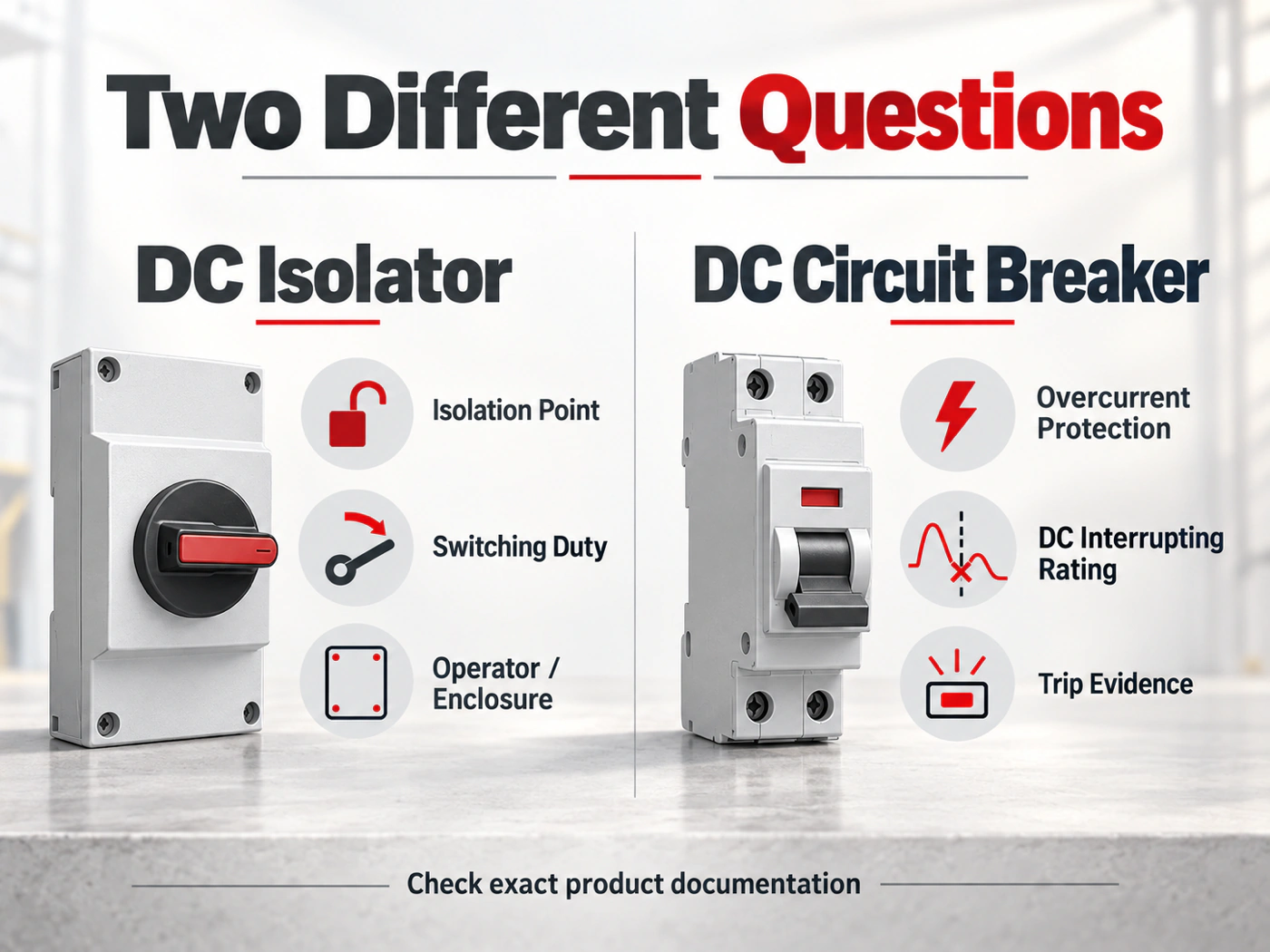
A DC isolator and a DC circuit breaker can both have a handle and poles, but they answer different design questions. The isolator purchase asks how the circuit will be switched or isolated for a defined purpose. The breaker purchase asks which overcurrent faults a documented device can interrupt. Confusing these functions can produce an RFQ that requests the wrong evidence, even before a model is chosen.
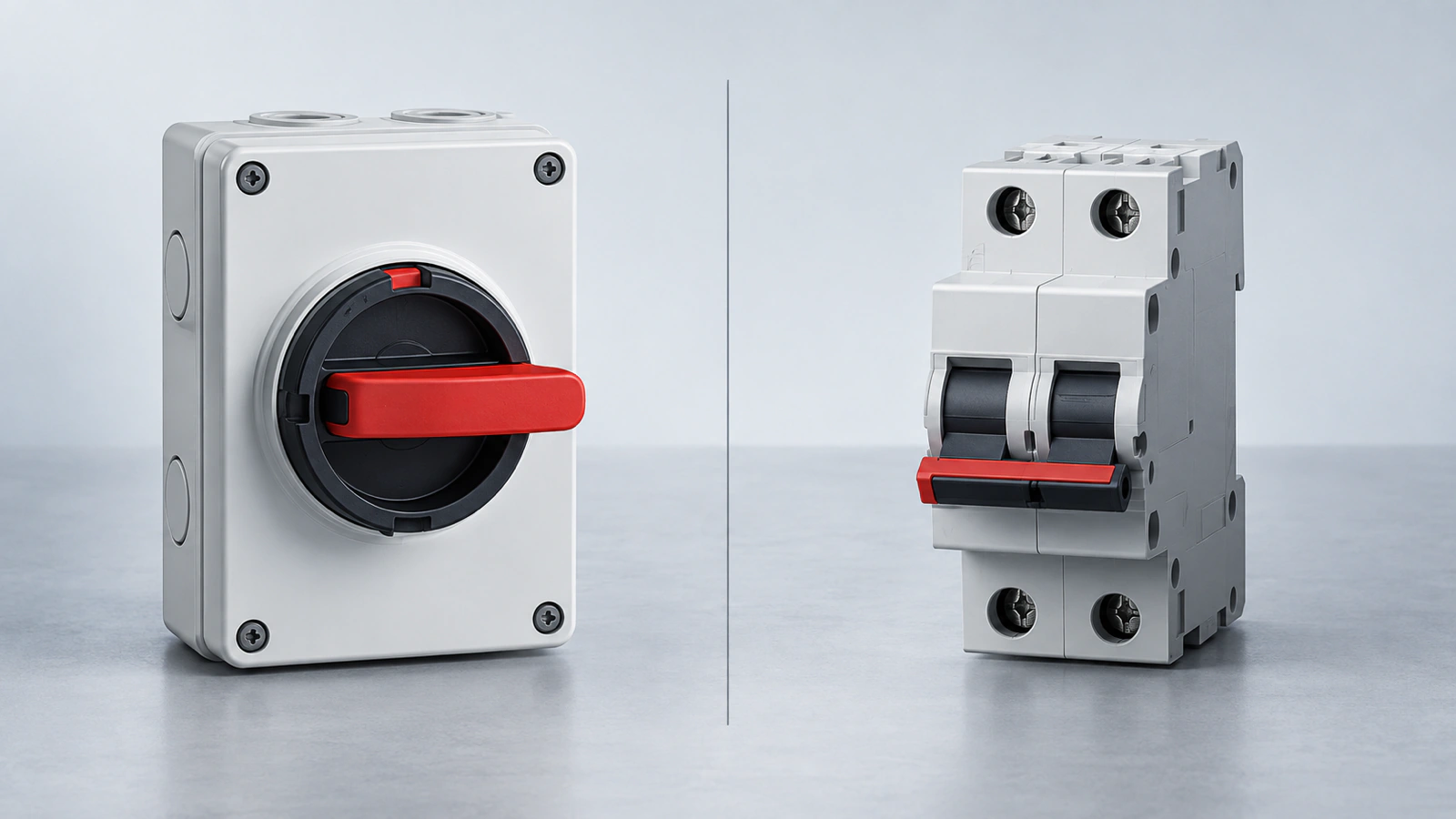
This is a role comparison for buyers, not a complete isolator or MCB selection guide. It does not prescribe that a project must install both devices, imply that any two RITOKS products form a tested combination, or replace a system design review. Use the detailed family guides and exact manufacturer records after the function has been defined.
Quick Functional Comparison
| Question | DC isolator / switch-disconnector | DC circuit breaker |
|---|---|---|
| Primary purchasing question | What switching/isolation duty must be documented? | Which overcurrent faults must be detected/interrupted? |
| Core evidence | DC switching duty, voltage, poles and isolation function | DC voltage, breaking rating, trip function and poles |
| Common mistake | Assuming a switch provides automatic fault interruption | Assuming every breaker has the required isolation role |
| Both may need | Exact diagram, environment and orderable code | Exact diagram, environment and orderable code |
The Isolation Question
An isolator or switch-disconnector is evaluated for its documented switching and isolation function. If the operator will open the circuit under load, the relevant DC switching duty must be established. A device described only as an “isolator” does not automatically have every load-breaking capability a buyer might need. Request the exact DC voltage/current, utilization category if applicable, pole arrangement and operating instructions for the quoted switch.
The isolator’s role does not substitute for a protective device simply because the current value on its label exceeds normal load. A protective design involves fault behavior and other system requirements. ABB’s low-voltage discussion distinguishes switch-disconnectors used for de-energization from circuit breakers used for short-circuit interruption. Its OTDC product information also illustrates that specific DC switch applications and switching categories are product-dependent. These are conceptual references, not RITOKS test results.
The Fault-Interruption Question
A circuit breaker is compared against the circuit’s voltage and prospective fault current at its proposed position. Its exact DC breaking and trip records matter. A breaker may also support an isolation function when the manufacturer documents it, but that cannot be assumed across products. The same handle action does not prove that two device categories have identical purpose or ratings.
Do not use an AC breaker’s rating as proof of DC fault interruption. Nor should a buyer compare a switch’s withstand or switching figure directly with a breaker’s interrupting figure as though they measured the same function. Ask which function the project actually requires and which document establishes it under the same circuit conditions.
Three Buyer Situations
A service switching point is requested
The buyer should identify whether the switch must operate under load, which conductors are involved and the required environment. Ask for a documented switch-disconnector function and exact connection diagram. Do not infer that this purchase also closes the overcurrent-protection design.
A fault-protection device is requested
The buyer should supply maximum DC voltage, continuous load and the prospective fault level, then ask for the exact breaker’s DC interrupting and trip data. If isolation is also a design requirement, request separate documentation for that function. An ampere marking alone answers neither question completely.
The design refers to both functions
Identify each function and its proposed device position in the project documents. This comparison does not assert that two catalog products should be wired together. Exact connection, upstream protection and any coordination or combined-use claim must come from the applicable manufacturer and system engineering records.
Compare Offers Without Mixing Ratings
| Record | Isolator offer | Breaker offer |
|---|---|---|
| Application function | Documented switching/isolation duty | Documented overcurrent/fault function |
| Voltage and poles | DC rating with exact connection | DC rating with exact connection |
| Fault evidence | Do not substitute switching rating for breaker breaking rating | DC breaking and trip evidence at system conditions |
| Environment | Enclosure/operator requirements | Mounting, enclosure and accessory requirements |
This table is not a ranking between devices. A complete answer for one function cannot fill a blank for the other. If a seller suggests a breaker in place of an isolator, or the reverse, ask which documented functions and project requirements the proposed alternative actually meets. Reject the phrase “equivalent rating” until the compared rating types are named.
The same discipline applies when a single product is advertised with more than one function. Record each required function separately and identify the evidence that supports it. A breaker documented for isolation may reduce the number of devices in a particular design, but this article cannot decide that architecture; conversely, adding a switch does not prove that the fault-protection requirement has been met.
Decision Workflow
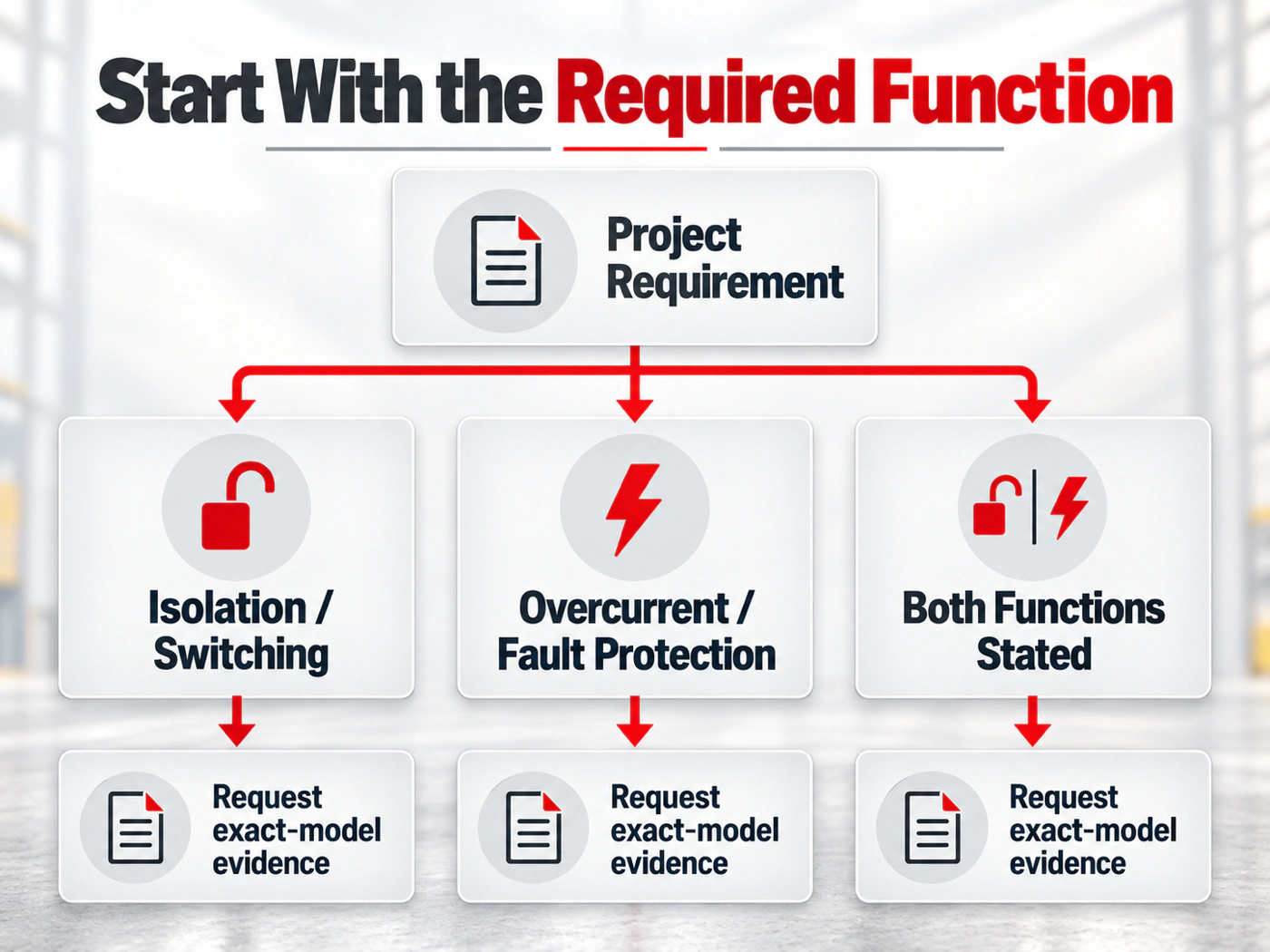
- State the project task in plain language: switching/isolation, overcurrent fault protection, or both.
- Record source type, maximum DC voltage, normal current, relevant fault conditions and device location.
- Request the exact model’s documentation for the function it is proposed to perform.
- Compare pole arrangements and diagrams only within their own manufacturer instructions.
- If both functions are present, seek exact system and coordination evidence before declaring a combination suitable.
Buyer and RFQ Checklist
Describe the source and the reason for the device, rather than sending only a photograph or a current value. Specify whether switching under load is intended, whether automatic fault interruption is required, and whether isolation must be documented. Add maximum voltage, continuous load, prospective fault estimate where available, pole and grounding context, enclosure needs, and quantity. Ask for the proposed order code and its exact duty, diagram and protective-function records.
RITOKS publishes a PV DC isolator family and a separate DC MCB family. Their links below illustrate different product roles; they do not describe a tested pairing. If a project requires a particular breaker architecture, the published MCB-versus-MCCB guide addresses that separate question. Do not turn this article into a universal DC protection overview; the broader multi-device guide already owns that intent.
Evaluate Substitution Proposals by Function
When a supplier proposes replacing one device type with the other, ask which required function the substitution is intended to satisfy. A proposed breaker must be checked for the project’s protection and any claimed isolation function from its exact documentation. A proposed isolator must be checked for the required switching or isolation duty, but it should not be credited with overcurrent interruption unless the exact product is documented for that function. The comparison starts with functions, not a shared current marking.
If a multifunction device is proposed, keep each claimed function attached to the same orderable code and document set. Do not combine a breaker family’s protection claim with an isolator family’s enclosure or operator feature. The project reviewer should confirm whether consolidating functions is acceptable for the actual circuit and applicable requirements. This guide only structures the evidence request; it does not approve a combined architecture.
Assign Evidence Ownership in the RFQ
The project owner or designer supplies the circuit conditions and states which switching, isolation and protection functions are required. The manufacturer or supplier identifies exact models and provides ratings, diagrams and supported accessories. Procurement compares complete delivered scope, including enclosures and operators, without changing the functional requirement to match an available item. These responsibilities should be visible in the RFQ response.
A useful comparison record has one row for every required function and one column for each candidate. Mark the supporting document and exact model in every completed cell. Leave unsupported cells open rather than filling them with assumptions. This makes it clear whether an offer contains one device or several, whether the required functions are covered, and which technical decisions still need human approval before an order can be released.
Where a proposal combines functions in one device, add a separate row for each claimed function and cite the exact supporting source in every row. A single family label should not automatically satisfy isolation, switching and protection requirements at once. The same method also makes multi-device proposals comparable without asserting that their components form a verified coordinated system.
Frequently Asked Questions
Can a DC isolator clear a short circuit?
Do not assume so. Ask which exact device and documented protective function is intended. A switching or isolation rating is not automatically a breaker fault-interruption rating.
Can a DC circuit breaker also act as an isolator?
Only when the exact product documentation supports the required isolation function and the design accepts it. The word “breaker” or the presence of a handle does not settle this.
Do I always need both devices?
That is a system-design decision. Define the functions and applicable requirements first; do not infer a universal two-device rule or a compatible product combination from this comparison.
Related RITOKS Products and Guidance
Use these pages as separate product and family records. A link is not a claim that two devices are interchangeable or coordinated.
PV DC Isolator Switches category
MCB versus MCCB architecture comparison
Technical References
The following manufacturer sources support the general concepts identified below. Their model ratings, diagrams and approvals do not transfer to RITOKS products.
ABB, Defining short-circuit values for circuit breakers
Supports the general low-voltage functional distinction; its AC-system discussion is not a DC rating or a wiring instruction.
Illustrates that specific DC switch-disconnectors have documented application/duty data; ABB product specifications do not apply to RITOKS products.
Request an Exact-Model Review
Send the recorded application requirements, exact documentation questions, quantity and destination through the RITOKS contact form. An RFQ requests an exact-model review; this guide does not approve a wiring design or recommend an automatic substitute.