
Technical Resources · Comparison
AC Contactor vs Motor Starter: Device and Assembly Boundaries
An AC contactor and a motor starter may both appear in a motor-control quotation, but they are not two names for the same deliverable. A contactor is a switching device whose main contacts, coil and optional auxiliaries must be specified. A starter request concerns a defined motor-control offering or assembly, with exact control, overload, enclosure and protective-device boundaries set by its manufacturer. The buying problem is to decide what scope the project actually needs before comparing quotes.
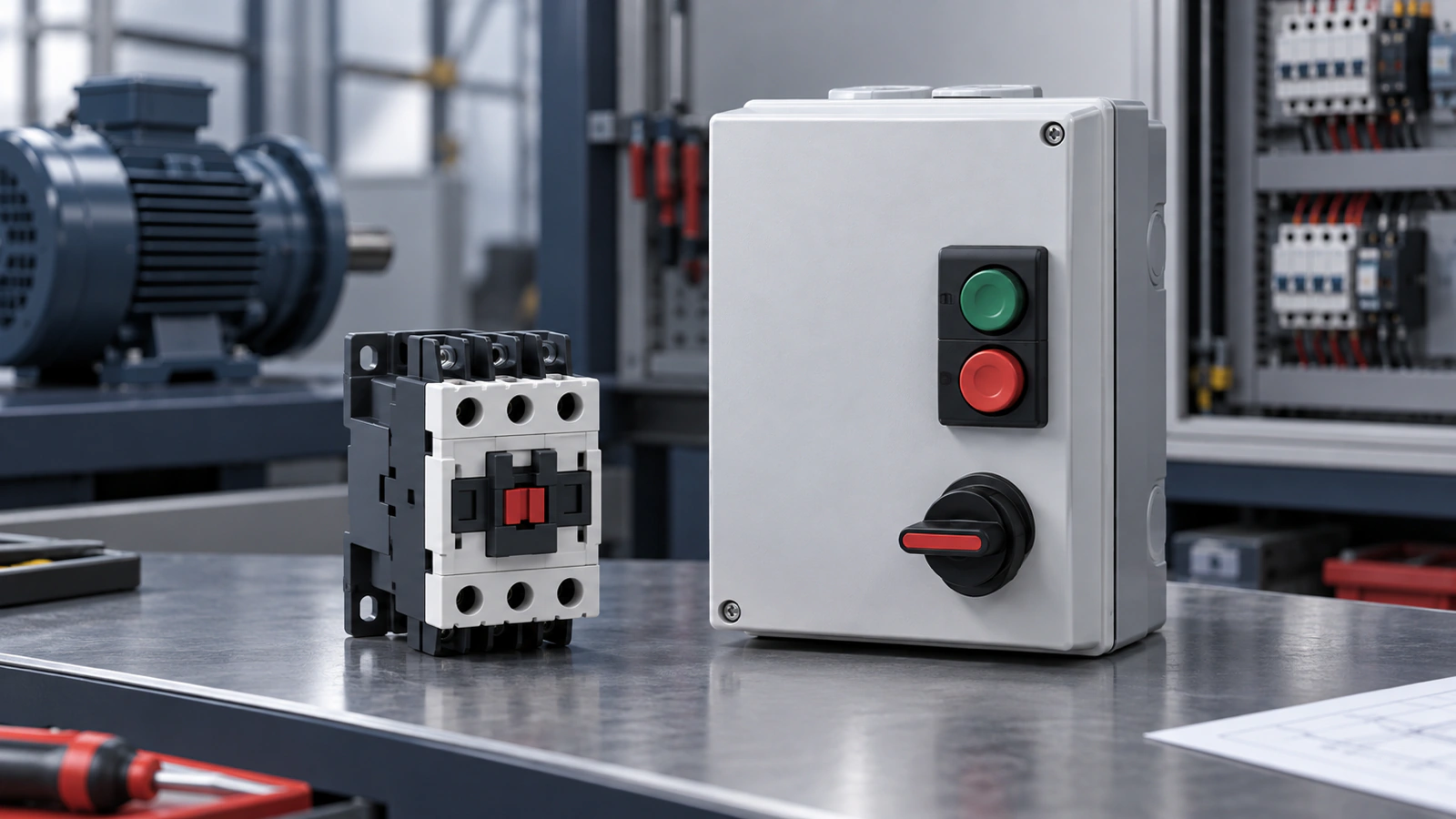
This page compares a device purchase with a starter offering. It does not replace the detailed AC contactor selection guide or the magnetic motor starter selection draft. It does not claim that any RITOKS contactor and overload relay form a coordinated starter. Documented components and test evidence, not a shared current figure or a photograph, control such statements.
Device Versus Assembly at a Glance
| Buyer question | AC contactor | Motor starter offering |
|---|---|---|
| What is being bought? | Specified electrically operated switching device | Specified motor starting/control product or assembled scope |
| Key electrical inputs | Load duty, operational current/voltage, poles, coil supply | Motor and circuit data, operating method, control supply and protection requirements |
| What is not implied? | Overload or short-circuit protection simply because it switches a motor | A particular internal component, upstream protective device or coordination result from the word starter |
| Evidence to request | Exact contactor order code and duty/coil/auxiliary data | Complete assembly code, component list, functions and applicable coordination record |
What a Contactor Specifies
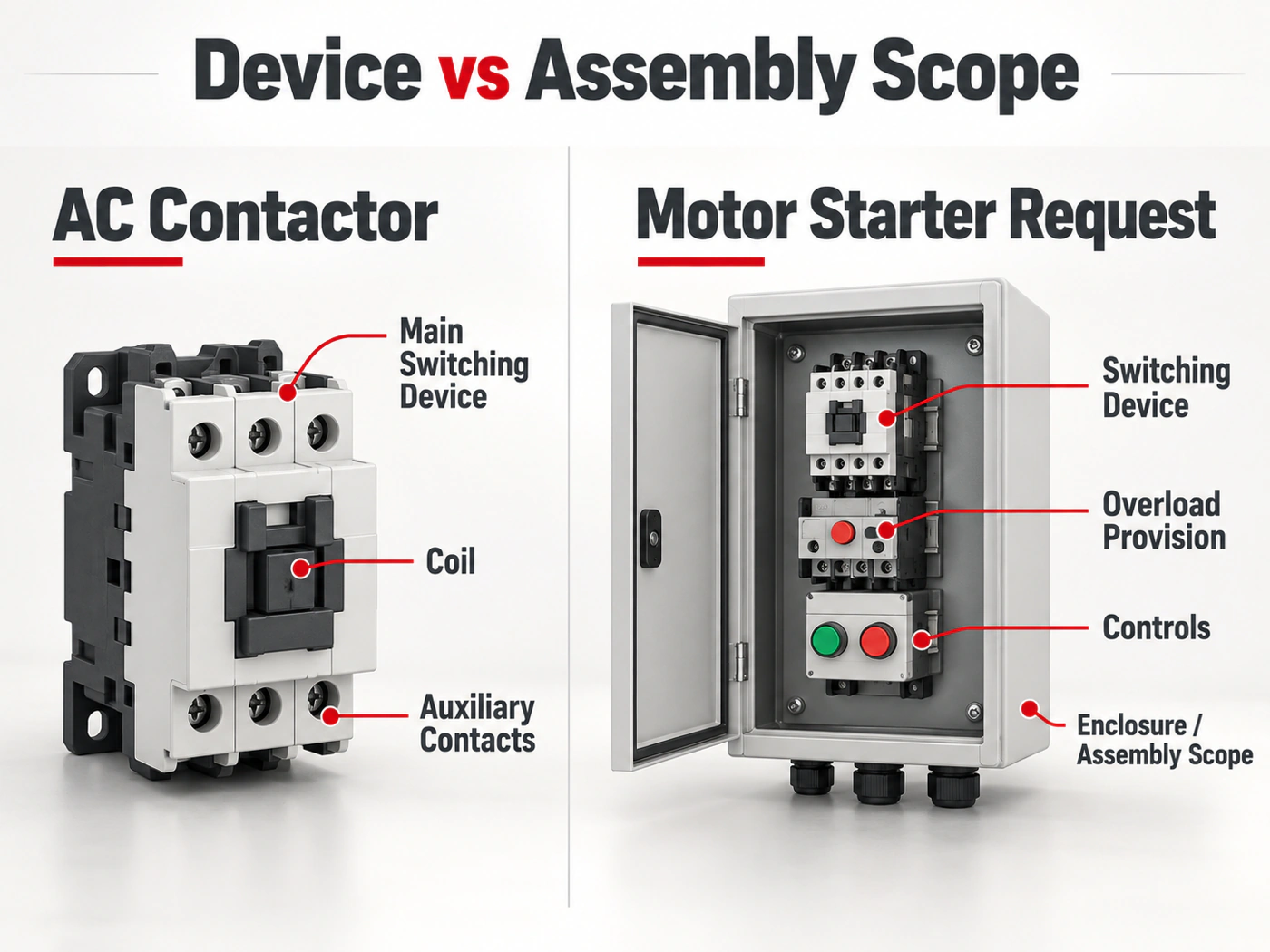
The contactor question begins with the controlled load and switching duty. Record the load description, operating voltage and current under the intended utilization duty, frequency of operation, required main poles, coil supply and auxiliary-contact needs. These fields are distinct. Schneider Electric’s contactor specification FAQ explicitly separates main contacts, auxiliary contacts and coil, and asks whether an enclosed motor starter is required as an additional scope question.
A contactor can switch a motor circuit when it is correctly selected, but the contactor’s own data does not specify a complete starting assembly. A buyer who needs an operator, enclosure, overload function or particular upstream protection should name those separately. Do not infer an overload relay, breaker or tested coordination from the contactor body alone. The published ZS3TF page describes a RITOKS contactor family, not every possible complete motor-control panel.
What a Starter Request Adds
A starter request must identify the motor and the operating task. State motor nameplate and application information available to the project, start/stop behavior, control supply, operator interface and enclosure context. Specify whether an overload function is required and what evidence the proposed assembly supplies. A starter can be offered in different configurations, so the word “starter” is not a universal bill of materials.
Ask for the exact supplied component list: switching device, overload provision where required, controls, enclosure and any included accessories. Ask what remains outside the supplier’s scope, particularly short-circuit protective devices and installation-specific engineering. An image of a closed enclosure does not reveal its internal components or confirm that a proposed circuit is coordinated.
Keep Protection and Coordination Separate
Motor overload protection and short-circuit protection address different conditions. A quote that mentions an overload relay does not by itself specify an upstream short-circuit protective device. Likewise, buying a contactor and an overload relay separately is not proof of a tested starter assembly. The responsible designer determines the system requirements, and the supplier must identify any exact tested combination it claims.
Schneider Electric describes coordination as a manufacturer-evaluated combination of contactor, overload relay and short-circuit protective device in its coordination FAQ. That is a principle of evidence, not a coordination certificate for ZS3TF, ZSLE1-D or any cross-family RITOKS pairing. Avoid using Type 1 or Type 2 coordination language for an offer unless its exact tested component record supports it.
Three Buying Situations
The panel builder needs a replacement contactor
Provide the existing complete code, load duty, coil supply, pole and auxiliary requirements, then check whether the candidate’s documentation supports those conditions. The replacement request should not silently become a complete starter request, and the purchaser should not promise drop-in compatibility without dimensions and terminal data.
The project wants a complete enclosed starter
Specify the motor/application, control behavior, overload requirement, enclosure and expected delivered components. Request the exact assembly code and a scope list. The vendor should identify any external protective device and the evidence needed before the system can be approved.
A supplier proposes separate devices instead of an assembly
Ask whether the proposal is a list of parts or a documented assembled solution. If it is a parts list, the project still needs engineering, wiring, assembly and coordination review. Similar headline ratings are not evidence that the components work together as claimed.
Compare Offers on Delivered Scope
| Check | Device-only offer | Starter offer |
|---|---|---|
| Order code | Exact contactor and included auxiliaries | Exact assembled configuration and component list |
| Control supply | Coil data for the quoted device | Coil, controls and operator arrangement |
| Overload | Not inferred from the contactor | Specified provision and exact component evidence |
| Enclosure | Project supplies it unless expressly included | Exact enclosure and environmental record |
| Coordination | Not established by a parts listing | Exact manufacturer tested combination if claimed |
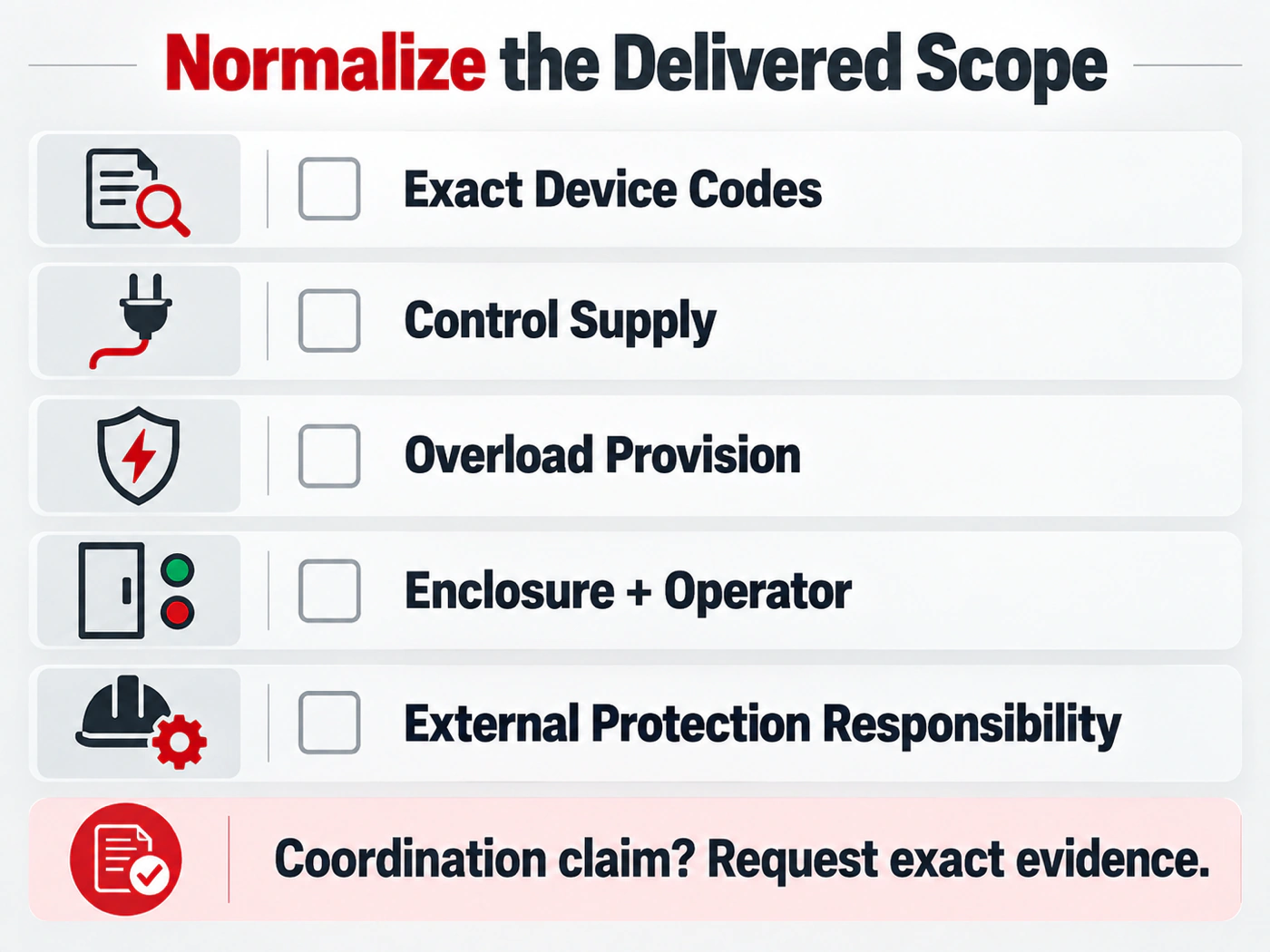
A cheaper device-only quote cannot be compared directly with an enclosed assembled offer. Normalize the scope first. If an offer omits the coil code, overload component or enclosure details that the project requested, ask for clarification rather than assuming it is equivalent to a more complete quote.
Buyer Workflow and RFQ Checklist
- Decide whether the request is for an individual switching device, a parts list or an assembled starter.
- Record motor/load duty, circuit voltage and current, control-supply details and operating pattern.
- For a contactor, request exact duty, main-pole, coil and auxiliary-contact information.
- For a starter, request exact component list, control/operator, overload and enclosure records.
- State the short-circuit protective-device responsibility; request exact coordination evidence for any claimed combination.
- Send order codes if known, quantity, destination and unresolved project questions for technical review.
RITOKS Product Examples
The published ZS3TF AC contactor and ZSLE1-D enclosed magnetic motor starter are different product-family records. Use them to explain the scope of an offer, not to imply that one contains the other or that components are mutually compatible. The separate AC contactor guide covers detailed contactor selection inputs; this comparison stays with the device-versus-assembly decision.
Normalize the Delivered Scope
Before comparing price, convert every offer into the same scope table. A contactor offer should identify the main switching device, coil, auxiliary contacts and included accessories. A starter offer should identify the switching device, overload provision, controls, enclosure and any other included components. Record short-circuit protection and installation work separately when they remain outside the package. This prevents a low-cost device-only quote from appearing equivalent to a complete assembly.
Where the supplier uses a commercial name such as magnetic starter, request the exact internal bill of material and assembly documentation. The name does not prove which overload function, control voltage or enclosure is included. If the project permits separate components, ask for the orderable code and evidence for each one. A shared manufacturer or matching current range is not a coordination record.
Stop Conditions Before an Order
Pause the purchase when the buyer has not decided whether the requirement is a replacement contactor, a set of components or a completed starter assembly. Also stop when motor/load duty, control supply, overload requirement or enclosure responsibility is missing. These inputs change the item being purchased and cannot be filled by choosing the nearest current value from a catalog.
The final RFQ should state the delivery boundary in plain language: what arrives assembled, what remains for the panel builder, which protection decisions remain with the system designer, and which exact documents support any claimed combination. With that record, procurement can compare lead time and price without losing the distinction between a switching device and a functional starter assembly.
At order release, repeat the accepted bill of material rather than using only the words contactor or starter. If a supplier changes a coil, overload element, enclosure or accessory, the revised parts list returns to review. This protects the approved scope and avoids treating a familiar assembly name as proof that every internal component and function remained unchanged.
Frequently Asked Questions
Is a contactor alone a motor starter?
Do not assume so. A contactor is a switching device; a starter request may include control, overload and enclosure requirements. Confirm what the exact supplied product includes.
Does an enclosed starter always contain a circuit breaker?
No conclusion follows from the enclosure or name alone. Read the exact assembly component list and identify any external short-circuit protection required by the system design.
Can I combine a contactor and overload relay with matching current labels?
A shared headline current is not coordination evidence. Request the exact component and manufacturer combination documentation before making a compatibility or coordination claim.
Related RITOKS Products and Guidance
Use these pages as separate product and family records. A link is not a claim that two devices are interchangeable or coordinated.
ZSLE1-D enclosed magnetic motor starter
Technical References
The following manufacturer sources support the general concepts identified below. Their model ratings, diagrams and approvals do not transfer to RITOKS products.
Schneider Electric, What information is required to correctly select a contactor?
Supports the distinction among main contacts, auxiliaries, coil and the separate enclosed-starter scope question. Schneider model details are not RITOKS specifications.
Schneider Electric, What is the definition of Type II Coordination?
Supports only the principle that a claimed coordinated motor-starter combination requires manufacturer testing of exact components; it does not certify a RITOKS combination.
Request an Exact-Model Review
Send the recorded application requirements, exact documentation questions, quantity and destination through the RITOKS contact form. An RFQ requests an exact-model review; this guide does not approve a wiring design or recommend an automatic substitute.