
Motor Starters for Industrial Motor Control · Technical Explainer
Motor Starters in Industrial Control Panels: Application Inputs
A motor starter control panel must be defined around the motor, driven process, operating sequence, protection architecture and installation environment. The term motor starter can refer to a device, an enclosed assembly or a wider panel function. A clear application brief prevents suppliers from quoting different scopes under the same name.
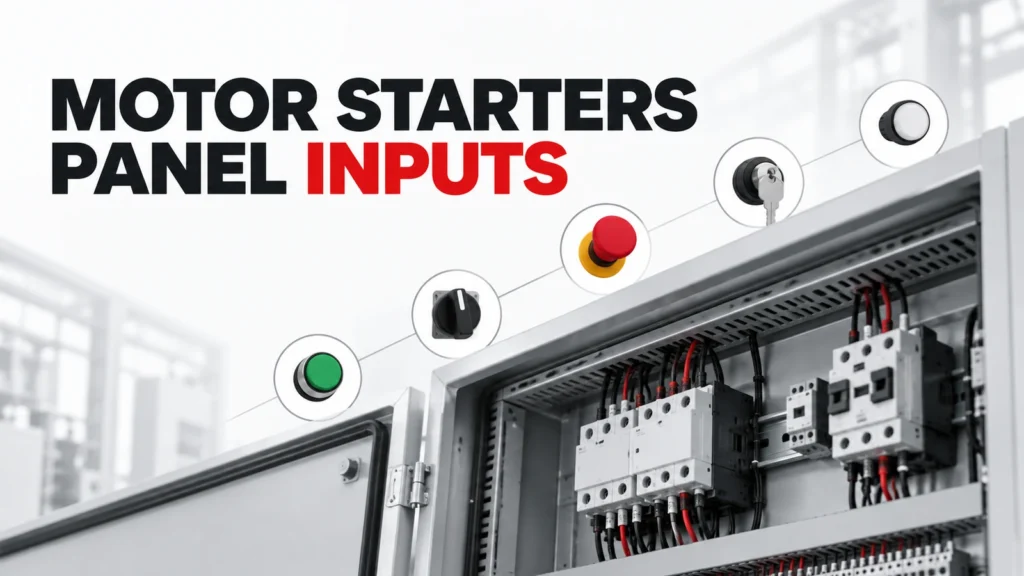
This application guide organizes motor-starter inputs for panel builders and buyers. It does not prescribe a wiring diagram, claim that a ZSLE1-D starter fits every motor, or approve a combination of contactor, overload protection, short-circuit protection and control devices without exact evidence.
Decision Inputs at a Glance
| Decision input | Buyer must confirm | Evidence required |
|---|---|---|
| Motor and load | Current, supply, starting behavior and driven-machine duty | Motor record and load profile |
| Starter scope | Open device, enclosed starter or panel assembly | Bill of material and boundary drawing |
| Protection | Overload, short-circuit and isolation responsibilities | Project protection architecture |
| Control | Local/remote commands, interlocks and status | Approved control narrative |
| Environment | Enclosure, contamination, temperature and service access | Site and panel-layout record |
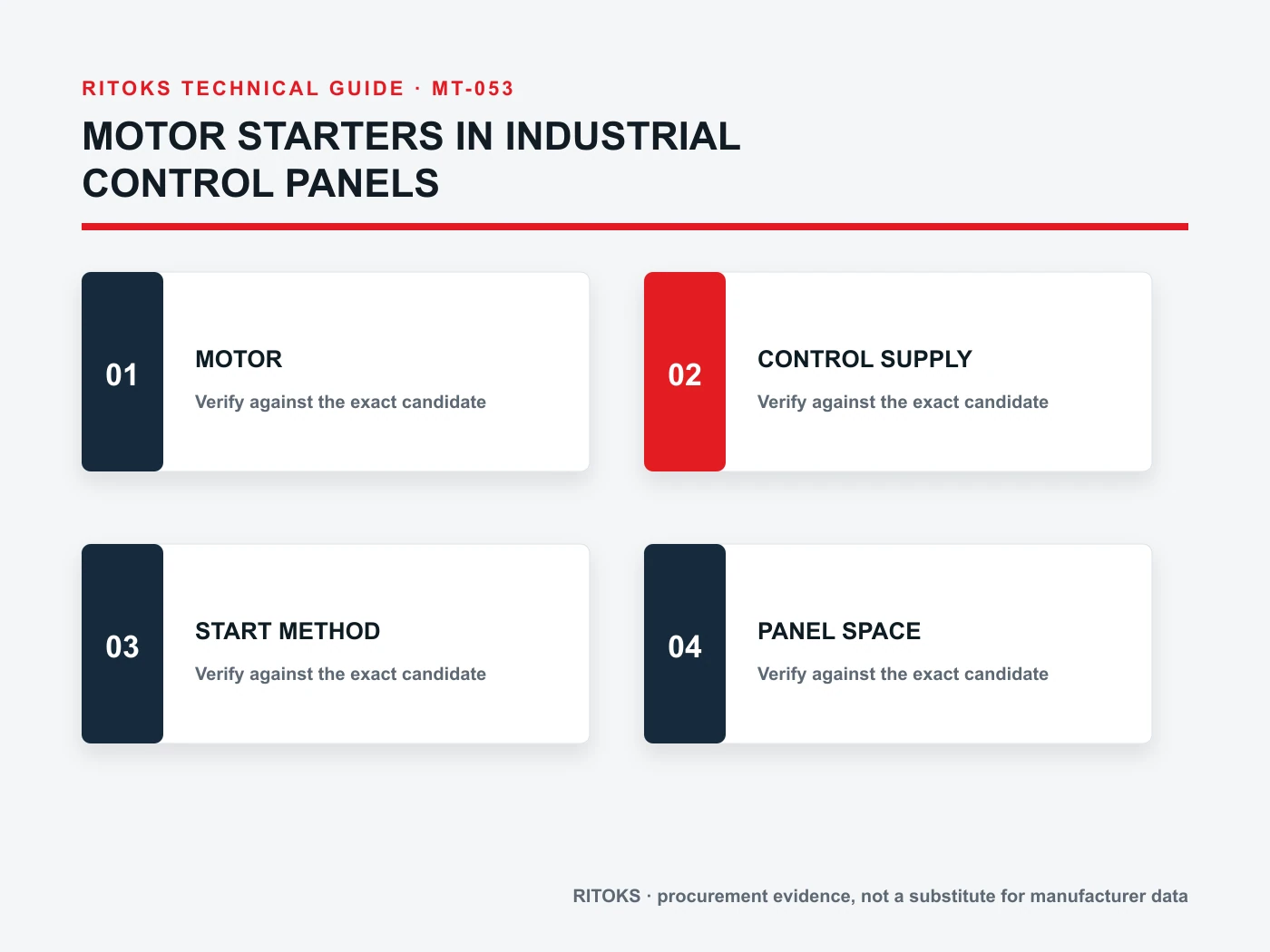
Define What the Starter Scope Includes
Begin by stating whether the request is for a starter device, an enclosed starter or a complete control-panel function. List which parts are expected, such as a contactor, overload relay, operator controls, enclosure, terminals or status indication.
Do not assume that the product name defines the full boundary. Two offers can both be called motor starters while one is a component combination and the other includes an enclosure and controls. Normalize the scope before comparing price.
Describe the Motor and Driven Process
Provide motor current, supply, phase arrangement and starting method together with the driven equipment. Record acceleration time, load inertia, starts per hour, reversing or jogging requirements and any periods of frequent cycling.
The process narrative matters because the same motor can experience different demands on a conveyor, pump, compressor or machine tool. Avoid reducing the application to horsepower or kilowatts when current and duty data are available.
Assign Each Protection Function
State which device provides sustained overload response, which provides short-circuit interruption, and where isolation is handled. A starter contactor is not automatically a short-circuit protective device, while an overload relay does not replace the upstream fault-protection design. For the relay portion of a quotation, use the thermal overload relay RFQ checklist to document motor current, adjustment range and reset requirements.
The panel protection study should define prospective fault current, interrupting requirements and the desired coordination outcome. Require exact combination evidence where components are expected to operate together.
Write a Control Narrative Before Choosing Hardware
Describe normal start and stop commands, local and remote modes, permissives, process interlocks, emergency-stop interaction, fault reset and restart behavior. Identify required status signals for PLC, HMI or hardwired indication.
This narrative guides coil supply, auxiliary contacts and operator devices. It also exposes ambiguous requests such as remote start without a defined stop priority. The article does not replace the machine safety design or functional safety assessment.
Plan the Panel Layout and Thermal Context
Record mounting space, wiring duct, terminal access, cable-entry direction and separation requirements. Include the heat released by starter components in the enclosure thermal review, especially where many starters operate in a compact panel.
Maintenance access should allow inspection and replacement without disturbing unrelated wiring. Verify mounting orientation and spacing from exact instructions rather than scaling a product photograph.
Document Environment and Service Conditions
State ambient temperature, altitude when relevant, dust, moisture, vibration, corrosion exposure and indoor or outdoor location. Define enclosure protection and condensation control at the panel level.
Also record maintenance capability, spare-parts strategy and whether operators need visible trip or running indication. A technically compatible device can still be a poor fit if access or service expectations are ignored.
Build an Exact-Model Evidence File
Create one approval record for the proposed Motor Starter order code. Put each project requirement beside the supplier document that answers it. Preserve the exact datasheet, drawing, curve, table or selection output used, including its revision or retrieval date. A category page can establish family context, but it cannot prove an exact rating, terminal arrangement or system combination.
Check that every accepted statement describes the same orderable item. Similar housings can contain different circuits, supplies, terminals, accessories or protection functions. Do not combine a family maximum from one variant, a diagram from another and an optional feature from a third. Mark unresolved fields explicitly so they remain visible in the commercial review.
Keep Project Inputs Separate From Product Evidence
The project team defines the application: source, load, duty, environment, controls, mechanical limits and required functions. The supplier identifies an exact Motor Starter and supports it with exact documents. Neither side should fill a gap by inference from appearance, a shared family name or one matching headline value.
Freeze the application record while quotations are being compared. If the load, voltage, duty, environment, cooling method, enclosure or required output changes, issue a revised record and ask each supplier to reconfirm the candidate. Otherwise apparently comparable quotations may be answering different technical requirements.
Common Procurement Errors
- Selecting Motor Starter from one headline rating while the application context remains incomplete.
- Using a circuit, curve, terminal drawing or performance claim from a neighboring model.
- Treating a family page or product photograph as exact technical evidence.
- Assuming an accessory, system function or coordination result is included without documentation.
- Approving a substitute without repeating the topology, rating, mounting and evidence review.
Resolve these gaps before comparing price and lead time. The reviewer should be able to trace every accepted statement either to the project requirement or to the exact candidate document. A proposal may remain commercially interesting while technically incomplete, but missing evidence must not disappear inside the quotation.
How to Compare Supplier Offers
| Application input | Why it matters | Evidence to retain |
|---|---|---|
| Starter boundary | Prevents device and assembly quotes from being mixed | Scope statement and bill of material |
| Motor duty | Controls switching and overload requirements | Motor and driven-load record |
| Protection architecture | Separates overload and fault functions | Study plus exact coordination documents |
| Control sequence | Defines commands, interlocks and restart | Approved control narrative |
| Panel environment | Controls enclosure and installation requirements | Site and layout record |
| Service plan | Affects access, indication and spares | Maintenance specification |
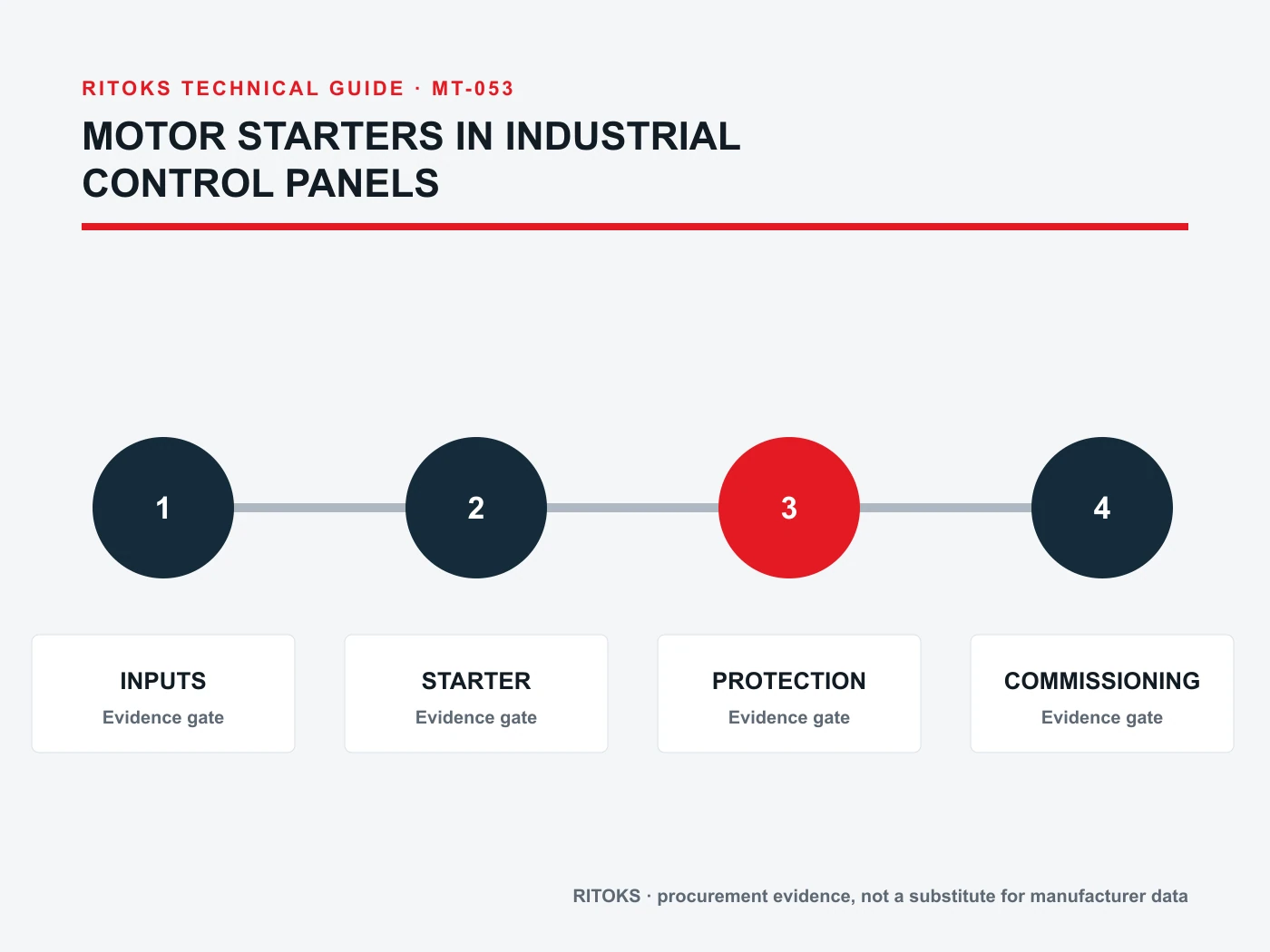
Normalize every Motor Starter offer to the same application record. Keep document revisions, test conditions, included accessories and open questions beside each value. This makes differences in delivered scope visible and prevents a lower-cost but narrower offer from appearing equivalent to a complete solution.
Decision Workflow
- Define the delivered starter and panel boundary.
- Freeze motor, load and starting-duty data.
- Assign overload, short-circuit and isolation functions.
- Write the control and restart narrative.
- Map required commands, interlocks and status points.
- Complete the panel layout, thermal and environment review.
- Compare exact offers against the same evidence file.
At each step, stop when a critical application input is unknown, the quoted model is ambiguous, a required claim is supported only by another manufacturer or another order code, or the installation falls outside the available evidence. These are engineering gaps, not editorial details.
RFQ Preparation Checklist
A useful RFQ for motor starter control panel is concise enough to answer and complete enough to prevent silent assumptions. Identify unknown values as questions and require a full orderable code rather than a generic family recommendation.
- Motor nameplate, load and supply
- Starting method and operating duty
- Required starter or assembly boundary
- Overload and short-circuit protection responsibilities
- Coil/control supply
- Local and remote commands and interlocks
- Required auxiliary contacts and status indication
- Enclosure, mounting, environment, quantity and destination
Request the current datasheet revision and the exact scope of any certification, compatibility, coordination or performance claim. Record quantity and destination after the technical inputs so commercial terms do not obscure unresolved engineering questions.
Frequently Asked Questions
Is a motor starter the same as a contactor?
No. A starter request normally includes additional motor-control or protection scope that must be defined.
Does an enclosed starter replace a control panel?
Not automatically. The delivered boundary, controls, protection and terminals must be listed.
Can a starter be selected from motor power alone?
No. Current, supply, starting duty, protection and control requirements are also needed.
Related RITOKS Products and Guidance
These links provide product-family context only. A contextual link does not claim interchangeability, compatibility or an approved system combination.
Motor Starter product category
ZSLE1-D enclosed magnetic motor starter
Technical References
These primary manufacturer sources support only the general engineering concepts described below. Their product ratings, circuit diagrams, approvals and coordination results do not transfer to RITOKS products.
ABB, Contactors and Overload Relays Guide
Supports general overload-relay selection inputs, reset and auxiliary-control concepts, and the need for coordinated motor-control documentation. ABB ratings and combinations do not transfer to RITOKS products.
ABB, Control Catalog: IEC Manual Motor Starters
Supports separating thermal overload behavior, magnetic short-circuit response, trip information and coordination evidence. Exact ABB characteristics do not describe a RITOKS MPCB.
Request an Exact-Model Review
Send the application requirements, exact-document questions, quantity and destination through the RITOKS contact form. An RFQ requests an exact-model review; this guide does not approve a circuit, installation or automatic substitute.