
AC Power Protection · Technical Explainer
Type A RCDs and Variable-Speed Drives: Check the Drive Manual First
Quick answer
A Type A residual current device is not automatically suitable for every variable-speed drive. Start with the exact drive installation manual, supply arrangement and protection purpose. Then compare those requirements with the ordered RCD variant. An RCCB, an RCBO and a breaker with a B trip curve describe different protection features, not interchangeable drive approvals.
A procurement list that says “Type A, suitable for inverter loads” leaves the decisive information missing. Which inverter? Connected to which supply? Under which manual revision? What residual-current behavior and immunity does that drive manufacturer require? The answers belong in the selection record before the device order is released.
This guide concerns document review for industrial buyers and panel teams. It does not prescribe wiring, sensitivity, trip delay or changes to a drive's EMC filter. A competent designer must determine the protection arrangement for the actual installation and applicable requirements. The useful output is a traceable decision, not a universal shopping rule.
Read the drive requirement before the RCD label
The drive manual is the starting document because the supply arrangement and converter architecture can affect the protection requirement. A family name is insufficient when the manual distinguishes connection cases. Record the full drive reference and the supply configuration together, then retain the instruction revision used for the decision.
Schneider Electric's ATV320 installation manual, revision NVE41289.09, illustrates why that distinction matters. Its residual-current protection section differentiates single-phase phase-to-neutral connections from three-phase connections and other single-phase supply arrangements. The listed RCD types are not identical across those cases. That is an exact-manual example, not an approval for another drive family.
Do not compress the instruction into “Schneider permits Type A.” Such a statement loses the qualifying connection arrangement and the exact device requirement. It also turns one manufacturer's example into a claim about unrelated equipment. Retain the relevant manual section in the engineering record and have the designer resolve whether the specified protective device matches it.
The same discipline applies when a replacement drive has the same motor power as its predecessor. Equal motor power does not establish equal residual-current behavior or identical installation instructions. Treat the new drive reference as a changed selection input. A previous panel schedule is useful evidence of what was installed, but it is not the new drive's approval document.
Separate the meanings hidden in similar labels
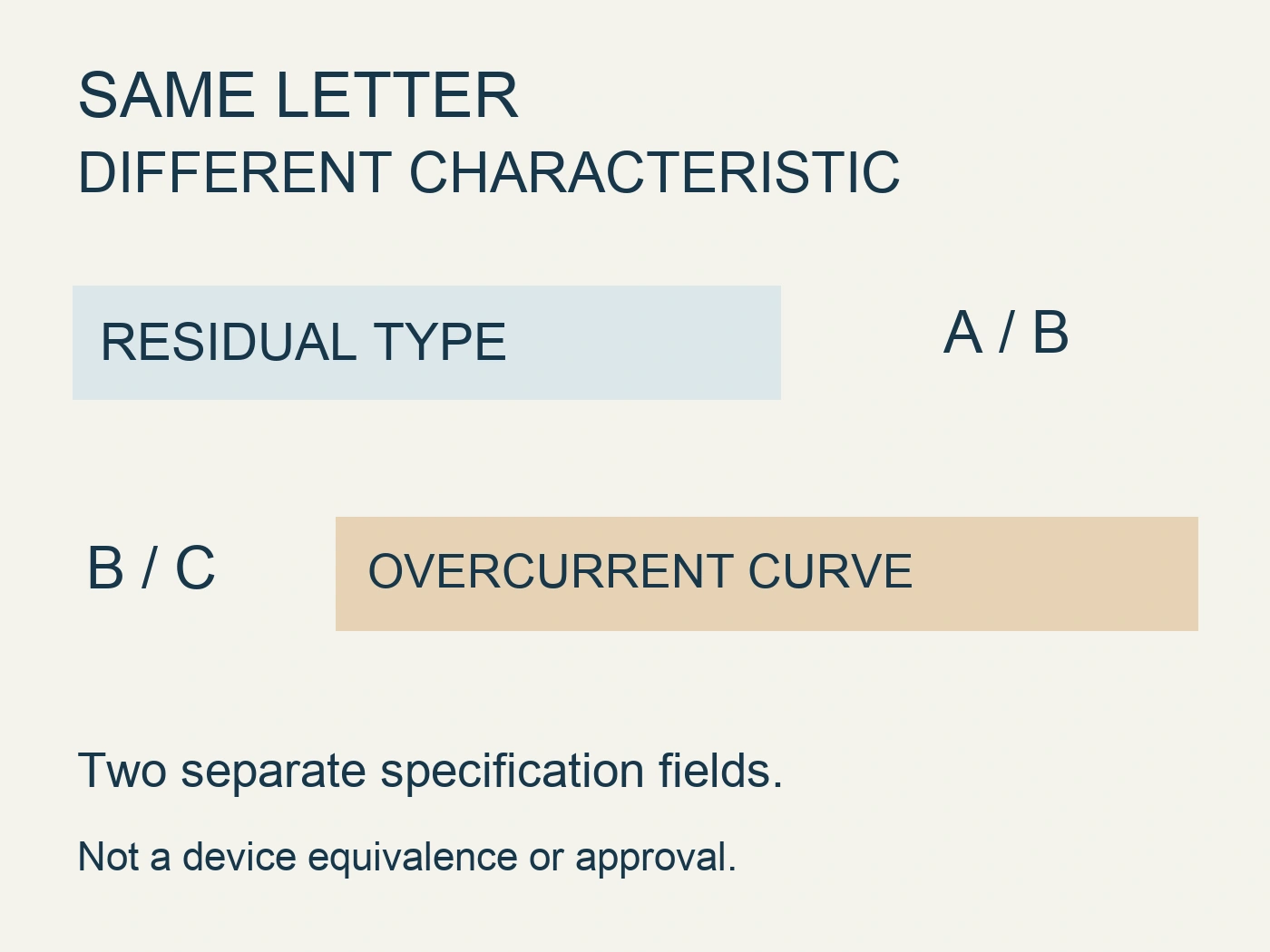
Type A, Type B and a B trip curve do not answer the same question. Residual-current type concerns the device's declared residual-current detection characteristics. An MCB trip curve concerns overcurrent response. A purchasing description that mixes the two can look complete while leaving the required RCD characteristic unidentified.
An RCCB and an RCBO also differ in protection scope. The RITOKS Type A RCCB family requires separate overload and short-circuit protection. The RITOKS 1P+N RCBO family combines residual-current and overcurrent functions, but its offered variants still need an exact configuration review. Neither family page establishes approval for a particular drive.
| Description in the order | Question it helps answer | Question still open |
|---|---|---|
| Type A RCD | Which residual-current characteristic is declared? | Does that characteristic satisfy this exact drive instruction? |
| B curve breaker | Which overcurrent trip characteristic is ordered? | What residual-current protection, if any, is present? |
| RCCB | Is residual-current protection provided as a separate function? | What separate overload and short-circuit protection is coordinated? |
| RCBO | Are residual-current and overcurrent functions combined? | Which residual-current variant and exact trip characteristic are ordered? |
| Drive-compatible claim | Is the supplier claiming an application fit? | Which drive reference, connection arrangement and documents support it? |
Use separate columns for residual-current type and overcurrent curve in the bill of materials. Do not place both in a single “type” field. That small change prevents a Type B residual-current requirement from being answered with a B curve overcurrent device.
The product label should also distinguish a declared immunity feature from a general Type A designation. A feature named for one manufacturer's product family cannot be assumed on another supplier's ordinary Type A device. Ask for the exact manufacturer's document rather than a verbal assurance that the devices are equivalent.
Keep leakage and protection suitability as separate questions
A nuisance trip investigation asks why an otherwise intended operating event causes disconnection. A suitability review asks whether the protective device can perform the required function with the connected equipment. Solving the first question does not prove that the second has been answered, and an absence of trips is not evidence of protection adequacy.
Schneider Electric's Altivar leakage FAQ identifies operating and installation factors such as startup, filtering, motor cable and switching conditions. It also discusses a reinforced Type A designation. Those observations explain why an RCD description needs more detail; they do not make every ordinary Type A product equivalent or override a current exact-drive manual.
For procurement, request the drive manufacturer's relevant leakage and protective-device guidance. For a site investigation, record which operating event precedes the trip and refer the record to the responsible engineer. Avoid turning a pattern such as “only at startup” into permission to raise a setting, remove protection or disconnect a filter.
The investigation record should identify whether the trip occurred during energization, acceleration, steady operation or another event. It should also state what equipment was connected and whether the condition was repeatable. These are observations, not a diagnosis. They give the reviewer a better question to answer than “which RCD stops tripping?”
Where the existing documentation does not establish the required characteristic, mark the selection unresolved. A supplier's proposed alternative may be useful, but it needs comparison with the governing instruction and design requirements. Do not describe it as an approved substitution until that comparison has a named decision owner.
Build a drive-to-device evidence sheet
A useful evidence sheet joins the drive instruction to the exact protective device, rather than collecting unrelated certificates. Each row should connect a selection question to a document and an accountable reviewer. The sheet becomes part of the panel's configuration record and can be revisited when either product changes.
| Selection input | Evidence to request | Decision to record |
|---|---|---|
| Exact drive and instruction revision | Full drive reference and current installation manual | Which instruction governs this configuration? |
| Supply arrangement | Approved supply description and drive connection case | Which manual case applies? |
| Required residual-current characteristic | Applicable drive instruction and designer's protection requirements | Does the proposed RCD characteristic match? |
| Leakage and immunity considerations | Manufacturer guidance for the intended configuration | Are the proposed immunity features documented and relevant? |
| Overcurrent protection scope | Exact RCCB or RCBO reference and coordinated protection documents | Which device provides overload and short-circuit protection? |
| Ordered variant | Supplier order code and matching technical sheet | Does the delivered configuration match the reviewed one? |
| Changes and approval | Dated review record with responsible designer | Which changes require selection review? |
Attach documents that can be matched to the order code. A catalogue covering several residual-current variants is not enough if the chosen variant remains unspecified. The same issue arises with pole configuration, rated current and residual sensitivity: the family can offer choices without documenting what has actually been selected.
Keep the drive manufacturer's requirement separate from the RCD supplier's declaration. The former defines an equipment-specific condition; the latter describes the proposed device. The designer's comparison is the link between them. Without that comparison, two complete-looking document sets can still leave the application decision unsupported.
A short unresolved-items list is better than an optimistic “pass” stamp. Examples include an unidentified drive supply case, a missing exact RCD variant or an unsupported immunity claim. State what document would close each item and who must review it. That makes follow-up specific without pretending that procurement staff have approved the installation.
Work through a conditional procurement example
Suppose a panel quotation lists a Type A RCCB alongside a variable-speed drive, but identifies only the drive family. The correct next action is not to select a more expensive device from memory. First obtain the full drive reference and supply arrangement, then locate the relevant requirement in the current manual.
If that instruction permits a particular residual-current characteristic for the stated connection case, the review can proceed to the exact RCCB document and the separate overcurrent protection arrangement. If the manual instead specifies another characteristic, the proposed selection remains unresolved until the design is corrected or an authorized manufacturer clarification establishes a valid alternative.
Now suppose the supplier changes the proposal to an RCBO with a B curve. That change may alter the overcurrent protection arrangement, but the B curve does not answer the residual-current question. The reviewer still needs the exact residual-current variant and the same drive-specific comparison. A combined device is not a shortcut around the evidence.
Finally, consider a revised drive supply arrangement after the original review. The sheet should flag the earlier approval as configuration-specific and require a new comparison. This avoids treating a past selection decision as permanent permission for every later wiring or equipment change. The example is a document workflow, not an installation recommendation or a tested matched assembly.
Fill the record when a connection case changes
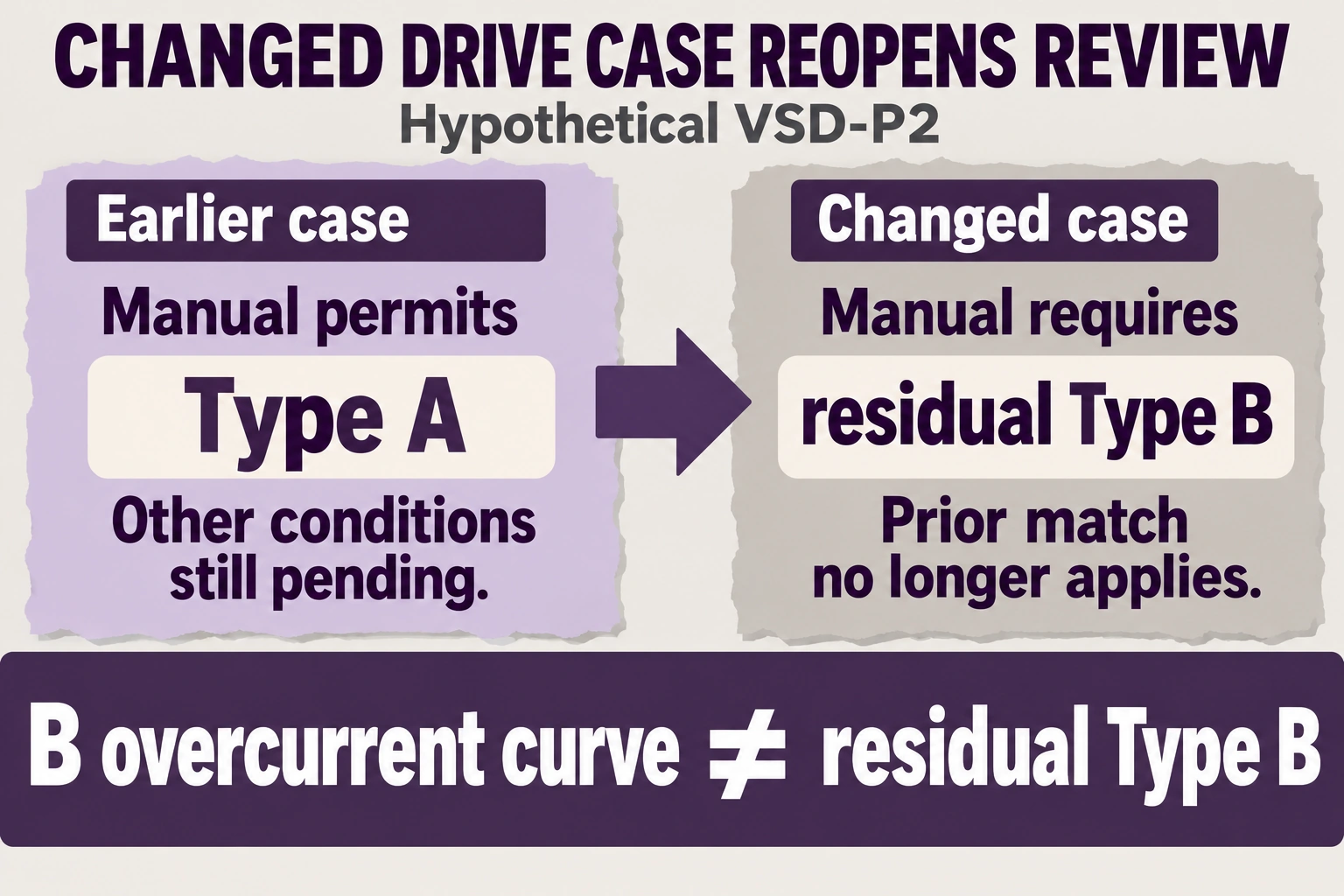
Use a hypothetical panel record called VSD-P2 to make the comparison explicit. The first quotation identifies a drive only by family and offers a Type A RCCB. Its filled status is “drive order code missing; supply case missing; RCD waveform category stated; application comparison pending.” That status identifies the two inputs preventing a decision without claiming that the offered RCCB is defective or that another device is already required.
Assume the buyer then obtains an exact manual whose applicable connection case permits a stated Type A characteristic, with additional conditions. The record becomes “governing drive case identified; Type A category potentially matches; exact immunity/other stated conditions and ordered RCCB variant under review; separate overcurrent arrangement pending.” This is an assumed manual result for teaching the workflow, not a new approval for every ATV320 or any RITOKS device. The word Type A closes only the category comparison; it does not erase the manual's other conditions.
Now suppose the design changes to a connection case that the governing manual instead requires to use Type B residual-current protection. The prior conditional match must be reopened. A proposed B-curve RCBO still leaves that changed waveform requirement unanswered, because its overcurrent curve is a different field. The revised record reads “drive case changed; previous Type A comparison no longer applicable; residual Type B declaration required for proposed device; overcurrent arrangement assessed separately.” This shows the precise mismatch rather than simply demanding a more expensive component.
There is a useful commercial tradeoff in keeping this review configuration-specific. It adds work when the drive or supply case changes, but prevents ordering against a broad family label that conceals the changed requirement. It also avoids reopening every unrelated panel decision: the engineer can identify which waveform, immunity and overcurrent records were affected and retain evidence that still applies. A motor-power match alone cannot perform that comparison.
Close VSD-P2 only when the drive instruction, exact device declaration and responsible design decision agree for the recorded configuration. Preserve any unresolved conditions in the quotation. The record is useful even when the final choice remains open, because it tells the supplier what evidence is missing and tells the buyer which earlier assumption changed.
References
- Schneider Electric. (2025). Altivar Machine ATV320 installation manual, NVE41289.09, residual-current protection section. Manufacturer manual.
- Schneider Electric. (2026). Can GFCI breakers or outlets be used with Altivar Drives? Manufacturer FAQ.