
Power Semiconductor Modules · Selection Guide
SCR Thyristor Module Selection Guide: Current Class, Voltage, Cooling and Model Verification
Selecting an SCR thyristor module requires more than matching a current number to a product name.
A practical sourcing process starts with the requirements already defined for the project, then narrows the available module family and confirms the exact electrical, mechanical and cooling data for the selected model.
RITOKS currently publishes three SCR thyristor module families: MTC 55A–200A SCR Thyristor Power Module, MTC 250A–1500A High Current SCR Thyristor Module and MTA 25A–1000A Dual SCR Thyristor Power Module.
The published current classes make it possible to screen candidate families. However, exact voltage ratings, internal circuit configuration, terminal arrangement, package drawings and many model-specific electrical parameters are not currently published across these families.
That means this guide should be used for family screening and model verification, not as an SCR circuit-design manual.
Contents
SCR Thyristor Module Selection at a Glance
| Selection Input | What the Buyer Should Check |
|---|---|
| Required current class | Compare the project requirement with the published MTC or MTA model classes |
| Required voltage | Confirm the exact voltage rating for the selected model |
| Module family | Identify whether an MTC or MTA family is being considered without assuming internal topology |
| Circuit/configuration requirement | Request the exact circuit or terminal diagram where configuration matters |
| Cooling | Confirm whether the exact model uses a particular cooling arrangement |
| Package / dimensions | Request a verified drawing for the selected model |
| Gate/control data | Use the exact model datasheet; do not infer from another SCR |
| Surge / dv/dt / di/dt | Confirm model-specific values from technical documentation |
| Documentation | Request datasheet, drawing and any required certification/test evidence |
| Exact model | Confirm the complete orderable model before quotation |
Industry thyristor portfolios normally distinguish multiple device parameters, including current, blocking voltage, surge current, junction temperature, dv/dt, package and circuit configuration rather than treating current class as the only selection variable. The Vishay official thyristor-module portfolio illustrates these as separate selection fields.
1. Start With the Published RITOKS SCR Families
The first useful step is understanding how the current RITOKS SCR module range is organized.
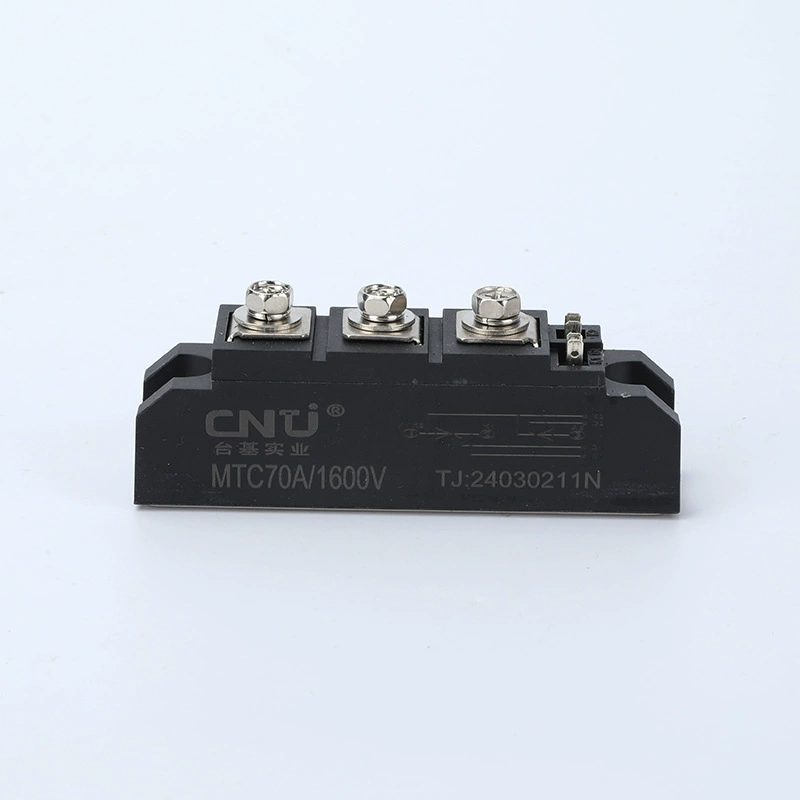
MTC 55A–200A
Published current classes:
- 55A
- 70A
- 90A
- 110A
- 200A
This is the lower-current MTC family currently published on the site.
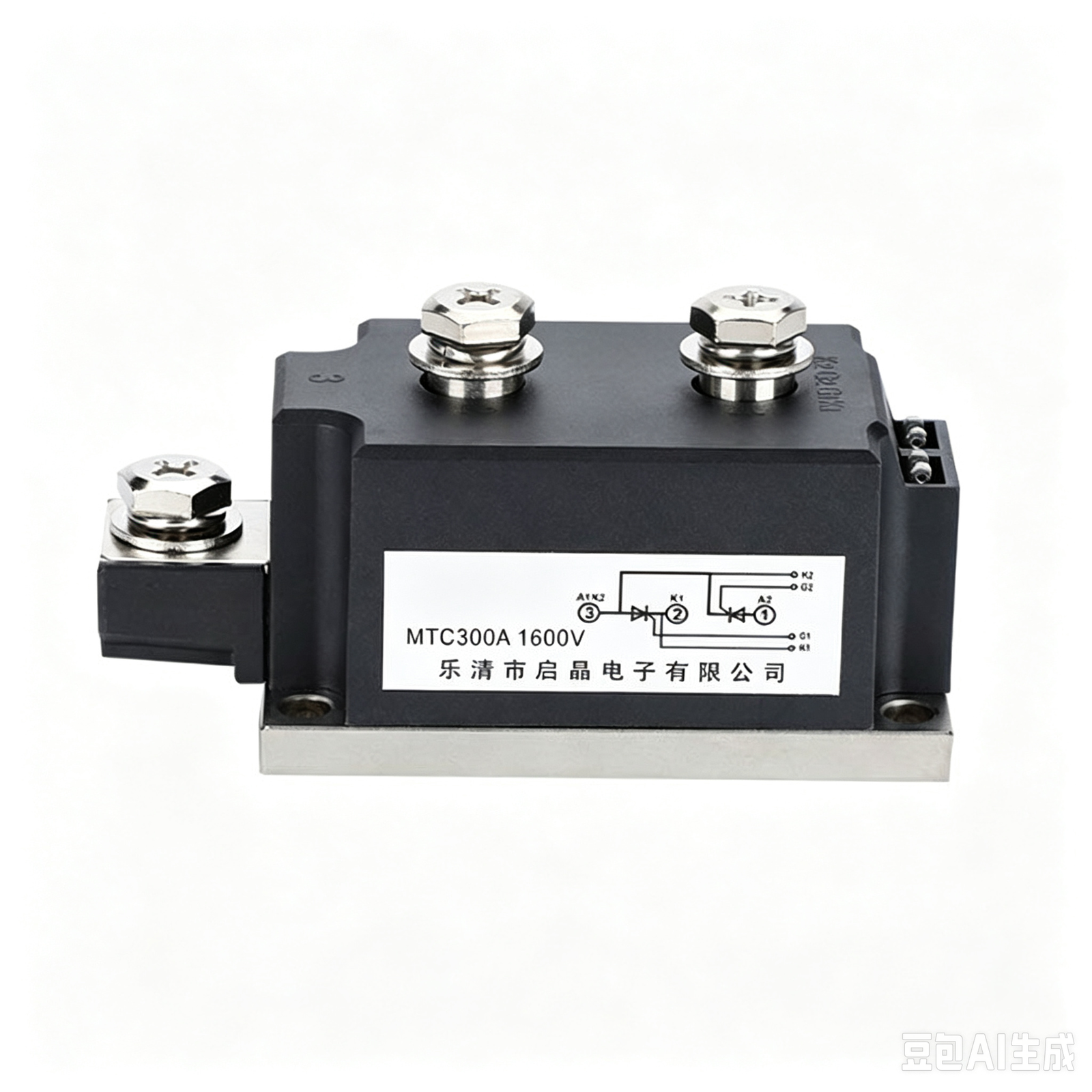
MTC 250A–1500A
Published current classes:
- 250A
- 300A
- 350A
- 400A
- 500A
- 600A
- 800A
- 1000A
- 1500A
This is the higher-current MTC family.
Some selected models are supplier-described with water-cooled versions, but that does not establish water cooling as the default for the entire family.
MTA 25A–1000A
Published current classes:
- 25A
- 55A
- 70A
- 90A
- 110A
- 130A
- 160A
- 200A
- 250A
- 300A
- 400A
- 500A
- 800A
- 1000A
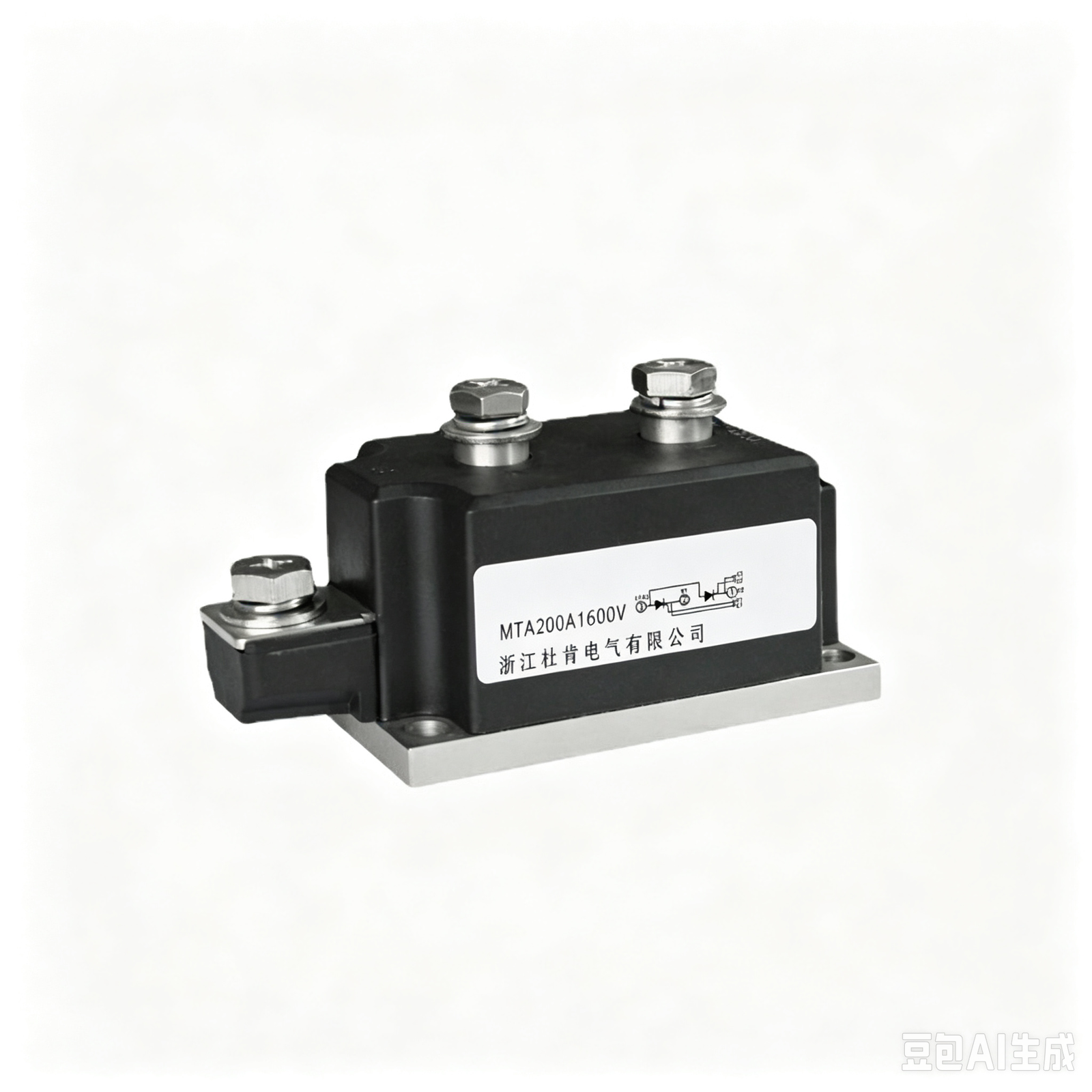
The current supplier table describes this as a dual-SCR module family and states two SCR devices.
That does not establish the complete internal topology.
The present evidence does not confirm whether those two SCRs are arranged as:
- anti-parallel
- common-anode
- common-cathode
- series
- another circuit configuration
Those details require an exact circuit or terminal diagram.
2. Current Class Helps Screen the Family — It Does Not Complete the Selection
The published current classes are useful for narrowing the candidate family.
For example, if a project has already established a required current class, the buyer can identify which published RITOKS family contains a corresponding class and then continue the verification process.
That does not mean:
required load current = same-number SCR module
or:
choose the nearest larger current class automatically.
Current rating is only one part of thyristor-module selection.
The exact device documentation may also contain blocking-voltage ratings, surge-current limits, temperature conditions and other model-specific parameters. Vishay’s current thyristor-module parametric catalogue, for example, separates current, blocking voltage, surge current, maximum junction temperature, dv/dt, package and circuit configuration as distinct fields.
For RITOKS modules, those external manufacturer values must never be transferred to MTC or MTA models.
3. Confirm the Exact Voltage Rating
The current RITOKS pages do not publish model-specific voltage data in enough detail for the three families.
Therefore, voltage should be handled as a confirmation field.
A buyer can provide:
Required blocking voltage: [project requirement]
and request:
Exact voltage rating/version for selected model: [to be confirmed]
Do not infer an MTC or MTA voltage rating from:
- the current class
- the product photograph
- another manufacturer’s module
- another MTC or MTA product
- a similar-looking package
The exact selected model needs its own verified data.
4. Do Not Infer MTC or MTA Topology From the Family Name
This is one of the most important boundaries in the current SCR range.
The letters MTC and MTA should be treated as RITOKS product-family names unless an exact technical source establishes the internal circuit.
For Products 346 and 347, the current pages do not publish:
- number of SCR devices
- internal topology
- terminal polarity
- circuit diagram
For Product 348, the supplier table supports only:
two SCR devices
It does not establish how they are electrically connected.
Therefore, do not publish a general rule such as:
- MTC means [specific topology]
- MTA means [specific topology]
A future MTC-vs-MTA topology article should wait until verified circuit diagrams and datasheets are available.
5. Package and Terminal Verification Matter
Mechanical compatibility cannot currently be established from the public product photographs.
For Product 346
- package drawing is pending
- dimensions are not published
- mounting details are not published
- terminal arrangement is not published
For Product 347
- multiple package versions may exist
- MTC350A specifically requires package confirmation
- dimensions and terminal information remain unverified
For Product 348
- package drawing is pending
- dimensions and mounting information are not published
- terminal arrangement is not published
If the module must fit an existing assembly or heatsink, request the verified drawing for the exact model before ordering.
Do not scale a product photograph to estimate dimensions.
6. Cooling Must Be Confirmed by Exact Variant
Cooling information also differs in completeness.
MTC 55A–200A
The exact cooling arrangement is not currently published.
MTC 250A–1500A
Water-cooled versions are mentioned for selected models only.
This does not mean every model in the family is water-cooled.
MTA 25A–1000A
Selected water-cooled versions are also mentioned.
Again, availability must be confirmed by exact model.
Power-semiconductor thermal management depends on the device, losses, package and operating environment; the Semikron Danfoss Application Manual treats semiconductor selection, operating conditions and thermal management as linked application-specific tasks rather than interchangeable fixed rules.
For an RITOKS inquiry, the safe wording is:
Cooling arrangement: confirm for exact model and project.
7. Do Not Create a Universal SCR Cooling Rule
The current RITOKS evidence does not support statements such as:
- higher-current MTC modules always require water cooling
- MTA modules use a particular heatsink type
- a specific current class requires a fixed heatsink dimension
- water cooling is always superior
- one family runs cooler than another
No universal heatsink table is currently published for Products 346, 347 or 348.
Any thermal design should use verified model data and the actual application conditions.
8. Gate Data Must Come From the Exact Datasheet
Gate triggering is an example of why model-specific documentation matters.
Infineon’s official thyristor triggering guidance treats gate-trigger data as device/datasheet-specific and notes that the actual trigger signal still depends on application needs.
That means this RITOKS selection guide should not invent or recommend:
- gate current
- gate voltage
- pulse width
- gate resistor
- firing-angle settings
- trigger waveform
for Products 346, 347 or 348.
Current RITOKS pages do not publish the required gate data.
Request the exact datasheet before designing the control circuit.
9. Surge, dv/dt and di/dt Are Also Model-Specific
Thyristor datasheets commonly specify dynamic and transient parameters separately from nominal current.
Official Infineon device documentation, for example, publishes parameters such as critical current-rise rate, blocking voltage, surge current, thermal resistance and junction temperature on exact device pages.
Those examples show why these parameters must be verified by exact device.
They are not RITOKS values.
The current RITOKS MTC/MTA pages do not publish enough evidence to provide:
- surge-current sizing
- dv/dt limits
- di/dt limits
- thermal-resistance values
- maximum junction temperature
- repetitive/non-repetitive current rules
Do not substitute another manufacturer’s numbers.
Published MTC and MTA Family Overview
| Family | Published Current Classes | Voltage | Cooling | Topology / Device Count | Package / Drawing | Datasheet |
|---|---|---|---|---|---|---|
| MTC 55A–200A | 55 / 70 / 90 / 110 / 200A | Confirm exact model | Exact arrangement not published | Not published | Drawing pending | Not currently published |
| MTC 250A–1500A | 250 / 300 / 350 / 400 / 500 / 600 / 800 / 1000 / 1500A | Confirm exact model | Selected water-cooled versions only | Not published | Multiple versions may exist; MTC350A requires confirmation | Not currently published |
| MTA 25A–1000A | 25 / 55 / 70 / 90 / 110 / 130 / 160 / 200 / 250 / 300 / 400 / 500 / 800 / 1000A | Confirm exact model | Selected water-cooled versions only | Supplier table states 2 SCR devices; complete topology unconfirmed | Drawing pending | Not currently published |
This table is a published-family overview, not an electrical-performance ranking.
10. How to Use the Published Current Ranges
A conservative workflow is:
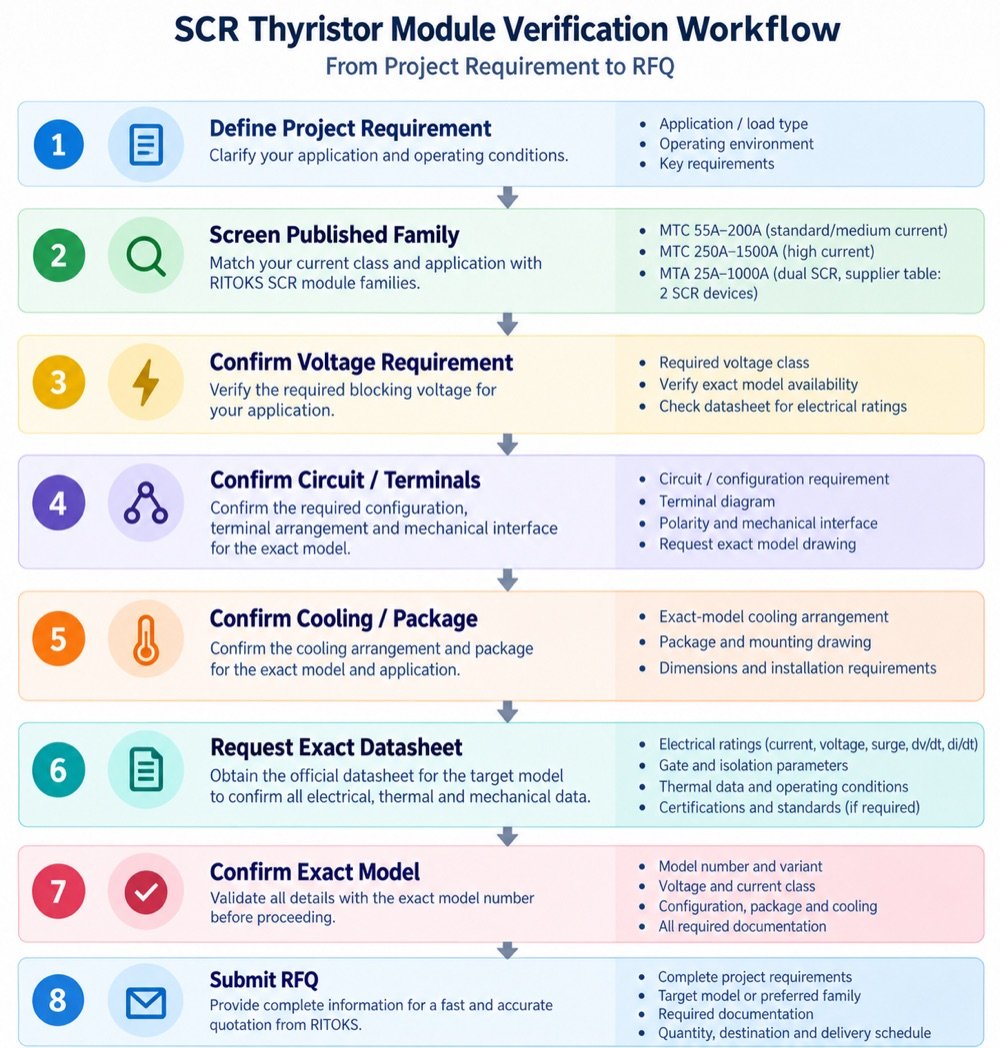
Step 1 — Start With the Project Requirement
Identify the electrical requirement already defined by the project.
Step 2 — Screen the Published Current Classes
Check which RITOKS family contains a relevant published class.
Step 3 — Confirm Voltage
Request the exact voltage rating/version.
Step 4 — Confirm Configuration
If topology or polarity matters, request the exact circuit and terminal diagram.
Step 5 — Confirm Cooling
Verify the cooling arrangement for the selected variant.
Step 6 — Confirm Mechanical Fit
Request package dimensions and mounting data.
Step 7 — Request Exact Datasheet
Confirm gate, surge, dv/dt, di/dt, temperature and other required electrical data from the selected model documentation.
Step 8 — RFQ
Quote the exact verified model and required documentation.
This workflow does not automatically select the SCR module.
11. What Should Not Be Selected From the Product Image
The current product media can help identify the family visually.
It should not be used to determine:
- internal circuit
- SCR count, except where explicitly stated in a supplier table
- terminal polarity
- gate terminal
- package dimensions
- mounting-hole spacing
- voltage rating
- cooling interface
- certification
Use the actual technical drawing or datasheet.
12. Application Lists Are Positioning, Not Engineering Approval
The three product pages include application wording.
Those lists can communicate the markets or equipment categories the supplier associates with the product family.
They do not prove that every model is suitable for every application listed.
A buyer should still verify:
- exact electrical ratings
- circuit configuration
- cooling
- mechanical fit
- gate/control requirements
- documentation
for the actual project.
13. Information to Include in an SCR Thyristor Module Inquiry
A useful inquiry can include:
- Application: [application]
- Required current class: [requirement]
- Required voltage: [requirement]
- Required circuit/configuration: [if known]
- Cooling requirement: [known requirement]
- Preferred family/model: [if known]
- Required dimensions/drawing: [if required]
- Required terminal/circuit diagram: [if required]
- Required datasheet/electrical data: [list]
- Required certification/test evidence: [if applicable]
- Quantity: [quantity]
- Destination: [country / region]
- Required delivery: [schedule]
If the electrical or mechanical requirement is not yet defined, mark it:
To be confirmed
rather than assuming a value from the family name.
14. What Data Is Still Missing?
The current public SCR pages are useful for family and current-class screening, but they are not complete engineering datasheets.
MTC 55A–200A
Priority missing data includes:
- model-specific voltage ratings
- internal circuit / device count
- terminal diagram
- package drawing
- dimensions
- cooling information
MTC 250A–1500A
Priority missing data includes:
- exact voltage ratings
- circuit/device count
- terminal diagram
- package drawings
- exact MTC350A package version
- model-specific water-cooling availability
MTA 25A–1000A
Priority missing data includes:
- complete internal topology
- terminal diagram
- exact voltage ratings
- package/dimensions
- exact cooling availability
Until those fields are available, an MTC-vs-MTA topology comparison would be premature.
Frequently Asked Questions
What SCR Module Current Classes Does RITOKS Publish?
Current published families include MTC 55A–200A, MTC 250A–1500A and MTA 25A–1000A model classes.
Can I Select an SCR Module From Current Rating Alone?
No universal selection rule is supported by the current product data.
Voltage, configuration, cooling, package, terminal information and model-specific electrical data may also need verification.
Does MTC Identify a Specific Internal Circuit?
The current RITOKS product evidence does not establish an MTC topology.
Do not infer the internal circuit from the family name.
Does “Dual SCR” Tell Me the MTA Circuit?
Not completely.
The current supplier table supports two SCR devices, but the exact connection topology is not established.
Are All High-Current MTC Modules Water-Cooled?
No such universal claim is supported.
Water-cooled versions are mentioned for selected models only.
Are Gate, Surge and dv/dt Values Published?
Not on the current RITOKS product pages reviewed for these three families.
Request exact model documentation.
Can I Compare MTC and MTA Directly?
Current family names and current ranges can be compared, but the evidence is not yet sufficient for a meaningful topology or electrical-performance comparison.
Need Help Narrowing an SCR Thyristor Module Family?
Start with the project requirements already defined:
- current class
- voltage requirement
- required circuit/configuration
- cooling
- package constraints
- documentation requirements
- quantity
Then screen the published MTC and MTA families and confirm the exact model before ordering.
Related Resources
Continue exploring Power Semiconductor Modules
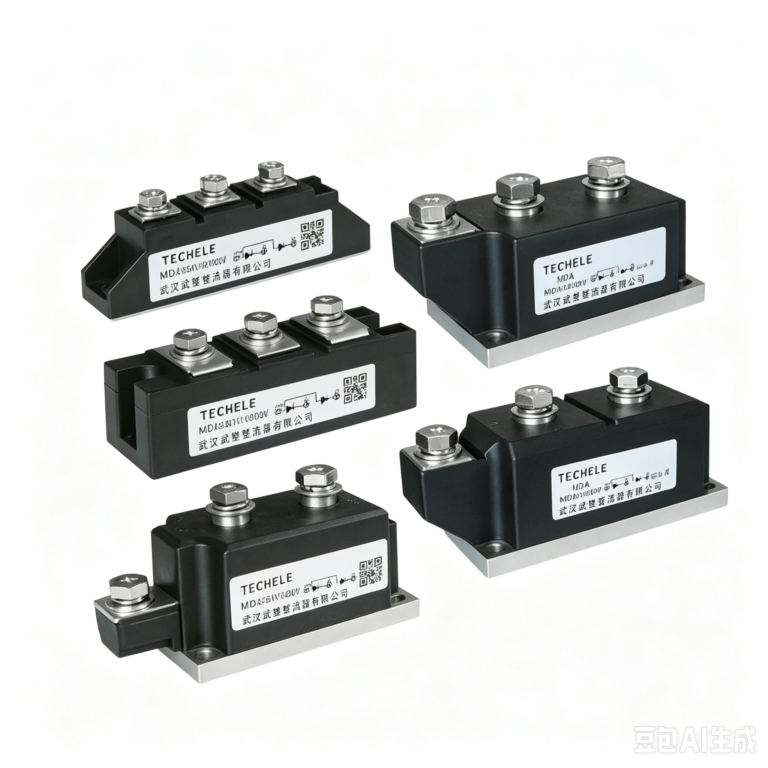
Diode Rectifier Module Selection Guide: Current, Voltage, Configuration and Model Verification
Selecting a diode rectifier module starts with a defined electrical and mechanical requirement, not with a family name…
Read guide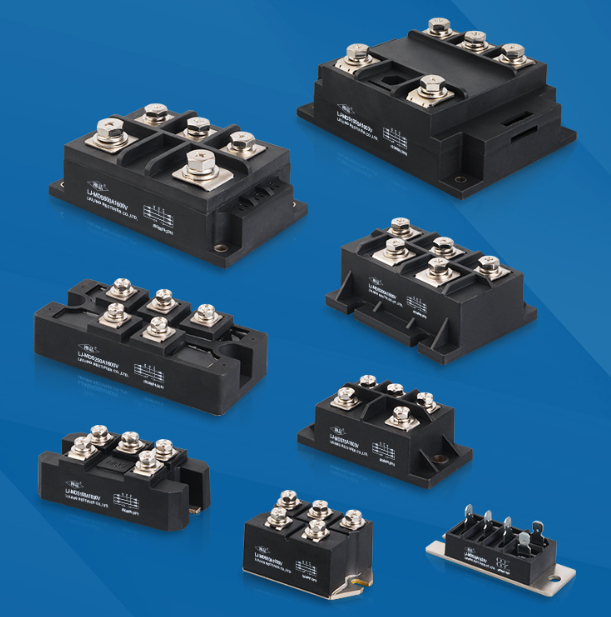
MDS 30A–250A vs 300A–1200A Bridge Rectifier Modules: Model Comparison
RITOKS currently publishes two MDS three-phase bridge rectifier module families covering different current-class ranges: MDS 30A–250A MDS 300A–1200A…
Read guide