
AC Power Protection · Selection Guide
AC MCB Selection Guide: Current, Poles, Trip Curve and Breaking Capacity
Selecting an AC miniature circuit breaker (MCB) involves more than choosing an ampere rating.

Two breakers with a similar current range may differ in:
- voltage
- pole configuration
- available trip-curve options
- breaking capacity
- mounting format
- exact product configuration
These differences matter when sourcing MCBs for an electrical panel, OEM project or replacement requirement.
The most useful approach is not to search for one universal rule such as:
“Use this curve for this load.”
or:
“6kA is enough for this application.”
Those decisions depend on the actual electrical system and confirmed engineering requirements.
A better sourcing process is to define the required parameters first, then compare them against the published data for the exact MCB model.
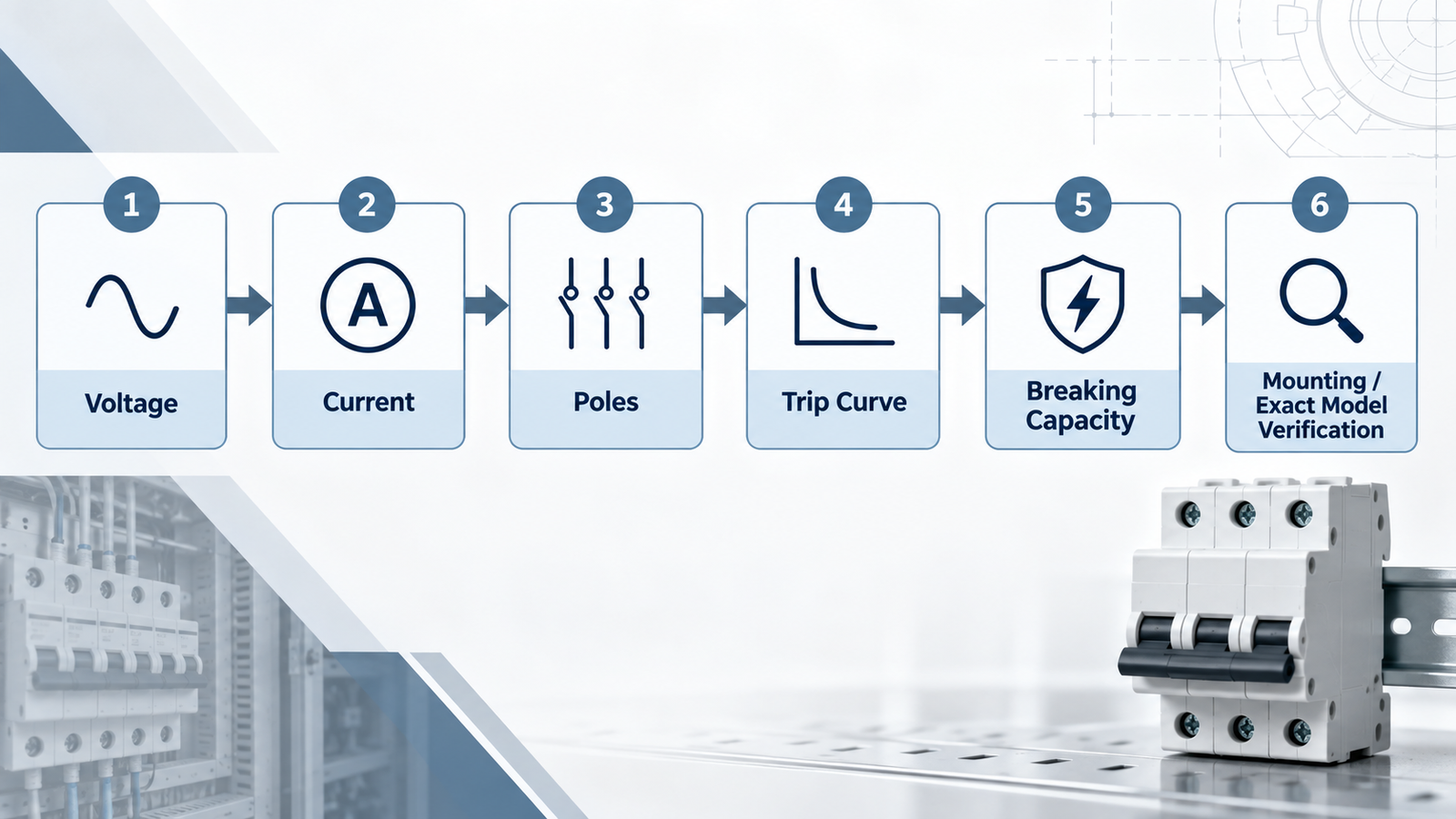
This guide explains how to evaluate the current RITOKS AC MCB range using five practical selection inputs:
- current rating
- pole configuration
- trip-curve availability
- breaking capacity
- mounting and exact-model verification
In This Guide
- Quick AC MCB Selection Summary
- Required AC voltage
- Current rating
- Pole configuration
- Trip-curve availability
- Breaking capacity
- Mounting format
- Selection process
- Frequently Asked Questions
Quick AC MCB Selection Summary
| Selection Factor | What to Confirm | Current RITOKS Published Examples |
|---|---|---|
| Voltage | Required AC system voltage | 230/240V AC and 230/400V AC product families |
| Current | Required breaker rating | Published variants from 1A to 63A overall |
| Poles | Required physical configuration | 1P, 1P+N, 2P, 3P, 3P+N and 4P depending on model |
| Trip Curve | Which curves are offered on the exact product | B/C or B/C/D depending on model |
| Breaking Capacity | Published value for the selected product or variant | 1kA, 6kA, or 10kA examples depending on model |
| Mounting | Mechanical installation format | Current products use 35mm or 35.5mm DIN-rail formats |
These are product-selection inputs, not universal electrical-design rules.
For available models, see the RITOKS Miniature Circuit Breakers (MCB) range within AC Power Protection.
1. Start With the Required AC Voltage
Voltage should be one of the first filters when comparing AC MCBs.
Current RITOKS published products include different voltage families.
For example:
- RTSXD01 — AC 230/400V
- RTSXD03 — AC 240V
- RTSXD02 — AC 240V
- RTSXD04 — AC 230/400V
- RTS-ACM60 — 230/240V AC
- RTS-AC47 — 230/400V AC
This means two breakers with similar current ratings may still be intended for different published voltage configurations.
The correct sequence is:
system requirement → candidate product → exact model confirmation
rather than selecting a breaker from current alone.
2. Select the Current Rating From Confirmed Model Options
The current RITOKS AC MCB range contains published variants from 1A to 63A overall, but those ranges are not identical across every product family.
Examples include:
RTSXD01
The RTSXD01 family publishes 1–63A variants, AC 230/400V and multiple pole configurations.
RTSXD02
The RTSXD02 family publishes 1–32A, AC 240V and 1P+N.
RTSXD03
Published range: 1–32A, AC 240V and 1P+N.
RTS-ACM60
The RTS-ACM60 family publishes 6–63A, 230/240V AC and 1P / 2P.
RTS-AC47
The RTS-AC47 family publishes 10–63A, 230/400V AC and 1P / 2P / 3P / 4P.
The current value therefore helps identify possible models, but it does not complete the selection.
A published 32A option in one family should not be assumed to have the same pole, curve, breaking-capacity or installation configuration as a 32A option in another family.
Current Rating Is Not a Cable-Sizing Rule
One important distinction should be kept clear.
An MCB product page may publish available current ratings.
That does not mean the product page alone establishes:
- the required conductor size
- the correct load calculation
- protective coordination
- allowable derating
- the correct breaker size for every installation
Those engineering decisions depend on the actual system and applicable design requirements.
For sourcing purposes, the current rating should be treated as one confirmed product parameter to compare against the buyer’s already-defined requirement.
3. Check the Pole Configuration
Pole configuration is another practical selection factor.
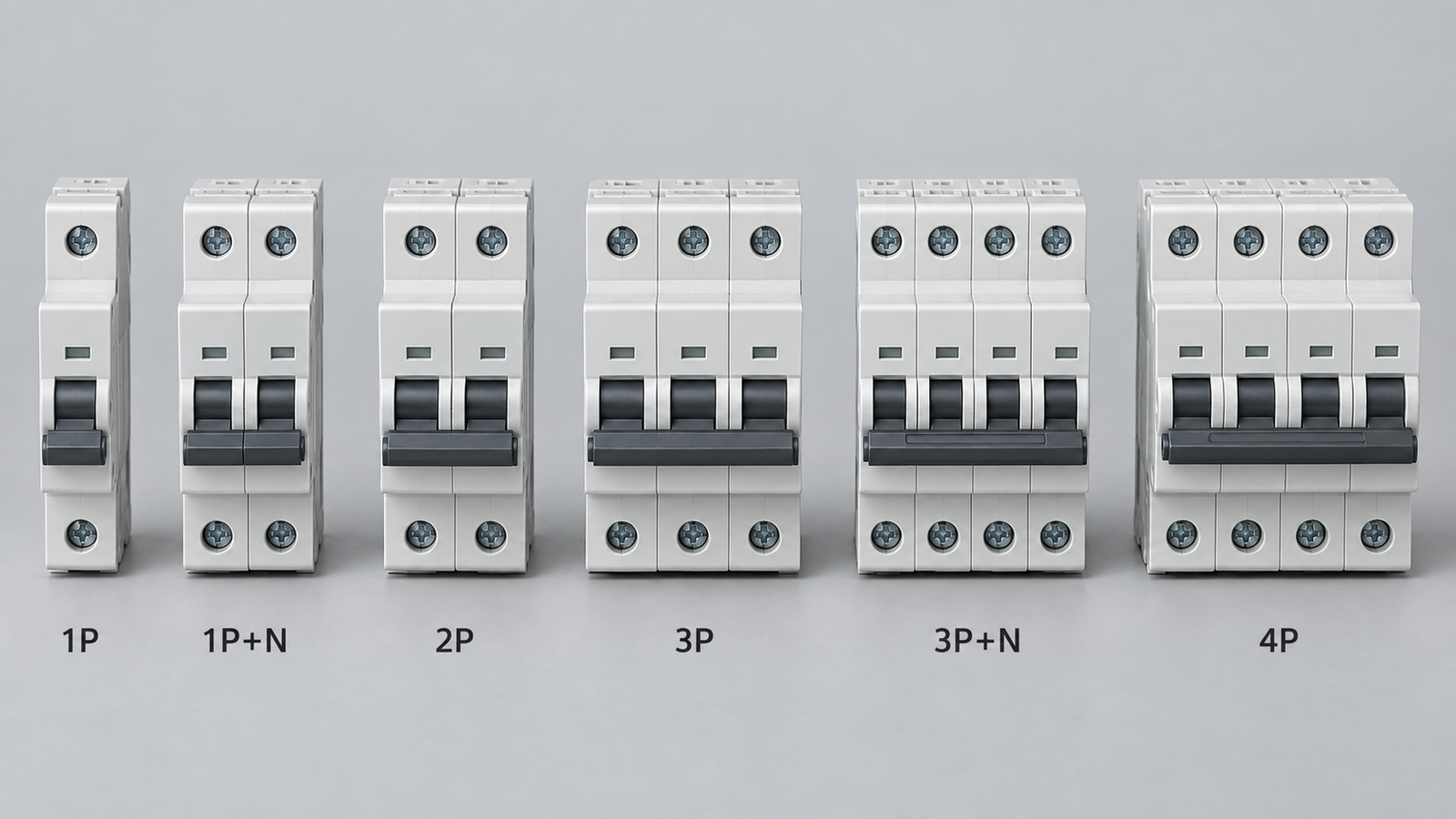
Current RITOKS published AC MCB families include several different physical options:
- 1P
- 1P+N
- 2P
- 3P
- 3P+N
- 4P
But not every model offers every configuration.
For example:
- RTSXD01: 1P+N, 2P, 3P, 3P+N and 4P
- RTSXD02 and RTSXD03: 1P+N
- RTS-ACM60: 1P and 2P
- RTS-AC47: 1P, 2P, 3P and 4P
This means pole configuration can quickly narrow the candidate product families.
Pole Count Should Not Be Selected From a Generic Rule
The available product configuration and the required electrical configuration are two different questions.
RITOKS product data can tell a buyer:
Which pole versions are available?
But it does not by itself establish:
Which conductor or neutral arrangement a particular electrical system must use?
That depends on the actual circuit and engineering requirements.
So the practical sourcing workflow is:
- define the required pole configuration
- identify products that offer it
- verify the exact model and documentation
4. Understand Trip-Curve Availability Without Overgeneralizing
Trip curve is an important MCB selection parameter, but this is also an area where overly simple advice can become misleading.
Current RITOKS product data confirms:
- RTSXD01: B / C / D
- RTSXD03: B / C
- RTSXD02: B / C
- RTSXD04: B / C / D
- RTS-ACM60: B / C
- RTS-AC47: not confirmed
This means RITOKS currently has published MCB families with B and C options, B/C/D options, and one family where the curve has not yet been confirmed.
What this data does not establish is a universal rule assigning each curve to a specific load.
B Curve vs C Curve vs D Curve: What Can Be Said Safely?
B, C and D are different trip-curve designations.
However, the current RITOKS website does not provide the complete time-current data needed to build a model-specific engineering comparison of:
- operating thresholds
- exact instantaneous-trip behavior
- time-current response
- load-specific curve recommendations
Therefore, the safest sourcing approach is:
- identify which curve the project requires
- check whether the candidate MCB family offers that curve
- verify the exact product documentation before ordering
For example, if a buyer requires a D-curve option, the current published data shows that RTSXD01 and RTSXD04 list B/C/D options, while RTSXD02, RTSXD03 and RTS-ACM60 currently list B/C.
That is a valid product-family comparison.
It is different from claiming that one curve is universally correct for a certain application.
5. Check Breaking Capacity on the Exact Model
Breaking capacity is another important product parameter that must remain tied to the exact MCB.
Current published examples include:
- RTSXD01: 10kA Icn / 7.5kA Ics
- RTSXD04: 10kA Icn / 7.5kA Ics
- RTSXD02: 6kA
- RTSXD03: 6kA
- RTS-ACM60: 6kA published as typical; exact variant should be confirmed
- RTS-AC47: 1kA
These differences provide useful sourcing information.
But they should not be converted into statements such as:
6kA is for residential applications.
or:
10kA is always required for industrial panels.
The required breaking capacity depends on the actual fault-duty conditions and project requirements.
The RITOKS product data can help identify which models publish a required value after that requirement has been established.
6kA vs 10kA: What Does the Product Data Tell Us?
The current product range shows that RITOKS offers both 6kA and 10kA MCB families.
That allows a buyer to shortlist products based on a required breaking-capacity specification.
For example:
- If the RFQ specifies a confirmed 10kA requirement, current published candidates include RTSXD01 and RTSXD04.
- If the RFQ specifies 6kA, current published candidates include RTSXD02 and RTSXD03.
- RTS-ACM60 also publishes 6kA as typical, but the exact selected variant should be confirmed before treating that value as final.
This is the correct role of product data:
match a defined engineering requirement to a confirmed product configuration.
The product catalog should not be used to invent the engineering requirement itself.
6. Consider the Mounting Format
All six current AC MCB families use DIN-rail mounting formats.
Published examples include:
- 35mm DIN rail
- 35.5mm DIN rail
This makes them relevant to modular electrical-panel installations designed around compatible DIN-rail arrangements.
But even where two MCBs use DIN-rail mounting, they may still differ in:
- poles
- current range
- voltage
- trip-curve options
- breaking capacity
- family configuration
Mounting compatibility alone is therefore not enough to establish full interchangeability.
AC MCB Families at a Glance
| Model | Voltage | Current | Poles | Curve | Breaking Capacity |
|---|---|---|---|---|---|
| RTSXD01 | AC 230/400V | 1–63A | 1P+N, 2P, 3P, 3P+N, 4P | B/C/D | 10kA Icn / 7.5kA Ics |
| RTSXD03 | AC 240V | 1–32A | 1P+N | B/C | 6kA |
| RTSXD02 | AC 240V | 1–32A | 1P+N | B/C | 6kA |
| RTSXD04 | AC 230/400V | 1–63A | 1P+N, 2P, 3P, 3P+N, 4P | B/C/D | 10kA Icn / 7.5kA Ics |
| RTS-ACM60 | 230/240V AC | 6–63A | 1P, 2P | B/C | 6kA typical; confirm variant |
| RTS-AC47 | 230/400V AC | 10–63A | 1P, 2P, 3P, 4P | Not confirmed | 1kA |
This table summarizes current published product data. It should not be interpreted as a complete engineering interchangeability table.
A Practical AC MCB Selection Process
A useful sourcing workflow is:
- Confirm the system voltage. Identify the required AC voltage before comparing breaker families.
- Confirm the required current rating. Use the project requirement to narrow candidate MCB models.
- Confirm the pole configuration. Define whether the project requires 1P, 1P+N, 2P, 3P, 3P+N or 4P, then compare only products that publish that configuration.
- Confirm the required trip curve. If the project already specifies B, C or D curve, identify which MCB families publish that option. Do not substitute one curve for another without confirming the project requirement.
- Confirm the required breaking capacity. Use the specified breaking-capacity requirement to filter products and keep the value attached to the exact model or variant.
- Confirm mounting and mechanical fit. Verify the DIN-rail format and installation requirements.
- Verify the exact product documentation. Before ordering, confirm the final model, configuration and any required supporting documentation.
Selection Examples
Example 1: A 1P+N Requirement
Suppose an OEM panel specification already calls for:
- AC 240V
- 1P+N
- a current option within 1–32A
- B or C curve
- 6kA breaking capacity
Current published RITOKS candidates include RTSXD02 and RTSXD03.
Both publish those headline selection parameters.
The buyer can then compare the exact model documentation, series positioning and other confirmed project requirements.
This example does not mean every 1P+N circuit should use these values.
It simply demonstrates how a defined specification can be matched to available product data.
Example 2: A B/C/D Curve Requirement
Suppose a project requires the ability to source B, C and D curve versions within one MCB family.
Current published options include RTSXD01 and RTSXD04.
Both currently publish:
- AC 230/400V
- 1–63A variants
- multiple pole options
- B/C/D curve availability
- 10kA Icn / 7.5kA Ics
The final configuration still needs to be confirmed by exact model and project requirement.
Example 3: A 1P or 2P DIN-Rail Family
If the project requires a simple 1P or 2P DIN-rail family, the RTS-ACM60 range may be a candidate.
Published characteristics include:
- 230/240V AC
- 6–63A variants
- 1P / 2P
- B/C curve
- 35mm DIN rail
Its 6kA value is published as typical and should be confirmed for the selected variant before final specification.
Common AC MCB Selection Mistakes
- Selecting from current rating alone. A 32A or 63A label does not tell you the voltage, pole configuration, trip curve or breaking capacity.
- Assuming every product offers B, C and D curves. Some current products list B/C/D, some list B/C, and one does not have a confirmed curve on the site.
- Treating 6kA and 10kA as application labels. Breaking capacity is a product parameter, not a shortcut that automatically defines the application.
- Assuming similar appearance means equivalent configuration. DIN-rail MCBs may look similar while offering different electrical and mechanical configurations.
- Generalizing one model’s data across the range. A rating published for RTSXD01 should not automatically be applied to RTSXD02, RTS-ACM60 or another family.
- Using the MCB catalog to perform cable sizing. Product current ratings do not replace the engineering process used to determine conductor sizing and protective-device coordination.
- Treating “Economic,” “Standard” or “Pro” as universal performance rankings. Use the confirmed specification of the exact product instead of unsupported assumptions about quality, lifetime, protection performance or application suitability.
What Information Should Be Included in an AC MCB RFQ?
A clear AC MCB RFQ checklist makes product matching much easier.
At minimum, consider including:
- required AC voltage
- required current rating
- pole configuration
- required trip curve, if specified
- required breaking capacity
- DIN-rail or mounting requirement
- quantity
- application or panel context
- required documentation
- packaging or OEM requirements if relevant
With these inputs, the inquiry can be matched against available RITOKS MCB families without relying on assumptions.
Frequently Asked Questions
How Do I Choose the Current Rating of an MCB?
Start with the current rating already defined by the project or electrical design, then identify MCB models that publish that rating. Product-page current options should not be used as a substitute for load calculation or cable sizing.
Does RITOKS Offer B, C and D Curve MCBs?
Current published RTSXD01 and RTSXD04 families list B/C/D curve options. RTSXD02, RTSXD03 and RTS-ACM60 currently list B/C options. The trip curve for RTS-AC47 is not confirmed on the current site.
Is 10kA Better Than 6kA?
Not as a universal statement. They are different published breaking-capacity values. The required value depends on the electrical system and project requirements.
Can I Choose MCB Poles Based Only on the Number of Wires?
The current product range shows which pole configurations are available, but it does not establish universal circuit or neutral-switching rules. The required pole configuration should come from the system design.
Are All 63A MCBs the Same?
No. Different 63A-capable product families may differ in voltage, poles, trip-curve availability, breaking capacity, mounting and other configuration details.
Need Help Selecting an AC MCB?
RITOKS supplies multiple AC miniature circuit breaker families with different current, pole, trip-curve and breaking-capacity configurations.
For an RFQ, provide:
- AC voltage
- required current
- poles
- required trip curve
- required breaking capacity
- mounting requirement
- quantity
- application
- any required documentation or OEM requirements
RITOKS can then match the inquiry against the currently available MCB families and confirmed product data.
Related Resources
Continue exploring AC Power Protection

AC MCB RFQ Checklist: What Buyers Should Specify
AC MCB RFQ Checklist: What Buyers Should Specify A clear AC miniature circuit breaker RFQ can save multiple…
Read guide
1P+N vs 2P Circuit Breakers: Configuration Questions for Buyers
1P+N vs 2P Circuit Breakers: Configuration Questions for Buyers When buyers compare 1P+N and 2P circuit breakers, the…
Read guide