
AC Power Protection · Comparison
B Curve vs C Curve vs D Curve MCBs: What’s the Difference?
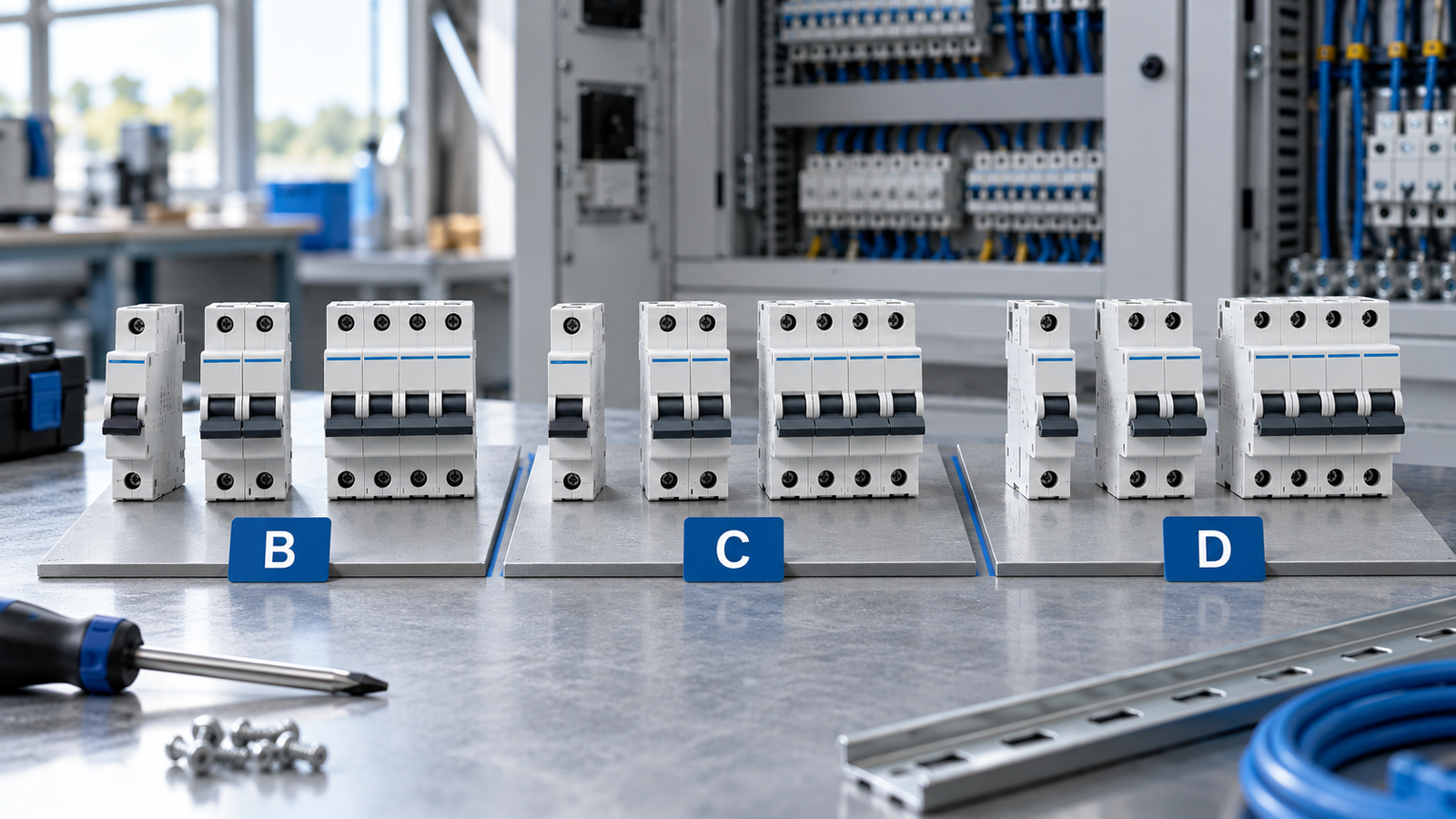
B, C and D curves are different tripping characteristics used with miniature circuit breakers (MCBs).
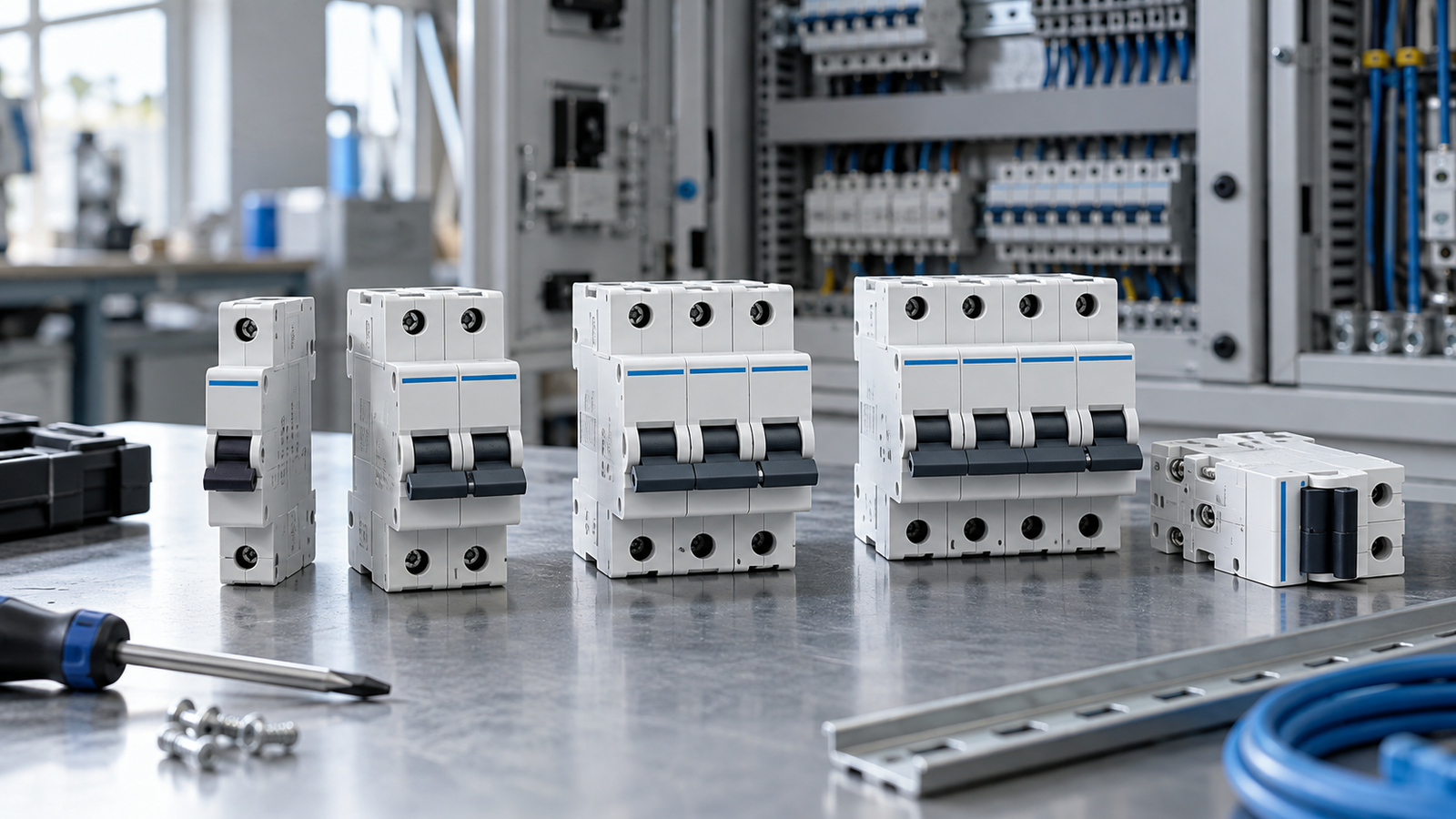
The letters do not describe the current rating, breaking capacity or number of poles. Instead, they help describe how the breaker responds to higher short-duration current in its instantaneous tripping region.
Manufacturer technical data commonly identifies the following characteristic ranges:
- B curve: approximately 3–5 × In
- C curve: approximately 5–10 × In
- D curve: approximately 10–20 × In
Here, In represents the breaker’s rated current for the characteristic being referenced. Eaton technical documentation publishes these same B, C and D short-circuit trip-response ranges for its miniature circuit breaker families.
The practical difference is that the three curves tolerate different levels of short-duration current before reaching the instantaneous trip region.
That does not mean one curve is universally better than another.
The required curve should come from the actual electrical design, expected inrush conditions and the documentation for the breaker being selected.
In This Guide
- Quick Comparison: B Curve vs C Curve vs D Curve
- What Is an MCB Trip Curve?
- What Is a B Curve MCB?
- What Is a C Curve MCB?
- What Is a D Curve MCB?
- Current RITOKS Curve Availability
- How to Choose Between B, C and D Curve Options
- Frequently Asked Questions
Quick Comparison: B Curve vs C Curve vs D Curve
| Characteristic | Common Instantaneous Trip Region | General Inrush Context |
|---|---|---|
| B Curve | 3–5 × In | Lower expected inrush |
| C Curve | 5–10 × In | Moderate expected inrush |
| D Curve | 10–20 × In | Higher expected inrush |
These ranges describe the general characteristic documented by major MCB manufacturers. They should not be treated as a model-specific RITOKS time-current curve unless the exact RITOKS product documentation confirms it.
Eaton’s industrial miniature circuit-breaker guidance, for example, describes B characteristic for lower-inrush situations, C for medium-inrush situations and D for higher-inrush situations. Its application guidance gives examples such as small transformers and control equipment for C characteristics, and higher-inrush equipment such as motors, transformers and power supplies for D characteristics. These are typical examples, not universal load-selection rules.
What Is an MCB Trip Curve?
An MCB protects a circuit against overcurrent conditions, but the way it responds depends on more than its ampere rating.
A trip characteristic describes part of that response.
For B, C and D curve MCBs, one of the most visible differences is the instantaneous or magnetic trip region.
Consider two breakers with the same nominal current rating.
A B-curve breaker and a D-curve breaker may both carry the same rated current under normal conditions, but their instantaneous trip regions can differ substantially.
That is why:
“32A B curve” and “32A D curve” do not describe identical protection behavior simply because both breakers are rated 32A.
The curve is therefore another selection parameter alongside:
- rated current
- voltage
- poles
- breaking capacity
- mounting format
- exact model
For the broader selection process, see AC MCB Selection Guide: Current, Poles, Trip Curve and Breaking Capacity.
What Is a B Curve MCB?
A B characteristic commonly uses an instantaneous trip region of approximately 3–5 times rated current.
In general terms, this means the instantaneous magnetic region is reached at a lower multiple of rated current than with C or D characteristics.
Manufacturer guidance commonly positions B characteristics where relatively low inrush current is expected.
However, that should not be converted into a rule such as:
“All lighting circuits must use B curve.”
The actual selection depends on the circuit, expected inrush, fault conditions and applicable design requirements.
Current RITOKS B-Curve Availability
Current published RITOKS AC MCB data confirms B-curve availability on:
The trip curve for RTS-AC47 is currently not confirmed.
These entries confirm availability only. They do not establish exact model-specific time-current behavior beyond the published curve designation.
What Is a C Curve MCB?
A C characteristic commonly uses an instantaneous trip region of approximately 5–10 times rated current.
Compared with B characteristic, this allows a higher short-duration current multiple before entering the instantaneous trip region.
Eaton describes C characteristic as suitable for situations with medium inrush and gives examples including small transformers, lighting, pilot devices, control circuits and coils. That is useful general context, but it does not mean every one of those applications automatically requires C curve.
Current RITOKS C-Curve Availability
C curve is currently the most widely confirmed curve across the published RITOKS AC MCB families:
- RTSXD01 — B / C / D
- RTSXD03 — B / C
- RTSXD02 — B / C
- RTSXD04 — B / C / D
- RTS-ACM60 — B / C
Again, RTS-AC47 currently has no confirmed curve designation on the site.
What Is a D Curve MCB?
A D characteristic commonly uses an instantaneous trip region of approximately 10–20 times rated current.
This is the highest of the three common instantaneous regions discussed here.
Manufacturer guidance often associates D characteristics with higher-inrush equipment. Eaton gives motors, transformers, power supplies and other highly inductive systems as typical examples.
The word typical matters.
It would be unsafe to conclude that:
“Motor = D curve.”
A motor circuit can involve many variables, including starting characteristics and the wider protection design. The breaker curve should therefore be selected from verified engineering requirements rather than from the equipment name alone.
Current RITOKS D-Curve Availability
Current published RITOKS data confirms D curve on:
- RTSXD01
- RTSXD04
The other currently published AC MCB families do not have confirmed D-curve availability on their product pages.
Why the Curves Use Different Instantaneous Regions
Electrical equipment can draw current above its steady operating level for a short time.
This can happen during events such as energization or startup.
If the breaker’s instantaneous trip region is too low for the expected short-duration current, the breaker may operate even though the event was part of normal equipment startup.
Conversely, simply choosing a curve with a higher instantaneous region is not automatically better.
The protection system still needs to respond appropriately to actual faults.
This is why B, C and D characteristics should be understood as different protection characteristics, not as quality grades.
D is not a “premium” version of C, and C is not an “upgrade” from B.
B vs C vs D at the Same Rated Current
Imagine three MCBs that all have the same rated current, In.
Using the common characteristic ranges:
- B reaches its instantaneous region around 3–5 × In
- C around 5–10 × In
- D around 10–20 × In
For illustration only, if In = 10A, those multiples correspond mathematically to:
- B: approximately 30–50A
- C: approximately 50–100A
- D: approximately 100–200A
This arithmetic example only demonstrates the meaning of the multiples. It is not a product-selection recommendation and should not be treated as the exact operating behavior of a specific RITOKS breaker.
Actual breaker behavior must be verified against the manufacturer’s exact time-current documentation and applicable product requirements.
Current RITOKS Curve Availability at a Glance
| RITOKS Model | B | C | D | Current Evidence |
|---|---|---|---|---|
| RTSXD01 | Yes | Yes | Yes | Published availability |
| RTSXD03 | Yes | Yes | — | Published availability |
| RTSXD02 | Yes | Yes | — | Published availability |
| RTSXD04 | Yes | Yes | Yes | Published availability |
| RTS-ACM60 | Yes | Yes | — | Published availability |
| RTS-AC47 | Not confirmed | Not confirmed | Not confirmed | Curve not confirmed |
This table should be used for product-family shortlisting only.
It does not mean that the external manufacturer curves cited earlier are the exact tested time-current curves of these RITOKS models.
How to Choose Between B, C and D Curve Options
The practical sourcing process begins with the required characteristic, not with a guess based on the product name.
1. Confirm the Load and Inrush Requirement
Determine whether the project documentation already defines:
- expected startup current
- inrush behavior
- required curve
- other protection constraints
If the required curve has already been specified, use that as the starting point.
2. Confirm the Rated Current
Trip curve and rated current are separate parameters.
For example:
- C16
- C32
- C63
all share the C designation but have different current ratings.
Do not select the curve first and ignore the required breaker current.
3. Confirm the Breaking Capacity
Trip curve and 6kA vs 10kA MCB breaking capacity are also different parameters.
A B, C or D designation does not tell you whether the breaker has:
- 6kA
- 10kA
- or another breaking-capacity value
That characteristic must be checked separately on the exact product.
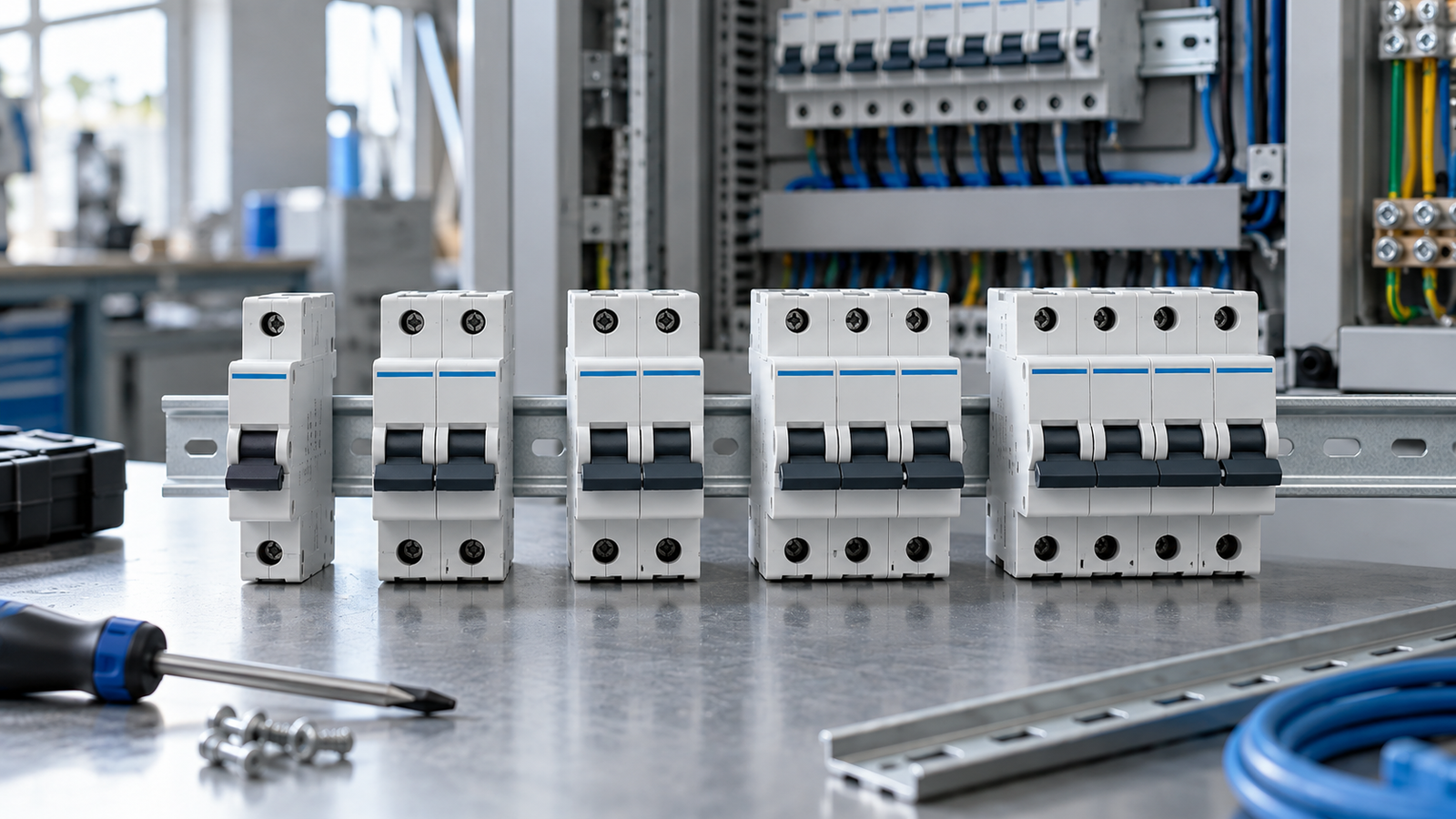
4. Confirm the Pole Configuration
A required B/C/D curve may only be useful if the same product family also offers the required:
- 1P
- 1P+N
- 2P
- 3P
- 3P+N
- 4P
configuration.
5. Verify the Exact Product Documentation
The final step is to verify the selected breaker itself.
Do not assume:
- every B curve behaves identically across all manufacturers
- every C curve has identical time-current tolerances
- every D curve is suitable for every high-inrush load
The curve designation is one part of the complete product specification.
Common B/C/D Curve Selection Mistakes
Treating B, C and D as Quality Levels
They are different trip characteristics, not “basic,” “better” and “best.”
Selecting From the Load Name Alone
Statements such as “motor means D curve” are too broad.
Expected inrush and the actual electrical design need to be considered.
Ignoring Rated Current
A correct curve paired with the wrong current rating is not a correct breaker selection.
Ignoring Breaking Capacity
B/C/D characteristic and breaking capacity are separate parameters.
Assuming the External Curve Data Automatically Applies to Every RITOKS Model
The 3–5 × In, 5–10 × In and 10–20 × In figures used in this guide are general characteristic ranges supported by authoritative manufacturer technical literature. RITOKS product pages currently confirm which curve letters are available, but they do not publish full model-specific time-current curves.
Creating a Curve Graph Without Model Data
A realistic-looking graph can imply more precision than the available evidence supports.
Until exact RITOKS model-specific time-current documentation is available, curve selection should rely on the published designation and project requirements rather than a fabricated graph.
When Should You Request More Technical Data?
For a routine sourcing inquiry, knowing the required curve designation may be enough to shortlist available models.
For more detailed engineering review, buyers may need additional documentation such as:
- exact time-current characteristic
- instantaneous-trip tolerance
- breaking-capacity data
- applicable product standard
- coordination information where required
- model-specific test or certification documents
Those requirements should be requested for the exact product rather than assumed from the B, C or D letter alone.
Frequently Asked Questions
What Is the Main Difference Between B, C and D Curve MCBs?
The main difference discussed here is the instantaneous trip region. Common manufacturer documentation uses approximately 3–5 × In for B, 5–10 × In for C and 10–20 × In for D.
Is C Curve Better Than B Curve?
No. They are different tripping characteristics. The appropriate choice depends on the circuit and expected inrush conditions.
Is D Curve Always Used for Motors?
No. D curve is commonly associated with higher-inrush applications, and manufacturer guidance often lists motors and transformers as examples, but the correct curve depends on the actual equipment and protection design.
Does RITOKS Offer B, C and D Curve MCBs?
Yes, on selected families. RTSXD01 and RTSXD04 currently list B/C/D options. RTSXD02, RTSXD03 and RTS-ACM60 list B/C. RTS-AC47 does not currently have a confirmed curve designation.
Does a Curve Letter Tell Me the Breaking Capacity?
No. Trip characteristic and breaking capacity are separate product parameters and should both be checked.
Need Help Selecting an MCB Trip Curve?
RITOKS offers AC miniature circuit breaker families with different current ratings, pole configurations, breaking capacities and B/C/D curve availability.
Use an AC MCB RFQ checklist to provide:
- AC voltage
- required current
- pole configuration
- required trip curve
- required breaking capacity
- quantity
- application
- any required technical documentation
RITOKS can then match the inquiry against currently published product families and confirmed model data.
Related Resources
Continue exploring AC Power Protection
AC MCB RFQ Checklist: What Buyers Should Specify
AC MCB RFQ Checklist: What Buyers Should Specify A clear AC miniature circuit breaker RFQ can save multiple…
Read guide
1P+N vs 2P Circuit Breakers: Configuration Questions for Buyers
1P+N vs 2P Circuit Breakers: Configuration Questions for Buyers When buyers compare 1P+N and 2P circuit breakers, the…
Read guide