
Thermal Management · Technical Explainer
Condensation and Dew Point in Electrical Enclosures: Decision Inputs
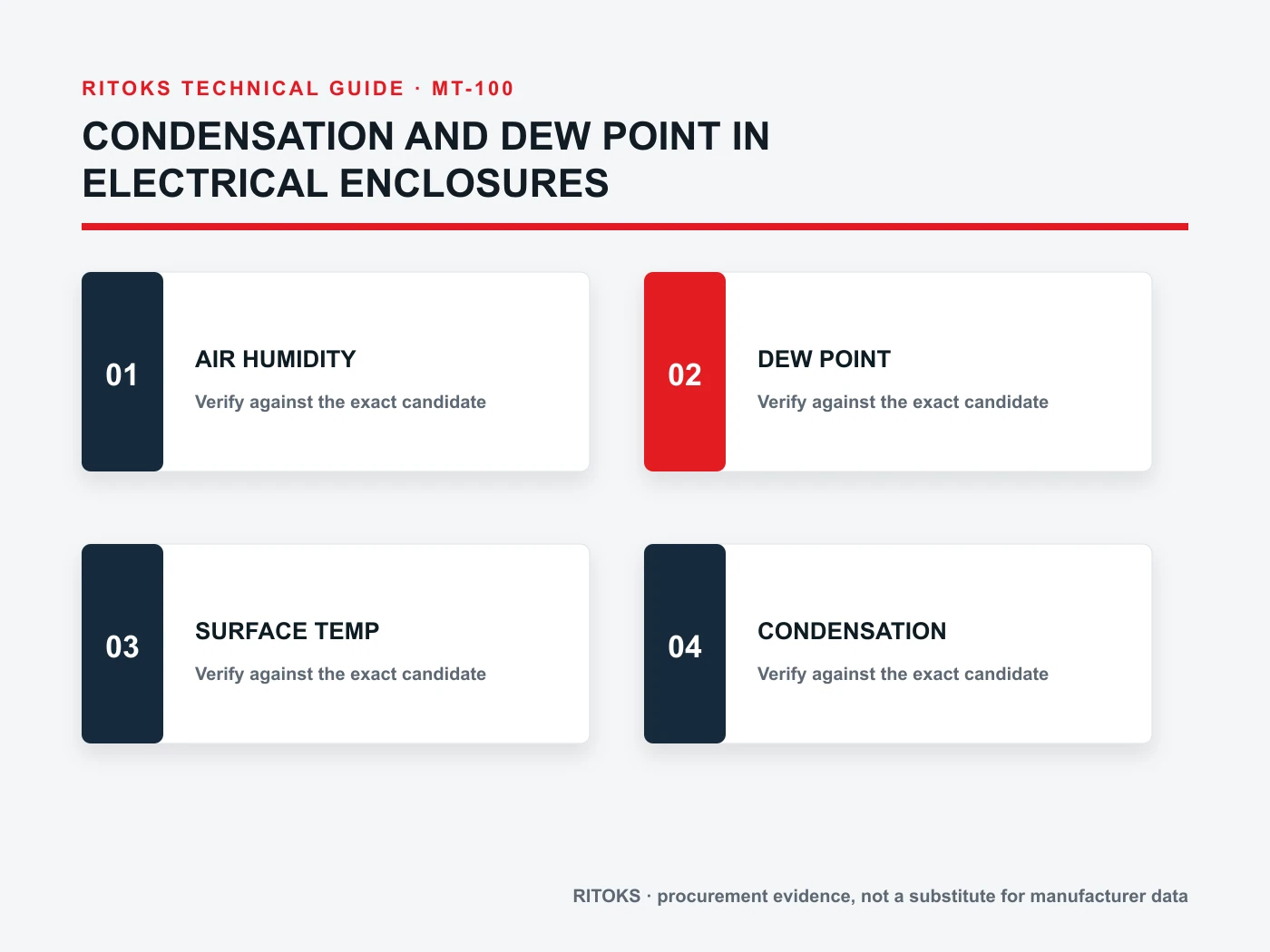
Condensation in an electrical enclosure is a temperature-and-moisture problem, not simply a high-humidity number. Moist air can meet a cooler surface inside a cabinet, and water can form when that surface reaches the air’s dew point. The relevant design question is therefore whether any internal surface may become cold enough while moisture is present.

This guide identifies the measurements and operating states needed to evaluate that risk. It is not a promise that a particular heater, fan or cooling unit will eliminate condensation. Enclosure construction, sealing, ambient weather, internal heat and maintenance practices have to be considered together.
What dew point tells the enclosure designer
Dew point is the temperature at which air with a given moisture content becomes saturated and condensation can begin as it cools. Relative humidity alone is incomplete because it changes with air temperature. A cabinet can appear acceptable at a warm internal-air reading while its wall, door, gland plate or component surface is cooler than the measured air.
For a practical review, pair internal air temperature and relative humidity with a surface-temperature estimate or measurement at the coldest likely location. The issue is the margin between surface temperature and dew point during the most unfavorable operating state. The National Institute of Standards and Technology explains the physical relationship among air temperature, relative humidity and dew point; it does not prescribe a universal cabinet setpoint.
A single daytime reading is not sufficient if the cabinet cools after equipment shutdown or experiences rapid outdoor temperature changes. Log conditions across startup, normal duty, idle periods and seasonal changes when those states are relevant. If no operating history exists, mark the environmental assumption explicitly and verify it during commissioning.
Locate moisture sources and cold surfaces
Moisture may enter through cable penetrations, open doors, inadequate seals, ventilating air or condensation already trapped during assembly. Some cabinets cycle between warmer internal operation and cooler shutdown, leaving residual moisture in the volume. A specification that says “indoor” or “outdoor” is too broad to establish the actual vapor load.
Identify surfaces most exposed to cooling: external walls, doors, roof panels, mounting plates near outer skins and components connected to cold metalwork. Their temperature can differ from the enclosure air. Inspect drainage paths and any visible water marks, corrosion, fogging or damp insulation. These observations help locate the mechanism but do not replace measurements if a permanent remedy is being designed.
Record how the cabinet is installed. A free-standing enclosure, a wall-mounted box and a cabinet exposed to solar heating may have different temperature profiles. Door-opening frequency and maintenance conditions matter, particularly where warm humid air is admitted and later cools. Map these factors before choosing an accessory from a catalogue.
Separate condensation control from heat removal
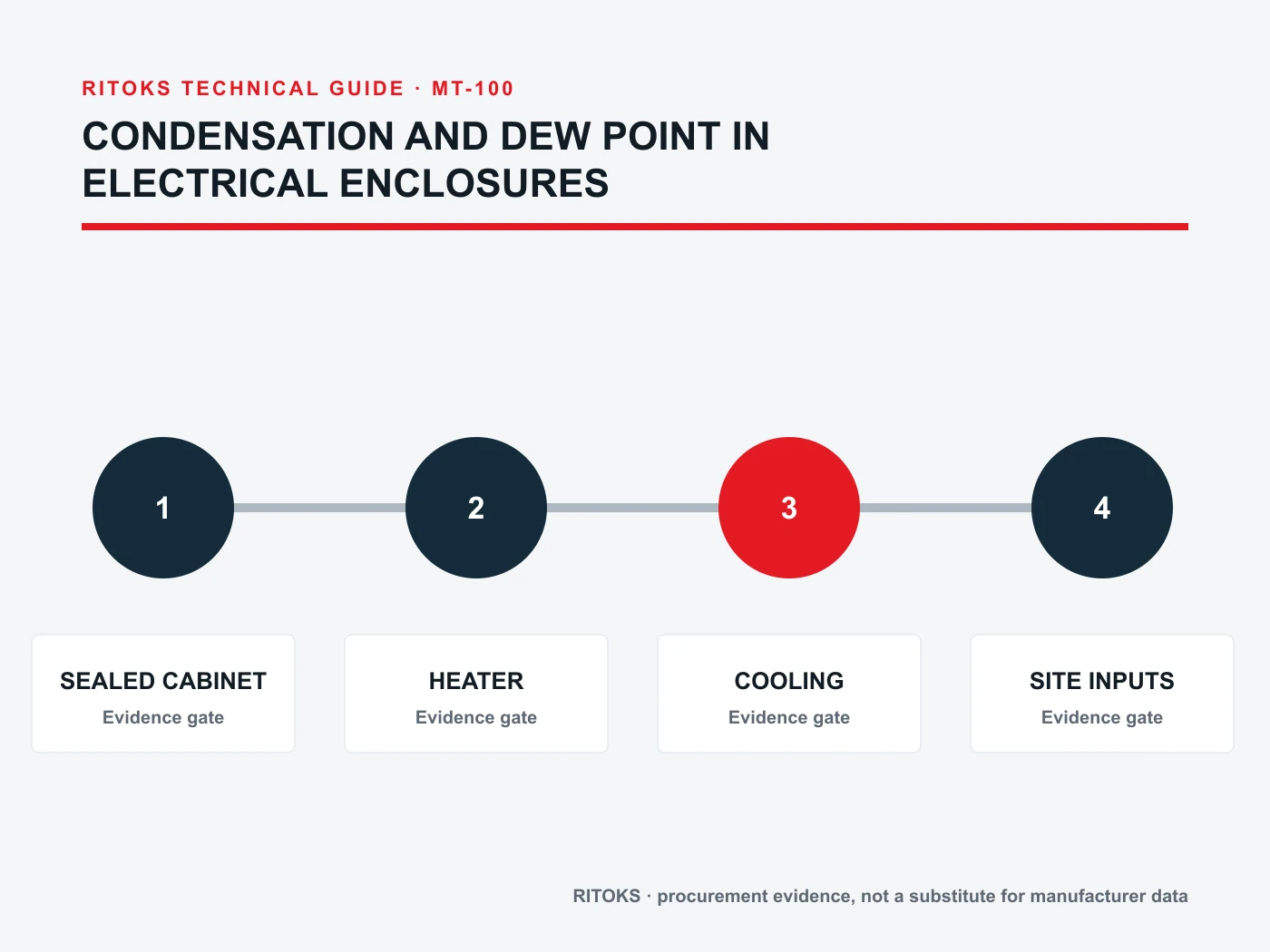
An enclosure may need to remove equipment heat and prevent moisture deposition at the same time. These goals can pull in different directions. Moving outside air through a cabinet can remove heat under favorable ambient conditions, but it can also introduce humidity or contaminants. A heater can raise local surface temperature to reduce condensation risk but adds heat that the equipment or cooling plan must accommodate.
An enclosure air conditioner changes temperature and can produce condensate that must be managed according to its installation instructions. It is not automatically a complete humidity-control system. The manufacturer’s operating limits, sealing requirements, drain arrangement and mounting instructions must be checked for the exact unit. Schneider Electric’s enclosure cooling-unit guide explicitly addresses relative humidity, sealing of openings and condensation risk; those conditions are product-specific and should not be generalized to all units.
Compare the three strategies against the project’s heat load, ambient range, humidity behavior, ingress-protection goal and maintenance capacity. Do not choose a filter fan solely because an enclosure feels hot, or a heater solely because droplets were seen once. Establish when each problem occurs and whether one device would worsen the other condition.
When a filter fan may be considered
A filter fan exchanges enclosure air with ambient air. It may support heat removal when ambient temperature and air quality are suitable, but it cannot by itself guarantee a dry internal environment. If the outside air is humid, ventilation may bring in moisture. Filter condition and airflow path also change actual performance over time.
Before considering the FD cabinet filter fan family, establish allowable internal temperature, heat load, ambient temperature, humidity, dust exposure, required ingress protection and the desired direction of airflow. Review the exact-model fan curve, filter data and installation instructions. The product page is a commercial starting point, not evidence of a condensation remedy for a specific cabinet.
When a heater and control may be considered
A controlled enclosure heater is one possible way to keep susceptible surfaces warmer during low-temperature or idle periods. Its effectiveness depends on heat distribution, cabinet size, wall losses, ventilation, sensor position and the control strategy. Heating the air sensor while a remote metal panel remains cold may leave the actual condensation mechanism unresolved.
ABB’s enclosure guidance describes anti-condensation heaters as a means of preventing atmospheric humidity from depositing inside a cabinet. That is a use case, not a universal power-sizing rule. Review the specific enclosure and heater installation instructions, wiring, overtemperature considerations and the location of a thermostat or hygrostat. The JRQ enclosure heater family can be evaluated only after these inputs are known.
Document whether the heater operates continuously, on temperature, on humidity or under a combined logic. Confirm how it behaves on power loss and after restoration. Commissioning should include a check of the sensor reading, heater operation and actual cold-surface condition, not merely a controller display.
When sealed active cooling may be considered
If ambient air exchange cannot meet temperature or contamination requirements, a sealed enclosure air conditioner may be considered. The calculation still needs internal heat dissipation, enclosure surface and installation exposure, ambient temperature, target internal temperature and the unit’s operating limits. Cooling capacity alone does not close the moisture review.
Discuss condensate handling, drain routing, enclosure sealing and maintenance before selection. Avoid assumptions that an air conditioner will always dehumidify enough to prevent every cold-surface event. The EP-A indoor enclosure air conditioner family is relevant when an engineered active-cooling solution is being evaluated; an exact model must be checked against the application.
Build a decision record from measurements
| Input | Why it matters | Record to keep |
|---|---|---|
| Air temperature and RH | Estimates moisture state and dew point | Logged operating-state measurements |
| Cold-surface temperature | Tests condensation margin | Surface location and measured/estimated value |
| Heat dissipation | Defines cooling and idle-period behavior | Equipment loss schedule |
| Ambient exposure | Changes heat and moisture flows | Site conditions and enclosure location |
| Openings and seals | Determine air and water ingress paths | Installation drawing and inspection record |
The record should identify the most unfavorable credible state rather than an average day. If a scenario is not measured, distinguish calculation from observation. Assign ownership for the heat-load estimate, moisture assessment, enclosure sealing and accessory installation so that a quotation does not hide gaps between disciplines.
Verification after installation
At commissioning, inspect cable entries and door seals, verify sensor location, and observe the selected control action in relevant operating states. Where the risk was identified at a particular wall or mounting plate, include that surface in the check. Log temperatures and humidity through a representative cycle if feasible. A successful bench run at room conditions cannot prove year-round condensation control.
Define maintenance tasks for filters, drains, seals, sensors and heaters as applicable. A clogged filter, damaged gasket or blocked condensate path can invalidate the original design assumptions. Record the acceptance criteria and the person responsible for follow-up. If water is still observed, investigate the mechanism rather than immediately increasing heater power or fan speed.
Questions before requesting equipment
Can a humidity reading alone predict condensation?
No. Use temperature and relative humidity to understand dew point, then consider the coldest relevant surface and the operating state. A warm air reading may conceal a cooler wall or component.
Will a fan always dry the enclosure?
No. Ventilation exchanges air with the surroundings. Whether that reduces or increases moisture risk depends on ambient conditions, airflow, cabinet sealing and subsequent cooling.
Is a heater rating enough to specify anti-condensation control?
No. Confirm surface-temperature behavior, distribution, controls and site conditions. A specific heater power or thermostat setting should come from the enclosure design and exact product instructions, not from a generic rule.
Bottom line
Treat dew point as a relationship between moisture state and cold surfaces. Measure or define the relevant states, then evaluate thermal-management options against both heat and moisture requirements. A documented enclosure review makes a supplier inquiry actionable without promising that one accessory solves every condition. Preserve the calculation assumptions and the commissioning log together so that future changes to equipment loading, seals or maintenance can be assessed against the original decision.
References
- NIST/NBS, General Guidelines for On-Site Calibration of Humidity and Moisture Control Systems, section on dew point.
- Schneider Electric, ClimaSys Cooling Units installation guide.
- ABB, enclosure technical information, heater and condensation discussion.