
Thermal Management · Technical Explainer
Cooling an Enclosure in a Dusty Facility: Choose the Air Path First
A dusty facility changes the meaning of a cabinet-cooling requirement. The question is not simply which device moves enough air. It is whether the proposed cooling path imports surrounding dust into sensitive electrical space, whether its filter can be maintained at the real site, and whether a more isolated heat-transfer method is needed. A fan that looks sufficient by free-air flow may be unsuitable when the enclosure must remain sealed against the local contamination. Equally, a closed-loop cooler is not automatically the right choice if the heat load, ambient temperature and maintenance requirements do not justify it.

This guide helps a panel builder or maintenance buyer compare filtered ventilation, separated-air-circuit heat exchange and an enclosure air conditioner. It is a decision framework, not an installation approval or a performance promise for any particular model. RITOKS publishes a Cabinet Cooling Fans category and an Enclosure Air Conditioners category. Those are different commercial routes. Confirm exact-model construction and site suitability from the current product documentation before placing an order.
Define what “dusty” means at this location
An abrasive powder near a conveyor is not the same exposure as light settled dust in a utility room. Ask where contamination is generated, how often it is airborne, whether it is conductive, hygroscopic or oily, and whether cleaning introduces water or compressed air. Record the cabinet location relative to the source. A cabinet near an intake, floor sweep zone or machine exhaust can experience very different loading from another cabinet in the same building. These observations shape filter selection and maintenance intervals; they are not reasons to claim a universal ingress rating.
Also establish the enclosure's required environmental protection. The rating belongs to the complete assembled cabinet in its final installation condition, not automatically to an individual fan, cooling unit or catalogue photograph. Cable entries, cutouts, gaskets and servicing can change the result. If dust exposure is a safety, process-quality or compliance concern, have the responsible engineer identify the governing specification and request exact evidence for the proposed assembly. Avoid assuming that a filter mat alone preserves the original cabinet rating.
Separate external contamination from internal heat generation. Dust can clog a filter and lower airflow, but the cabinet still has an electrical heat load. List drives, power supplies, contactors, power electronics, transformers and other heat-generating devices, with their operating duty and losses when known. Record the highest credible ambient temperature and the internal temperature limit required by the most sensitive device. A ventilation concept is credible only if the ambient air can remove heat under the design condition. Rittal's industrial enclosure guidance distinguishes direct air exchange from separated circuits and notes that conventional filter fans are not the general answer for highly dusty settings.
Option one: filtered ventilation exchanges site air
A cabinet filter fan draws or pushes ambient air through a filter and into the enclosure, usually with an exhaust opening completing the path. The filter reduces entry of particles within its specified performance, but it does not make the air path closed. Whenever the fan runs, the cooling medium is the surrounding facility air. The design therefore relies on ambient air being cool enough, on the filter remaining effective, and on a controlled airflow route through the equipment rather than a short circuit between nearby openings.
For this option, request an installed airflow assessment, not only a bare fan's free-air number. Filter media, grille, exhaust filter, cabinet restriction and clogging all add pressure loss. The operating point moves as a filter loads with dust. Ask the manufacturer for fan-curve and filter data applicable to the intended arrangement. The RITOKS FD filter-fan family is a relevant published family, but its exact airflow and protection performance must be checked at model and assembly level. Do not copy a competitor's filter efficiency or pressure drop to FD.
Filter access matters as much as initial selection. Can maintenance staff reach the filter without opening a hazardous cabinet or blocking production? Is replacement media specified and available? Does the facility have a schedule driven by measured pressure, temperature or inspection rather than an arbitrary calendar? If filter maintenance is likely to be missed, the cooling design should not quietly depend on frequent cleaning. A clogged filter can reduce heat removal at the moment ambient conditions are most demanding.
Positive pressure may help limit leakage through some unintended openings, but it does not erase ingress paths or prove an enclosure rating. A poorly placed intake can pull contaminated air from the worst location. An exhaust path positioned near the intake can bypass the components needing cooling. The panel builder must show inlet, outlet, internal obstructions and service access on the cabinet layout before a filter fan is treated as adequate.
Option two: separated air circuits avoid direct exchange
An air-to-air heat exchanger transfers heat across a barrier while keeping the enclosure's internal air and the surrounding air in separate circuits. That architecture addresses the direct-dust-ingress problem of a filter fan, but it still needs a temperature difference and clear external airflow. If the outdoor side is dusty, its surfaces or external circuit may need maintenance even though dust does not intentionally enter the sealed internal circuit. The manufacturer's actual construction and environmental limits determine whether the unit suits a given facility.
Rittal describes air-to-air heat exchangers as having two separate air circuits and contrasts them with fan-and-filter units that exchange ambient air. That general distinction is useful for the buyer's concept review. It does not establish that RITOKS currently offers a specific heat-exchanger model, and it does not establish compatibility with an existing cabinet. Treat this option as a functional alternative to ask about, not as a product recommendation derived from a category that may not exist.
An air-to-water heat exchanger also separates the cabinet air from the facility air, but it introduces a water circuit and its own infrastructure, leak and maintenance questions. Whether that is desirable depends on site utilities and engineering requirements. Do not group air-to-air and air-to-water designs as if they share the same installation burden. Neither should be selected from the word “dusty” alone. Establish heat load, ambient and facility support first.
Option three: a closed-loop enclosure air conditioner
An enclosure air conditioner can remove heat from a cabinet while keeping its internal cooling circuit separated from ambient air, subject to exact unit construction and installation. It becomes relevant when ambient air is too warm for direct ventilation or when the enclosure must avoid importing contaminated air. The cooling unit still rejects heat to its surroundings and needs adequate external circulation. It may form condensate, so drainage, sealing and service cannot be afterthoughts.
The RITOKS EP-A indoor enclosure air-conditioner family is an indoor product route. Its family page is not an approval for every dusty facility, for outdoor mounting, or for any door, side or roof position. Request exact-model performance data at the project's ambient and internal design temperatures, as well as installation drawings, airflow openings, condensate management and service clearances. If the location includes oily mist, corrosive dust or washdown, ask whether that exposure is within the proposed unit's documented application limits.
A closed-loop label does not mean maintenance-free. The external heat-rejection side can accumulate contamination; filters or coils may require cleaning according to its manual. Cabinet gaskets and penetrations must remain intact. The selected air conditioner's energy use and operating behavior should be considered against the duty, but no energy-savings comparison is valid without matching loads, ambient conditions and product data.
Compare the paths without conflating them
| Cooling path | What crosses the enclosure boundary | Dust question | Key proof to request |
|---|---|---|---|
| Filtered ventilation | Ambient air intentionally enters and exits | Can the filter and assembly control site particles throughout service? | Installed airflow, filter specification, maintenance plan and assembly protection |
| Air-to-air heat exchange | Heat transfers between separate air circuits | Can the external circuit tolerate and shed site dust? | Exact heat-exchanger performance and construction documentation |
| Enclosure air conditioner | Refrigerated system cools an internal circuit | Are external heat rejection, sealing and condensate suited to exposure? | Exact-model cooling performance, mounting and environmental documents |
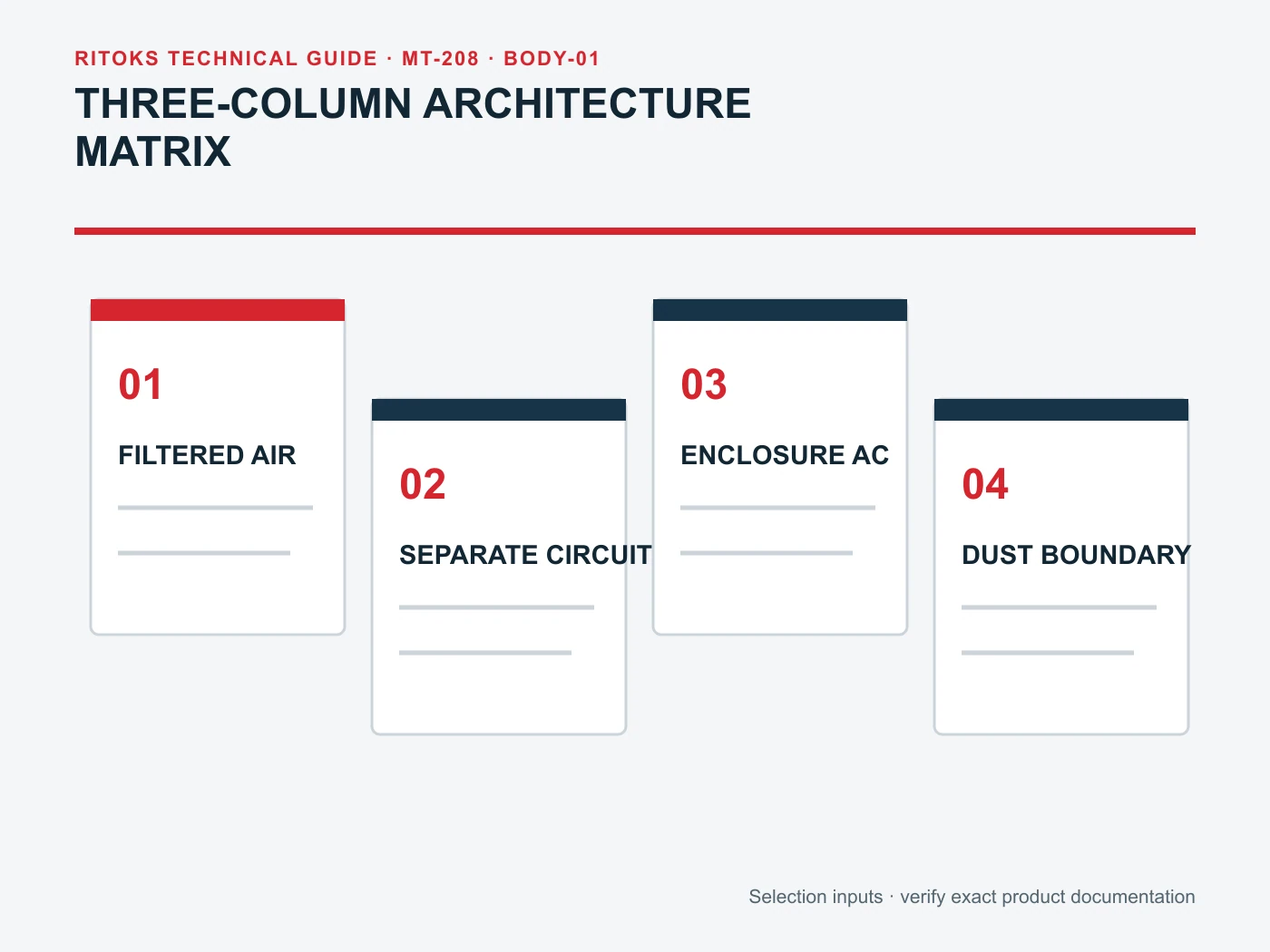
The table compares functions. It does not rank products by a universal efficiency, ingress rating or operating cost. If ambient temperature exceeds the required cabinet temperature, ordinary direct-air ventilation cannot cool the interior below that incoming air merely by moving more of it. If ambient air is cooler but very dirty, the dust-control requirement may dominate. If the internal heat load is low, passive dissipation might also deserve an engineering check. Start with conditions, then compare documented alternatives.
Build a dust-aware RFQ
The most useful RFQ describes the cabinet and the environment precisely enough for a supplier to reject unsuitable options. Include enclosure dimensions and construction, the location and orientation available for cooling hardware, ambient temperature range, desired internal limit, heat losses or load list, and required assembly protection. Describe dust source, particle behavior if known, cleaning process, and whether water, oil mist or corrosive agents are present. State what maintenance staff can access and how often the cabinet may be shut down.
For a filter-fan candidate, request the fan/filter/exhaust arrangement and installed airflow evidence. Ask how filter loading will be monitored and what replacement media is specified. For a heat exchanger, request separate-circuit construction, performance at design temperatures and cleaning requirements on the ambient side. For an air conditioner, request exact cooling capacity at the design point, cutout and mounting template, external airflow path, condensate route, service access and environmental limits. None of these requests implies the data is already published for a RITOKS model.
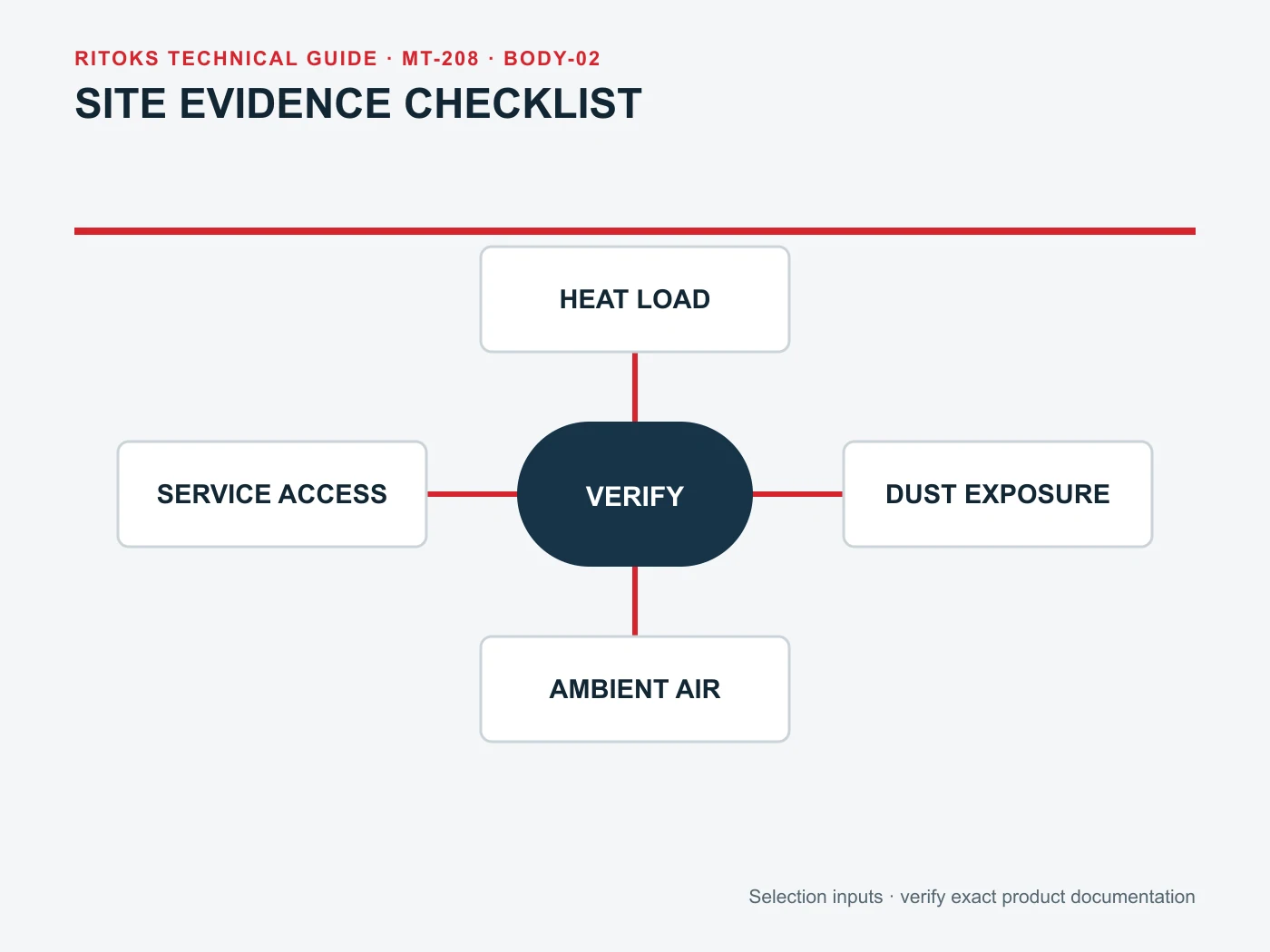
Specify the approval boundary. The panel builder may be responsible for the finished enclosure's protection and electrical safety; the equipment supplier is responsible for accurate exact-model documentation; the facility owner defines environmental conditions and maintenance. Record who validates the completed assembly after modifications. A catalogue unit rating cannot substitute for an enclosure-level review.
Use a staged decision rather than a one-word answer
First screen out paths that cannot meet the temperature relationship or contamination boundary. Then compare the remaining options on documented capacity, space, service, power and site-maintenance burden. Finally verify the exact model in the actual cabinet layout and ask for the operating manual before cutting the enclosure. This prevents a cheap but unmaintainable intake fan and an oversized active cooler from becoming equally plausible mistakes.
For a dusty-facility project, begin with the RITOKS Cabinet Cooling Fans category if filtered ambient-air exchange remains viable, or the Enclosure Air Conditioners category if the design needs an isolated active cooling path. Keep heat exchangers as a separately evidenced inquiry. Whichever route remains, ask for the exact-model and assembly evidence that proves suitability under the facility's real dust and thermal conditions.