
Technical Resources · Selection Guide
DC MCB Selection Guide: Voltage, Current, Poles and Breaking Capacity
A DC miniature circuit breaker (MCB) is easy to identify by its form, but difficult to specify from its faceplate current alone. A buyer may receive several plausible offers with different DC voltage limits, pole arrangements or fault-interruption ratings. The buying problem is to turn a circuit requirement into a comparable, exact-model request without treating an AC rating or a familiar enclosure shape as DC evidence.

This guide addresses DC MCB selection inputs. It does not decide whether an MCB or molded-case breaker architecture is preferable; that separate comparison has its own guide. It also does not provide a wiring diagram. The electrical designer must establish system conditions, and the exact manufacturer record must establish the proposed breaker configuration.
Selection at a Glance
| Buyer input | Record before comparing offers | Exact-model evidence to request |
|---|---|---|
| Voltage envelope | Source type; operating range; maximum possible DC voltage, including relevant open-circuit conditions | DC voltage rating for the proposed pole connection and polarity |
| Current and load | Normal current; expected sustained and transient loading; circuit duty | Rated current and applicable trip characteristics at stated conditions |
| Fault level | Prospective short-circuit current at the proposed breaker position | DC breaking capacity at the actual voltage and configuration |
| Pole arrangement | Required number of conductors to interrupt; system grounding context | Manufacturer diagram and any polarity or series-pole restrictions |
| Installation context | Panel space, mounting and ambient conditions | Dimensions, mounting instructions and applicable operating limits |
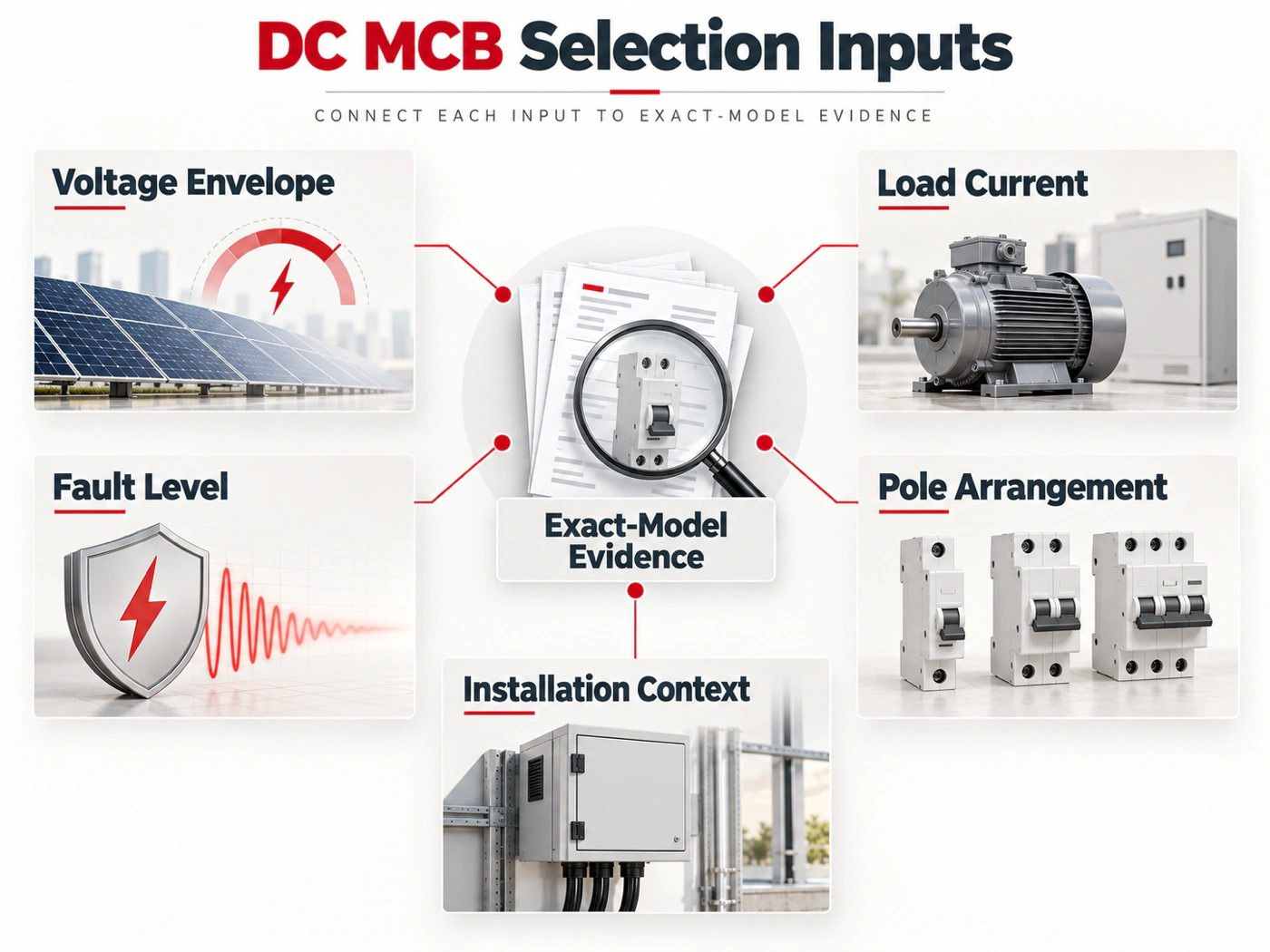
Start With the Circuit, Not the Ampere Marking
Ask the designer for a single circuit record. Identify whether the source is a PV string, battery, power supply or another DC source; these are descriptions of the application, not interchangeable breaker approvals. Record the operating voltage and the maximum voltage the breaker may see. A nominal system label is not automatically the maximum voltage at the device. If that maximum is unknown, leave the candidate model unapproved and request the system calculation.
Record normal load current and the behavior that matters to protection selection: continuous operation, startup or charging transients, and any foreseeable operating changes. Do not choose a trip characteristic simply because the current marking seems adequate. The exact trip information and allowable conditions must come from the candidate model. Record the prospective short-circuit current at the installation point separately from normal current; the two numbers answer different questions.
Read the DC Rating as a Configuration
The comparison is not merely “breaker rated voltage greater than system voltage.” Check the manufacturer table at the relevant DC voltage, pole arrangement, connection scheme and polarity. Some series show a different permissible voltage when poles are used in a stated configuration. That is a property of the documented series, not permission to improvise a series connection on another MCB. The ABB DC-MCB technical guide illustrates why the complete rating and connection record must stay together.
Next compare the prospective fault level with the candidate’s DC interrupting rating at that same configuration. An AC short-circuit rating is not a substitute. If a seller provides only a headline breaking figure without its DC voltage or pole conditions, ask for the underlying datasheet page. If the breaker is intended for isolation as well as overcurrent protection, ask whether the exact product documentation supports that function; do not infer it from the word “breaker.”
A Practical Comparison of Two Offers
| Comparison question | Offer A | Offer B |
|---|---|---|
| Exact orderable code | Record the complete code and revision | Record the complete code and revision |
| DC voltage proof | Identify the datasheet row and pole diagram | Identify the datasheet row and pole diagram |
| Fault interruption | Match the rating to the circuit fault estimate | Match the rating to the circuit fault estimate |
| Trip and environment | Check curve/setting and ambient conditions | Check curve/setting and ambient conditions |
The table is deliberately a document comparison rather than a fabricated numerical example. Reject neither offer merely because its headline current differs. First determine whether both supplied complete evidence for the same circuit requirement. A blank cell is an information request, not an invitation to infer a rating. If the circuit fault estimate changes, revisit both offers rather than carrying forward the previous selection.
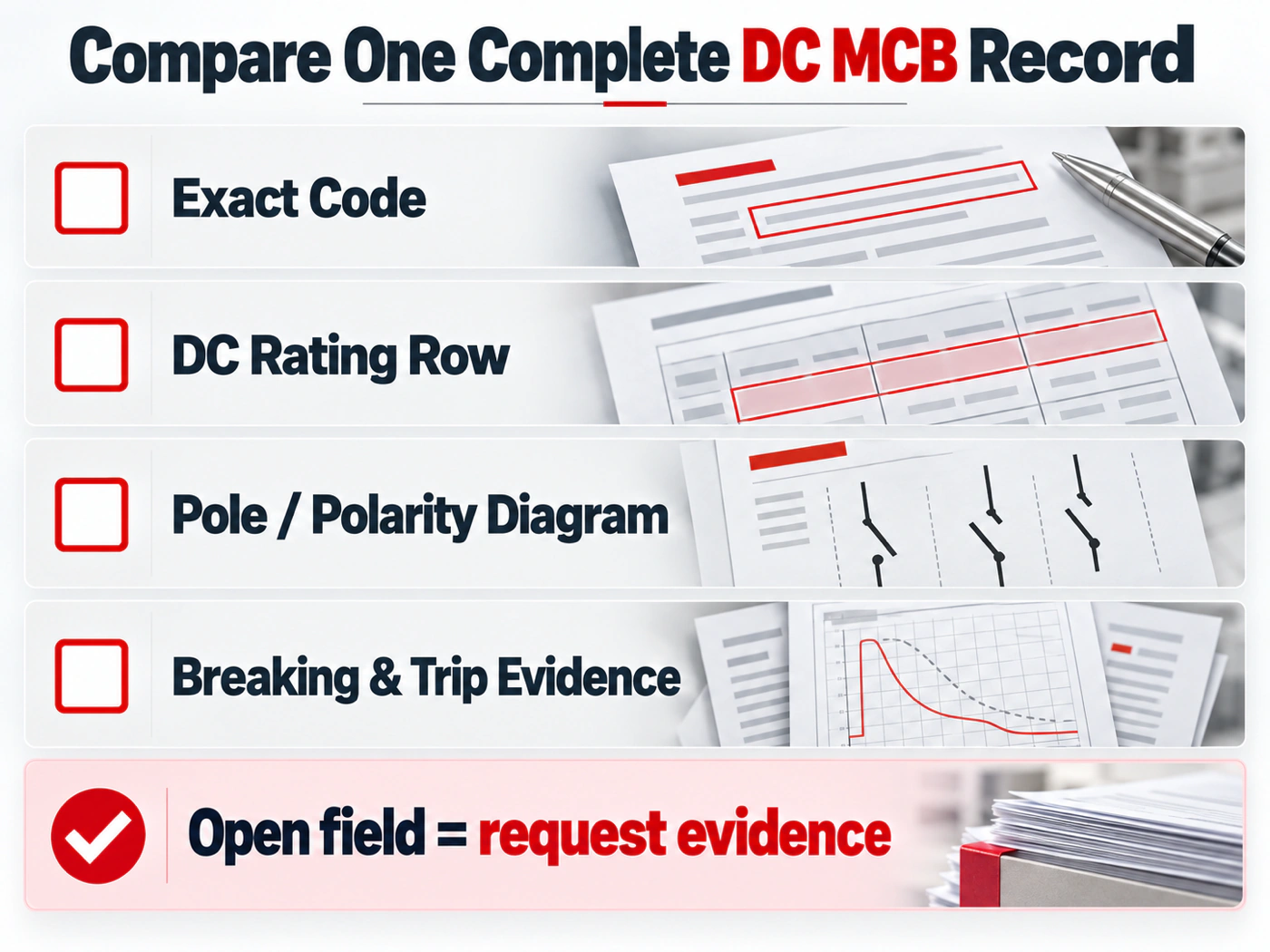
Decision Workflow for the Buyer
- Obtain the circuit voltage envelope, load profile and prospective fault current from the project owner.
- Define the required switching/protection function and which conductors the design requires to be interrupted.
- Shortlist only exact DC-rated MCB variants with a complete manufacturer rating table and connection diagram.
- Compare voltage, pole/polarity and breaking capacity as one documented configuration; then check trip and installation conditions.
- Record every open question against its source document. Ask the manufacturer or qualified designer to resolve gaps before ordering.
Use Published RITOKS Families as Separate Examples
RITOKS publishes a 2P DC MCB family with a 500-1000V page and a separate high-current, lower-voltage DC MCB family. These are examples of why a generic phrase such as “DC MCB” is insufficient: the product records describe different voltage and current envelopes. Read the exact configuration table on each page rather than combining the most attractive numbers from two products. Neither product page establishes compatibility with a particular project by itself.
When requesting a quotation, name the candidate family only if it is actually being considered. Include the complete circuit record even when a model has already been proposed by a distributor. This allows the response to identify which assumptions and documents were used, and it prevents a substitute from being treated as electrically equivalent because it fits the same rail.
Buyer and RFQ Checklist
- Application and source type; intended protection and switching function.
- Normal and maximum circuit voltage, load current and known transient behavior.
- Prospective fault current at the breaker location and the basis used to determine it.
- Required pole arrangement, grounding context and any existing system diagram for engineering review.
- Ambient, enclosure and mounting constraints; required quantity and destination.
- Exact model code, DC rating table, pole/polarity diagram, trip information and evidence for any requested isolation function.
Control Substitutions and Document Changes
A substitute should restart the evidence comparison at the exact order code. Similar dimensions, terminal positions or current markings do not preserve the original DC voltage limit, breaking capacity, trip behavior or permitted pole connection. Ask the supplier to identify every changed field and provide the replacement rating table and connection page. If the substitute belongs to another series, record it as a new candidate rather than editing the original row. This keeps procurement convenience from becoming an unsupported equivalence claim.
Document revisions also matter when the model name stays the same. Record the issue date or revision of the datasheet used for approval and keep it with the quotation. If a later document changes the rating table, accessory list or environmental condition, return the change to the responsible reviewer. A product photograph, marketplace listing or copied distributor table is identification support only; it cannot replace the manufacturer evidence behind the selected configuration.
Close the Buying Record Before Release
Before a purchase order is released, place the project input, candidate code and supporting documents in one comparison record. Each numerical entry should retain its condition: voltage with its pole arrangement, breaking capacity with its test voltage, and trip information with its exact model. Mark unknown values as open questions. This simple discipline prevents a buyer from combining a voltage row from one variant, a fault rating from another and a connection drawing from a third.
The completed record should also state who owns the unresolved decisions. The buyer can confirm quantity, delivery destination and enclosure constraints; the supplier can identify order codes and manufacturer documents; the electrical designer must confirm the circuit assumptions and final application. When those responsibilities are explicit, an RFQ becomes a controlled request for evidence rather than an invitation for an automatic model recommendation.
Finally, record the acceptance basis in language that another buyer can follow: the exact candidate, circuit revision, reviewed documents and any conditions that remain outside the supply scope. This does not turn procurement into engineering approval. It ensures that a repeat order or later substitution starts from the same evidence instead of reconstructing the decision from a faceplate photograph.
Frequently Asked Questions
Can I use an AC-rated MCB if the current marking matches?
No AC marking alone proves a DC application. Request the exact manufacturer DC voltage, pole and breaking-capacity documentation. The answer depends on the orderable model and its permitted configuration, not the external shape.
Does a two-pole label tell me how to connect the device?
No. A pole count is a product description, not a complete DC wiring instruction. Check the exact manufacturer diagram and have the proposed circuit reviewed by the responsible designer.
What should I do if the prospective fault current is unknown?
Do not infer it from normal load current. Ask the project designer for the fault estimate at the intended breaker position before comparing interrupting ratings.
Related RITOKS Products and Guidance
Use these pages as separate product and family records. A link is not a claim that two devices are interchangeable or coordinated.
DC Miniature Circuit Breakers category
High-current low-voltage DC MCB product family
MCB versus MCCB architecture comparison
Technical References
The following manufacturer sources support the general concepts identified below. Their model ratings, diagrams and approvals do not transfer to RITOKS products.
ABB, Electrical Installation Solutions: Miniature Circuit Breakers, DC applications
Supports the need to read DC voltage, pole connection and polarity from one exact breaker-series record. ABB values and diagrams are not RITOKS ratings or installation instructions.
Request an Exact-Model Review
Send the recorded application requirements, exact documentation questions, quantity and destination through the RITOKS contact form. An RFQ requests an exact-model review; this guide does not approve a wiring design or recommend an automatic substitute.