
Power Distribution Components · Technical Explainer
DIN Rail Power Supply Derating in a Hot Control Cabinet

Start with the temperature that the rating actually uses
A cabinet's room-temperature design record can look comfortable while the installed DIN-rail power supply operates beside heat-producing equipment. The nominal output-current label does not settle how much continuous output is permitted at that location. The relevant question is whether the actual installation matches the selected supply's temperature and mounting conditions.
A DIN rail power supply temperature derating cabinet review needs the exact model's applicable curve, the manufacturer's ambient-temperature definition and the installed arrangement. Keep continuous demand distinct from short-term output capability. Neither room temperature nor the absence of a thermal shutdown proves that the derated operating limit has been respected.
This guide gives control-panel designers a curve-applicability record and an allowed-output worksheet. It does not calculate enclosure cooling capacity, prescribe a fan arrangement or provide a live measurement procedure. Its scope is the power supply's own permitted output under documented installation conditions, not the selection of the entire cabinet's thermal-management system.
Identify the RTX-DPS evidence that is still needed
The RITOKS RTX-DPS DIN-rail power-supply page identifies a control supply and asks the buyer to consider operating-temperature derating. Its public output specification describes the listed reference, but it does not include a complete temperature derating curve or a mounting-specific continuous-output table.
Do not interpret that omission as proof that the supply needs no derating or cannot operate in a warm panel. It means the applicable model-specific information is still needed. Request the actual technical document, its revision, relevant input conditions and the manufacturer's definition of the temperature used for the rating.
Also request the mounting and clearance instructions for the selected reference. A general DIN-rail description is not a declaration that every orientation or spacing gives the same permitted output. Keep the orderable model and actual installation arrangement linked to the document used for acceptance.
Use a manufacturer example without transferring its values
PULS's CP20.245-R2 datasheet defines the ambient location used in its environmental information, distinguishes continuous and short-term output curves and provides mounting-orientation guidance. Its enclosed-installation discussion also distinguishes the inside conditions from the temperature outside the box.
Those are product-specific documentary examples. This article does not copy their temperature location, clearance, derating rate, output current, altitude allowance or orientation values into RTX-DPS. The example explains which definitions to seek in the selected supply's own documentation, not how to populate a missing RITOKS rating table.
The same datasheet notes that its derating limits are not automatically hardware-controlled. That illustrates an important evidence distinction: a protective response and a permitted operating envelope are not the same declaration. No corresponding thermal protection mechanism is asserted for RTX-DPS here.
Keep room, cabinet and local ambient records distinct
Room air temperature, a cabinet's general interior temperature and the local ambient used by a power-supply curve describe different locations. A record from one location cannot silently substitute for another. Use the selected manufacturer's actual definition before deciding whether an existing temperature observation is applicable.
Record the observation location and the conditions under which it was obtained. The responsible engineer's approved assessment should account for the relevant cabinet loading, surrounding equipment and intended operating condition. This article supplies no universal sensor position or claim that one interior observation represents every installation state.
A local thermal environment can change when neighboring equipment or loading changes. Retain those conditions with the record instead of keeping only a temperature number. A commissioning observation made under one arrangement does not establish the unchanged applicability of a curve after a materially different installation is introduced.
Do not substitute a surface temperature for a defined surrounding-air temperature without supporting instructions. Both may be useful observations, but they answer different questions. The curve's horizontal axis and its stated temperature definition determine which evidence belongs in the allowed-output review.

Read the continuous-output curve before the headline range
Identify what the vertical axis actually represents: output current, power or another stated quantity. Retain the units, selected output condition and any accompanying notes. A general operating-temperature range is not necessarily a declaration of full nominal output throughout that range.
Then identify which line applies to continuous operation. A short-term allowance must retain its duration and other conditions; it cannot be used as an unlimited current budget because it appears above another line. If the documentation has more than one operating curve, preserve the distinction instead of choosing the most generous one.
Keep input and output conditions with the selected curve. A document may qualify its output capability under particular supply or adjustment conditions. Do not assume that the curve for one documented condition automatically covers another, or derive an absent limit from a family-level headline.
Read any interpolation or endpoint instructions that the actual document provides. This guide gives no invented RTX-DPS slope, breakpoint or extrapolation rule. If the observation falls outside the documented scope, the appropriate record is an applicability question for the manufacturer and responsible designer, not a guessed extension of the graph.
Check mounting direction, clearances and adjacent equipment
The installed orientation must match the applicable instructions or the documented alternative arrangement. A power supply rotated to fit a panel can have different allowed conditions where the manufacturer declares them. Do not retain a standard-orientation curve while leaving the change of orientation unrecorded.
Clearance instructions need the same discipline. Record the actual required distances and their conditions from the selected model's document. This article assigns no universal gap above, below or beside RTX-DPS and does not prescribe rearranging energized equipment.
Keep neighboring heat sources and ventilation restrictions visible in the installation record. A spacing diagram without its associated assumptions can hide the condition under which it applies. The aim is to determine whether the manufacturer's declared arrangement matches the proposal, not to claim a new thermal result from a drawing alone.
Where another condition, such as altitude, is relevant to the selected model's documentation, retain that applicability check as well. Do not multiply independent-looking correction factors unless the manufacturer actually permits that method. Several qualifications in a document do not automatically form one universal arithmetic derating formula.
Build an allowed-output acceptance worksheet
The following original worksheet connects conditions to the required evidence. It is not a RITOKS derating table. Only the exact-model technical document can supply the allowed output and installation requirements; unresolved fields remain unresolved until the responsible review obtains them.
| Review field | Record to retain | Acceptance question |
|---|---|---|
| Supply identity | Orderable reference and document revision | Does this document cover the proposed unit? |
| Electrical conditions | Applicable input and output configuration | Does the selected curve cover these conditions? |
| Temperature definition | Manufacturer-defined ambient location | Is the retained observation comparable? |
| Thermal observation | Relevant temperature and operating conditions | Does it represent the intended installed state? |
| Mounting | Actual orientation and applicable instructions | Is the standard or alternative curve appropriate? |
| Spacing and surroundings | Required clearances and adjacent arrangement | Are the documented installation conditions met? |
| Output duty | Continuous demand and any separate transient demand | Is each compared with its correct allowance? |
| Allowed output | Applicable limit with all qualifications retained | Is the demand inside the supported envelope? |
Consider a documentary case in which a quotation cites a room temperature while the chosen supply curve defines a local ambient condition. The output limit has not yet been established for the installation. Obtain a comparable observation rather than treating the room value as a completed thermal acceptance record.
In another case, a layout revision rotates the supply and reduces its available space. An earlier standard-mounting acceptance cannot be carried forward unchanged. Review the applicable arrangement and supporting conditions before confirming the available continuous output; no numerical correction is implied by this example.
Compare demand without merging continuous and transient claims
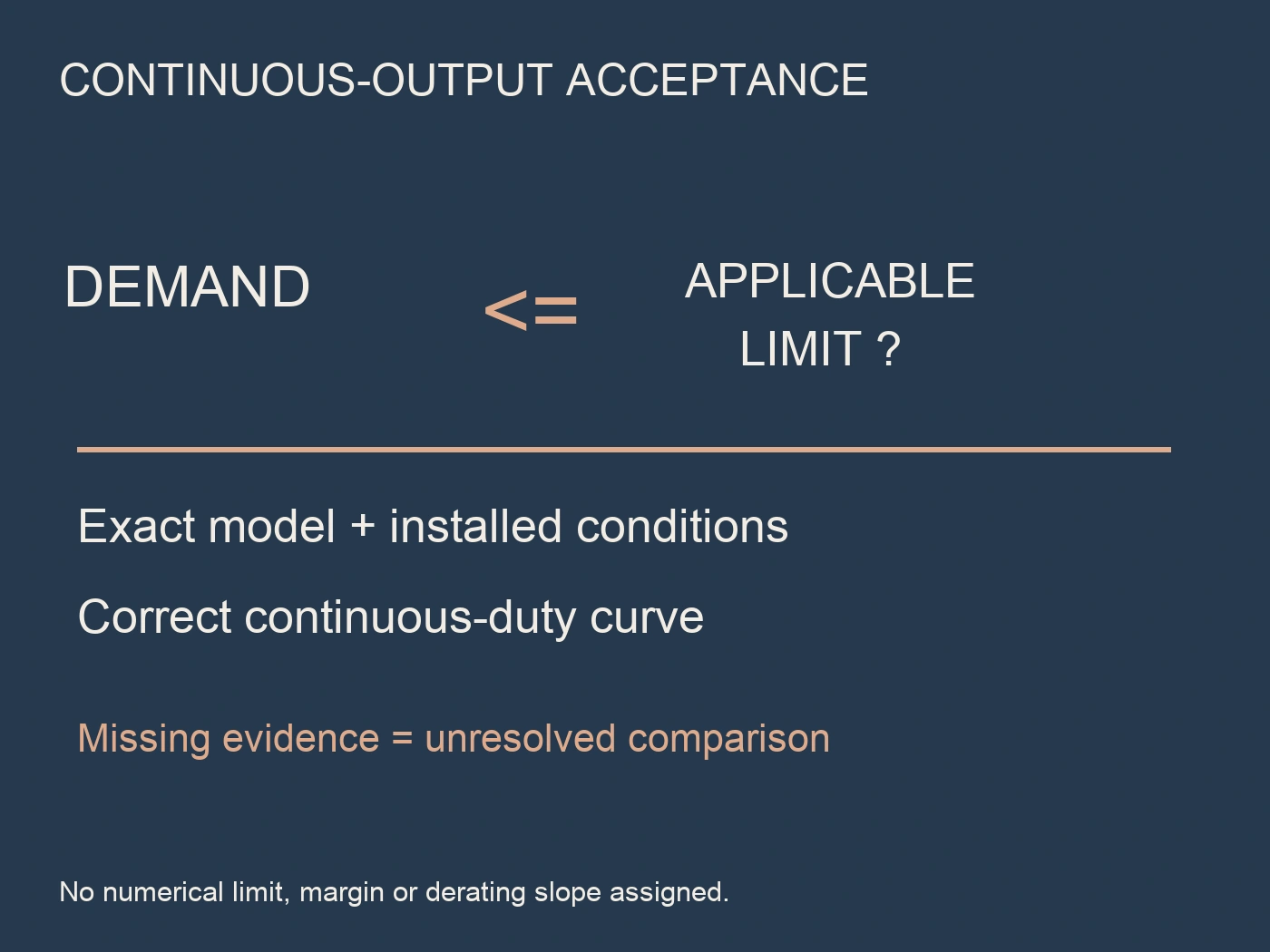
Keep the intended continuous load requirement in its own record, with the relevant operating conditions. Compare that demand with the supported continuous-output limit for the installation. A nominal current label under unspecified conditions is not a substitute for the applicable limit.
Startup and other short-duration demands need their own evidence. A supply that meets a derated steady requirement has not thereby passed a capacitive-startup review. Conversely, a successful brief startup does not establish continuous thermal suitability. These are different acceptance questions rather than interchangeable demonstrations.
Retain the team's actual uncertainty or margin policy without inventing a universal percentage. Where the applicable limit or observation remains uncertain, record the gap and responsible decision. A spreadsheet with a precise-looking result is not more authoritative than the incomplete inputs from which it was produced.
Do not use a protective trip as the derating boundary
A protective shutdown, if the selected device documents one, is a response to a defined condition. Its existence does not authorize loading up to the point where it acts. The permitted continuous output must come from the applicable rating and installation evidence.
Likewise, an operating period with no shutdown proves only the observations actually recorded during that period. It does not independently establish compliance with every temperature, mounting or life-related condition. Do not describe a brief functional check as a complete thermal acceptance test or invent a longevity claim from it.
Close the inquiry with the installed conditions attached
For an RTX-DPS inquiry, provide the exact reference, input/output arrangement, continuous demand, intended mounting and relevant surrounding conditions. Request the temperature definition, continuous-output curve, installation clearances and any applicable alternative-orientation limits.
Keep the accepted limit with the observation and document revision that support it. If the installation or operating conditions change, revisit the affected fields. The useful result is a traceable permitted-output record for the actual proposal, not a borrowed derating curve or a bare statement that the cabinet feels cool enough.
Source notes
Sources inspected 1 October 2026. The worksheet and documentary cases are original tools, not measured RTX-DPS data or a prescribed temperature-test procedure.
- RITOKS RTX-DPS: public control-supply reference and operating-temperature selection boundary.
- PULS CP20.245-R2 datasheet, March2026 revision1.3, sections2,16,24.11 and24.12: actual model-specific ambient definition, continuous/short-term distinction, enclosure conditions and mounting qualification. No numerical limits transferred to RITOKS.