
Thermal Management · Comparison
Enclosure Cooling vs Anti-Condensation Heating: Different Thermal Problems
Enclosure cooling and anti-condensation heating solve different thermal problems. Cooling removes or transports excess heat when internal temperature would otherwise rise too far. A heater raises local temperature to reduce condensation risk during cool or changing conditions. Selecting one from the product name alone can leave the actual problem untreated.
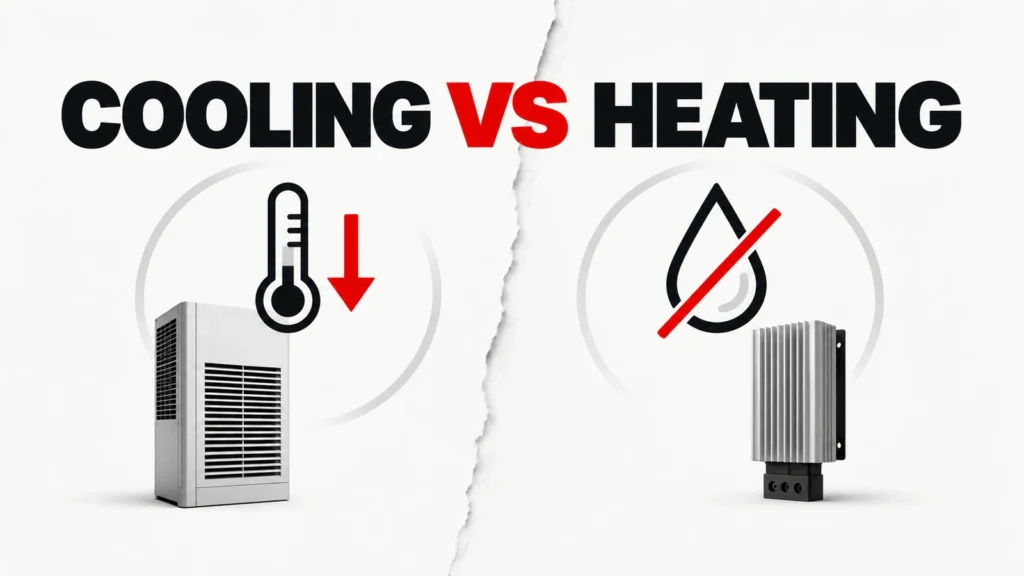
This comparison defines the decision boundary between cooling and anti-condensation heating. It does not calculate a final heat balance, dew point, heater wattage or cooling capacity for an unknown cabinet, and it does not claim that linked RITOKS products form an approved combined system.
Buying Decision at a Glance
| Decision input | Buyer must confirm | Evidence required |
|---|---|---|
| Primary risk | Excess internal temperature or moisture condensation | Documented thermal and humidity problem statement |
| Heat sources | Internal losses and external heat gain | Equipment loss schedule and site conditions |
| Moisture | Humidity, temperature cycling and cold surfaces | Site measurements or design climate data |
| Control | Temperature, humidity or dew-point-related strategy | Exact controller and product documentation |
| Environment | Sealed/ventilated cabinet, dust, washdown and outdoor exposure | Enclosure and installation requirements |
Define the Problem Before the Product
Begin with the failure mode. Excess temperature threatens equipment limits and service life. Condensation can create moisture on surfaces when their temperature falls below the local dew point. A cabinet can face one problem, the other, or both at different operating states.
Record when the risk occurs: full-load production, a hot ambient period, overnight shutdown, cold startup, door opening or seasonal temperature change. Time and operating state prevent a single spot temperature from being mistaken for the whole application.
Cooling Addresses a Positive Heat Balance
Cooling or ventilation is considered when equipment losses and external heat gain would push the enclosure above its permissible internal temperature. The method depends on ambient air quality, required separation, target temperature and the magnitude of heat removal.
A filter fan exchanges cabinet air with ambient air and therefore depends on a useful temperature difference and acceptable contamination conditions. An enclosure air conditioner can maintain a controlled internal circuit, but capacity still must be read at the intended operating point.
Heating Addresses Cold-Surface and Moisture Risk
An anti-condensation heater adds heat so selected surfaces or cabinet air remain above conditions where condensation forms. Its purpose is not to remove equipment heat. Heating a cabinet that already has an excessive heat load can worsen the temperature problem.
Humidity, air leakage, surface temperature, cabinet volume, placement and control method all affect the result. A wattage label by itself cannot prove condensation prevention. Request the exact heater and control guidance for the intended enclosure.
Recognize Mixed and Seasonal Conditions
Outdoor and intermittently operated enclosures may need cooling during loaded hot periods and anti-condensation heating during shutdown or cold transitions. That does not mean both devices should operate together without a defined control strategy.
Document operating modes, setpoints, sensor locations, interlocks and failure states. Require exact compatibility and control evidence for any proposed combination. Separate product pages are not evidence that the products have been tested as one system.
Choose the Thermal Management Boundary
Decide whether ambient air can enter the enclosure, whether internal temperature must remain below ambient, and whether contaminants or washdown require a closed-loop method. Also define whether local component airflow is different from cabinet-level heat rejection.
Rittal planning guidance supports evaluating heat loss, ambient conditions and cabinet construction together. Use the principle, not another manufacturer’s equipment value, when preparing a RITOKS inquiry.
Build an Evidence File Before Approval
Create one review sheet for the proposed Enclosure Cooling Strategy order code or system. Put project inputs in one column and supplier evidence in the other. Preserve the exact pages, drawings, curves and tables used in the decision, including their revision or retrieval date. A category page can establish product-family context, but an exact rating, connection or performance claim must trace to the quoted configuration.
Check that every accepted value describes the same orderable item. Similar housings can contain different circuits, supplies, terminals, airflow arrangements or accessories. Do not combine a family maximum from one variant, a drawing from another and an optional feature from a third. Mark unresolved fields explicitly instead of allowing them to disappear in the commercial quotation.
Control Changes During Sourcing
Keep the application record frozen while suppliers respond. If the load, voltage, environment, duty, enclosure, control method or required output changes, issue a revised record and ask each supplier to reconfirm the candidate. Otherwise two quotations may look comparable while answering different technical requirements.
A proposed substitute returns to the same evidence gate. Matching dimensions, a similar product photograph or one equal headline rating is not enough. The substitute must satisfy the required functions and conditions with its own exact documentation.
Common Procurement Errors
- Selecting Enclosure Cooling Strategy from one headline rating while leaving the application context undefined.
- Using a curve, diagram or performance claim from a neighboring model.
- Comparing data measured under different voltage, temperature, airflow or duty conditions.
- Treating included accessories and system functions as obvious from a product name.
- Approving a substitution without reopening the technical evidence review.
Do not ask a heater to solve an overheating cabinet or assume a cooling fan eliminates shutdown condensation. Compare offers against two operating states: maximum running heat and low-temperature or humid shutdown. They are different design questions even in the same enclosure.
How to Compare Supplier Offers
| Comparison point | Required evidence | Do not accept |
|---|---|---|
| Primary objective | Cooling: remove excess heat; heating: reduce condensation risk | “Temperature control” without a defined risk |
| Driving data | Cooling: heat load and ambient; heating: humidity and cold surfaces | One room-temperature reading |
| System boundary | Ventilated, closed-loop or local airflow defined | Fan, heater and air conditioner treated as interchangeable |
| Controls | Operating modes, sensors and setpoints documented | Simultaneous operation assumed acceptable |
| Evidence | Exact capacity or heater/control data | Physical size or headline wattage alone |
Normalize every Enclosure Cooling Strategy offer to the same application record. Keep document revisions, test conditions and open questions beside each value. A proposal can remain commercially interesting while technically incomplete, but missing evidence must stay visible until it is resolved.
Decision Workflow
- Identify the equipment failure risk and operating state.
- Record heat losses, external ambient range, humidity and cabinet construction.
- Determine whether ambient-air exchange is acceptable.
- Select a cooling, heating or mixed strategy at the system level.
- Request exact product performance and control documentation.
- Verify the installed system under the relevant hot, cold and transition conditions.
Record when the cabinet overheats and when moisture appears. Assign cooling, ventilation or anti-condensation heating to the relevant operating state, then verify the exact product's controls and environmental boundary. Do not combine their capacities into one headline number.
RFQ Preparation Checklist
A useful RFQ for cabinet cooling vs heating is concise enough to answer and complete enough to prevent silent assumptions. Identify unknown values as questions and require an exact orderable code rather than a generic family recommendation.
- Cabinet dimensions, material and installation position
- Equipment heat-loss schedule and duty cycle
- Maximum/minimum ambient and target internal temperature
- Humidity, condensation history and temperature cycling
- Dust, washdown, corrosion and outdoor exposure
- Allowed ventilation or closed-loop requirement
- Control, sensor, alarm and interlock expectations
- Quantity, destination and exact document needs
Request the current datasheet revision and the scope of any certification, compatibility or performance claim. Record quantity and destination after the technical inputs so commercial terms do not obscure unresolved engineering questions.
Stop Conditions Before Order Release
Do not release the order while a critical application input is unknown, the quoted model is ambiguous, a required rating is supported only by another manufacturer’s document, or installation conditions fall outside the available evidence. These are engineering gaps, not editorial details.
The approval record should state what the selected item does, what remains outside its scope and which exact documents support the decision. If the application or candidate changes, reopen the affected checks rather than carrying the previous conclusion forward.
Frequently Asked Questions
Can a cabinet heater cool equipment by improving circulation?
No. A heater adds heat. Air movement and heat rejection are separate functions.
Does a filter fan prevent condensation?
Do not assume so. It exchanges air and may introduce humid ambient air; condensation risk requires its own assessment.
Can cooling and heating be used in one enclosure?
Potentially, when different operating states require them, but the controls and exact components must be engineered and documented as a system.
Related RITOKS Products and Guidance
Use these links as separate category, product and Resource records. A contextual link does not claim interchangeability, compatibility or an approved system combination.
Enclosure Cooling Strategy product category
EP-A enclosure air conditioners
Cabinet cooling fan selection guide
Enclosure air conditioner selection guide
Technical References
These primary manufacturer sources support only the general concepts identified below. Their product values, diagrams and approvals do not transfer to RITOKS products.
Rittal, Technical System Catalogue: Cooling with Ambient Air
Supports separating internal heat loss, surface heat exchange, permissible temperature rise, airflow and environmental conditions. Rittal formulas and equipment data must be used only within their stated conditions.
Rittal, RiTherm Climate Control Planning
Supports needs-based enclosure climate-control planning from cabinet, heat-load and ambient inputs. It is not an exact RITOKS product selector.
Request an Exact-Model Review
Send the application requirements, exact documentation questions, quantity and destination through the RITOKS contact form. An RFQ requests an exact-model review; this guide does not approve a wiring design, installation or automatic substitute.