
技術リソース · 比較
Split-Core vs Solid-Core Current Transformers
Split-Core vs Solid-Core Current Transformers begins with a controlled application record, not a catalog headline. Buyers should define the real system, installation and service conditions before comparing candidate products. Every decisive claim then needs support from the exact proposed order code.
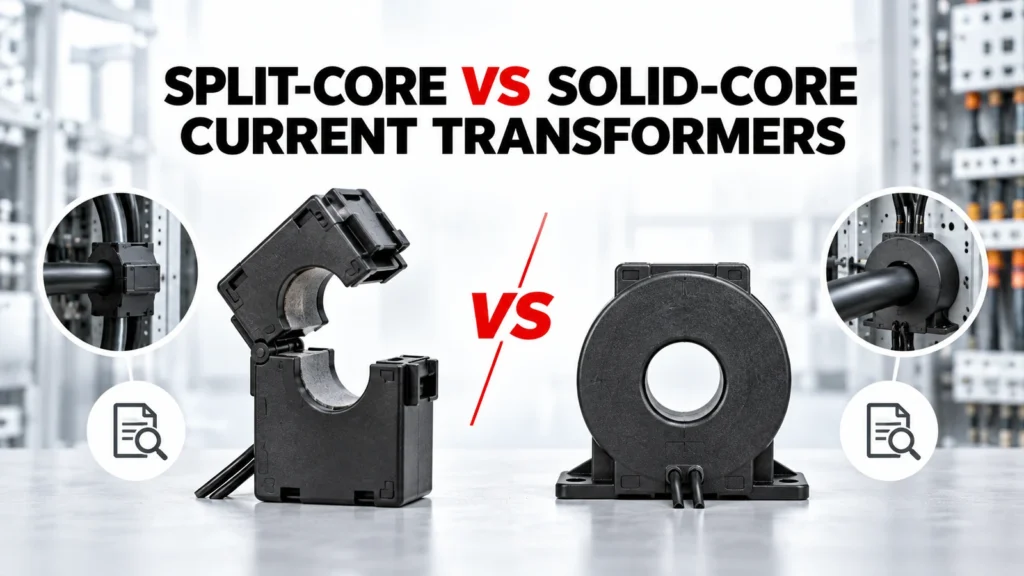
This comparison explains procurement and installation questions created by split-core and solid-core construction. It does not declare one construction universally more accurate, assign a ratio, approve an open-secondary practice or transfer any performance value between models.
意思決定の入力要素の概要
| レビュー対象エリア | 購入者は以下を定義しなければならない | 必要な証拠 |
|---|---|---|
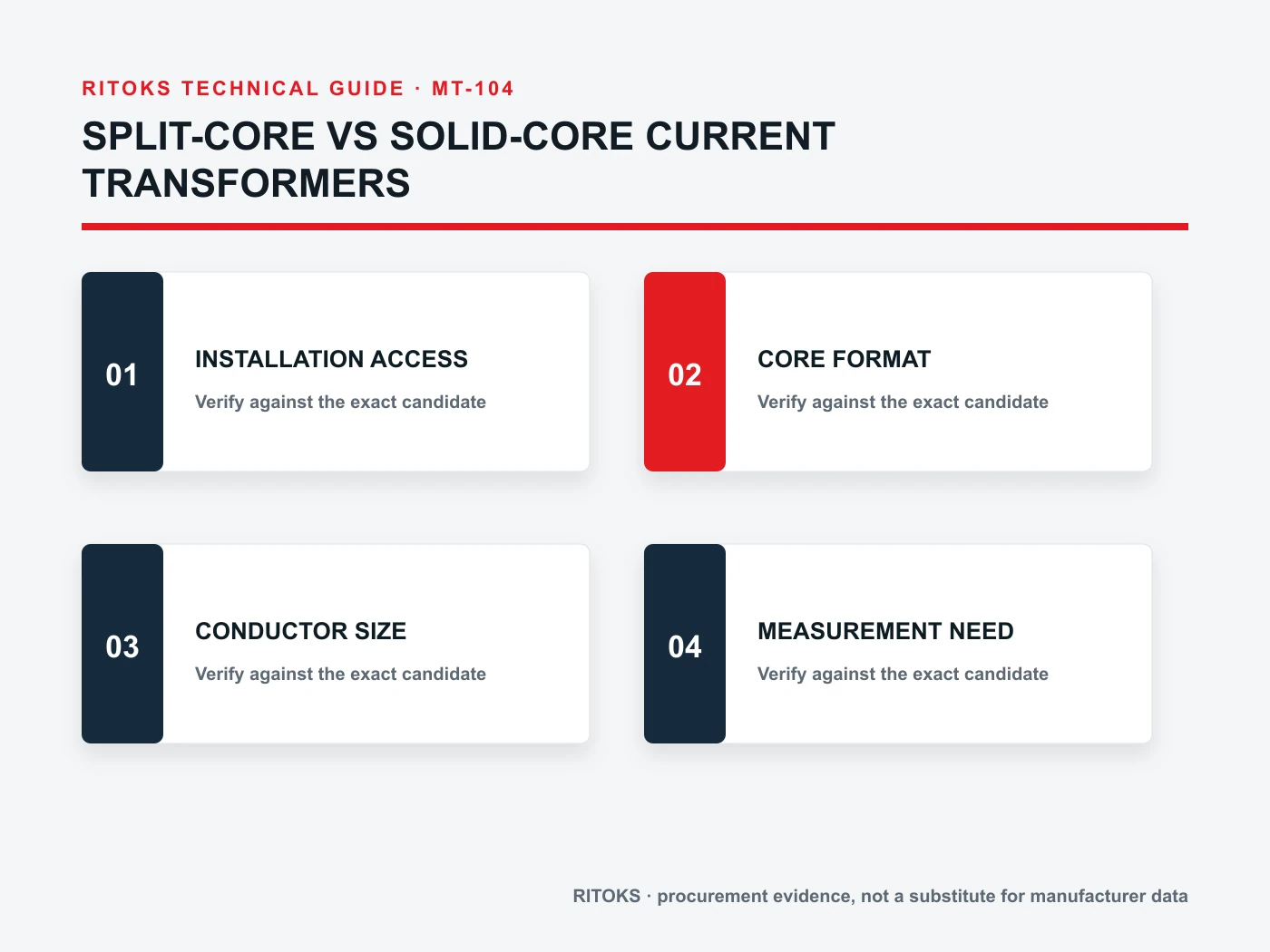
| 設置へのアクセス | Whether the primary conductor can be disconnected or rerouted | Site survey and installation sequence |
| 機械的嵌合 | Conductor or busbar shape, aperture and available clearance | Exact drawing and panel layout |
| Measurement duty | Primary range, secondary interface, burden and required performance | Meter input data and exact CT curves |
| 建設 | Opening mechanism, core closure or one-piece body | Exact-model construction drawing |
| サービス | Inspection, replacement and secondary-circuit controls | Maintenance method and safety procedure |
The Core Construction Changes the Installation Method
A split-core current transformer opens so it can be placed around an existing conductor without threading the conductor through a closed aperture. A solid-core transformer has a continuous core opening, so the installation normally requires access to pass the conductor through it. This mechanical distinction can dominate retrofit planning.
Construction alone does not prove electrical performance. Two CTs with different housings may also differ in ratio, output type, burden, accuracy class, frequency range, insulation and environmental limits. Compare exact order codes under the same measurement requirement.
Use Installation Access as the First Decision Gate
For a retrofit, record whether the circuit can be de-energized, whether the conductor can be disconnected and whether there is physical room to open, place and close a split-core device. Include adjacent conductors, bends, busbar supports, barriers and enclosure access in the survey.
For new equipment, a solid-core design may be practical because the conductor routing can be planned during assembly. That does not make it an automatic choice. Manufacturing sequence, replacement strategy and the approved metering architecture still need review.
Verify Aperture and Conductor Geometry
A nominal conductor size is not enough to establish fit. Confirm the exact aperture drawing, conductor or busbar dimensions, insulation thickness, bend radius and the clearance needed to install or operate the opening mechanism.
Do not force a split core closed around an unsuitable conductor or assume that a same-family housing has the same aperture. Mechanical strain, an incomplete closure or interference with nearby components can invalidate the intended installation.
Compare the Complete Measurement Chain
Define the expected primary current range, secondary output, connected meter or transducer, lead arrangement and permissible burden. Verify ratio, accuracy and phase performance from exact-model data at applicable conditions rather than from a family headline.
The CT and receiving instrument form a system. A mechanically convenient transformer is not useful if its output and burden requirements do not match the meter. Conversely, a promising performance table does not solve an inaccessible installation.
Treat Split-Core Closure as a Controlled Interface
The mating core surfaces and closure mechanism are part of a split-core product’s construction. Follow the exact instructions for opening, cleaning, closing, securing and inspecting the device. Do not insert material at the joint or improvise a latch repair.
Record whether repeated opening is permitted and how a closed condition is confirmed. If contamination, vibration or maintenance handling is significant, include those conditions in the supplier review rather than assuming the joint is unaffected.
Keep Secondary-Circuit Safety in the Work Plan
Current-transformer secondary circuits require an approved installation and service method. The exact CT and system documentation governs terminal treatment, burden connection, shorting provisions, grounding and safe de-energized work.
This comparison intentionally does not give a wiring procedure. Procurement should require the terminal diagram and installation instructions for the exact order code, while the project team supplies the approved panel and maintenance design.
正確なモデルの証拠ファイルを作成する
Create one approval record for the proposed Current Transformer order code. Put each project requirement beside the supplier document that answers it. Preserve the exact datasheet, drawing, curve, table, instruction or selection output used, including its revision or retrieval date. A category page can establish family context, but it cannot prove an exact rating, construction, terminal arrangement or system combination.
承認済みの記述がすべて、同一の注文可能な商品を記述していることを確認してください。あるバリエーションの「ファミリー上限」、別のバリエーションの「図」、さらに別のバリエーションの「オプション機能」を組み合わせて使用しないでください。未解決の項目は、技術レビューおよび商談レビューの段階で表示されたままになるよう、明示的にマークしてください。.
プロジェクトのインプットと成果物の根拠は区別しておく
The project team defines the application: source, load, duty, environment, controls, mounting, service and required functions. The supplier identifies an exact Current Transformer and supports it with exact documents. Neither side should fill a gap by inference from appearance, a shared family name or one matching headline value.
見積書の比較を行っている間は、申請記録を凍結してください。電気的負荷、環境、冷却方法、筐体、設置条件、または要求される機能に変更が生じた場合は、改訂版記録を作成し、すべてのサプライヤーに対して候補品の再確認を依頼してください。.
発注前に受入記録を定義する
Write the acceptance record before a preferred Current Transformer is chosen. Include the project inputs, proposed order code, included accessories, document revisions, exceptions, assumptions and the person responsible for resolving each open point. This prevents the technical basis from being reconstructed after price negotiations have already narrowed the choice.
必須要件と、単なる希望事項や将来の選択肢とを区別してください。必須要件には、直接的な証拠または文書化された技術的決定が必要です。希望事項は比較に影響を与える可能性がありますが、安全性やコンプライアンスの要件として提示してはなりません。将来の選択肢については、プロジェクトで実際にその導入が見込まれる場合にのみ確認すべきです。なぜなら、オプション機能によって、注文コード、端子、寸法、または関連文書が変更される可能性があるからです。.
納品された部品および完成した組立品を確認する
Incoming inspection should compare the delivered Current Transformer, labels, accessories and documents with the approved record. Do not accept a same-family replacement solely because its appearance or one rating matches. Record any substitution and repeat the affected review before installation.
組み立て後は、部品の資料だけでは確認できない機能や状態を検証してください。この確認には、必要に応じて、機械的な嵌合、承認済み配線図に基づく配線、制御動作、温度、気流、警報、または保守用アクセスなどが含まれる場合があります。発注書に一律の限界値を定めるのではなく、プロジェクトの試験計画書において、代表的な動作状態と受入基準を明確に定義してください。.
調達におけるよくあるミス
- Selecting a Current Transformer from one headline value while the application context remains incomplete.
- 近隣の注文コードに含まれる曲線、回路、図面、またはクレームを使用すること。.
- カテゴリページ、商品写真、または名目上のサイズを、正確な互換性の証拠として扱うこと。.
- 付属品、システム機能、または調整結果が、関連する文書なしに含まれていると仮定する。.
- 電気・機械・証拠の審査を繰り返し行わずに、代替案を承認すること。.
価格や納期を比較する前に、こうした不備を解消しておきましょう。技術的には不完全であっても、提案書は商業的に魅力的なままである可能性がありますが、不足している証拠が見積書の中に埋もれてしまわないようにしなければなりません。.
サプライヤーの提案を比較する方法
| レビュー対象エリア | 購入者は以下を定義しなければならない | 必要な証拠 |
|---|---|---|
| 注文コード | 提案された商品本体および付属品一式 | 正確なデータシートと測定範囲 |
| アプリケーションの適合性 | 提出された運転条件および環境条件 | 各要件に対する書面による回答 |
| 機械的統合 | 取り付け、端子、クリアランスおよび保守 | 正確な図面と説明書 |
| 電気的な証拠 | 適用される定格、特性曲線、およびトポロジー | Exact-modelの技術文書 |
| 未解決事項 | 未知の要素、例外、および仮定 | 日付入り説明リスト |
Normalize every Current Transformer offer to the same application record. Keep document revisions, test conditions, included accessories and open questions beside each value. This makes differences in delivered scope visible and prevents a lower-cost but narrower offer from appearing equivalent to a complete proposal.
意思決定ワークフロー
- システムの境界と動作状態を固定する。.
- 電気、機械、環境、およびサービスに関する入力を記録してください。.
- 確認する候補注文コードを1つ選択してください。.
- すべての重要な主張について、正確なモデルに基づく証拠と照らし合わせて検証すること。.
- 商業的な比較を行う前に、例外事項や仮定を整理しておくこと。.
- アプリケーションのリスクに応じて、完成したアセンブリの検証を行う。.
重要な入力値が不明な場合、引用されたモデルに曖昧さがある場合、必須の主張が他のメーカーや注文コードによってのみ裏付けられている場合、あるいは設置条件が利用可能な証拠の範囲外である場合は、そこで中止してください。これらは編集上の細部ではなく、技術的な不備です。.
見積依頼書(RFQ)作成チェックリスト
A useful RFQ for split core vs solid core current transformer is concise enough to answer and complete enough to prevent silent assumptions. Identify unknown values as questions and require a full orderable code rather than a generic family recommendation.
- INSTALLATION ACCESS
- APERTURE FIT
- CONDUCTOR ROUTE
- SERVICE PLAN
- RATIO
- OUTPUT
- BURDEN
- EXACT CURVES
- 必要書類および修正事項
- 数量、配送先、および希望する配送範囲
サプライヤーに対し、除外事項、前提条件、および選択肢を個別に明記するよう依頼してください。技術的な入力事項の後に数量と仕向地を記載し、商取引条件によって未解決の技術的な問題が覆い隠されないようにしてください。.
よくある質問
Can I select a Current Transformer from one rating or size?
いいえ。選定には、申請書類一式、正確な構造仕様、および該当するすべての電気的、機械的、熱的、環境的条件ならびに文書要件が必要です。.
ファミリーページを承認の証拠として使用できますか?
ファミリーページは概要を把握するのに役立ちます。承認にあたっては、正確な注文コードのデータシート、図面、説明書、およびプロジェクト固有の技術的根拠を使用する必要があります。.
見た目が似ているモデルは互換性がありますか?
必ずしもそうとは限りません。外観が似ている筐体であっても、内部の回路、材質、端子、定格、付属品などが異なる場合があります。代替品ごとに確認作業を繰り返してください。.
見積書にはどのような項目を記載しておくべきでしょうか?
プロジェクトの入力事項の欠落、検証されていない「正確なモデル」の主張、不明確な付属品、または未解決の設置条件については、当然のこととして扱うのではなく、未解決事項としてリストアップする必要があります。.
関連するRITOKSのリソースおよびRFQ
以下をご覧ください Current Transformer product category, 主な関連商品のページを確認する, 関連商品のオプション2を確認する, 関連商品のオプション3を確認する. これらのページでは、商業的な背景情報を提供しています。具体的な適合性については、プロジェクトの実績および提示された注文コードによって異なります。.
技術記録の準備が整い次第、, 申請書類および必要書類をRITOKSに送付してください 正式な見積書をご請求ください。最終的な選定については、プロジェクトエンジニアの承認およびメーカーの最新資料に基づいて決定してください。.