
Technical Resources · Comparison
Split-Core vs Solid-Core Current Transformers
Split-Core vs Solid-Core Current Transformers begins with a controlled application record, not a catalog headline. Buyers should define the real system, installation and service conditions before comparing candidate products. Every decisive claim then needs support from the exact proposed order code.
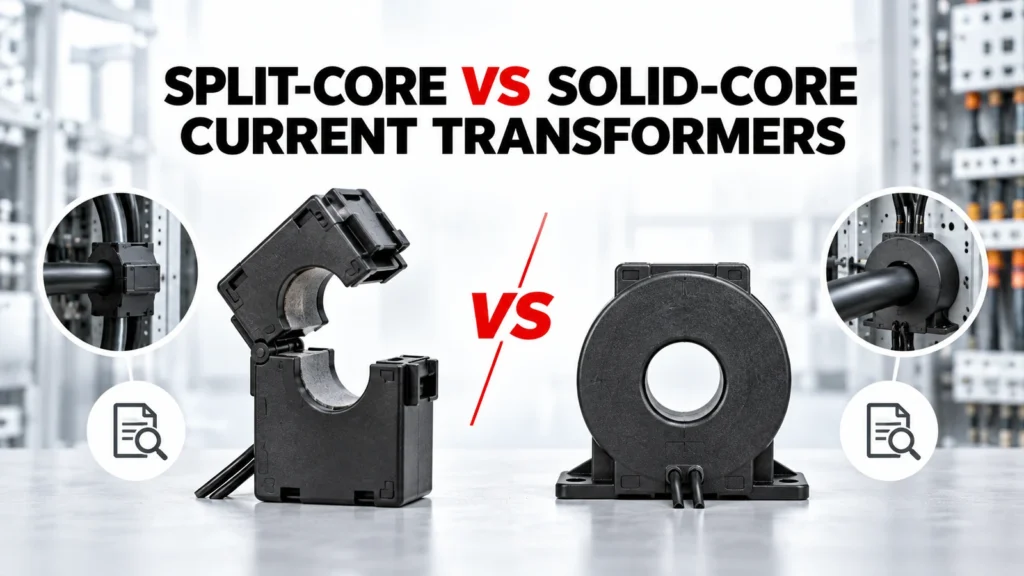
This comparison explains procurement and installation questions created by split-core and solid-core construction. It does not declare one construction universally more accurate, assign a ratio, approve an open-secondary practice or transfer any performance value between models.
Decision Inputs at a Glance
| Review area | Buyer must define | Evidence required |
|---|---|---|
| Installation access | Whether the primary conductor can be disconnected or rerouted | Site survey and installation sequence |
| Mechanical fit | Conductor or busbar shape, aperture and available clearance | Exact drawing and panel layout |
| Measurement duty | Primary range, secondary interface, burden and required performance | Meter input data and exact CT curves |
| Construction | Opening mechanism, core closure or one-piece body | Exact-model construction drawing |
| Service | Inspection, replacement and secondary-circuit controls | Maintenance method and safety procedure |
The Core Construction Changes the Installation Method
A split-core current transformer opens so it can be placed around an existing conductor without threading the conductor through a closed aperture. A solid-core transformer has a continuous core opening, so the installation normally requires access to pass the conductor through it. This mechanical distinction can dominate retrofit planning.
Construction alone does not prove electrical performance. Two CTs with different housings may also differ in ratio, output type, burden, accuracy class, frequency range, insulation and environmental limits. Compare exact order codes under the same measurement requirement.
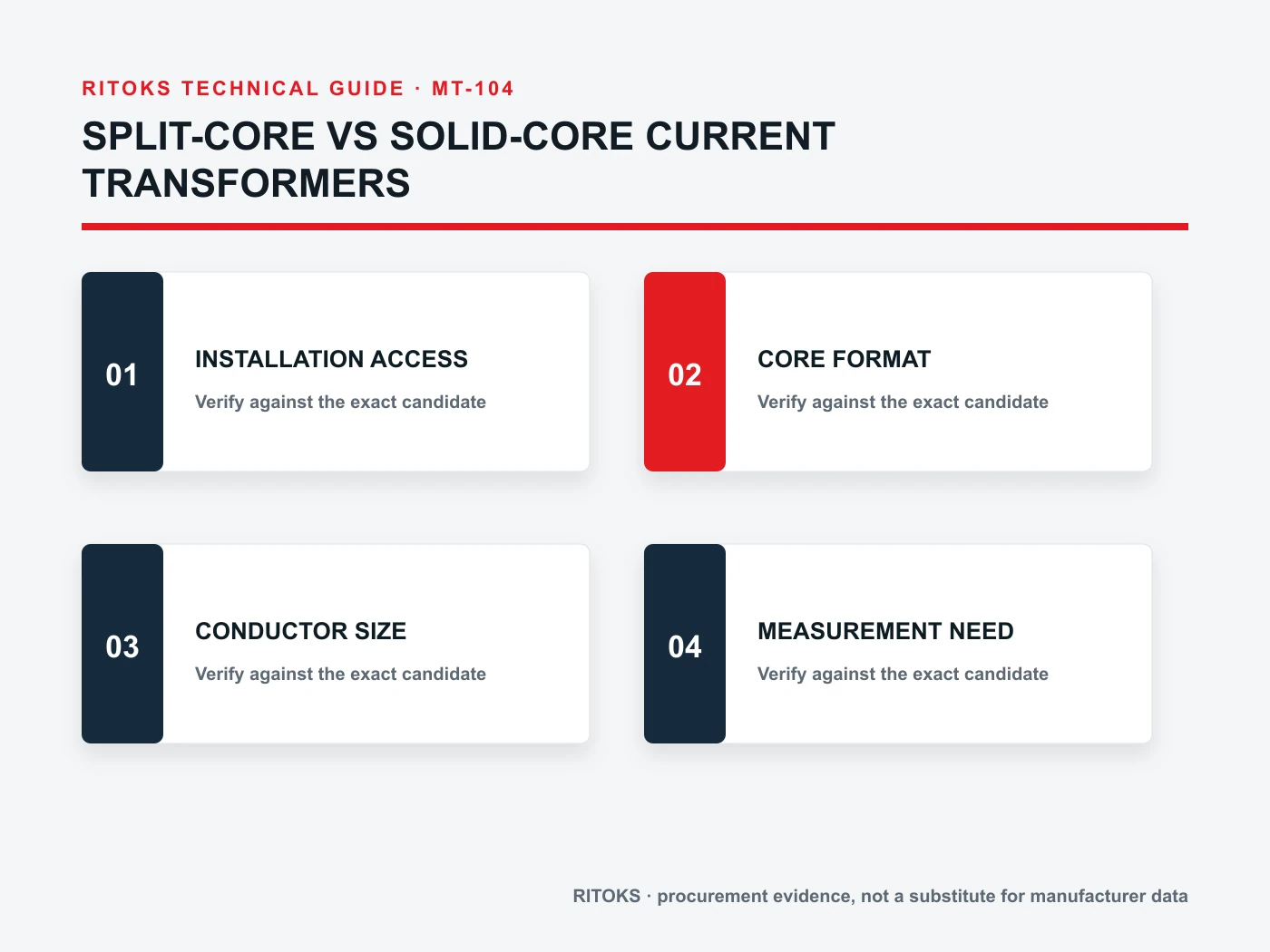
Use Installation Access as the First Decision Gate
For a retrofit, record whether the circuit can be de-energized, whether the conductor can be disconnected and whether there is physical room to open, place and close a split-core device. Include adjacent conductors, bends, busbar supports, barriers and enclosure access in the survey.
For new equipment, a solid-core design may be practical because the conductor routing can be planned during assembly. That does not make it an automatic choice. Manufacturing sequence, replacement strategy and the approved metering architecture still need review.
Verify Aperture and Conductor Geometry
A nominal conductor size is not enough to establish fit. Confirm the exact aperture drawing, conductor or busbar dimensions, insulation thickness, bend radius and the clearance needed to install or operate the opening mechanism.
Do not force a split core closed around an unsuitable conductor or assume that a same-family housing has the same aperture. Mechanical strain, an incomplete closure or interference with nearby components can invalidate the intended installation.
Compare the Complete Measurement Chain
Define the expected primary current range, secondary output, connected meter or transducer, lead arrangement and permissible burden. Verify ratio, accuracy and phase performance from exact-model data at applicable conditions rather than from a family headline.
The CT and receiving instrument form a system. A mechanically convenient transformer is not useful if its output and burden requirements do not match the meter. Conversely, a promising performance table does not solve an inaccessible installation.
Treat Split-Core Closure as a Controlled Interface
The mating core surfaces and closure mechanism are part of a split-core product’s construction. Follow the exact instructions for opening, cleaning, closing, securing and inspecting the device. Do not insert material at the joint or improvise a latch repair.
Record whether repeated opening is permitted and how a closed condition is confirmed. If contamination, vibration or maintenance handling is significant, include those conditions in the supplier review rather than assuming the joint is unaffected.
Keep Secondary-Circuit Safety in the Work Plan
Current-transformer secondary circuits require an approved installation and service method. The exact CT and system documentation governs terminal treatment, burden connection, shorting provisions, grounding and safe de-energized work.
This comparison intentionally does not give a wiring procedure. Procurement should require the terminal diagram and installation instructions for the exact order code, while the project team supplies the approved panel and maintenance design.
Build an Exact-Model Evidence File
Create one approval record for the proposed Current Transformer order code. Put each project requirement beside the supplier document that answers it. Preserve the exact datasheet, drawing, curve, table, instruction or selection output used, including its revision or retrieval date. A category page can establish family context, but it cannot prove an exact rating, construction, terminal arrangement or system combination.
Check that every accepted statement describes the same orderable item. Do not combine a family maximum from one variant, a diagram from another and an optional feature from a third. Mark unresolved fields explicitly so they remain visible in technical and commercial review.
Keep Project Inputs Separate From Product Evidence
The project team defines the application: source, load, duty, environment, controls, mounting, service and required functions. The supplier identifies an exact Current Transformer and supports it with exact documents. Neither side should fill a gap by inference from appearance, a shared family name or one matching headline value.
Freeze the application record while quotations are being compared. If the electrical duty, environment, cooling method, enclosure, installation or required function changes, issue a revised record and ask every supplier to reconfirm the candidate.
Define the Acceptance Record Before Ordering
Write the acceptance record before a preferred Current Transformer is chosen. Include the project inputs, proposed order code, included accessories, document revisions, exceptions, assumptions and the person responsible for resolving each open point. This prevents the technical basis from being reconstructed after price negotiations have already narrowed the choice.
Separate mandatory requirements from preferences and future options. A mandatory condition needs direct evidence or a documented engineering decision. A preference can influence comparison but should not be presented as a safety or compliance requirement. Future options should be checked only when the project genuinely expects them, because optional features can change the order code, terminals, dimensions or supporting documents.
Verify the Delivered Item and the Finished Assembly
Incoming inspection should compare the delivered Current Transformer, labels, accessories and documents with the approved record. Do not accept a same-family replacement solely because its appearance or one rating matches. Record any substitution and repeat the affected review before installation.
After assembly, verify the functions and conditions that cannot be proven from component literature alone. The check may include mechanical fit, wiring against the approved diagram, control behavior, temperatures, airflow, alarms or service access as applicable. Define representative operating states and acceptance criteria in the project test plan rather than inventing universal limits in the purchase order.
Common Procurement Errors
- Selecting a Current Transformer from one headline value while the application context remains incomplete.
- Using a curve, circuit, drawing or claim from a neighboring order code.
- Treating a category page, product photograph or nominal size as exact compatibility evidence.
- Assuming an accessory, system function or coordination result is included without documentation.
- Approving a substitute without repeating the electrical, mechanical and evidence review.
Resolve these gaps before comparing price and lead time. A proposal may remain commercially interesting while technically incomplete, but missing evidence must not disappear inside the quotation.
How to Compare Supplier Offers
| Review area | Buyer must define | Evidence required |
|---|---|---|
| Order code | Complete proposed item and included accessories | Exact datasheet and scope |
| Application match | Submitted operating and environmental conditions | Written response to each requirement |
| Mechanical integration | Mounting, terminals, clearances and service | Exact drawings and instructions |
| Electrical evidence | Applicable ratings, curves and topology | Exact-model technical documents |
| Open points | Unknowns, exceptions and assumptions | Dated clarification list |
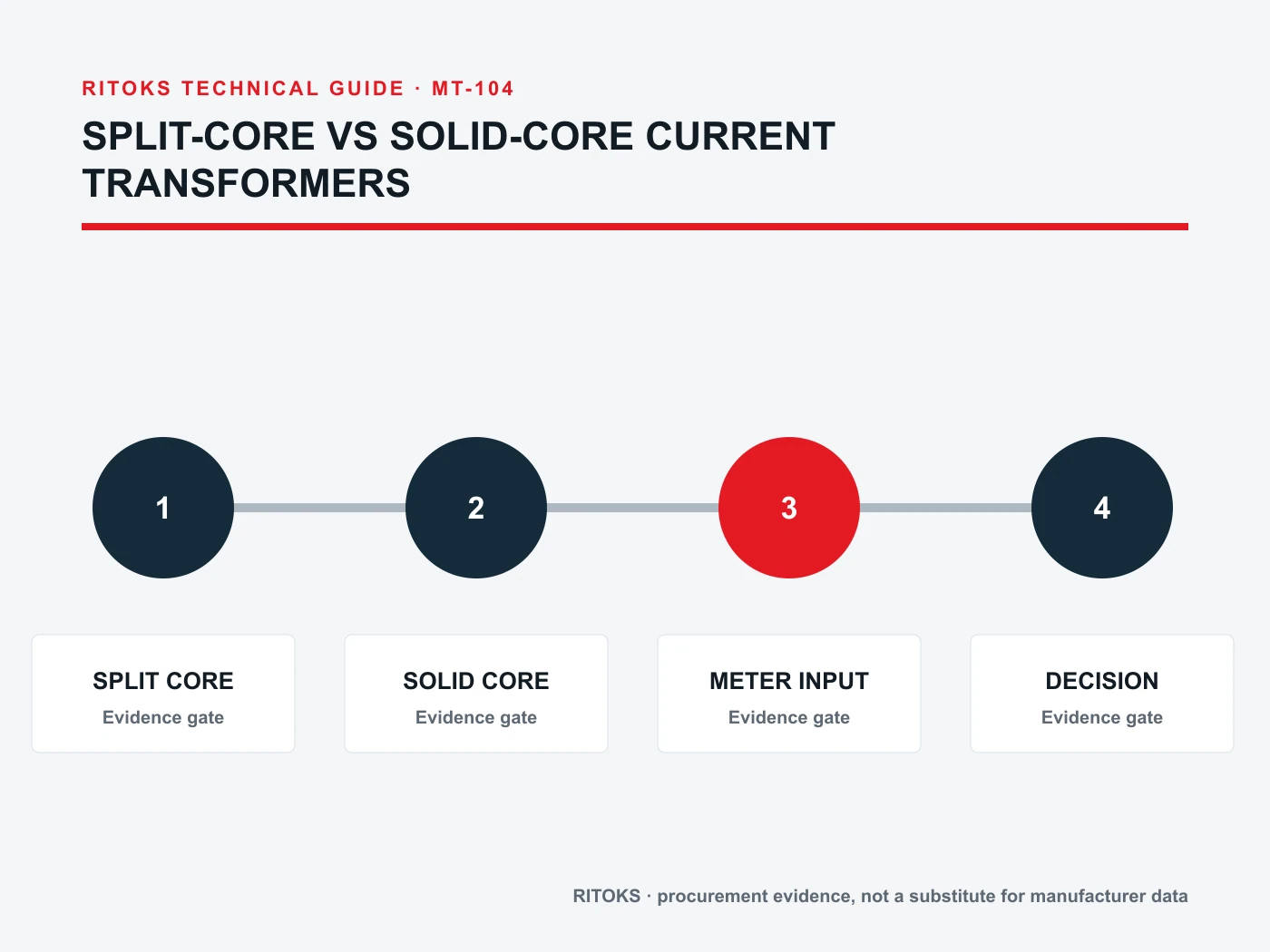
Normalize every Current Transformer offer to the same application record. Keep document revisions, test conditions, included accessories and open questions beside each value. This makes differences in delivered scope visible and prevents a lower-cost but narrower offer from appearing equivalent to a complete proposal.
Decision Workflow
- Freeze the system boundary and operating states.
- Record electrical, mechanical, environmental and service inputs.
- Choose a complete candidate order code for review.
- Verify every critical statement against exact-model evidence.
- Resolve exceptions and assumptions before commercial comparison.
- Validate the finished assembly where application risk requires it.
Stop when a critical input is unknown, the quoted model is ambiguous, a required claim is supported only by another manufacturer or order code, or the installation falls outside available evidence. These are engineering gaps, not editorial details.
RFQ Preparation Checklist
A useful RFQ for split core vs solid core current transformer is concise enough to answer and complete enough to prevent silent assumptions. Identify unknown values as questions and require a full orderable code rather than a generic family recommendation.
- INSTALLATION ACCESS
- APERTURE FIT
- CONDUCTOR ROUTE
- SERVICE PLAN
- RATIO
- OUTPUT
- BURDEN
- EXACT CURVES
- Required documents and revisions
- Quantity, destination and requested delivery scope
Ask the supplier to state exclusions, assumptions and options separately. Record quantity and destination after the technical inputs so commercial terms do not obscure unresolved engineering questions.
Frequently Asked Questions
Can I select a Current Transformer from one rating or size?
No. Selection requires the complete application, exact construction and all applicable electrical, mechanical, thermal, environmental and documentation conditions.
Can I use a family page as approval evidence?
A family page is useful for orientation. Approval should use the exact order-code datasheet, drawing, instructions and project-specific engineering evidence.
Are similar-looking models interchangeable?
Not automatically. Similar housings can contain different circuits, materials, terminals, ratings or accessories. Repeat the review for every substitute.
What should remain open in the quotation?
Any missing project input, unverified exact-model claim, unclear included accessory or unresolved installation condition should be listed as an open point rather than assumed.
Related RITOKS Resources and RFQ
Browse the Current Transformer product category, review the primary related product page, review related product option 2, review related product option 3. These pages provide commercial context; exact suitability still depends on the project record and the quoted order code.
When the technical record is ready, send the application and evidence requirements to RITOKS for a documented quotation. Keep the final selection subject to the project engineer’s approval and the current manufacturer documentation.