
Thermal Overload Relays for Motor Protection · Comparison
Manual vs Automatic Reset on Thermal Overload Relays
Understand how manual and automatic overload-relay reset modes affect restart review, control logic and exact-model documentation. A useful buyer review connects the project requirement to one exact orderable product and preserves the evidence used for approval.
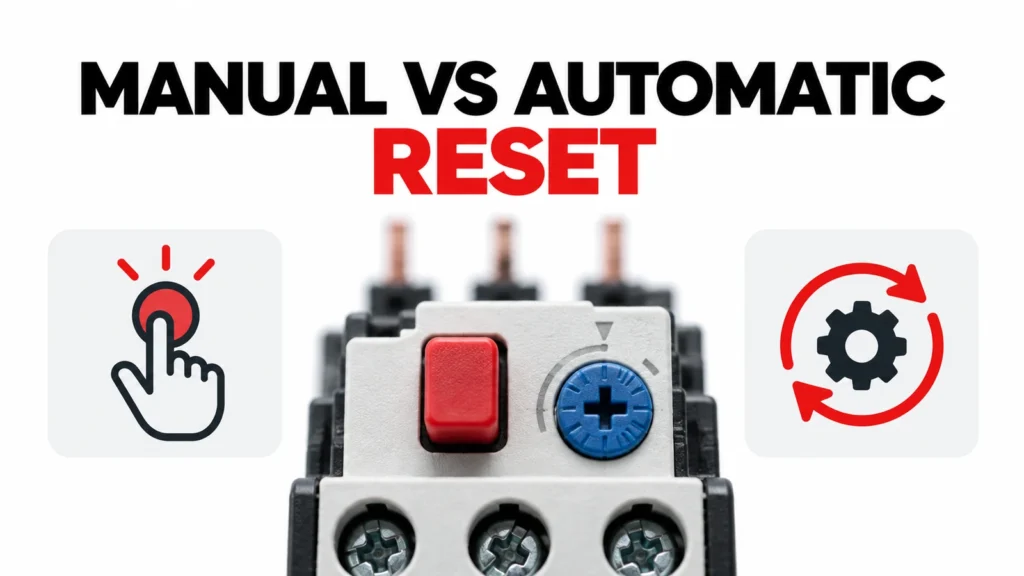
This guide compares reset concepts for a thermal overload relay. It does not prescribe control wiring, authorize automatic restart or claim a reset function for a RITOKS model unless the exact product documentation confirms it.
Decision Inputs at a Glance
| Review field | Buyer must define | Evidence to request |
|---|---|---|
| Reset action | Local human action or documented automatic behavior | Exact relay instructions |
| Restart path | What the control circuit permits after reset | Approved control narrative |
| Trip cause | How overload or phase-related conditions are investigated | Maintenance procedure |
| Indication | Local state and required auxiliary feedback | Exact contact diagram |
| Coordination | Relay, contactor and upstream protection roles | Complete starter documentation |
Reset and Restart Are Different Decisions
Reset describes how the overload relay returns from a tripped state within its documented behavior. Restart describes what the wider control system does afterward. Conflating the two can turn a product option into an unintended machine action. A buyer should therefore review reset mode and restart permission as separate requirements.
Manual reset generally introduces a deliberate local action, while automatic reset may remove that action after the relay is ready to reset. Neither phrase alone defines the whole sequence. The contactor circuit, PLC logic, maintained commands and safety functions determine whether a motor can energize again.
Manual Reset Supports Deliberate Confirmation
A manual-reset requirement can help ensure that someone acknowledges the trip before the control path is restored. The useful question is not whether manual is universally safer, but where the action occurs, who performs it and what investigation must happen first. The maintenance procedure should answer those questions.
Confirm the physical reset method for the exact relay and mounting arrangement. A button on the device, a remote reset accessory and a reset through another mechanism are not interchangeable assumptions. Ask for the approved instruction rather than interpreting a front-panel photograph.
Automatic Reset Requires a Restart-Hazard Review
Automatic reset may be useful in a deliberately designed process, but it can also make the relay ready while a start command remains present. The risk assessment and control narrative must determine whether that behavior is acceptable. Procurement must not select it merely to reduce service visits.
Record the conditions under which reset occurs, any cooling or recovery behavior described by the manufacturer, and the control state that follows. Then verify that the proposed circuit prevents an unexpected restart whenever the application requires human intervention or another supervised sequence.
Auxiliary Contacts Communicate State, Not Intent
An overload relay may provide contacts used to drop a contactor, indicate a trip or signal a controller. Those contacts report the relay state within their documented arrangement. They do not by themselves create a complete restart interlock, safety function or diagnostic strategy.
List the required normally open and normally closed roles without guessing terminal numbers. Request the exact contact diagram and ratings for the proposed order code. The control designer can then integrate the signal into the approved sequence.
Investigate the Cause Before Returning to Service
Resetting the relay does not explain why it operated. The maintenance process should review motor load, phase conditions, mechanical obstruction, starting behavior, relay setting basis and any environmental influence that belongs to the application. The exact investigation depends on the equipment and qualified procedures.
Repeated resetting without resolving the cause can conceal a developing problem. An RFQ or design review should therefore define useful indication and diagnostic access, not just the preferred reset position. This is a system-operability question as much as a device feature.
Capture Reset Mode in the Approved Starter Record
The final starter record should include the relay order code, adjustment range, selected reset mode, auxiliary-contact arrangement, compatible contactor interface and upstream protection evidence. Preserve the drawing and document revisions used in approval.
If a supplier substitutes another relay, repeat the reset and control review. A similar housing or current range does not prove identical reset behavior. Treat any unverified default setting as an open item before commissioning or purchase.
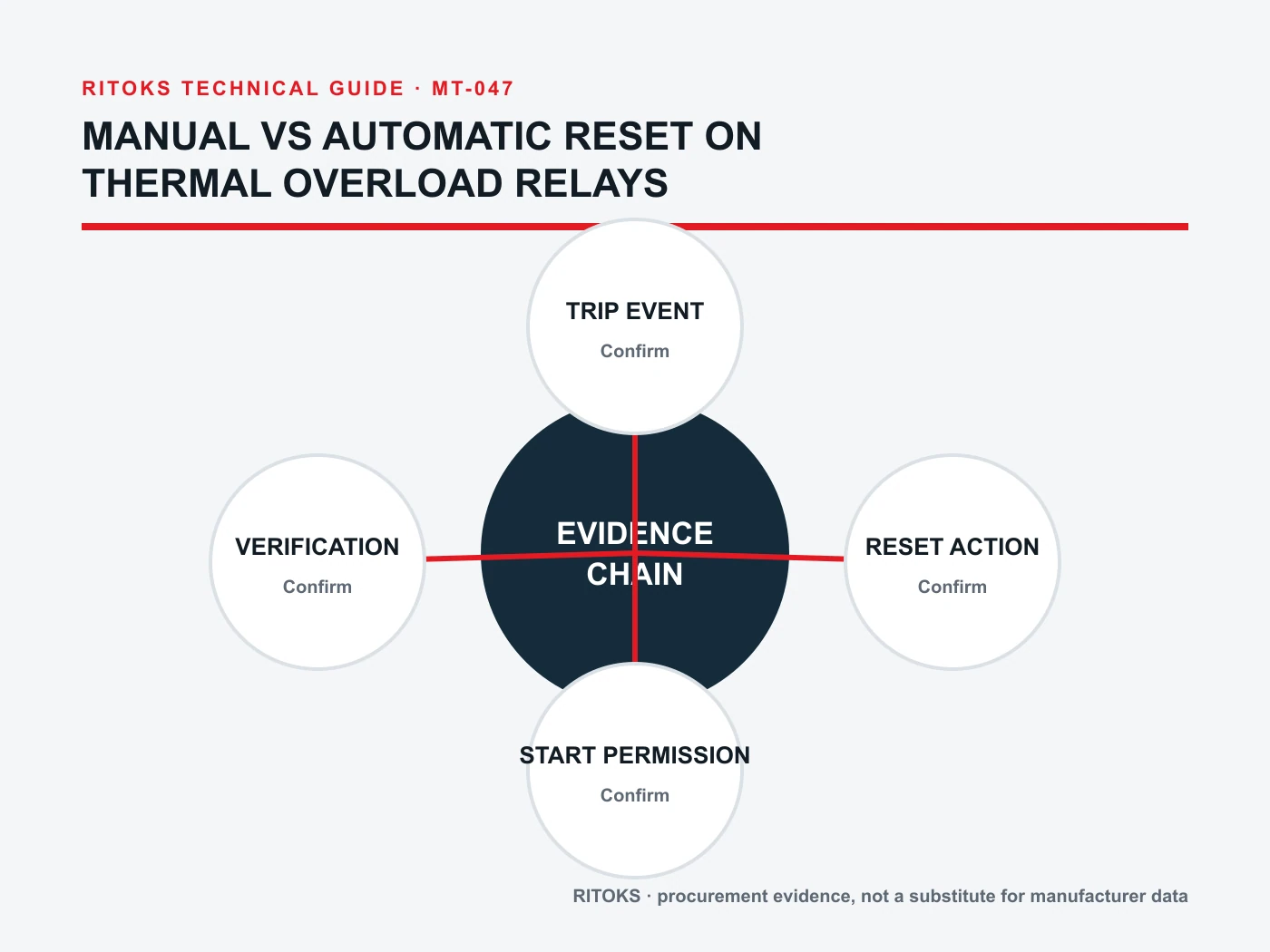
Build an Exact-Model Evidence File
Create one approval record for the proposed Thermal Overload Relay order code. Put each project requirement beside the supplier document that answers it. Preserve the exact datasheet, drawing, table, instruction or selection output used, including its revision or retrieval date. A category page can establish family context, but it cannot prove an exact rating, terminal arrangement or system combination.
Check that every accepted statement describes the same orderable item. Similar housings can contain different circuits, supplies, terminals, accessories or functions. Do not combine a family maximum from one variant, a diagram from another and an optional feature from a third. Mark unresolved fields explicitly so they remain visible in the commercial review.
Keep Project Inputs Separate From Product Evidence
The project team defines the application: source, load, duty, environment, controls, mechanical limits and required functions. The supplier identifies an exact Thermal Overload Relay and supports it with exact documents. Neither side should fill a gap by inference from appearance, a shared family name or one matching headline value.
Freeze the application record while quotations are being compared. If the topology, source, load, environment, enclosure or required output changes, issue a revised record and ask each supplier to reconfirm the candidate. Otherwise apparently comparable quotations may be answering different technical requirements.
Common Procurement Errors
Avoid selecting a Thermal Overload Relay from one headline value while the application context remains incomplete. Do not use a circuit, curve, terminal drawing or performance claim from a neighboring model. A product photograph and a family page can support discovery, but neither is exact technical evidence.
Also avoid assuming that an accessory, communication function, protection role or coordinated result is included unless it appears in the quotation and exact-model documents. A substitute requires the same topology, rating, mounting and evidence review as the original candidate.
How to Compare Supplier Offers
Normalize every Thermal Overload Relay offer to the same application record. Keep document revisions, stated conditions, included accessories and open questions beside each value. This makes differences in delivered scope visible and prevents a lower-cost but narrower offer from appearing equivalent to a complete solution.
Stop the comparison when a critical application input is unknown, the quoted model is ambiguous, a required claim is supported only by another manufacturer or order code, or the installation falls outside the available evidence. These are engineering gaps, not editorial details.
Control Revisions and Substitutions
Give the approved Thermal Overload Relay record a revision identifier and keep it with the project file. If the supplier changes the order code, accessory, firmware, drawing or stated operating condition, identify the change before accepting it. A substitution is a new technical proposal even when its price, housing or product-family name looks familiar.
Repeat only the affected checks, but do not waive them. Confirm that the revised candidate still answers the frozen application, that every referenced document belongs to it and that all open exceptions have an owner. This small change-control step prevents a technically reviewed selection from being replaced by an unreviewed commercial equivalent.
Decision Workflow
- Freeze the application and system record before choosing a catalog code.
- Identify the exact function and every interface that requires evidence.
- Request one complete order code with its current datasheet and drawings.
- Map each project requirement to a specific manufacturer statement.
- Record deviations, accessories, document revisions and unresolved questions.
- Repeat the review whenever the application or proposed product changes.
Use this workflow as a procurement and evidence discipline. It does not replace qualified design, installation instructions or the responsible engineer's approval for the Thermal Overload Relay application.
RFQ Preparation Checklist
A practical manual vs automatic reset overload relay should be concise enough for a supplier to answer and complete enough to prevent silent assumptions. Identify unknown values as questions rather than allowing them to become undocumented selections.
- Reset action: Local human action or documented automatic behavior.
- Restart path: What the control circuit permits after reset.
- Trip cause: How overload or phase-related conditions are investigated.
- Indication: Local state and required auxiliary feedback.
- Coordination: Relay, contactor and upstream protection roles.
- Exact product code, included accessories and documentation revision
- Quantity, destination, required approvals and commercial scope
Request the exact scope of any classification, compatibility, coordination or performance claim. Record quantity and destination after the technical inputs so commercial terms do not obscure unresolved engineering questions.
Frequently Asked Questions
Does automatic reset always restart the motor?
Not by itself, but the wider control circuit may permit restart. Review both functions together.
Is manual reset always required?
No universal answer applies. Use the application risk assessment and control narrative.
Can the reset mode be inferred from a selector picture?
No. Confirm the exact order code and manufacturer instructions.
Related RITOKS Products and Guidance
These links provide product-family context only. A contextual link does not claim interchangeability, compatibility or an approved system combination.
Thermal Overload Relay product category
Technical References
These manufacturer sources support only the general engineering concepts described below. Their product ratings, circuit diagrams, approvals and coordination results do not transfer to RITOKS products.
ABB, Contactors and Overload Relays Guide
Supports general overload-relay reset, trip and starter-coordination concepts. ABB combinations and settings do not transfer to RITOKS products.
ABB, Control Catalog: IEC Manual Motor Starters
Supports separating overload behavior, short-circuit protection and coordinated starter roles. Exact ABB characteristics do not describe a RITOKS device.
Request an Exact-Model Review
Send the application requirements, exact-document questions, quantity and destination through the RITOKS contact form. An RFQ requests an exact-model review; this guide does not approve a circuit, installation or automatic substitute.