
Molded Case Circuit Breakers for Power Distribution · Technical Explainer
MCCB Trip Unit Selection: Fixed and Adjustable Settings
An MCCB can have a thermal-magnetic or electronic trip unit, and the available settings can be fixed, partly adjustable or adjustable across several protection functions. The visible dial or the word “adjustable” is not enough to specify a breaker. A buyer needs the exact frame, trip-unit designation, rated current or sensor, setting range, time-current behavior, system voltage, fault level and coordination requirement. Changing a trip setting is an engineering decision, not a way to make an underspecified breaker fit an order.

RITOKS currently publishes the GYCM8 thermal-magnetic MCCB family in its AC Molded Case Circuit Breakers category. The page gives frame families, model-dependent current and pole choices, and a thermal-magnetic architecture. It does not publish a complete fixed-versus-adjustable setting matrix or every time-current curve for each model. This article explains what to request without attributing an ABB, Schneider or Eaton adjustment function to GYCM8.
A Trip Unit Has More Than One Job
An MCCB's trip unit responds to conditions such as overload and short circuit according to its documented characteristic. Thermal-magnetic designs commonly combine a thermal element with a magnetic element. Electronic trip units can offer different functions or ranges, depending on their exact variant. These descriptions are architectural, not evidence that every MCCB of a given frame has the same knobs.
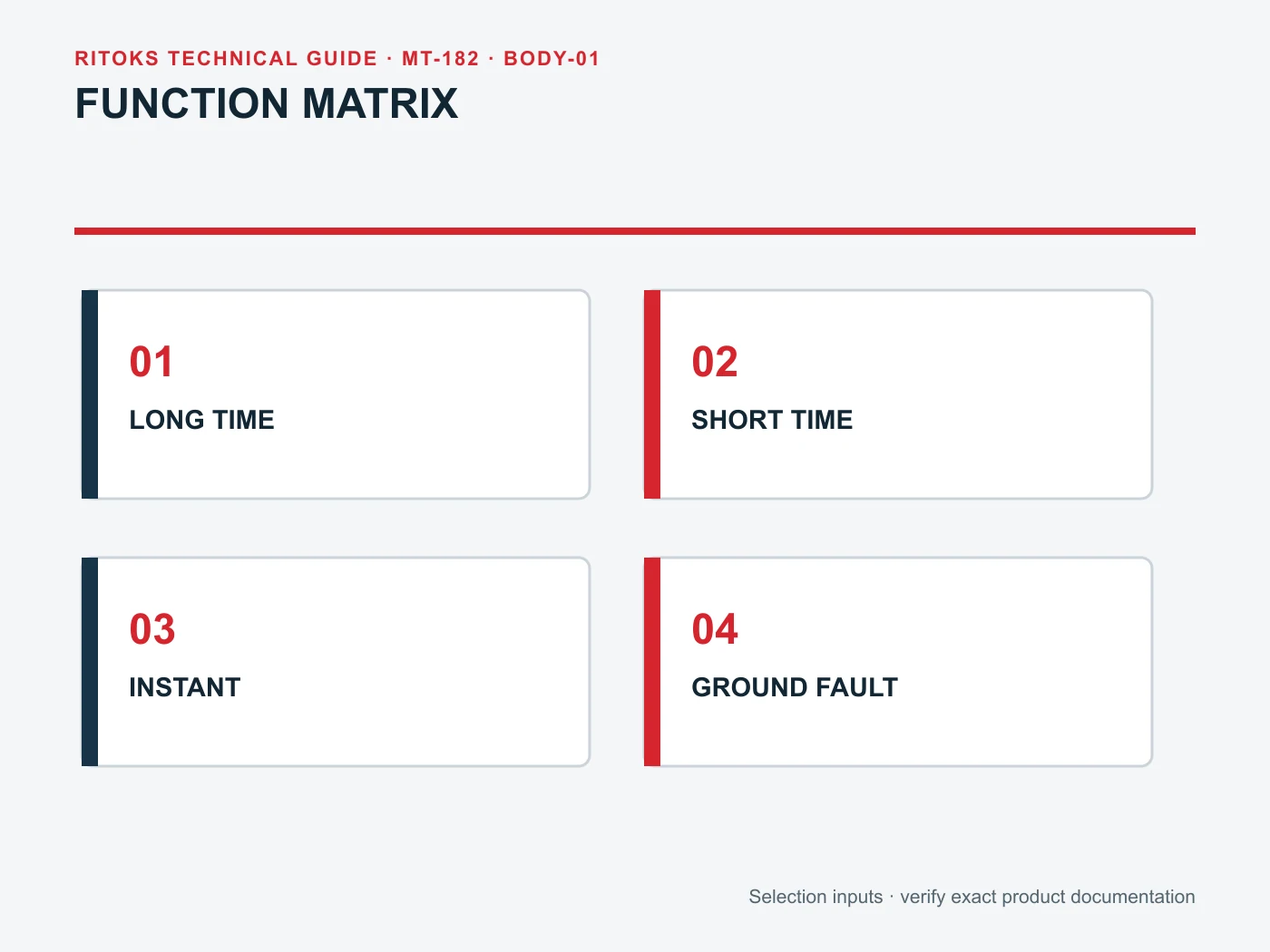
The long-time element is generally relevant to sustained overcurrent and conductor or load protection. Instantaneous or short-time behavior concerns higher fault currents and the system's interruption sequence. Some units have ground-fault functions, while others do not. A procurement schedule should list each required function separately, including whether it is fixed or adjustable. “Adjustable trip” without naming the function can conceal a serious mismatch: a thermal adjustment does not prove an instantaneous adjustment, and a ground-fault dial is not an overload setting.
ABB's MCCB technical literature tabulates different electronic trip-unit functions and their settings by named variant. Schneider Electric's MCCB range distinguishes thermal-magnetic and electronic trip options in its own product families. These manufacturer examples demonstrate variation, not GYCM8 specifications.
Fixed Versus Adjustable Is a Function-by-Function Question
A fixed trip function has a manufacturer-defined characteristic associated with the exact breaker or trip-unit configuration. An adjustable function allows a documented setting within a stated range, subject to its instructions and any restrictions. “Partly adjustable” is common enough that the purchase order must name each adjustable function and its available positions. A breaker could have adjustable long-time pickup but fixed magnetic pickup, or a different combination entirely.
ABB product literature illustrates thermal-adjustable/magnetic-fixed and thermal-adjustable/magnetic-adjustable architectures in named families. It also documents electronic trip units with adjustable long-time, short-time, instantaneous and ground-fault functions in specific variants. The point is not to recommend those models; it is to show why no single “MCCB adjustable” label can be carried over to RITOKS GYCM8.
Ask the GYCM8 supplier for a settings table or exact model sheet. If the available evidence lists a fixed thermal-magnetic unit, record it as fixed; if an adjustable version is offered, request the actual dials, ranges and tolerances for that version. Do not photograph a similar faceplate and assume the product being shipped has the same mechanism. The full orderable designation should be on the quotation and label.
Keep Frame Rating, Trip Rating and Setting Separate
The MCCB frame describes a housing or mechanical family, not automatically the current that the trip unit will protect at. A frame can support different rated-current options. If the trip unit has a setting range, the chosen setting is yet another number. Write those fields on different lines. For example, the GYCM8 page lists several frame families and their current options, but that public matrix is not a trip-adjustment schedule. Do not treat the highest frame number as an adjustable setting.
State the load current, conductor ampacity and applicable design rules from the project. Then ask for the exact breaker current rating and permitted setting. The engineer must check whether the intended setting protects the conductors and equipment under real operating and ambient conditions. An adjustment chosen to stop nuisance tripping may also weaken protection. The site article does not prescribe a dial position for any installation.
The frame and rated current also do not determine breaking capacity. RITOKS's GYCM8 page retains C, S, M and H capacity codes with frame-, pole- and voltage-specific Icu/Ics data. The available prospective fault current at the installation point must be compared with the selected breaker's documented interrupting performance at the actual operating voltage. A trip adjustment cannot compensate for inadequate breaking capacity.
Obtain the Time-Current Evidence
Time-current curves show how a trip unit is intended to respond over a range of currents under defined conditions. A buyer comparing fixed and adjustable options needs curves for the exact model and setting choices, including tolerances. Without them, the claim “selective with the downstream breaker” is unsupported. A table of ampere ratings and a photograph of a dial do not replace a coordination study.
The key inputs are the upstream and downstream protective devices, available fault currents at relevant points, conductor and equipment limits, starting or inrush profiles, and the required continuity objective. The designer then checks overlap, let-through behavior and manufacturer coordination tables where applicable. This article cannot infer selectivity from a wider setting range, nor can it guarantee that an adjustable unit will coordinate with a particular MCB or MPCB.
ABB's guide to instantaneous selectivity shows how manufacturer data and exact trip-unit functions matter to coordination. Its values apply to ABB devices only. RITOKS GYCM8 requires its own evidence before a purchaser can state a coordination result. If the project has no required coordination study, still document the expected protective role rather than describing “adjustability” as inherently superior.
Overload, Short Circuit and Ground Fault Are Distinct
Define the protection functions the circuit actually requires. Long-time protection concerns sustained overcurrent. Instantaneous and short-time functions respond to higher current conditions according to different pickup and delay characteristics. Ground-fault sensing is a separate feature and must not be inferred from the presence of an electronic display or a molded case. List each required function and any settings or accessories in the RFQ.
The installation's grounding and neutral arrangement can affect the suitability of a ground-fault function. Likewise, motor circuits may have starting characteristics and a separate motor-protection architecture. Keep the RITOKS Motor Protection Circuit Breakers family distinct from general distribution MCCBs. A GYCM8 feeder device should not be advertised as an MPCB or an approved motor-starter combination without exact evidence.
Avoid importing a DC protection claim into this AC article. RITOKS has a separate DC MCCB category and DC product references; AC GYCM8 operational voltage and interruption data do not establish suitability for a DC circuit. The project one-line must identify AC or DC before selecting a breaker. For GYCM8, its published Ue values are AC and model dependent.
An Exact-Model Comparison Table
Use a blank comparison sheet when quotations arrive:
| Field | Fixed candidate | Adjustable candidate |
|---|---|---|
| Orderable breaker and trip unit | Documented exact reference | Documented exact reference |
| Frame and rated current | Supplier model row | Supplier model row |
| Long-time pickup and delay | Fixed values/curve if applicable | Range, increments and curve if applicable |
| Short-time and instantaneous | Exact behavior | Exact range and behavior |
| Ground-fault function | Present or absent, with evidence | Present or absent, with evidence |
| Icu/Ics at operating voltage | Exact model table | Exact model table |
| Pole, terminals and mounting | Exact drawing | Exact drawing |

The labels are questions, not assertions that both candidate types exist in the RITOKS catalog. Leave a cell blank or mark it pending until the supplier documents it. An unsupported number should not be copied from a different frame or competitor data sheet. Compare total protection performance and coordination evidence, not just how many dials are visible.
Field Setting and Change Control
If the selected unit has adjustable settings, the design package should state the approved values, basis and person responsible for applying them. Document the final position during commissioning. If the panel is serviced later, the setting record helps distinguish a deliberate protection change from an accidental movement. Tamper covers or seals may be appropriate where the actual model provides them; do not claim they are included with GYCM8 unless confirmed.
Changes after equipment is installed require renewed review. A higher long-time pickup may affect conductor protection; a shorter or longer delay may affect coordination; changing instantaneous behavior may change fault-clearing performance. The exact manufacturer's instructions and the system protection study govern. A supplier should not pre-set a breaker from a short email saying only “63 A panel” without the required circuit data.
An electronic trip unit may also need its own setup or power procedure. ABB technical documentation gives examples where setup mode depends on a battery, portable pack or loaded breaker for that manufacturer's equipment. Do not extrapolate that to GYCM8. Request the commissioning manual for the exact unit offered.
RFQ Inputs for a Defensible Choice
Send RITOKS or another supplier a complete selection brief:
- State AC system voltage, frequency, phase and pole arrangement, and the installation location on the one-line diagram.
- Provide load current, conductor data, operating duty, inrush or motor-starting conditions, and ambient enclosure conditions.
- Provide calculated available fault current and the required interrupting performance at the chosen voltage.
- Specify required long-time, short-time, instantaneous and ground-fault functions individually, including any adjustable ranges needed by the protection study.
- Identify upstream and downstream devices and request exact time-current curves or coordination data.
- State mounting, terminal, accessory, document, quantity and destination requirements; request the full orderable model and trip-unit designation.
The GYCM8 page and AC MCCB category are the appropriate RITOKS starting points. Contact RITOKS with the brief, especially if a setting option or curve is essential. A fixed unit may be suitable when its documented characteristic satisfies the circuit; adjustability matters only when exact available settings support the approved protection design.
Source notes
- RITOKS GYCM8 thermal-magnetic MCCB and AC MCCB category: current product-family facts and missing exact setting data.
- ABB MCCB technical literature and ABB selectivity guide: third-party examples of variant-specific trip functions and coordination; no ratings transferred to GYCM8.
- Schneider Electric MCCB range: manufacturer example of thermal-magnetic versus electronic trip availability.