
AC Power Protection · Technical Explainer
When an NH Fuse Opens: Investigating the Feeder Before Replacement
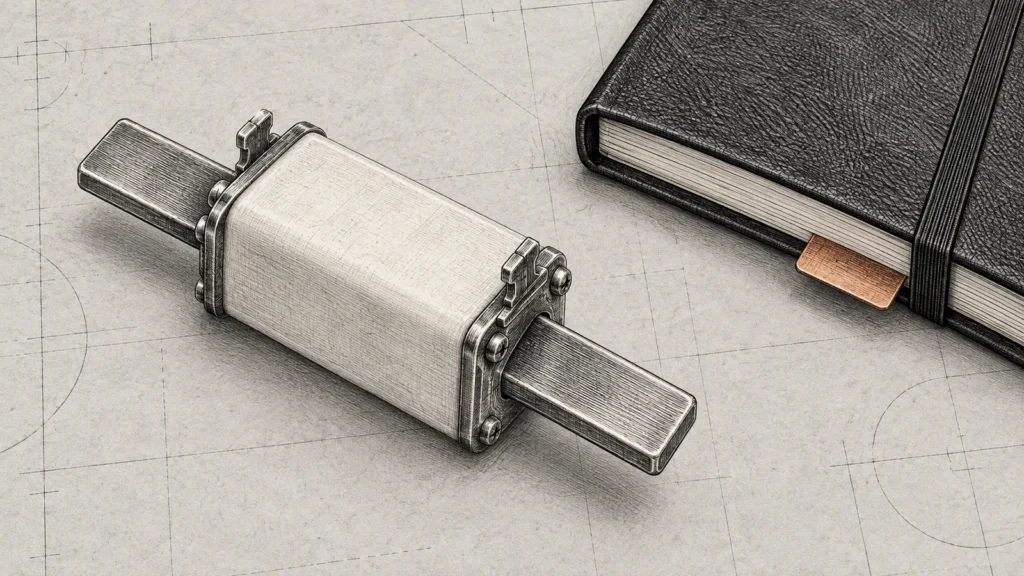
Record the event before restoring the feeder
The practical question behind blown fuse vs good fuse is first an evidence question, not a visual replacement decision. Before replacing an opened NH fuse, separate three questions: what caused the interruption, whether the retained feeder and holder are suitable for service, and whether the proposed replacement preserves the accepted protection. Preserve event and load records, assess component condition under the approved work procedure, and identify the exact replacement. A new fuse answers only the component-supply question; the responsible qualified person must establish safe restoration from the relevant evidence.
For a panel builder or industrial buyer, the useful output is an event record that connects the installed fuse to the feeder it protected. Record which circuit lost supply, when the interruption was noticed, which fuse position was involved and whether other devices reported an event. Keep observations separate from explanations. A description such as “darkened holder” is an observation; “overload caused it” is a conclusion requiring evidence.
RITOKS lists the RTX-NHG NH gG fuse-link family. The family page provides a commercial starting point, not a complete investigation of an installed feeder. Request the selected model's time-current information, electrical ratings, holder requirements and replacement documentation against the actual circuit record.
This guide is a documentation framework for qualified, deenergized inspection. It is not a live probing procedure, a fuse-changing instruction or permission to restore supply. The site's approved isolation, verification and work procedures govern physical work, including other sources and stored energy where relevant.
Establish the restoration decision and its owner
The investigation needs a named restoration authority and a defined decision record. A replacement part arriving on site does not settle whether the circuit is suitable for service. Separate the decision to obtain a replacement from the decision to install it and from the decision to reenergize the feeder.
For covered United States workplaces, OSHA 1910.334(b)(2) requires safe restoration to be established and prohibits repetitive manual reclosing or reenergization through replacement fuses. Its note expressly allows no circuit examination where circuit design and protective devices establish overload rather than a fault. This exception is not established merely by naming an event “overload.”
That is a US regulatory reference, not a worldwide legal rule. Other jurisdictions and site procedures require their own review. The same OSHA section restricts overcurrent-protection modification, while its testing provisions reserve electrical testing to qualified persons. This article neither prescribes testing nor replaces those requirements.
Use the applicable restoration decision to identify what evidence is missing. If the responsible person cannot distinguish a documented overload from an unresolved fault, preserve that uncertainty. An explanation offered under production pressure does not become an accepted conclusion because it appears on a maintenance ticket.
Build an evidence tree without guessing the cause
Start the tree with the quality of the event evidence, not the appearance of the fuse. Distinguish a documented overload explanation, evidence indicating a fault investigation and an event that remains unresolved. The branches identify questions and responsible reviewers; they do not prescribe automatic restoration or a replacement rating.
| Evidence branch | Questions to resolve | Record to retain |
|---|---|---|
| Documented overload explanation | Does the circuit and device information establish overload rather than fault? | Design basis, load history and responsible determination |
| Fault evidence present | What event, alarm or component finding needs professional investigation? | Event timing, circuit location and investigation scope |
| Event remains uncertain | Which observations are missing or contradictory? | Open questions, evidence owner and service disposition |
| Local component damage | What condition affects the fuse, holder or connection? | Deenergized condition record and manufacturer's assessment |
These branches can overlap. A damaged holder is a component finding, not proof that the feeder had no other fault. A recorded load increase deserves investigation but does not exclude a damaged cable or another issue. Preserve competing explanations until the evidence supports the agreed disposition.
Avoid a tree that ends every branch with “fit a new fuse.” The actual outcomes may involve repair, further investigation, rejection of a proposed substitute or documented acceptance by the responsible authority. The record should make that decision visible rather than hiding it inside a purchasing action.

A filled event record that does not overclaim the cause
Consider this hypothetical maintenance record, created to show how the evidence tree works rather than report a real customer event. Feeder F3 lost supply during a production restart. A stored supervisory log places a machine-start request immediately before the interruption. The available meter history contains interval averages, the installed fuse's order code is legible, and an approved deenergized condition record describes discoloration at one holder position. No transient current recording is available.
The first entry is an observation: “restart request preceded noticed loss of supply.” The working hypothesis is “a changed starting duty may be relevant.” Its limitation is that a command timestamp and averaged load record do not establish the current profile that operated the fuse. The next useful evidence is the actual equipment-change record and the selected fuse characteristic, reviewed by the responsible engineer. A larger replacement would answer neither question.
The second entry is “holder position shows discoloration.” That finding creates a component-assessment question even if the restart is later accepted as part of the explanation. It does not show that the holder caused the interruption or that the holder can be reused. The condition disposition stays open until the actual construction and permitted maintenance criteria have been assessed. This prevents a plausible load explanation from erasing a separate condition finding.
The filled overall disposition is “cause unresolved; holder assessment pending; original fuse identity known; proposed equivalent replacement under review; restoration decision not yet recorded.” It is deliberately more informative than “blown fuse replaced.” If later evidence establishes overload rather than fault within an applicable design and regulatory framework, the responsible person can record that basis. If the evidence indicates another fault or damage, the investigation follows that finding instead.
This approach reduces unnecessary enquiries as well. The supplier needs the known fuse and holder references and the specific missing characteristic or matching information. The site reviewer needs the event and condition evidence. Sending each party the question they can answer avoids asking a component supplier to certify an entire feeder from a photograph or asking maintenance to infer replacement equivalence from an ampere marking.

Read load history in its measurement context
Load history becomes useful only when its circuit boundary, time coverage and measurement method are known. A recorded average cannot automatically describe a brief event, and a machine's nameplate is not a record of what the feeder carried. Compare the event with the actual operating history and selected fuse documentation.
Gather existing records from approved sources: production sequence, equipment changes, meter history, controller events and earlier maintenance reports. Mark the time reference of each record. If one system reports a supervisory timestamp and another stores a local event time, establish how they relate before treating adjacent entries as simultaneous.
Ask whether a new machine, changed operating schedule or added load altered the original design assumptions. Record the change without declaring it the cause. A simultaneous startup, longer duty period or load transfer may be relevant, but its significance depends on the actual current profile and the protective-device information.
Use the exact model's time-current characteristic when the responsible engineer reviews overload behavior. Preserve the curve revision and its stated conditions. Do not redraw a generic gG curve as an RTX-NHG test result, infer a guaranteed opening time from one current reading or use the event to justify a larger fuse.
Keep appearance separate from a causal finding
Physical condition provides evidence of what must be assessed, but appearance alone cannot identify the complete event mechanism. Record discoloration, deformation, damaged insulation and contact condition under the approved deenergized work process. A photograph supports a condition description; it does not independently establish overload, short circuit or serviceability.
Use consistent identifiers in the condition record. Identify the feeder, phase or position, holder reference and photographed component. Retain the original observation before parts are removed or replaced where the approved procedure permits. If the observation was made after work had already changed the assembly, state that limitation.
Ask the selected component manufacturer how damage affects reuse of the holder and its associated parts. A new fuse does not repair a damaged contact assembly. Equally, do not declare every visible mark a failed holder without the appropriate assessment. The decision needs the actual construction, condition and permitted maintenance information.
Record missing information honestly. An inaccessible contact area, an absent earlier photograph or an unreadable label leaves a gap. Filling that gap with a confident explanation can lead the next reviewer to accept a condition that was never examined. The condition record should preserve the uncertainty and the person responsible for resolving it.
Treat replacement identity as a separate evidence record
The replacement record must identify the part being proposed and why it matches the accepted protective design. Current rating alone does not establish replacement equivalence. Check the complete fuse and holder identities, documented electrical duty and relevant coordination requirements without allowing mechanical fit to stand in for technical acceptance.
Mersen's replacement-fuse application note distinguishes troubleshooting and repair from confirming replacement protection. Its subject is UL Class CC and supplementary midget fuses, not NH fuse substitution. Use the introductory distinction only; its product recommendation and numerical ratings do not approve an RTX-NHG replacement.
| Replacement field | Evidence needed | Why it stays separate |
|---|---|---|
| Exact fuse identity | Manufacturer, order code and selected documentation | A family name does not identify every rating |
| Holder and mechanical interface | Exact holder reference and approved matching information | Physical fit does not settle electrical suitability |
| Circuit duty | Approved voltage, current and protective-design requirements | The event is not authority to alter protection |
| Coordination evidence | Applicable pair or system documentation | Replacing one component can affect the design record |
| Condition disposition | Accepted assessment of retained parts | A new fuse does not erase existing damage |
If the original part is unavailable, treat the substitute as a proposal requiring the relevant review. An equal ampere marking is not enough to close every field. Keep the proposed part pending until its identity and protection role are accepted; do not substitute a higher rating simply because a repeat interruption is inconvenient.
Close the investigation with named evidence
A completed record separates what happened, what was examined and what was accepted. It should explain the conclusion and its limits without presenting a purchasing document as a restoration certificate. Link each accepted finding to a source record and identify the person responsible for the final circuit disposition.
Attach the event timeline, available load information, component condition and replacement identity as separate records. Distinguish firsthand observations from supplier statements and hypotheses. If a relevant event log was unavailable or the original part identity could not be confirmed, retain that limitation in the handover rather than removing it for a cleaner report.
Document any repairs or approved design changes independently from the fuse purchase. The investigation should show which issue was resolved and how the responsible reviewer accepted the result. A completed repair ticket does not automatically close unrelated open questions about the holder, circuit or substitute.
Finally, assign the follow-up responsibility. A recurring event needs the earlier evidence, not merely a count of replacement fuses. Preserving the records makes later comparisons meaningful: the team can identify whether the same circuit conditions returned, a different component was installed or the original explanation needs reconsideration.
Send a focused supplier enquiry
For an RTX-NHG enquiry, send the exact required configuration and the accepted feeder design information. Request the selected fuse's time-current documentation, holder matching information and relevant protective-duty evidence. Describe unresolved findings as questions. Do not ask the supplier to approve an unexplained feeder condition from a picture alone.
The panel builder should maintain two clear deliverables: an event evidence tree and a replacement identity record. The first organizes the investigation; the second documents the proposed component. Neither replaces the qualified restoration decision. Together they prevent an ambiguous interruption from becoming an undocumented change to the feeder's protection.
Source notes
- Occupational Safety and Health Administration. 1910.334, Use of equipment, particularly (b)(2), its overload note, (b)(3) and (c). https://www.osha.gov/laws-regs/regulations/standardnumber/1910/1910.334 . Accessed 2026-09-30. US jurisdictional reference, not worldwide legal guidance.
- Mersen. Standardizing on ATDR UL Class CC Fuses for Replacements, introduction. https://de.mersen.com/sites/default/files/medias/PIM/files/TT-AT2000-1-Standardizing-on-ATDR-UL-Class-CC-Fuses-for-Replacements.pdf . Accessed 2026-09-30. General distinction only; Class CC substitution recommendation not transferred to NH fuses.
- RITOKS. RTX-NHG NH gG fuse-link family. https://ritoks.com/products/rtx-nhg-nh-gg-fuse-links/ . Exact model and replacement evidence to be confirmed.