
Enclosure Heaters for Control Cabinets · Technical Explainer
Outdoor Cabinet Heating: Ambient, Condensation and Power Inputs
An outdoor electrical cabinet may need heating for a documented minimum equipment temperature, for a moisture-control strategy, or for both. “Outdoor” alone does not determine a heater model. A cabinet beside a sheltered building, one exposed to wind and rain, and one containing intermittently powered equipment can have different cold-case duties. The buying decision starts with site conditions and the actual operating state, then moves to heater output, control, supply and installation evidence. This guide helps panel builders describe those inputs without claiming that a generic heater will solve every outdoor enclosure problem.
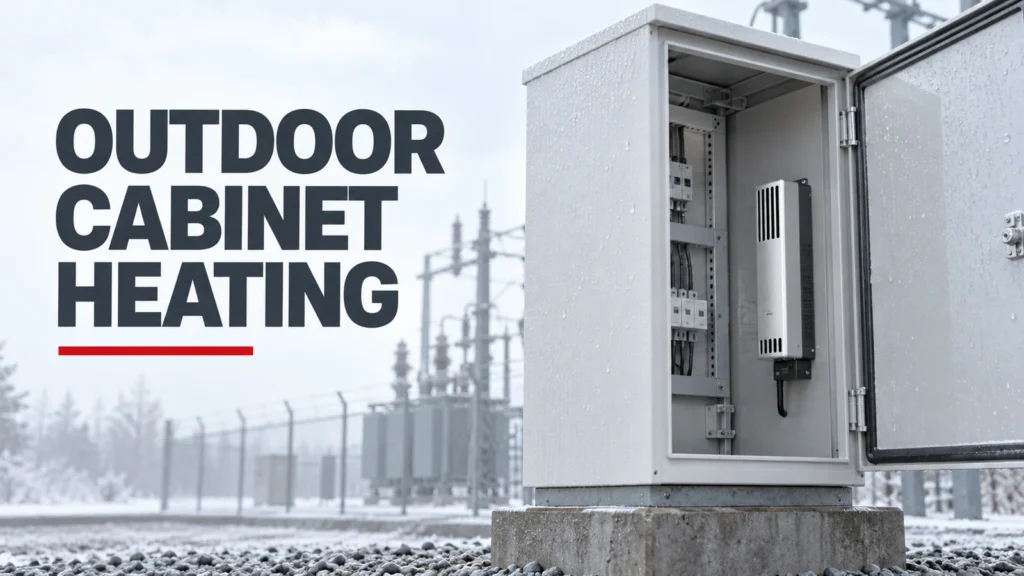
Heating should also not be confused with summer cooling. The same cabinet may need a separate high-ambient temperature assessment. A heater can hold a minimum condition when heat is being lost, but it cannot dissipate the electrical load when the surrounding air is hot. Keep the winter heating brief and the warm-weather cooling brief separate so quotations answer the right engineering question.
Establish the lowest credible ambient condition
Specify the temperature that matters to the installation, not merely a regional annual average. A site may have a lower overnight temperature than its daytime process condition, and equipment can be inactive during the coldest period. The design ambient should be paired with the minimum internal condition needed by the most sensitive component or by the selected condensation-control plan. Equipment manuals, project specifications and site measurements should support that target. Do not substitute a commonly quoted thermostat setting for the required temperature.
Record whether the cabinet is exposed to moving air, sheltered from wind, recessed, shaded or placed in direct sun. Rittal's technical catalogue distinguishes an indoor static-air heating calculation from outdoor moving-air siting. Its example method applies an outdoor adjustment to its own stated assumptions. That is evidence that exposure changes heat transfer; it is not a universal factor to copy into every RITOKS project. Ask the chosen calculation method how it represents the actual installation.
The enclosure construction matters as much as the ambient figure. Dimensions, material, insulation, exposed surfaces, mounting structure, door fit, cable entries and ventilation paths influence heat flow. A cabinet mounted to another structure may exchange heat differently from a free-standing enclosure. Provide the real geometry and surface exposure rather than asking a supplier to estimate wattage from “outdoor cabinet, medium size.”
Identify when internal equipment contributes heat
Power supplies, drives and other installed equipment may dissipate heat while energized. That heat can affect the heater requirement, but it is available only in the operating state that produces it. If the cabinet is unpowered overnight, during maintenance, or on a backup schedule, its internal heat may disappear exactly when ambient temperature is lowest. The cold-case duty must therefore specify operating state. Ask for documented component losses rather than subtracting nameplate input power from a heater estimate.
The cabinet might operate in more than one mode: normal duty, standby, shutdown and restart. Prepare a simple mode table with ambient condition, internal load and required protected temperature for each. The highest heater duty may arise in a standby mode even if normal production generates more heat. If the design requires a defined warm-up time after prolonged shutdown, add that as a separate requirement. A steady-state heat balance cannot establish how fast a cold cabinet, its metalwork and its equipment will reach the target.

Rittal's climate-control material represents the heat balance in terms of enclosure surface loss and installed heat loss. Its formulation is useful for understanding inputs, but it does not authorize an exact RITOKS heater recommendation without the specific cabinet and model. The RITOKS enclosure-heater family page also frames selection around documented capacity, supply, mounting and control.
Treat condensation as a separate failure mode
Condensation is not identical to low temperature. It depends on moisture, air and surface temperatures, and changes over time. A heater may help keep internal surfaces from becoming cold enough for moisture to collect, but it cannot fix a leaking gasket, an open cable entry or liquid water already entering the enclosure. Outdoor cabinets also see humidity and temperature cycling. Document where moisture appears, when it appears and whether it coincides with shutdown, dawn, rain, washing or door opening.
STEGO's enclosure-condensation explanation connects cooling and surface moisture and presents heating as one response. That supports the general concept, not a guaranteed outcome for a different cabinet. The control method must match the objective. A thermostat responds to local temperature; a hygrostat responds to local relative humidity. A fixed heater without suitable control may run when not needed or fail to respond to the relevant condition if the system design is wrong. Confirm whether the chosen heater includes control or requires a separate device.
If the requirement is “no condensation on electronics,” ask what evidence will verify it. A controller's indicated value at one sensor may not represent the coldest internal surface. Thermal bridges, door panels and metal mounting plates can remain cooler than nearby air. A site test or engineering review may be needed to validate the final cabinet. The article does not prescribe dew-point margins, thermostat setpoints or humidity thresholds without project evidence.
Confirm the available power and electrical interface
The heater's electrical supply is not a minor purchasing detail. Record the available voltage type, frequency where relevant, circuit arrangement and how the cabinet is powered during shutdown. A heater on the same switched supply as the protected equipment may have no energy during the state that needs heating. If the design uses auxiliary or backup power, document its availability and intended control. The panel designer must verify protection, wiring, switching and grounding for the exact equipment.
Ask the supplier whether the proposed heater is intended for AC or DC operation, whether its model requires an external thermostat or hygrostat, and what its actual electrical demand is under the relevant conditions. PTC and conventional resistance heater arrangements may behave differently; product-family labels alone cannot establish inrush or operating current. A control contact must be rated for the load it switches, or the design may require a relay. Do not infer compatibility from matching nominal voltage alone.
The published JRQ Series enclosure-heater family is the RITOKS route for exact heater-model questions. A buyer should identify the candidate model and request its datasheet and installation instructions. This article does not claim a particular JRQ version is outdoor-rated, includes a thermostat, or supports a given supply. Those properties must be established for the exact part before quotation or installation.
Evaluate mounting and heat distribution
Available space is not the same as a suitable mounting position. Identify the cabinet's free mounting area, rail or plate construction, door swing, cable routes, sensitive equipment and service access. Confirm required clearance and orientation with the selected heater's instructions. A heater placed next to a thermostat sensor can terminate heat too early for remote components, while a blocked convection path can leave a cold pocket. The final location should support representative sensing and safe separation from heat-sensitive parts.
Rittal's published heater guidance discusses lower-enclosure placement in its own distribution example. That is a useful reminder to consider circulation, but not a universal instruction for another manufacturer's heater. Some cabinet layouts may require a different position or several smaller heaters to distribute heat. Compare those arrangements through the actual model's installation limits and a cabinet-level thermal assessment, not a copied layout from a brochure.
Outdoor exposure may also affect maintenance. Check whether the installer can inspect the heater and control without compromising enclosure sealing. Consider whether a dirty filter, opened vent or damaged gasket changes the cabinet's heat loss over time. A heater does not substitute for a proper enclosure environmental rating, and its presence does not grant one to the assembly.
Build an outdoor heating decision table
| Input group | Buyer should provide | Why it changes the decision |
|---|---|---|
| Ambient | Coldest relevant site condition, wind exposure and shelter | Defines heat-loss boundary |
| Protected condition | Equipment minimum or moisture objective | Defines target and control variable |
| Cabinet | Dimensions, material, exposed faces and openings | Defines thermal path |
| Operating mode | Normal, standby, shutdown and restart heat sources | Determines available internal heat |
| Electrical | Supply during cold modes and control interface | Determines usable heater arrangement |
| Mechanical | Mounting, circulation, clearance and service space | Determines installation feasibility |
The table is an RFQ aid, not a heater calculator. Avoid filling a missing field with a convenient assumption. If site ambient or equipment limits are uncertain, record the range and ask the design authority to approve the value before a model is selected. A supplier can then state which assumptions were used in its proposal and which remain open.
What to send with the RFQ
- Identify the enclosure and outdoor exposure: dimensions, material, mounting, wind, shelter and openings.
- Provide the site cold-case ambient and the minimum condition the protected equipment requires.
- Explain any observed condensation: location, timing, weather or shutdown association.
- Describe normal, standby and unpowered operating states, including documented internal equipment losses where known.
- State the available heater supply in each relevant state and the proposed control objective.
- Provide allowable heater mounting locations, clearance constraints and required service access.
- Request exact-model output data, supply and control documents, installation instructions and the calculation basis used in the quotation.

An inquiry with these inputs allows the supplier to distinguish a cold-temperature requirement from a moisture-control problem and to explain a candidate heater choice. It also avoids a false sense of precision. A general weather label, a guessed cabinet size or a single annual average temperature is not enough to sign off the system.
Final selection check
Outdoor cabinet heating is an application assessment. Define the coldest operating state, protected temperature or humidity objective, real enclosure heat paths, power availability and mounting envelope before choosing output. Use the RITOKS enclosure-heater category to identify the published family, then request exact JRQ model evidence against the project brief. Keep any unverified environmental rating, certification or performance statement out of the final specification until the supplier provides model-specific documentation.