
Radiatory modułów zasilających · Objaśnienie techniczne
SCR and Rectifier Module Heatsink Mounting: Evidence Checklist
SCR and Rectifier Module Heatsink Mounting: Evidence Checklist begins with a controlled application record, not a catalog headline. Buyers should define the real system, installation and service conditions before comparing candidate products. Every decisive claim then needs support from the exact proposed order code.

This evidence checklist organizes the documents needed to review mounting between a power semiconductor module and a heatsink. It does not prescribe a universal torque, flatness, compound thickness, insulation stack or temperature limit; those values must come from the exact module, heatsink, interface and assembly instructions.
Podsumowanie danych wejściowych do decyzji
| Obszar przeglądu | Kupujący musi określić | Wymagane dowody |
|---|---|---|
| Geometry | Baseplate, holes, keep-outs and contact area | Exact module and heatsink drawings |
| Interfejs | Approved material, preparation and application method | Exact installation instruction |
| Mocowanie | Hardware, sequence, tool and tightening value | Manufacturer mounting procedure |
| Izolacja | Required electrical isolation and thermal consequences | Approved insulation-system evidence |
| Thermal verification | Loss, temperatures, airflow and acceptance points | Calculation plus assembled test |
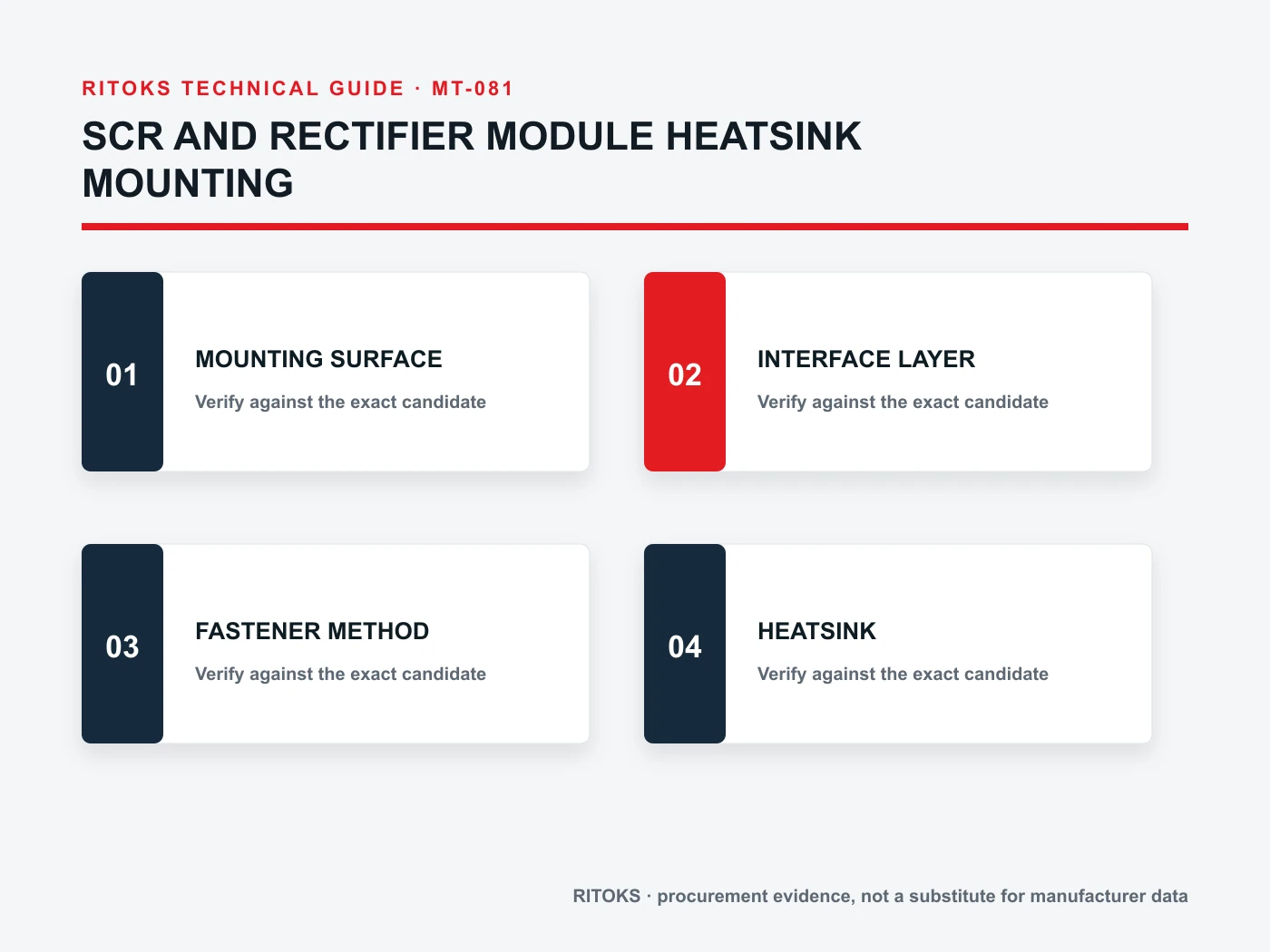
Freeze the Exact Module and Heatsink Pair
Record the full module order code and the exact heatsink extrusion, machining drawing or finished part number. Similar module footprints can differ in hole position, baseplate shape, terminal clearance or mounting instruction. A generic family outline is not enough for machining approval.
Overlay the two controlled drawings and identify the intended contact area, mounting holes, terminal keep-outs, conductor approach and service space. If an adapter plate is proposed, treat it as a separate thermal and mechanical component with its own evidence.
Inspect the Contact Surfaces
The heat-transfer interface depends on the assembled surfaces. Review the exact requirements for flatness, finish, cleanliness and damage limits from the relevant manufacturer documents. Do not substitute a shop rule or a value copied from a neighboring module.
Define how incoming heatsinks and modules are protected from dents, burrs and contamination. Establish an inspection method that can identify a surface problem before fastening hides it.
Specify the Interface Material as a System Component
Thermal compound, pad or isolating material affects contact resistance, assembly process and electrical behavior. Use only a material and application method supported by the complete design. More material is not automatically better, and an improvised layer can prevent proper seating.
Record supplier, grade, thickness or application control, coverage area, storage and replacement rules where applicable. If the interface also provides insulation, confirm its electrical role and how clamping affects its performance.
Follow the Exact Fastening Procedure
Fastener type, washer arrangement, tightening sequence and final torque influence contact pressure and module stress. These details must come from the exact mounting instructions and the approved mechanical design. This article intentionally provides no universal torque number.
Use a controlled tool and document the assembly sequence. If the design requires staged tightening, recheck or settling time, include it in the work instruction. Do not use terminal-torque data as mounting-torque data.
Include Insulation and Clearance in the Review
Determine whether the module base, heatsink or surrounding assembly must be electrically isolated. Add insulators, bushes or barriers only as part of an approved design because they can alter both thermal performance and mechanical stack height.
Check terminal clearance, creepage and service access using the applicable project requirements and exact drawings. The heatsink may be physically large enough but still unsuitable if terminals or busbars cannot be routed safely.
Verify the Finished Thermal Assembly
Calculate semiconductor loss with exact device data and real operating duty. Carry that heat through every interface to the cooling medium. For forced air, include the actual fan, duct, obstruction and inlet condition rather than a free-air assumption.
Test representative assemblies at the specified load and environment. Define measurement locations and acceptance limits before testing. If the module, interface, machining, fan or enclosure changes, assess whether the verification remains applicable.
Stwórz plik dowodów oparty na modelu dokładnym
Create one approval record for the proposed Power Module Heatsink order code. Put each project requirement beside the supplier document that answers it. Preserve the exact datasheet, drawing, curve, table, instruction or selection output used, including its revision or retrieval date. A category page can establish family context, but it cannot prove an exact rating, construction, terminal arrangement or system combination.
Należy sprawdzić, czy każda zaakceptowana specyfikacja dotyczy tego samego produktu dostępnego w sprzedaży. Nie należy łączyć maksymalnej wartości dla rodziny z jednego wariantu, schematu z innego wariantu oraz opcjonalnej funkcji z trzeciego wariantu. Należy wyraźnie oznaczyć pola, które nie zostały jeszcze wypełnione, tak aby pozostawały widoczne podczas przeglądu technicznego i handlowego.
Należy oddzielać dane wejściowe projektu od dowodów dotyczących produktu
The project team defines the application: source, load, duty, environment, controls, mounting, service and required functions. The supplier identifies an exact Power Module Heatsink and supports it with exact documents. Neither side should fill a gap by inference from appearance, a shared family name or one matching headline value.
Należy wstrzymać proces rozpatrywania ofert na czas porównywania ofert. Jeśli zmienią się parametry elektryczne, warunki otoczenia, metoda chłodzenia, obudowa, sposób montażu lub wymagane funkcje, należy sporządzić zaktualizowaną dokumentację i poprosić wszystkich dostawców o ponowne potwierdzenie wyboru.
Przed złożeniem zamówienia należy określić protokół odbioru
Write the acceptance record before a preferred Power Module Heatsink is chosen. Include the project inputs, proposed order code, included accessories, document revisions, exceptions, assumptions and the person responsible for resolving each open point. This prevents the technical basis from being reconstructed after price negotiations have already narrowed the choice.
Należy odróżnić wymagania obowiązkowe od preferencji i przyszłych opcji. Warunek obowiązkowy wymaga bezpośrednich dowodów lub udokumentowanej decyzji inżynierskiej. Preferencja może mieć wpływ na porównanie, ale nie powinna być przedstawiana jako wymóg bezpieczeństwa lub zgodności. Przyszłe opcje należy uwzględniać tylko wtedy, gdy projekt rzeczywiście je przewiduje, ponieważ funkcje opcjonalne mogą wpłynąć na kod zamówienia, zaciski, wymiary lub dokumentację towarzyszącą.
Sprawdź dostarczony element i gotowy zestaw
Incoming inspection should compare the delivered Power Module Heatsink, labels, accessories and documents with the approved record. Do not accept a same-family replacement solely because its appearance or one rating matches. Record any substitution and repeat the affected review before installation.
Po montażu należy sprawdzić funkcje i parametry, których nie da się zweryfikować wyłącznie na podstawie dokumentacji technicznej poszczególnych komponentów. Kontrola może obejmować dopasowanie mechaniczne, zgodność okablowania z zatwierdzonym schematem, działanie układów sterowania, temperatury, przepływ powietrza, sygnały alarmowe lub dostęp serwisowy – w zależności od sytuacji. W projekcie planu testów należy określić reprezentatywne stany pracy i kryteria odbioru, zamiast ustalać uniwersalne wartości graniczne w zamówieniu.
Typowe błędy związane z zamówieniami publicznymi
- Selecting a Power Module Heatsink from one headline value while the application context remains incomplete.
- Wykorzystanie krzywej, obwodu, rysunku lub zastrzeżenia z sąsiedniego kodu zamówienia.
- Traktowanie strony kategorii, zdjęcia produktu lub rozmiaru nominalnego jako dowodu dokładnej zgodności.
- Zakładając, że akcesorium, funkcja systemu lub wynik koordynacji zostały uwzględnione bez dokumentacji.
- Zatwierdzenie zastępcy bez ponownego przeprowadzania przeglądu instalacji elektrycznej, mechanicznej i dowodów.
Przed porównaniem ceny i terminu realizacji należy wyeliminować te niedociągnięcia. Oferta może pozostać atrakcyjna pod względem handlowym, nawet jeśli jest niekompletna pod względem technicznym, jednak brakujące informacje nie mogą zostać pominięte w samej ofercie.
Jak porównać oferty dostawców
| Obszar przeglądu | Kupujący musi określić | Wymagane dowody |
|---|---|---|
| Kod zamówienia | Kompletny zestaw proponowanych elementów wraz z dołączonymi akcesoriami | Dokładna specyfikacja techniczna i zakres zastosowania |
| Zgodność aplikacji | Zgłoszone warunki eksploatacyjne i środowiskowe | Pisemna odpowiedź na każde z wymagań |
| Integracja mechaniczna | Montaż, zaciski, odstępy i konserwacja | Dokładne rysunki i instrukcje |
| Dowody elektryczne | Obowiązujące parametry znamionowe, krzywe i topologia | Dokumentacja techniczna dotycząca konkretnych modeli |
| Kwestie do rozstrzygnięcia | Czynniki nieznane, wyjątki i założenia | Lista wyjaśnień z datą |
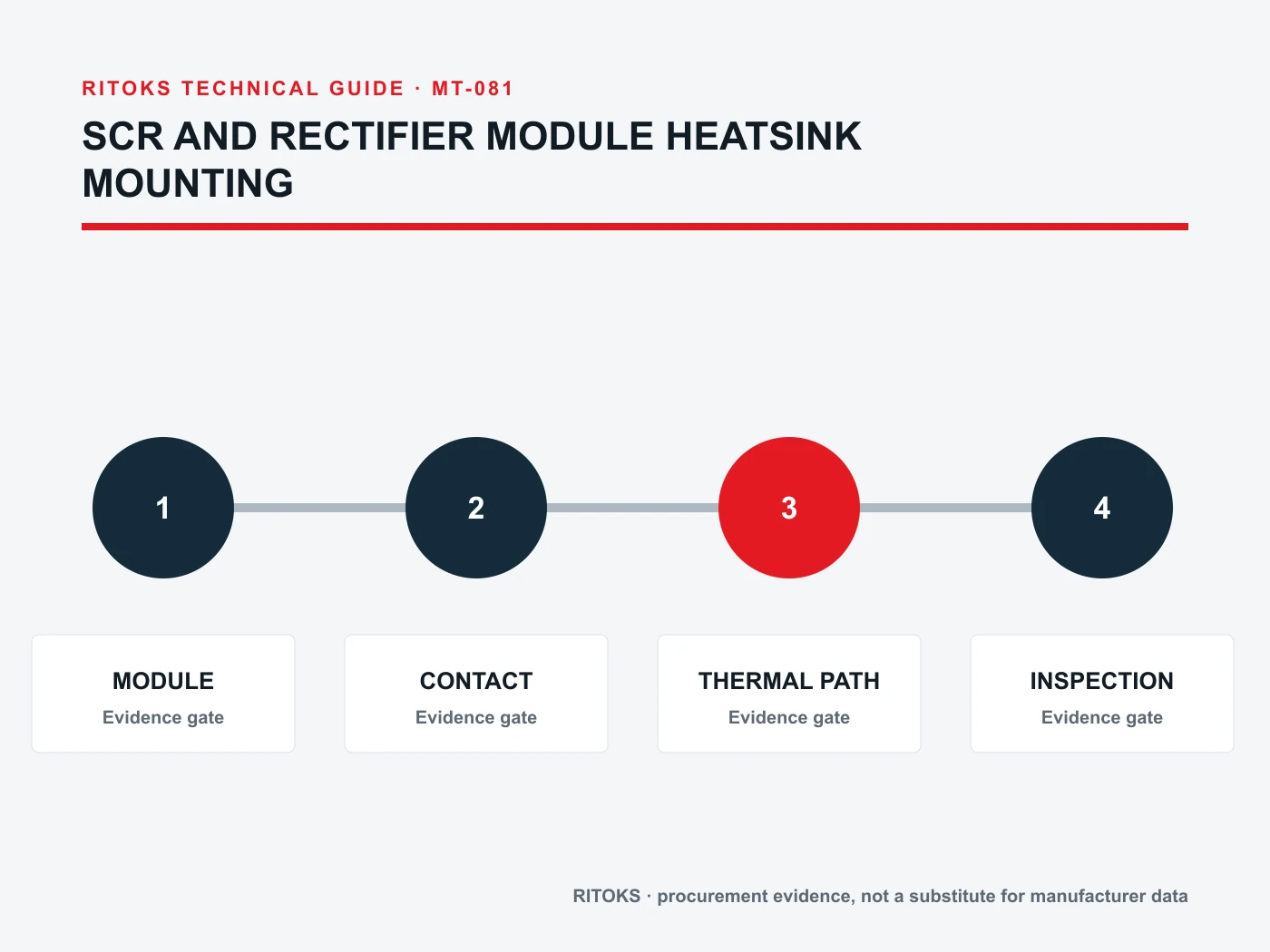
Normalize every Power Module Heatsink offer to the same application record. Keep document revisions, test conditions, included accessories and open questions beside each value. This makes differences in delivered scope visible and prevents a lower-cost but narrower offer from appearing equivalent to a complete proposal.
Proces podejmowania decyzji
- Należy ustalić granice systemu i stany robocze.
- Należy rejestrować dane dotyczące parametrów elektrycznych, mechanicznych, środowiskowych oraz serwisowych.
- Wybierz pełny kod zamówienia kandydata do sprawdzenia.
- Każde kluczowe stwierdzenie należy zweryfikować w oparciu o dowody pochodzące z modelu dokładnego.
- Przed przystąpieniem do porównania ofert handlowych należy wyjaśnić wszelkie wyjątki i założenia.
- W przypadku gdy wymaga tego ryzyko związane z zastosowaniem, należy przeprowadzić weryfikację gotowego zespołu.
Należy przerwać pracę, gdy kluczowa wartość wejściowa jest nieznana, przytoczony model jest niejednoznaczny, wymagane twierdzenie znajduje potwierdzenie jedynie u innego producenta lub w innym kodzie zamówienia albo gdy instalacja wykracza poza zakres dostępnych danych. Są to luki techniczne, a nie szczegóły redakcyjne.
Lista kontrolna dotycząca przygotowania zapytania ofertowego
A useful RFQ for scr module heatsink mounting is concise enough to answer and complete enough to prevent silent assumptions. Identify unknown values as questions and require a full orderable code rather than a generic family recommendation.
- EXACT DRAWINGS
- SURFACE CONDITION
- INTERFACE MATERIAL
- FASTENING METHOD
- DEVICE LOSS
- CONTACT PATH
- HEATSINK
- AIRFLOW TEST
- Wymagane dokumenty i poprawki
- Ilość, miejsce przeznaczenia i żądany zakres dostawy
Należy poprosić dostawcę o oddzielne wyszczególnienie wyłączeń, założeń i opcji. Ilość i miejsce przeznaczenia należy odnotować po danych technicznych, aby warunki handlowe nie przesłaniały nierozstrzygniętych kwestii technicznych.
Najczęściej zadawane pytania
Can I select a Power Module Heatsink from one rating or size?
Nie. Wybór wymaga przedłożenia kompletnego wniosku, dokładnego projektu oraz spełnienia wszystkich odpowiednich warunków elektrycznych, mechanicznych, termicznych, środowiskowych i dokumentacyjnych.
Czy mogę wykorzystać stronę rodzinną jako dowód zatwierdzenia?
Strona poświęcona rodzinie produktów pomaga w zorientowaniu się w temacie. Podczas zatwierdzania należy korzystać z arkusza danych technicznych zawierającego dokładny kod zamówienia, rysunku, instrukcji oraz dokumentacji technicznej dotyczącej konkretnego projektu.
Czy modele o podobnym wyglądzie są wymienne?
Nie automatycznie. Podobne obudowy mogą zawierać różne obwody, materiały, zaciski, parametry znamionowe lub akcesoria. Należy powtórzyć analizę dla każdego zamiennika.
Co powinno pozostać otwarte w ofercie?
Wszelkie brakujące dane wejściowe dotyczące projektu, niezweryfikowane twierdzenia dotyczące modelu dokładnego, niejasności dotyczące dołączonych akcesoriów lub nierozstrzygnięte kwestie związane z warunkami montażu należy uwzględnić jako kwestie do wyjaśnienia, a nie przyjmować za pewnik.
Powiązane materiały RITOKS i zapytania ofertowe
Przejrzyj Kategoria produktów: Radiatory do modułów zasilających, zapoznaj się z główną stroną produktu, zapoznaj się z opcją 2 produktu powiązanego. Strony te przedstawiają kontekst handlowy; ostateczna zgodność nadal zależy od historii projektu oraz podanego kodu zamówienia.
Gdy dokumentacja techniczna będzie gotowa, przesłać wniosek wraz z wymaganymi dokumentami do RITOKS w celu uzyskania pisemnej oferty. Ostateczny wybór powinien być uzależniony od zgody inżyniera projektu oraz aktualnej dokumentacji producenta.