
Rack Power Distribution · Technical Explainer
Rack PDU RFQ for Data Centers: Input, Outlet, Mounting and Monitoring Fields
A data-center rack PDU quotation should describe one installable configuration, not a collection of attractive features drawn from different product families. The rack has an upstream power source, equipment cords, physical mounting envelope and operating requirement. Those facts determine whether the buyer needs a basic distribution unit, a local metered unit, a network-managed smart PDU or a dual-input ATS rack PDU. A request saying only “rack PDU with monitoring” can miss the input connector, outlet layout, rack orientation and source architecture that make a unit usable.

This guide provides a data-center-specific RFQ field set. It is narrower than a general buyer checklist because it ties each requested capability to a rack power path and deployment test. RITOKS currently publishes separate Rack PDUs and Socket Modules, Metered Rack PDUs, Smart Rack PDUs and ATS Rack PDUs categories. Their functions must not be merged into one implied model.
Draw the rack's input path first
Identify the upstream source, phase arrangement, nominal voltage, current limit and actual input connector required at the rack. Note whether the PDU will use a cord and plug, hardwiring if a product supports it, or another documented connection. The selected input must match both the electrical supply and the site connector standard. A generic voltage-and-current pair is not sufficient: a unit can have the right nominal rating and still carry an incompatible plug or cable length.
If the rack has A and B power feeds, identify what the equipment itself does with them. Dual-cord equipment can be distributed across separate feeds through an appropriate design. Single-cord equipment needing automatic source transfer may require an ATS rack PDU, which is a different architecture. The RITOKS LA-PD ATS family is explicitly dual-input and model-specific. Do not infer transfer time, phase or branch-protection details that its public page leaves unconfirmed. A Smart PDU's network interface does not make it an ATS, and a local meter does not create a redundant input.
Ask the site electrical owner to state the circuit and connector at each planned rack position. An equipment-level bill of materials helps: upstream breaker or distribution, receptacle, PDU input, output outlets and connected devices. This chain makes a configuration reviewable. The article does not choose a protective device or wire size, which require the complete design and applicable rules.
Build the outlet schedule from connected equipment
List every device cord and its required outlet standard before selecting a PDU outlet count. Include network equipment, servers, storage, management devices and any approved spare positions. Record the connector type and any locking or retention requirement. Do not assume a regional socket or IEC C13/C19 label fits a cord without checking the exact mating connector and rating. If equipment is dual-corded, note which PDU or feed each cord should use.
The RITOKS rack PDU and socket category contains assembled PDUs and modular socket components. A modular socket listing is not proof that a complete assembled PDU with any desired outlet combination is already documented. Ask for the exact outlet layout and approved configuration drawing. The published basic 1U and regional outlet families can be a reference for available types, but their specifications must not be copied into a metered, smart or ATS model.
Position matters as well as count. Large plugs can block adjacent outlets; short equipment cords can limit reach; and a vertical PDU may avoid using rack units but need rear-cabinet clearance. Provide the rack elevation, equipment placement and preferred outlet grouping. The supplier can then check a proposed drawing against the actual cabinet rather than quoting from a simple outlet-count line.
Specify horizontal or vertical mounting
State rack width, usable depth, available rear space and whether the PDU should be 1U/2U horizontal or 0U vertical. Provide the rack make, rail or mounting pattern when exact fit is important. Ask for dimensions, mounting accessories, cable-exit orientation and the door-clearance envelope. A product family may illustrate several formats while a particular platform and outlet layout supports only some of them. The P Series public page, for example, describes mounting choices as platform-dependent rather than fixed by its PA/PB/PC/PD function names.
Include service considerations. Can an operator see a local display with doors closed? Can a network cable reach the management port without pinching? Will the input cord route without blocking exhaust or cabling? Can a replacement unit be installed without moving critical equipment? These questions are practical layout checks, not assertions that every model offers tool-less mounting or live replacement.
If the rack is in a constrained aisle, request a marked drawing rather than relying on a generic product photograph. The installed device may be longer, wider or differently oriented than the marketing image. Dimensions and bracket details belong to the exact model and configuration supplied with the quotation.
Choose the function family deliberately
A basic rack PDU distributes power. A local metered PDU adds documented display/measurement. A smart PDU may add network monitoring, management or outlet switching according to its exact platform. An ATS rack PDU provides a documented dual-source transfer architecture for suitable single-cord loads. These are functional distinctions, not a hierarchy in which each family automatically includes every feature below it.
The RITOKS Metered Rack PDU category frames local measurement as its buyer intent. The P Series smart family separates aggregate-monitored PA, per-outlet-monitored PB, aggregate-monitored-and-switched PC and per-outlet-monitored-and-switched PD platforms. If the requirement is “remote power cycle one server,” only a platform with the documented switching function should be evaluated. If the requirement is “show input load at the rack,” a local-display configuration may be sufficient. Do not pay for or depend on functions the project cannot use.
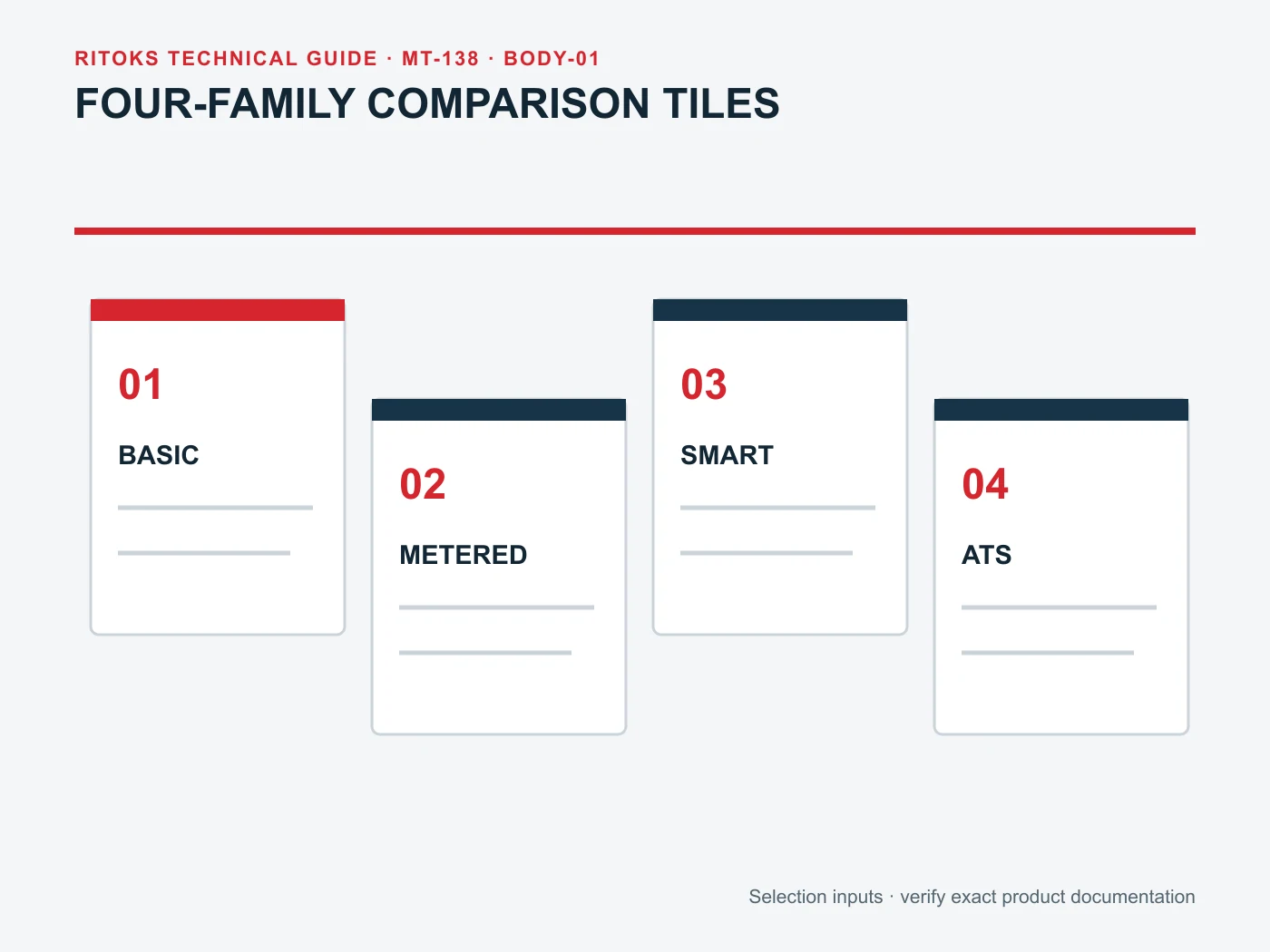
For an ATS request, the two sources and transfer objective should be documented independently from monitoring. The LA-PD page describes an optional hot-swap management card, not standard network management on every model. Any requirement for transfer time, source priority, alarms or communications needs exact-model evidence. An RFQ should mark those details as requirements to be confirmed, not supplied facts.
Write the monitoring requirement in data terms
If the operations team needs PDU data, list the required measurements and where each is taken: input, branch or outlet. State whether viewing a local display is enough or whether the data must enter a DCIM, BMS or other monitoring system. Specify required interface and protocol only after the monitoring system's needs are known. Request the selected model's MIB, register map or API document, if applicable. A broad product-family statement is not enough to approve integration.
The RITOKS P Series public matrix lists platform-dependent protocols. A function not listed for one platform should be treated as unconfirmed there. Ask about units, data update, timestamps, alarms and missing-data behavior when those matter to the integration. A unit can have a network port and still fail a particular system's acceptance test if the required values are unavailable or cannot be mapped reliably.
Environmental inputs need their own line item. If temperature or humidity channels are needed, ask whether the sensors are included, which platform accepts them and where the probes should be located. Do not confuse a sensor port with a supplied sensor. Raritan and Vertiv manufacturer materials describe more advanced monitoring on their own products; those examples demonstrate why a data dictionary matters but do not transfer their measurements or protocols to a RITOKS unit.
Request protection and compliance evidence
Ask what protective devices are incorporated in the exact PDU and how the upstream circuit is designed. Do not assume a switch, surge component or display equals branch overcurrent protection. Request the exact nameplate, datasheet, installation instructions and applicable compliance documentation for the destination market. RITOKS's general categories note that certification evidence varies by model. A logo on a category page should never become an unsupported certification claim for a quoted configuration.
Temperature, airflow and environment also matter in a rack. Supply the site operating conditions and ask for the PDU's documented limits. The PDU must fit the electrical and mechanical system, not simply the purchasing description. If the cabinet has unusual humidity, dust or service conditions, include them rather than assuming data-center use guarantees compatibility.
Copy-ready data-center RFQ schedule
| Section | Fields to complete |
|---|---|
| Rack and site | Rack format, mounting preference, depth and access envelope |
| Input | Feed count, phase, voltage/current requirement, plug and cord |
| Outlets | Standards, count, grouping, connected loads and retention needs |
| Function | Basic, local metered, network monitored, switched or ATS |
| Monitoring | Measurement point, parameters, interface, protocol and sensor needs |
| Transfer, if needed | Dual sources, single-cord load, exact timing and priority requirements |
| Evidence | Model/variant, drawing, datasheet, installation and compliance documents |
| Commercial | Quantity, destination, delivery requirement and permitted alternates |

Use one row per actual rack configuration if a project has different rack types. Where input connectors or outlet standards vary, do not ask the supplier to decide silently. Mark alternatives as alternatives and request separate configurations. That keeps electrical and function features attached to one exact quote line.
Acceptance before deployment
Compare the returned configuration with the rack schedule, not just the marketing family name. Verify input and output connections, rack fit, control architecture and monitoring data on the same exact model. Ask for a sample or documented demonstration when integration is a gating requirement. Check a representative measurement or alarm with the intended system in a controlled test. If switching or source transfer is involved, follow an approved test procedure that does not risk live critical loads.
The RITOKS Rack Power Distribution range provides the family map. The RFQ should lead to a specific, evidence-backed basic, metered, smart or ATS choice. A complete schedule and exact-model documentation are what turn a “rack PDU” inquiry into a deployable data-center power component.