
SCR Thyristor Modules · RFQ Checklist
SCR Thyristor Module RFQ Checklist
An SCR thyristor module RFQ should describe the circuit that drives and cools the device, not just request a voltage and current class. Thyristor topology, conduction waveform, gate drive, surge duty, heatsink and package can all change the appropriate exact model. A high current number in a family catalogue does not make a module interchangeable with an existing part.
This checklist is for power-electronics engineers and sourcing teams preparing a comparable quotation. It does not choose a firing circuit or heatsink for an unknown application. The final selection needs model-specific electrical, thermal and mechanical documents plus a project design review.
Specify circuit topology and internal connection
State whether the application is a controlled rectifier, AC power controller, soft starter or another switching function. Provide the schematic showing where each SCR conducts and how the load is connected. A single SCR, dual SCR, half-controlled bridge and other arrangements have different terminal maps. The word “thyristor module” is not a circuit diagram.
If replacing an existing module, include the original internal schematic and terminal assignment. Package similarity is not proof of topology. Ask the supplier to return the proposed order code's internal circuit drawing and identify any change to anode, cathode or gate terminals.
For multiple devices in one package, describe which paths conduct in each operating state. Thermal load may not be shared equally. The RFQ should show whether one chip or the whole package controls the design limit.
Provide voltage and transient conditions
Give nominal and maximum supply voltage, frequency where relevant, anticipated line variation and transient environment. Ask for exact-model repetitive and non-repetitive blocking-voltage data and their conditions. A headline blocking rating should be compared with the real circuit stress, not with a nominal source figure alone.
Describe the snubber, surge suppression and commutation arrangement if the design includes them. If those elements are not finalized, identify the missing decision. A supplier cannot infer transient margin from current rating or package size.
Do not copy a rating from a related family or another manufacturer's similarly named module. Ask for the data sheet revision used in the quote so the voltage decision can be traced to the exact product.
Send current as a waveform and duty cycle
Record average and RMS current information relevant to the manufacturer's model, conduction angle, load waveform, continuous duty and startup events. A controlled rectifier at one firing angle and a soft starter during acceleration may impose different losses despite the same load-current headline.
List surge or overload current with duration and repetition. Distinguish a rare non-repetitive event from routine inrush. Published surge-current data have test conditions; they should not be treated as a repetitive operating rating without manufacturer confirmation.
Provide the expected fault and protection scheme. State upstream fuses, breakers and the available short-circuit current. A thyristor can be exposed to damaging fault energy before a general-purpose protective device opens. Ask for any manufacturer guidance on semiconductor protection and coordination relevant to the candidate.
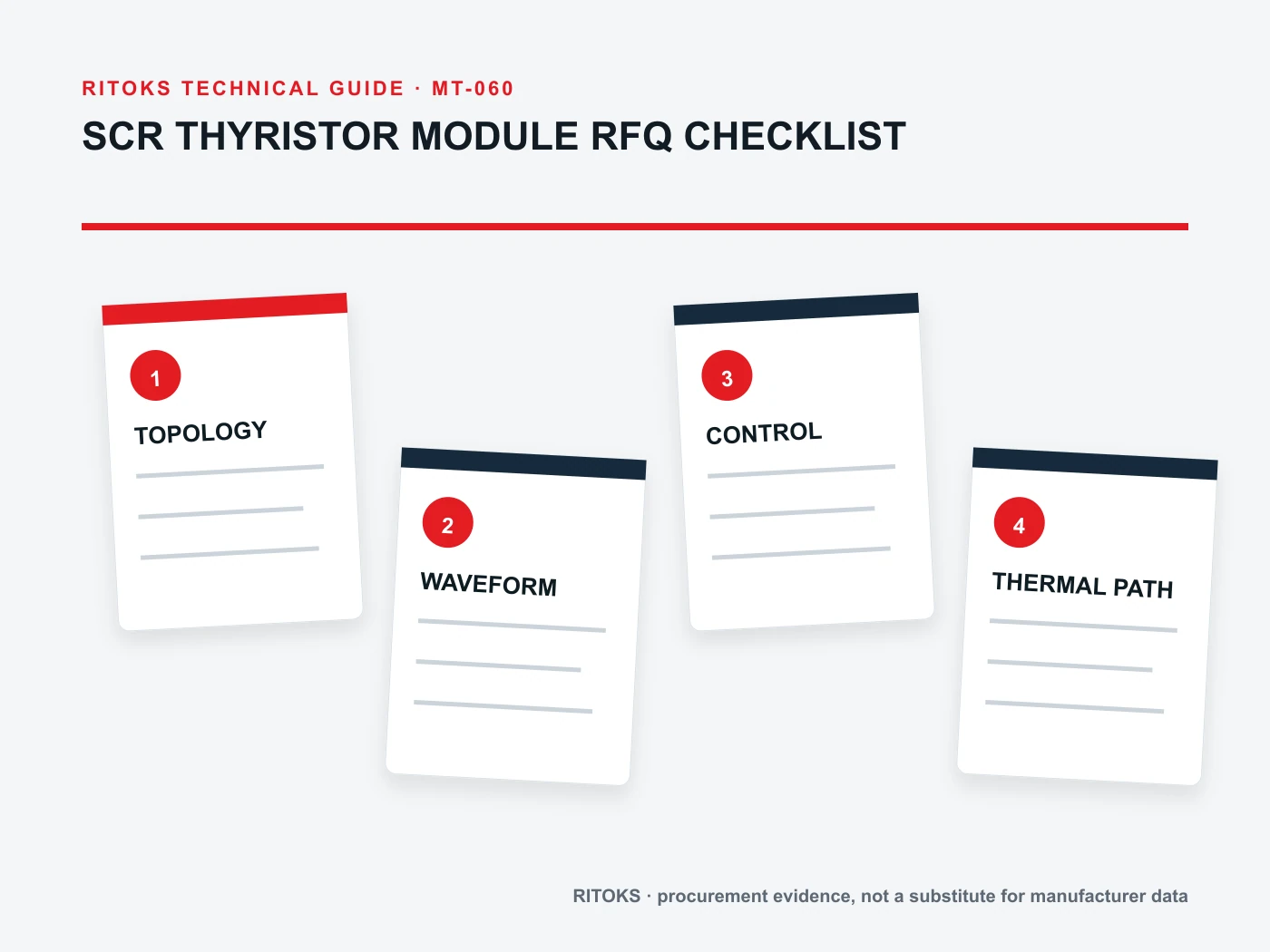
Define gate-drive compatibility
Provide the gate-driver or controller type, firing strategy, isolation method and available gate pulse conditions. The module must receive a gate signal that meets its exact trigger requirements across temperature and circuit states. A module with suitable main-terminal current and voltage ratings may still be incompatible with an existing drive design.
Ask for gate trigger and maximum gate-limit data, recommended pulse or drive guidance and the terminal layout. Clarify whether the gate return is separate and how the module must be connected to minimize interference. Do not substitute a generic “standard gate” claim for the exact datasheet.
For retrofit work, compare the existing and proposed module's gate characteristics before ordering. A control-board change may be necessary even if the power terminals appear to fit. Record that as a design deviation, not a hidden accessory issue.
Describe the thermal installation
Send maximum local ambient temperature, enclosure conditions, available heatsink, airflow or liquid cooling, mounting surface and thermal interface plan. The module's current rating is conditional on heat removal. A quotation should provide exact loss data, thermal resistance or impedance, permissible junction temperature and installation instructions.
Specify whether multiple modules share a sink and where they sit. Heat spreading and airflow can make a shared assembly hotter than a single-module test. If a new sink is needed, request a thermal calculation or design review rather than letting procurement select an extrusion by physical size alone.
Infineon's thyristor/diode-module installation documentation explains how thermal interface material and its application affect heat transfer. That principle informs the RFQ, but the proposed RITOKS module needs its own mounting instructions. Do not copy torque, grease or flatness requirements from a different product.
Capture package and connection constraints
Give allowable footprint, mounting-hole pattern, terminal type, busbar or cable layout, clearance and service access. Provide the existing assembly drawing for replacement projects. A module that shares a broad package family may have different anode/cathode/gate positions or base insulation.
Ask for the exact dimensional drawing, terminal identification, electrical isolation information and fastening sequence. If the supplier proposes a substitute requiring busbar changes, mark it as a redesign rather than a drop-in equivalent. Mechanical fit and electrical insulation both need approval.
Build a comparable response matrix
| RFQ area | Project supplies | Supplier returns |
|---|---|---|
| Topology | Circuit and conducting paths | Exact internal schematic |
| Voltage | Operating and transient envelope | Blocking data and conditions |
| Current | Waveform, duty and surge | Current and surge evidence |
| Gate | Driver and pulse strategy | Trigger and limit data |
| Thermal | Sink, ambient and airflow | Loss, impedance and mounting guide |
| Mechanical | Footprint and conductors | Dimension and terminal drawing |
Request all documents for the quoted order code and note their revision. If the supplier gives a family catalogue, identify which variant-dependent values still need confirmation. Compare offers at the same circuit duty, not at unrelated vendor test points.
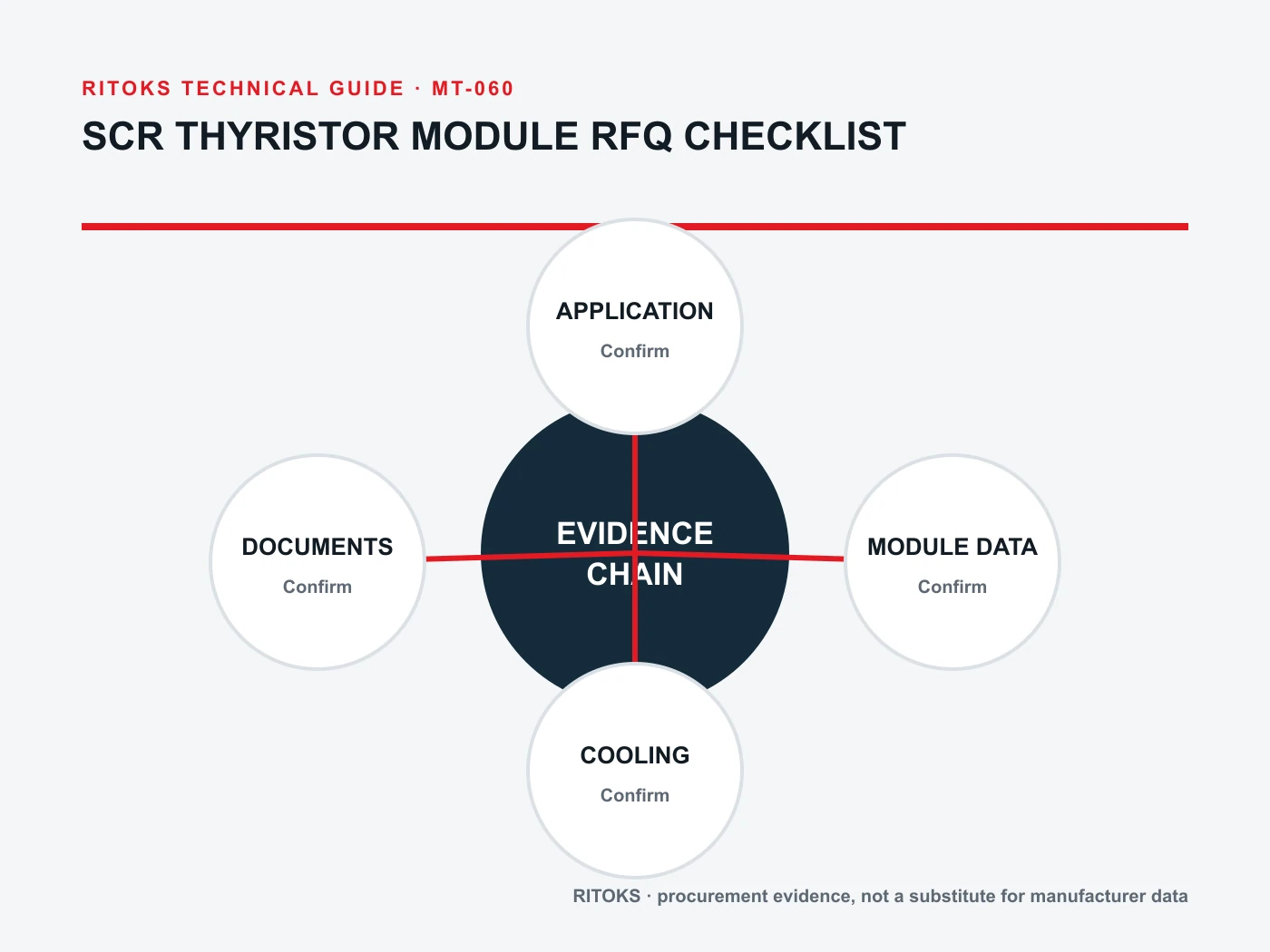
Plan validation before purchase release
For a new design or significant substitution, plan gate-drive checks, waveform measurements, sustained temperature testing and review of surge or fault assumptions. State which tests are design qualification and which are routine production checks. A supplier's datasheet describes device limits; installed-system measurements confirm that the design operates within them.
Record the approved thermal interface and mounting process so production can reproduce the tested assembly. A prototype with carefully hand-applied compound may perform differently from a repeat build if torque or surface preparation is uncontrolled.
If an input is still unknown, mark the quotation conditional. An estimated load waveform, proposed sink or assumed line transient should not silently become a guaranteed design fact. Close each item before final module approval.
Handle supplier alternatives transparently
Different SCR modules can share a broad current and voltage class while differing in internal topology, gate sensitivity, thermal path or terminal arrangement. Ask each bidder to state deviations from the requested circuit and installation. A higher voltage label does not compensate for an incompatible gate interface, and a familiar package outline does not prove the same internal connection.
For a replacement project, compare original and proposed datasheets side by side. Check repetitive and non-repetitive voltage, conduction and surge conditions, gate limits, junction-to-case data, mounting and electrical isolation. Record which existing tests can be retained and which need repeating. Procurement should not mark a model “equivalent” until engineering has reviewed the full electrical and thermal consequences.
Keep the final quotation tied to one order code. If the supplier changes a suffix for mounting, packaging or interface material, the thermal and mechanical instructions may change too. Confirm the suffix before purchase release and again on receipt. Include the approved drawing revision, gate-driver reference and heatsink assembly identifier in the purchase record so future substitutions can be evaluated against the same baseline.
RITOKS product families as sourcing context
The SCR/thyristor module category can orient the inquiry. The MTA dual-SCR family, MTC SCR family and high-current MTC family are commercial starting points, not application approvals.
Send the completed circuit, waveform, drive and cooling checklist through RITOKS contact. Request exact model documents and a list of deviations from the requested conditions. A useful quote answers the engineering questions as well as the price question.
Frequently asked questions
Is a voltage/current pair enough for an SCR quote?
No. Topology, current waveform, gate drive, thermal conditions, surge duty and package also determine suitability.
Can a similar package replace an old module?
Only after internal connection, terminals, gate requirements, losses, mounting and ratings are compared for the exact order codes.
Does a large heatsink solve all current-duty questions?
No. Current and surge limits, losses, interface and cooling must all be checked. A sink cannot create a missing electrical rating.
Bottom line
A complete SCR module RFQ joins topology, voltage, current waveform, gate drive, cooling and package requirements. Ask for exact-model evidence and keep unresolved values explicit. That yields a comparable supplier response without inventing performance claims.