
Power Semiconductor Modules · Technical Explainer
SiC Short-Circuit Protection: Building a Detection-to-Turn-Off Budget

Quick answer
A SiC short-circuit timing budget is useful only when its start event, intermediate boundaries, and final current-interruption endpoint are defined consistently. A sensor response figure, a driver delay, and a module's stated short-circuit conditions cannot be compared merely because their units are all nanoseconds or microseconds. Establish what each interval includes, identify any overlap or gap, and match the complete result to the selected device, fault case, and operating conditions.
For purchasing and design review, build a timing correspondence record rather than choosing a universal protection time. It should show the exact module and protection configuration, the evidence behind each interval, and the engineer responsible for unresolved applicability. This article explains how to read that record. It does not provide fault-creation instructions, protection settings, a gate-drive prescription, or a qualified protection design.
Begin with the event that the clock describes
“Response time” is incomplete without a description of the event being observed. A published interval might start when a threshold is crossed, when a fault is initiated, or when a logic signal changes. Its endpoint might be an output transition or a change in power-device current. These definitions are not interchangeable. Before adding a figure to a budget, write both endpoints in ordinary language beside the number.
The most useful format is a chain of named boundaries. One record may describe the period before a detector reports an event; another may describe how a command reaches the driver; a third may concern the power stage's response. A chain is complete only if adjoining boundaries actually correspond. Similar names in two documents do not establish that correspondence, especially if their authors use different thresholds or observation points.
Consider a hypothetical supplier response that says “detection completed” while the system requirement says “fault current interrupted.” The response may be accurate yet incomplete. It establishes an intermediate milestone, not the requested endpoint. Ask what happens between the two stated events and which record covers that interval. This question is more useful than asking the supplier to repeat a smaller headline delay.
Keep a demonstration attached to its configuration
Sahan, Kaczmarek, Ebli and Grambichler's November 2021 article, hosted by Infineon, describes a particular current-sensor, SiC-module and gate-driver experiment. Its reported detection-and-turn-off result belongs to that configuration and fault setup. It illustrates why the observed current response and the detector signal need distinct interpretation; it does not supply a universal SiC withstand time or qualify another module's protection chain. Infineon-hosted article
A demonstration can be helpful even when its hardware is different from the proposed build. It shows the kind of evidence that makes a timing statement interpretable. The buyer should then request corresponding evidence for the selected configuration rather than transferring the demonstration's number. The distinction is between learning how to ask a question and treating another system's answer as one's own.
Avoid filling a missing application condition with a familiar number from an earlier project. A figure associated with a different device technology, sensor arrangement, or fault case remains evidence about that arrangement. A matching unit does not create matching applicability. Keep unavailable values blank until the responsible engineering source can identify their scope.
Add intervals only when the boundaries do not overlap
An explicitly hypothetical example illustrates timing arithmetic. Suppose a documented chain is divided into four sequential, nonoverlapping intervals: 200 ns, 100 ns, 150 ns, and 250 ns. Their sum is 700 ns. This result is valid only within the assumed event definitions. It is not a measured response, a recommended design target, or a margin to any assumed semiconductor withstand time.
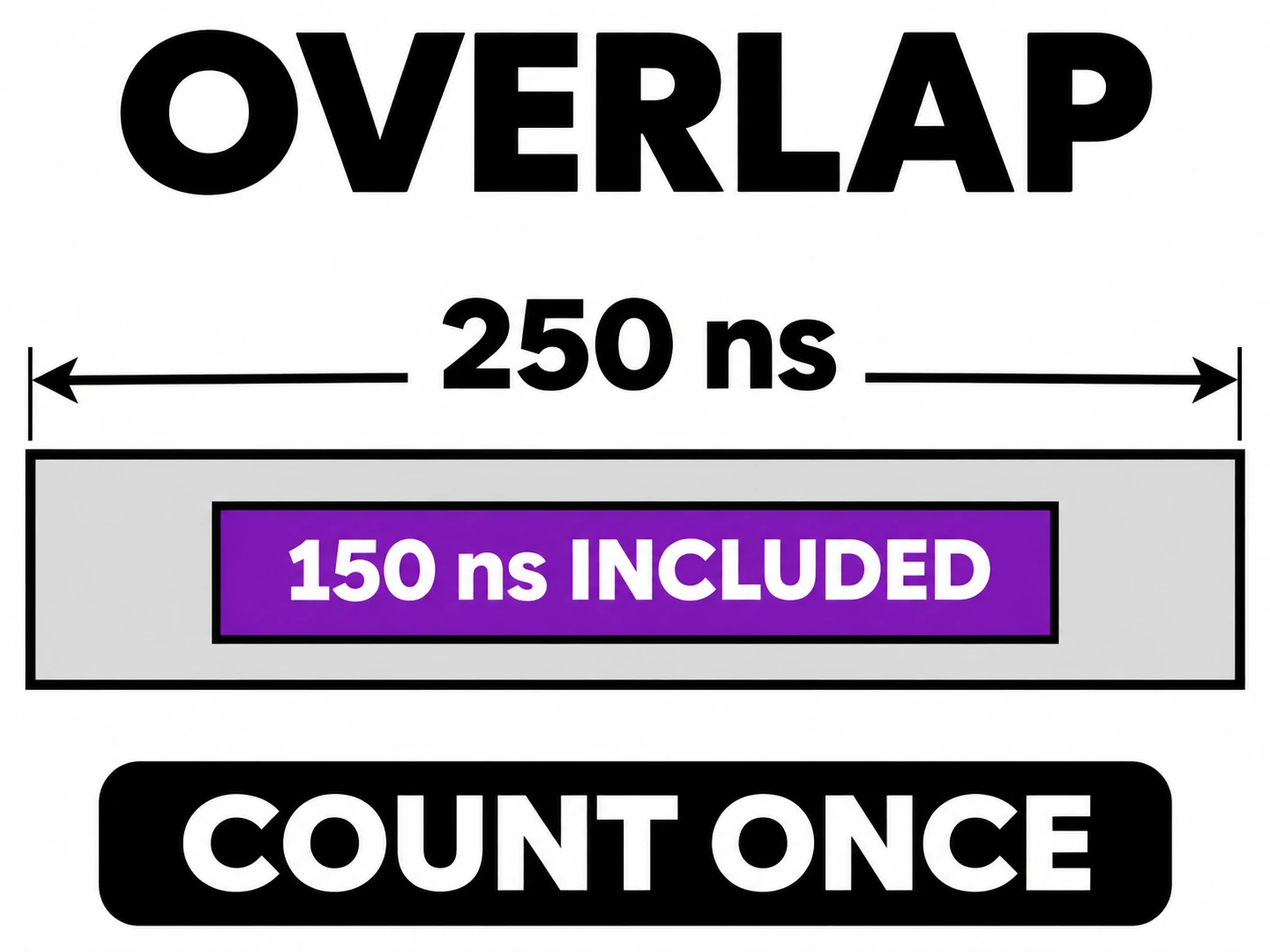
Now suppose the 250 ns figure already includes the preceding 150 ns interval. Adding all four values would count that portion twice. Conversely, if the first stated figure begins after an unrecorded event, the same arithmetic could omit a gap. A correctly calculated sum can therefore describe the wrong interval. Boundary definitions are part of the calculation, not optional notes added after the total.
For the original example, the four values should be represented as adjoining segments with common endpoints. If their documentation instead describes separate observation windows, keep them separate until their relationship is established. Do not force a neat diagram by moving a segment or assuming that two event labels are synonymous. An unresolved boundary is an engineering question, not a formatting defect.
A second hypothetical calculation shows what a remaining allowance means. Assume a project review assigns a one-thousand-nanosecond analysis allowance to the same defined interval. Subtracting the illustrative seven-hundred-nanosecond total leaves three hundred nanoseconds of unallocated allowance. This invented allowance is not a semiconductor withstand rating, a recommended protection target, or an established margin of safety. Its purpose is to explain the bookkeeping needed when comparing a covered total with an explicitly defined project constraint.
If one interval is only typical, the three-hundred-nanosecond remainder has not become a guaranteed reserve. If an endpoint changes, recalculate the comparison using the changed definition rather than preserving the attractive remainder. A timing diagram should show both the assumed allowance and the included intervals, so that the mathematical relationship remains visible without implying that the selected hardware has passed a fault test.

Separate event coverage from speed
A fast response for one stated fault case does not establish coverage of every fault the system review considers. Record the fault description beside the timing result before comparing speed. If a supplier's document covers a named configuration and event, preserve those nouns when the result enters the quotation. A shortened summary such as “fast protection included” discards the information that determines applicability.
This matters when different participants ask different questions. The component supplier may discuss a detector output. The drive designer may ask about a power-stage fault. The equipment buyer may expect a complete protection function. Those questions can be related, but the offered deliverable must connect them explicitly. Otherwise the parties can agree on a timing number while disagreeing about the function being purchased.
Use a coverage statement alongside the timing chain: the selected fault case, the stated start and end events, and the configurations included in the assessment. Where a condition is absent, record it as unresolved rather than labeling the assembly failed. This keeps the review accurate and gives the engineer a defined question to answer without inventing a test requirement.
Read typical, bounded and conditional information carefully
A budget should preserve the language used by each source. A typical figure describes a different evidentiary claim from a stated maximum under named conditions. If the intended review needs bounded timing, a collection of typical figures does not become a bounded total merely by adding them. The supplier must identify how the applicable range, tolerance, or uncertainty is treated in the selected configuration.
Likewise, preserve temperature, supply, revision, and configuration references when they are part of a published statement. Do not quietly take the smallest value from one condition and combine it with another value from an incompatible condition. A timing record is useful because it shows which values belong together. Its role is not to manufacture a favorable total from independent best cases.
If no numerical bound is available, a qualitative answer can still advance the review. It may identify the relevant document owner, distinguish an observed result from a declared limit, or show that an interval includes filtering already counted elsewhere. Resolve those questions first. Numerical precision does not compensate for uncertainty about what the numbers describe.
Use an original timing correspondence record
The following record is a buyer's aid for reading supplied evidence. It is not a mandatory standard, a test procedure, or an acceptance rule for a particular product.
| Entry | Question the answer must resolve |
|---|---|
| Module and revision | Which exact ordered device does the review cover? |
| Fault case | Which stated event and configuration produced the claim? |
| Timing start | What physical or documented event starts this interval? |
| Detector boundary | Which observation ends the detector's stated interval? |
| Intermediate path | Which logic, isolation or filtering intervals are included? |
| Driver boundary | What command and output events define the driver interval? |
| Current endpoint | Which evidence identifies the requested interruption endpoint? |
| Conditions and bounds | Which configurations, temperatures and tolerances apply? |
| Decision owner | Who resolves gaps, overlap and application suitability? |
For each row, record a document identity and a short applicability statement. Repeating a product name is insufficient where the claim concerns a complete chain. Similarly, a diagram that names all the components is not automatically timing evidence. It may establish the proposed architecture while leaving interval definitions and operating-condition coverage unresolved.
Keep the chain's unresolved items separate from purchasing actions. Receiving a file can close a document-request task without closing the engineering decision. The record should distinguish these states so that a complete attachment list is not mistaken for an accepted protection function. This distinction becomes especially valuable when a supplier substitutes one component after the initial quotation.
Apply the record to a substitution
Imagine a hypothetical proposal in which the module stays unchanged but the detector revision changes. The earlier total may remain applicable, or it may require review. The purchasing team should identify which interval and conditions were associated with the replaced component, then ask the responsible engineer to address that difference. Recalculating with a new headline response number alone may miss changes in event definitions or included filtering.
Another hypothetical substitution changes only the wording of a supplier's claim from “output asserted” to “turn-off completed.” That is not merely an editorial improvement. Ask what evidence supports the new endpoint and whether it describes a command or the power-stage response. The record makes this question visible before the broader claim enters an approved commercial specification.
The same discipline helps compare two offers. Compare their covered functions and endpoint definitions before comparing totals. A proposal with a larger clearly scoped interval may provide more useful evidence than a smaller number with an unspecified endpoint. The purpose is an interpretable comparison, not a ranking based on isolated speed figures.
Make the RFQ ask for the function being purchased
For the XS004HB120N6 SiC MOSFET half-bridge family, identify the intended module revision and request the selected protection configuration's applicable documentation. The family listing does not establish a short-circuit withstand condition, detector-to-current-interruption total, or approved sensor and driver combination.
State whether the request is for a component, a documented protection subassembly, or a complete system function. Include the proposed fault-case description and the unresolved boundaries from the timing record. The responsible engineer can then address applicability without guessing what the buyer means by “response time.” This also keeps an RFQ from implying that a module supplier has accepted responsibility for unspecified external hardware.
Keep the final record concise: the accepted configuration, the covered events, the timing evidence and its conditions, and any unresolved application questions. A useful detection-to-turn-off budget is an account of defined intervals attached to the right system. Its value comes from that correspondence, not from the number of decimal places in the total.
Source notes
Sahan, B., Kaczmarek, K., Ebli, M., & Grambichler, K. (2021, November). Fast short-circuit protection of SiC-MOSFETs through AC current sensors. Bodo's Power Systems, 44–47. https://www.infineon.com/assets/row/public/documents/60/54/infineon-fast-short-circuit-protection-of-sic-mosfets-through-ac-current-sensors-article-en.pdf
RITOKS. (n.d.). XS004HB120N6 SiC MOSFET half-bridge modules. https://ritoks.com/products/xs004hb120n6-sic-mosfet-half-bridge-modules/