
Bridge Rectifier Modules · Comparison
Single-Phase vs Three-Phase Bridge Rectifier Modules
A single phase vs three phase bridge rectifier module comparison begins with the actual AC source. The incoming phase arrangement determines the topology the designer must consider, while load, cooling and mechanical integration determine whether an exact module can be used. Similar-looking packages can conceal different internal circuits.
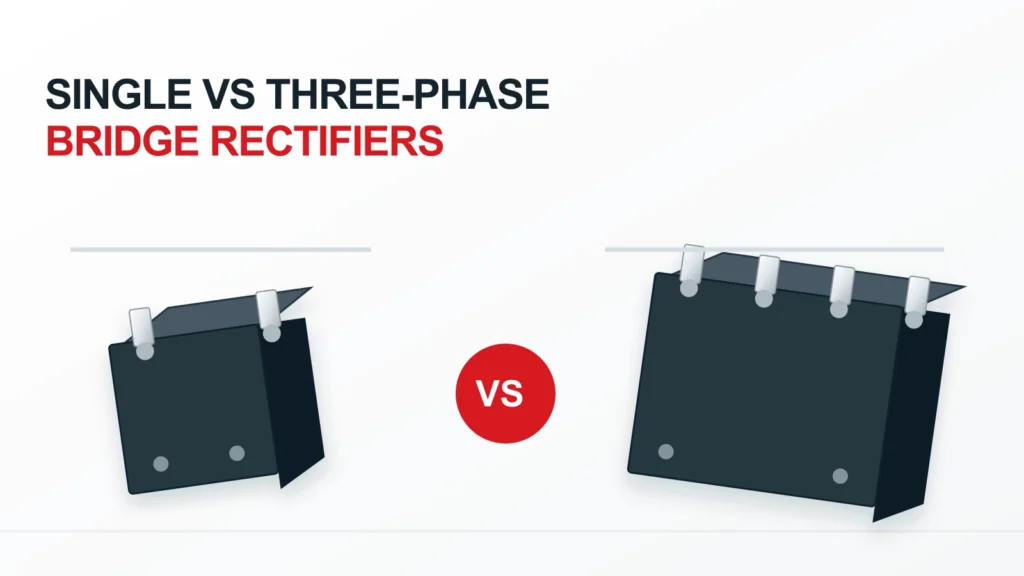
The purpose of this guide is to help buyers request the right evidence for either architecture. It does not claim that a single-phase module and a three-phase module can be exchanged, nor that the products linked below include both types.
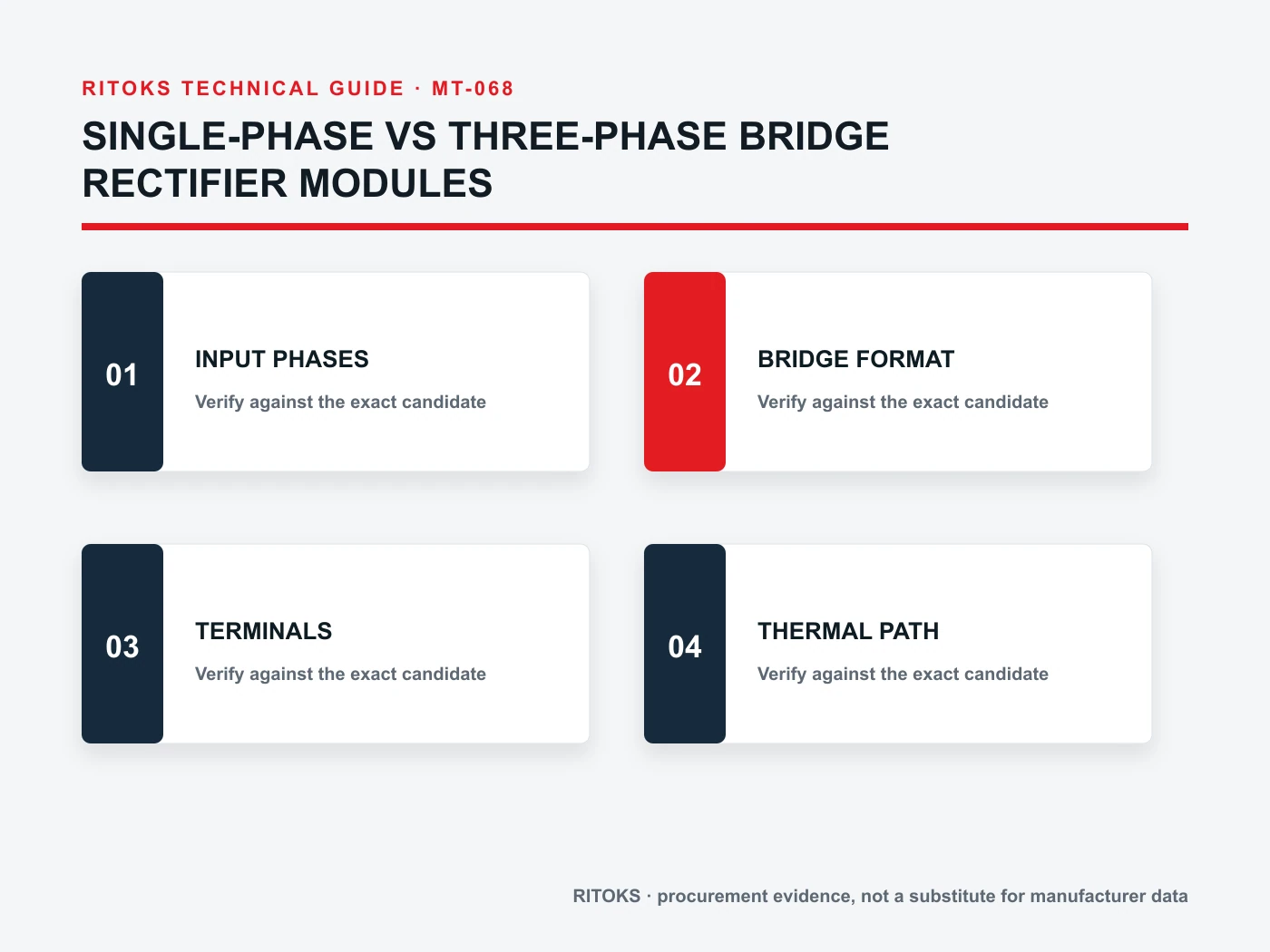
Decision Inputs at a Glance
| Review area | What the buyer records | Evidence to request |
|---|---|---|
| Input supply | Actual phase arrangement and operating range | Project electrical diagram |
| Topology | Internal bridge circuit and terminal assignment | Exact module schematic |
| DC side | Load profile and allowed output behavior | System design analysis |
| Thermal | Losses, mounting and cooling conditions | Module and heatsink evidence |
Identify the AC source before the package
Draw the supply at the rectifier terminals, including its phase arrangement, expected voltage variation and protective devices. A site may have three-phase power available while the particular equipment branch feeding the rectifier is single-phase. The module must match that branch, not the building label.
State the intended DC load and operating modes. The rectifier is part of a power conversion system, so the supplier needs more than a package size or nominal ampere figure to assess a candidate.
How a single-phase bridge is framed
A single-phase bridge topology is arranged around the available single-phase AC input. Its current path, terminal count and output waveform differ from a three-phase bridge arrangement. The exact module diagram shows what the package actually contains.
Do not infer the circuit from a common housing style. If a supplier proposes a single-phase part, request its internal schematic, pin assignment and test conditions for that exact order code. The product links in this package are three-phase examples and should not be used as single-phase evidence.
How a three-phase bridge is framed
A three-phase bridge receives a three-phase input and has a different device arrangement and terminal map. The full three-phase path must be documented, including which terminals accept each phase and how the DC output is identified.
Check the exact module diagram against the project schematic. Do not assume every three-phase module has identical terminals, baseplate isolation or connection hardware simply because the title names the same bridge type.
Keep output and ripple claims conditional
The input architecture affects the rectified output, but the actual DC behavior depends on input conditions, load, smoothing components and system design. A product label alone cannot promise a particular usable DC voltage or ripple at the load.
Provide the load range, duty, required output condition and downstream circuit. Ask the design engineer to evaluate the complete conversion stage. The supplier can then confirm that the proposed module is evaluated under relevant conditions.
Evaluate current and losses as a system
A current headline is meaningful only with its specified thermal and electrical conditions. Rectifier losses create heat, and a module installed without a suitable cooling path may not operate as the catalog test arrangement assumes.
Request exact forward-loss or thermal information, mounting instructions and the heatsink interface. Keep module selection and heatsink selection connected while preserving separate evidence for each component.
Review mechanics and insulation details
Check the baseplate, mounting holes, torque instructions, terminal geometry, clearance and isolation information where relevant. These determine whether the candidate can be installed in the equipment as designed.
A familiar package outline is not an approval of a new module. Dimensioned drawings and exact instructions must replace visual guesses, especially when changing between manufacturers or current ranges.
Compare offers without merging architectures
Ask each supplier to identify the exact single-phase or three-phase topology it is quoting. Keep input, output, thermal and mechanical evidence beside the complete code. If two offers assume different AC sources, they are not competing solutions to the same design brief.
Resolve those assumptions before commercial comparison. The accepted technical file should include the system diagram, module schematic, cooling basis and any change to downstream components.
Build an Exact-Model Evidence File
A category or product-family page helps locate relevant options; it does not by itself approve one variant. For bridge rectifier modules, keep the full proposed order code, current datasheet, terminal or mounting drawing, operating instructions and any project calculation together. Read the conditions attached to each rating or function. If the evidence belongs to a neighboring model, request the correct document instead of carrying the claim across.
The project team owns the system inputs and acceptance criteria. The supplier owns the evidence for the offered item. In the technical review, place each mandatory requirement beside the exact document and revision that answers it. Mark a missing field as open, conditional or unsupported. This creates a traceable decision and prevents a favorable headline value from hiding an incompatible connection or installation condition.
Compare Complete Offers
| Item | Record in the comparison | Reason |
|---|---|---|
| Orderable item | Full code, variant and included accessories | Prevents family-level assumptions |
| Application match | Written response to each project input | Keeps exceptions visible |
| Documentation | Datasheet, drawing, instructions and revisions | Links claims to the offered item |
| Open points | Owner and due date for clarification | Avoids silent acceptance |
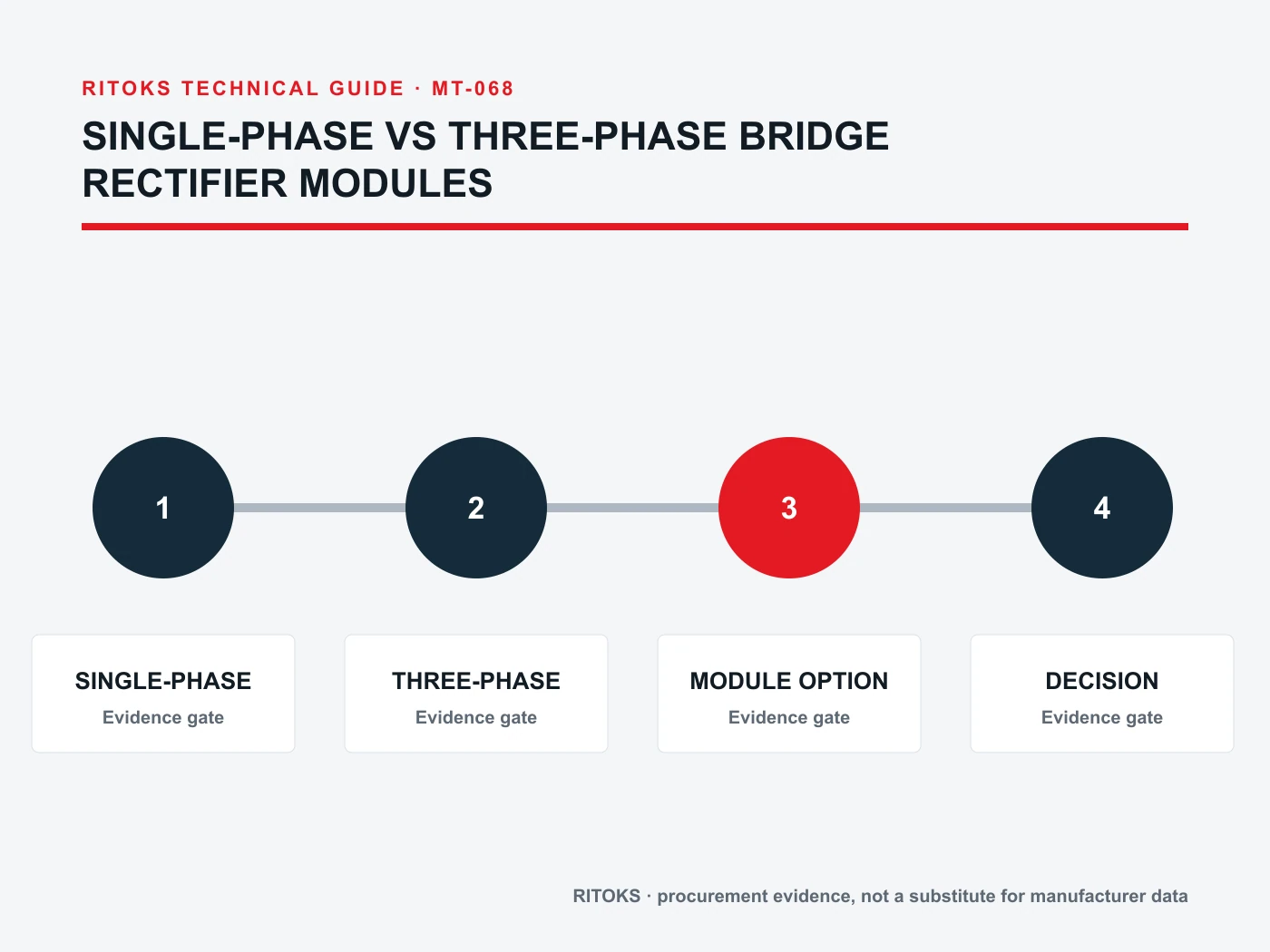
Use the same project brief for every quotation. Commercial terms such as price and lead time can be compared once the technical scope is normalized. Do not treat omitted accessories, unsupported ratings or an unresolved wiring assumption as equivalent to a documented offer. If an alternative is proposed, ask which inputs change and repeat the affected review.
Review Installation and Acceptance
Before installation, confirm that the delivered label, complete code and accessories match the approved record. Compare terminals, mounting, conductor access and any stated orientation with the exact instructions. A product that appears physically similar to the approved version may still have a different electrical configuration, control option or test basis.
Plan an as-built check that addresses the project's real risks. This may involve wiring against the approved diagram, functional response, measurements under representative operating states and confirmation of any communication or alarm feature. Record the conditions and results. The acceptance plan should come from the application and supplier evidence, not from a generic article checklist.
Request for Quotation Checklist
- Identify the circuit, equipment and location that bridge rectifier modules must serve.
- Attach the system drawing and operating states that define the application.
- Record ac input and its source document.
- Record bridge topology and its source document.
- Record dc output and its source document.
- Record load profile and its source document.
- Confirm the exact-model evidence for loss data.
- Confirm the exact-model evidence for heatsink.
- Confirm the exact-model evidence for terminals.
- Confirm the exact-model evidence for datasheet.
- Request the full order code, accessories, drawings and data-sheet revision.
- Ask for exclusions, assumptions, substitutes and unresolved engineering points.
The RFQ should be specific enough for a supplier to answer without inventing missing project values. If an essential input is not yet known, label it as a question and identify who will determine it. Do not turn an assumption into a rating, a compliance claim or an approved installation method.
What Changes the Decision
A decision can change when the source arrangement, load behavior, environment, installation geometry or required function changes. Revisit the selected bridge rectifier modules whenever one of those inputs moves outside the approved brief. Recheck the order code and the exact evidence affected by the change; do not rely on a previous approval for a circuit that now asks the component to do different work.
Keep a short revision history of the project brief, supplier response and accepted exception list. This record helps engineering, purchasing and commissioning work from the same version. It is especially useful when a quotation is revised, a substitute is offered or the panel design changes after the first comparison.
Questions to Resolve Before Approval
Ask who owns each remaining technical question for the proposed bridge rectifier modules. The buyer should confirm the system inputs and installation constraints; the supplier should confirm the exact item, included options and applicable documentation. Put the answer and document revision beside the question. An unanswered point should remain visible in the comparison rather than being converted into an assumed feature.
When a quotation offers an alternative, ask for a written explanation of the changed circuit, mounting or performance basis. Review any new drawing with the project engineer and record whether the proposed change is acceptable. A substitution is a new technical decision even if it appears commercially equivalent. This is especially important when multiple suppliers use similar family labels for different configurations.
Frequently Asked Questions
Can a three-phase bridge be used as a direct substitute for a single-phase bridge?
Do not assume so. The exact topology, terminal use and system design must be reviewed.
Does the phase count determine the final DC output?
No. Input conditions, loading and downstream circuit also determine the result.
Are the linked RITOKS modules single-phase examples?
No. The related product pages are three-phase examples; request a separate documented candidate for a single-phase application.
Relevant RITOKS Pages
For product-family context, see Power Semiconductors. The related published product pages include Mds Three Phase Bridge Rectifier 30a 250a, Mds High Current Bridge Rectifier 300a 1200a. Use their current exact-model documents when comparing a proposed item.
For an application-specific quotation, send the project brief to RITOKS with the diagrams and open questions above.