
DC Surge Protective Devices · Technical Explainer
Surge Protection in PV Combiner Boxes: What Must Be Verified
A photovoltaic combiner box brings multiple DC source circuits into a common outgoing path, so its surge-protection review must begin with the actual array and earthing architecture. Selecting a device from one voltage or discharge-current headline leaves important questions unresolved: which conductors are protected, where the device is installed, what other protective stages exist and whether the exact model documentation covers the proposed arrangement.
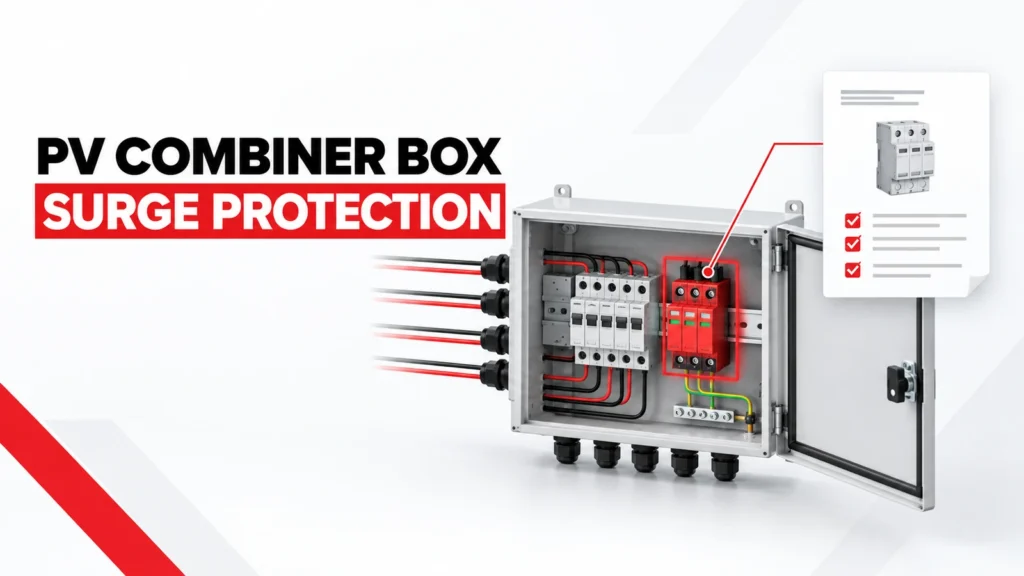
This guide explains the application and evidence questions for a DC SPD located in a photovoltaic combiner box. It does not provide a wiring instruction, calculate protection levels, approve a coordination scheme or transfer ratings from one SPD model to another.
Decision Inputs at a Glance
| Decision input | Buyer must confirm | Evidence required |
|---|---|---|
| DC source envelope | Maximum continuous array condition and abnormal operating case | Approved project single-line and calculation basis |
| Protection location | Position relative to string inputs, outgoing circuit and inverter | Combiner drawing with cable routes |
| Conductor topology | Poles, protected paths and earthing arrangement | Exact-model circuit diagram |
| Coordination | Upstream and downstream protective stages and separation | System review using supplier evidence |
| Environment | Enclosure condition, contamination, heat and service access | Combiner specification and maintenance plan |
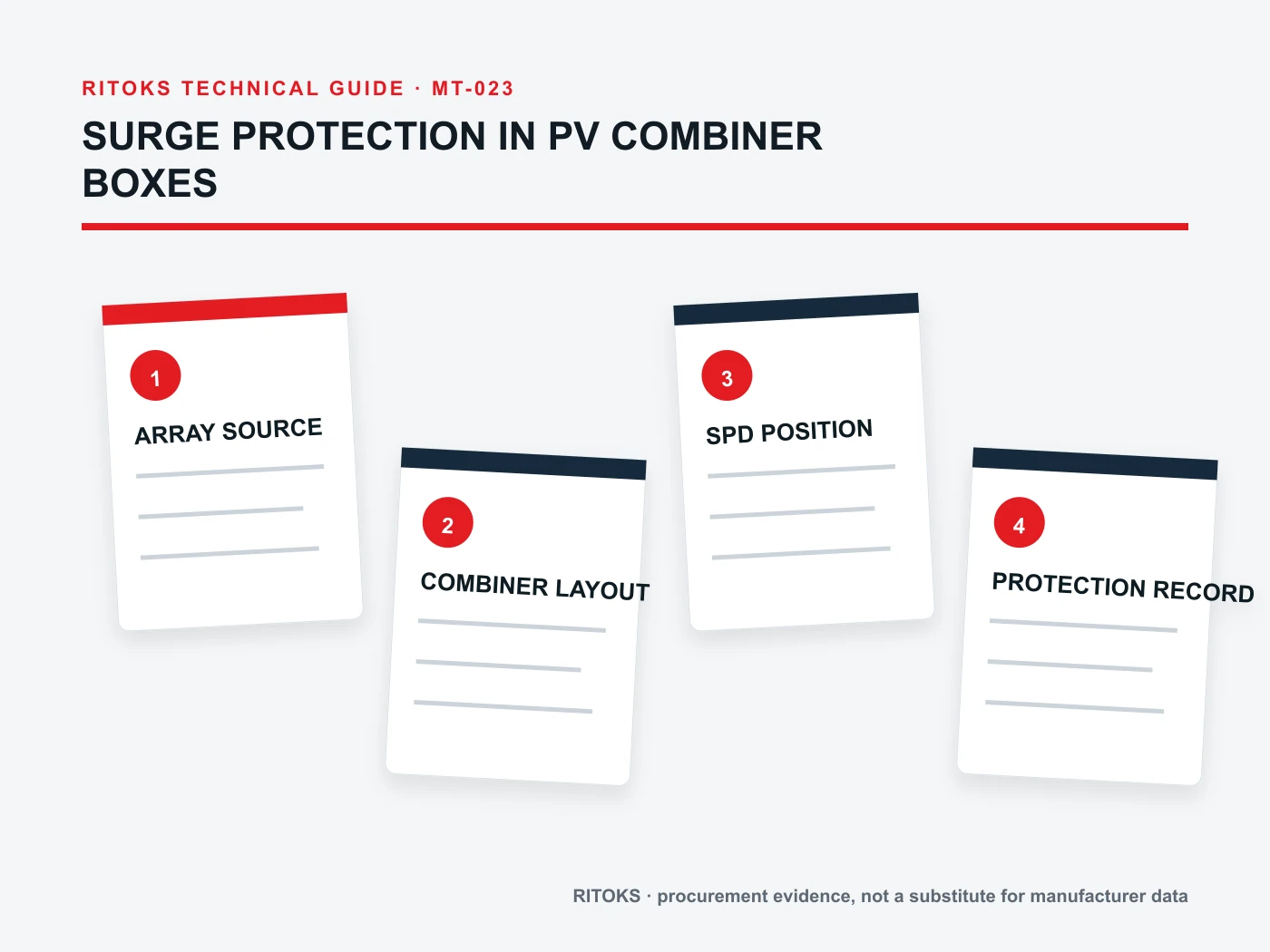
Start With the PV DC Architecture
Document the string arrangement, maximum source condition, conductor relationship to earth and the location of the combiner relative to the inverter. The label “PV system” is too broad because grounded and ungrounded arrangements, cable routing and protective stages can create different SPD topology requirements.
Use one approved single-line as the common reference for engineering and procurement. If alternate array layouts may be supplied, treat them as separate cases instead of assuming the same SPD arrangement covers every version.
Define the Protection Boundary
Mark where external conductors enter the enclosure, where parallel strings combine and where the outgoing cable leaves. The review should explain which transient paths the proposed device is intended to limit and which paths remain outside its function.
An SPD is not an isolator, overcurrent protective device or substitute for the project earthing design. Keep these functions separate in the bill of materials and in the technical comparison, even when they share the same combiner box.
Match Topology to the Exact Circuit Diagram
Pole count alone does not prove that a device suits the conductor arrangement. Require the exact internal circuit diagram, terminal identification and permitted connection configuration for the quoted order code.
Do not build an approval from a photograph or from the diagram of a neighboring product. Similar modular housings can contain different protective networks, monitoring contacts or replaceable elements.
Review Voltage Evidence in Context
The buyer should compare the array operating envelope with the exact parameter definitions and conditions in the manufacturer documentation. A familiar voltage number is not enough when the parameter meaning, conductor relationship or test basis is unclear.
Record the project calculation revision beside the candidate datasheet. If the source design changes, reopen the review rather than carrying the old device selection into the new architecture.
Coordinate the Complete Protection Path
A combiner-box SPD operates as one stage in a wider protection concept. Review other stages, conductor length, backup protection, earthing path and inverter requirements using evidence applicable to the proposed system.
Avoid generic claims that two stages are “coordinated” without the underlying conditions. Ask the supplier to identify the exact products, configuration and document that support any coordination statement.
Plan Installation and Inspection
Terminal access, conductor routing, bend space, status visibility and replaceable-module access affect whether the design can be assembled and maintained as intended. These points belong in the enclosure layout review before the purchase order is frozen.
Define how status is inspected and how a failed element is identified, isolated and replaced. The maintenance instruction must follow the approved model documentation and the site safety procedure.
Build an Exact-Model Evidence File
Create one approval record for the proposed DC SPD order code. Put each project requirement beside the supplier document that answers it. Preserve the exact datasheet, dimensioned drawing, circuit diagram, performance curve or application note used, including its revision or retrieval date. A category page establishes family context but cannot prove an exact rating, terminal arrangement, optional feature or system combination.
Check that every accepted statement describes the same orderable item. Similar housings can contain different circuits, terminals, materials, firmware or accessories. Do not combine a maximum from one variant, a drawing from another and a feature from a third. Mark unresolved fields explicitly so they remain visible during engineering and commercial review.
Keep Project Inputs Separate From Product Evidence
The project team defines the application: source, load, duty, environment, controls, mechanical limits and required functions. The supplier identifies an exact DC SPD and supports it with exact documents. Neither side should fill a gap by inference from appearance, a shared family name or one matching headline value.
Freeze the application record while quotations are compared. If the circuit, load, duty, environment, enclosure, thermal method or required output changes, issue a revised record and ask each supplier to reconfirm the candidate. Otherwise apparently comparable quotations may be answering different technical requirements.
Common Procurement Errors
- Selecting DC SPD from one headline rating while the application context remains incomplete.
- Using a circuit, curve, terminal drawing or performance claim from a neighboring model.
- Treating a family page or product photograph as exact technical evidence.
- Assuming an accessory, system function or coordination result is included without documentation.
- Approving a substitute without repeating the electrical, thermal, mechanical and evidence review.
Resolve these gaps before comparing price and lead time. The reviewer should be able to trace every accepted statement either to the project requirement or to the exact candidate document. A proposal may remain commercially interesting while technically incomplete, but missing evidence must not disappear inside the quotation.
How to Compare Supplier Offers
| Comparison point | Required evidence | Do not accept |
|---|---|---|
| Exact identity | Full orderable code and variant description | Family name alone |
| Application match | Response against the frozen project inputs | Generic suitability statement |
| Technical evidence | Current exact-model documents with revision | Screenshot or neighboring-model page |
| Delivered scope | Included accessories, interfaces and documents | Undefined “standard package” |
| Open questions | Visible deviation and clarification list | Silence treated as compliance |
| Substitution | Fresh review against every requirement | “Equivalent” based on appearance |
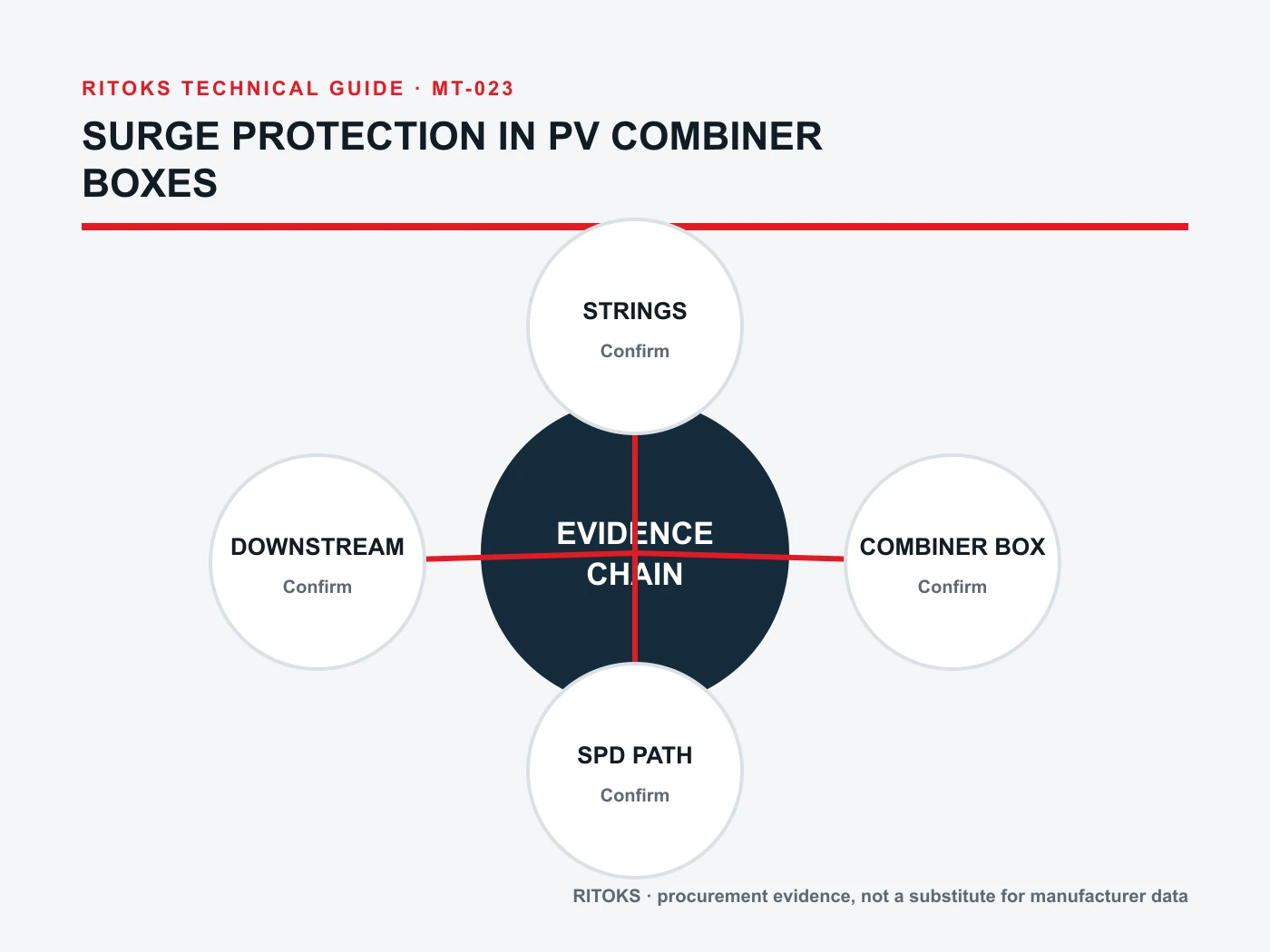
Normalize every DC SPD offer to the same application record. Keep document revisions, test conditions, included accessories and open questions beside each value. This makes differences in delivered scope visible and prevents a lower-cost but narrower offer from appearing equivalent to a complete solution.
Decision Workflow
- Freeze the application architecture and operating case.
- Record environmental, thermal and mechanical constraints.
- Identify the required DC SPD function without assuming a model.
- Request a complete order code and exact supporting documents.
- Compare every claim with its conditions and definitions.
- Resolve deviations and coordination questions before commercial approval.
- Archive the accepted evidence with the final bill of materials.
Stop the review when a critical application input is unknown, the quoted model is ambiguous, a required claim is supported only by another manufacturer or another order code, or the installation falls outside the available evidence. These are engineering gaps, not editorial details.
RFQ Preparation Checklist
A useful RFQ for pv combiner box surge protection is concise enough to answer and complete enough to prevent silent assumptions. Identify unknown values as questions and require a full orderable code rather than a generic family recommendation.
- PV array
- Combiner position
- Conductor topology
- Earthing arrangement
- Inverter boundary
- System record
- Exact SPD code
- Coordination evidence
- Installation drawing
- Inspection plan
- Quantity, destination and required document language
Request the current datasheet revision and the exact scope of any certification, compatibility, coordination or performance claim. Record quantity and destination after the technical inputs so commercial terms do not obscure unresolved engineering questions.
Handoff From Engineering to Purchasing
Engineering approval should identify the exact DC SPD code, accepted document revisions, unresolved deviations and the application record used for the decision. Purchasing can then compare commercial offers without silently changing the technical basis. If a supplier proposes another code, different accessory or revised configuration, route it back through the same review instead of treating it as an administrative substitution.
Keep the approved evidence with the purchase order and final bill of materials. Receiving and production teams need enough information to recognize the accepted item and to stop when labeling, terminal arrangement, accessories or documentation differ. This handoff also gives maintenance teams a traceable starting point for replacement decisions rather than relying on a photograph, an old invoice description or one headline rating.
Frequently Asked Questions
Can an AC SPD be used because its voltage looks similar?
Do not decide from a headline voltage. Verify DC suitability, topology and every required parameter in the exact-model documentation.
Does the SPD replace string overcurrent protection?
No. Surge limitation and overcurrent protection are different functions and must be reviewed separately.
Is pole count enough to select a combiner SPD?
No. Confirm the actual conductor and earthing topology against the exact circuit diagram.
Related RITOKS Products and Guidance
These links provide published product-family context only. A contextual link does not claim interchangeability, compatibility or an approved system combination.
Published RITOKS DC SPD product page
Published RITOKS DC SPD product page
Related published RITOKS technical guide
Related published RITOKS technical guide
Technical Reference
The following source supports only the general engineering concept stated in this guide. Its product ratings, circuit diagrams, approvals and coordination results do not transfer to RITOKS products.
Phoenix Contact, Surge protection for photovoltaic systems
Supports treating the PV DC location and system architecture as selection inputs; it does not provide RITOKS ratings or approve an installation.
Request an Exact-Model Review
Send the application requirements, exact-document questions, quantity and destination through the RITOKS contact form. An RFQ requests an exact-model review; this guide does not approve a circuit, installation or automatic substitute.