
Technical Resources · Technical Explainer
What Is a gPV Fuse? Scope, Standards and Selection Boundaries
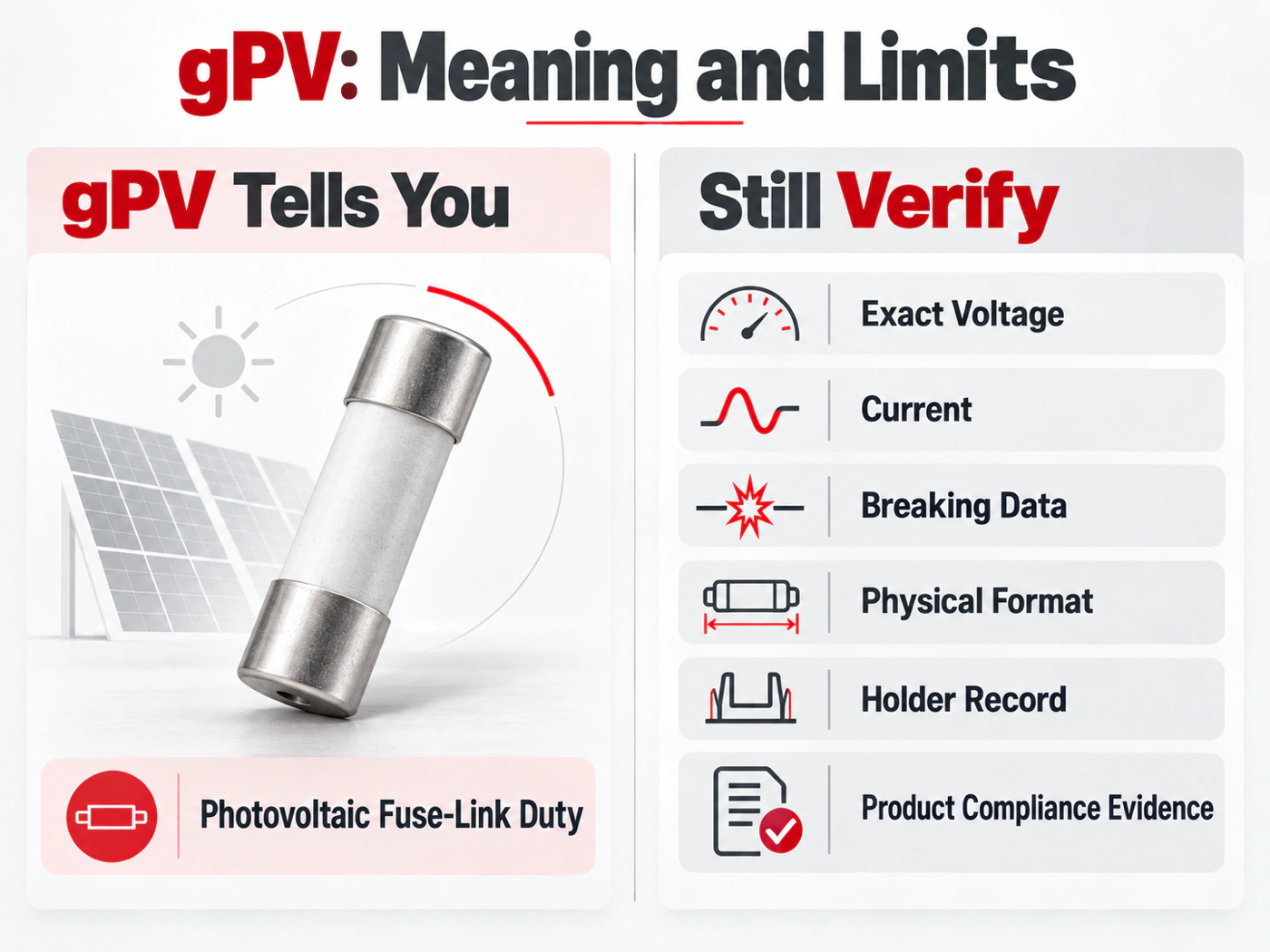
The letters gPV on a fuse-link listing answer one narrow question: what kind of application category is being described? They do not identify a complete fuse rating, a holder, a specific PV installation or a verified RITOKS model. Buyers often see gPV alongside dimensions, voltage and current and assume the designation itself settles the selection. It does not.

This guide owns the meaning and limits of the gPV designation. For the broader task of choosing a DC fuse link by circuit voltage, current, breaking behavior and holder, use the DC fuse selection guide. This page does not calculate a PV string protection design, provide installation instructions or state that every PV system needs the same fuse arrangement.
gPV at a Glance
| Question | What gPV tells you | What it does not tell you |
|---|---|---|
| Application | A photovoltaic-specific fuse-link utilization category | Suitability for any other DC source |
| Electrical rating | The duty classification, not a number | The particular voltage, current or breaking capacity |
| Physical form | No unique cartridge format | Dimensions or a compatible holder |
| Orderability | A term to check on the exact link record | An order code or certification for a named product |
What the Designation Means
Mersen’s photovoltaic protection technical note describes gPV as a general-purpose fuse link for photovoltaic applications in the context of IEC 60269-6. That source explains why PV DC interruption needs application-specific consideration. Its discussion is useful for interpreting the designation; it is not a statement that a particular RITOKS fuse has passed any certification or meets a specific rating. Ask for the exact product documentation for such claims.
The “PV” part identifies the photovoltaic application context. The classification should not be read as a generic promise of suitability for batteries, semiconductor protection or every other DC load. It also does not determine the number or location of links in a real array. Such decisions depend on the electrical design, applicable rules and manufacturer records, which an article about the label cannot establish.
The Marking Is Not a Voltage or Current Rating
A product may display gPV along with other markings, but the letters alone do not encode the rated DC voltage, ampere value or physical dimensions. When comparing two gPV offerings, put their exact order codes and rating tables side by side. A buyer should not infer that two links are identical because they share the designation, or that a 10x38 and a 10x65 family represent alternate packages of the same electrical design.
A circuit’s nominal label may also differ from its maximum relevant voltage. The project designer should provide the circuit record, and the link documentation should specify the applicable voltage and conditions. The same separation applies to current: the fuse link’s printed current is not an automatic instruction for selecting the circuit value. Ask for the relevant manufacturer operating information if the duty raises a question.
Breaking and Operating Behavior Still Need Documents
The Mersen note explains that DC interruption involves voltage and prospective fault-current conditions. That is a general reason to request exact link data, not a basis for copying Mersen’s example curves to another brand. A complete comparison needs the selected link’s breaking information and operating characteristics for the intended circuit. If a seller supplies only “gPV” and a current value, the record is incomplete.
Do not infer performance at low PV fault levels, coordination with a different protective device or a universal time-current curve from the designation. Those claims require model-specific evidence and system context. Where the relevant circuit conditions are unknown, record them as an engineering question rather than filling the gap with an example taken from a technical note.
A Holder Is a Separate Purchasing Decision
gPV describes the link’s application class, not a holder interface. The link’s dimensions and contact details must be checked with the exact holder. The holder has its own voltage, current, thermal and environmental limits. A link that appears to fit mechanically has not been proven suitable as a complete assembly.
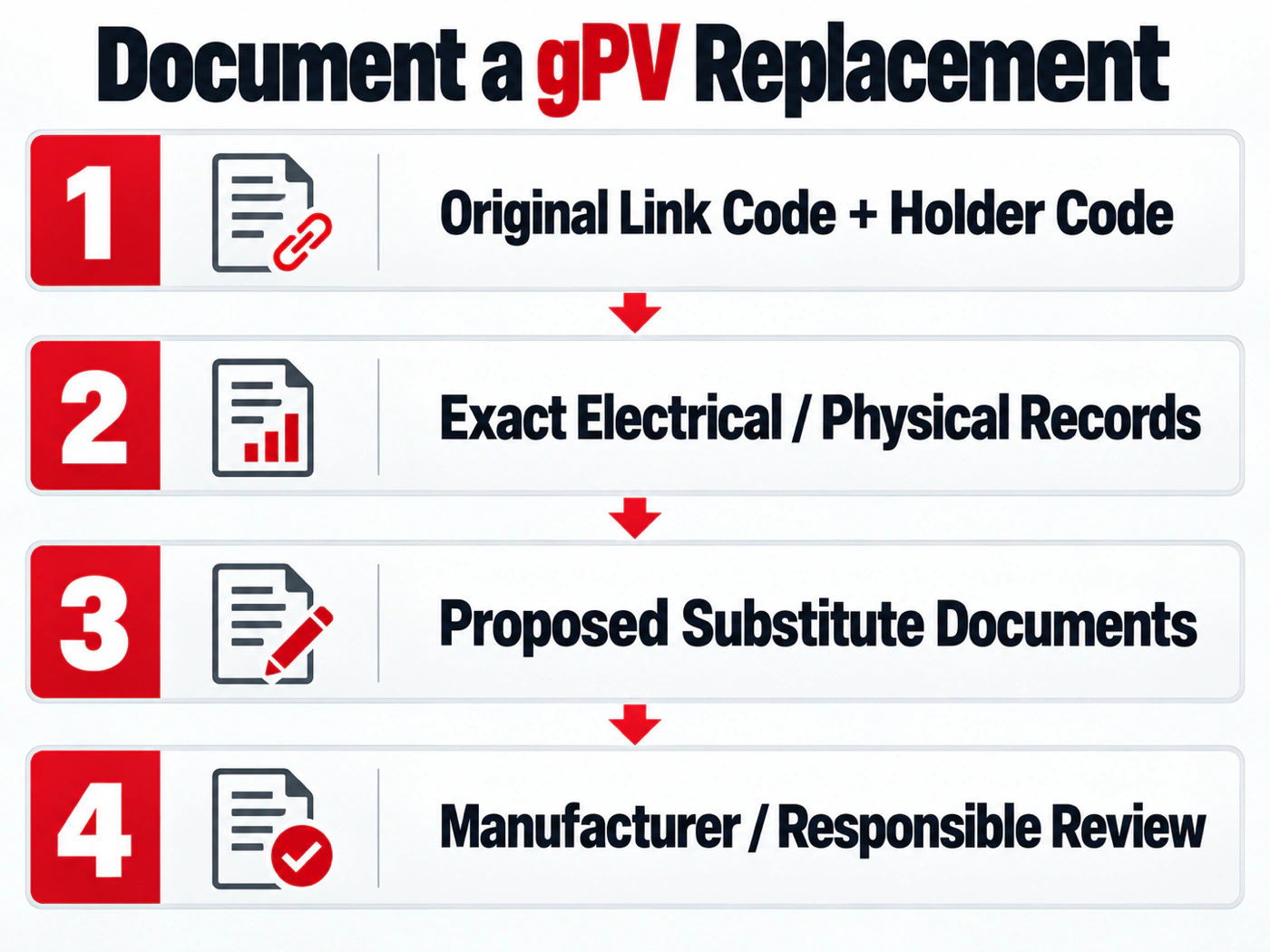
For replacement procurement, identify the original holder and link codes if available. For a new assembly, ask the supplier to provide both exact codes and the compatibility basis. Do not transfer a holder pairing shown in one manufacturer catalog to a different RITOKS link solely because the nominal size is the same.
Compare Two gPV Listings
| Field | Listing A | Listing B |
|---|---|---|
| Designation | Confirm gPV on exact link record | Confirm gPV on exact link record |
| Electrical data | DC voltage, current, breaking and operating record | DC voltage, current, breaking and operating record |
| Physical data | Dimensions and supported holder | Dimensions and supported holder |
| Evidence | Exact datasheet and revision | Exact datasheet and revision |
This comparison deliberately contains no invented numbers. The designation may match while the ratings and format differ. If one listing omits a breaking characteristic or compatible holder record, ask for the missing document before treating it as interchangeable with the other. A lower price is not evidence of equivalence.
Buyer Workflow and RFQ Inputs
- Describe the PV application and identify whether the request is a replacement or a new design.
- Record maximum circuit voltage, operating current and assessed fault conditions from the project.
- Request the exact gPV fuse-link code, rated values and operating/breaking documentation.
- Identify the existing holder or ask for an exact supported holder and its independent ratings.
- Separate the designation from certification claims; request any compliance evidence for the named product.
- Provide quantity, destination and unresolved system questions to the supplier.
RITOKS Examples Without Merging Families
RITOKS publishes 10x38 and 10x65 gPV fuse-link families as different product pages. Their titles communicate different physical formats and published electrical envelopes. They are examples of why “gPV” cannot serve as a complete item description. Read the exact row for the proposed link and ask for its documented holder pairing. Do not combine one family’s voltage with another family’s size or current.
Separate a Standard Designation From a Product Claim
A technical article can explain what a designation means without claiming that a named product conforms to the referenced standard. Keep those two evidence levels separate in the buyer record. The general explanation should cite an authoritative source for the category; a product-specific compliance statement requires the exact manufacturer document, model identity and applicable edition. A logo, catalog heading or seller description is not a substitute for that record.
This separation also protects comparisons. Two suppliers may both use the term gPV while offering different voltage ratings, current ranges, breaking characteristics, dimensions or documentation. The shared category helps define the intended application duty, but it does not make the products interchangeable. Compare the exact fields that matter to the project and preserve the source for each value.
Identify Replacements Without Guessing
For an existing installation, photograph and transcribe the link and holder markings, but treat the image as identification support. Record the original order codes and obtain the relevant documents where possible. If the original link is unavailable, ask the manufacturer or responsible supplier for a documented replacement that addresses electrical characteristics, physical format and holder compatibility. Do not approve a substitute solely because it carries the same gPV letters and nominal size.
For a new RFQ, include the PV application description, maximum voltage, operating current, assessed fault conditions, desired fuse-link category, physical constraints and holder requirements. Mark any unconfirmed compliance or coordination question explicitly. The result should be a complete request for exact-model review, not a universal formula that converts the word gPV into a model recommendation.
Keep the evidence package usable after the quotation. Store the selected link and holder codes, document revisions, project input record and any manufacturer confirmation together. If a later shipment proposes a different code, repeat the product-specific checks instead of relying on the unchanged gPV description. This traceability is valuable to procurement and maintenance because it shows which facts came from the application, which came from the exact product record and which questions remain subject to technical approval.
The same record helps prevent category drift in future purchases. A request for a different DC source should not inherit the gPV choice merely because the physical format is convenient. Start again from the new application duty and evidence, then decide whether the category is relevant. The designation remains a classification input, never a universal substitute for circuit and exact-model review.
Frequently Asked Questions
Does gPV mean every DC fuse is suitable for solar applications?
No. It is a photovoltaic fuse-link category. A product without the relevant documented PV duty cannot be treated as equivalent merely because it is described as DC-rated.
Does gPV prove a particular RITOKS fuse is certified?
No. The category explanation is not a certification document. Ask for the exact model’s applicable test or compliance evidence before making a product-specific claim.
Can a gPV link be placed in any holder of the same size?
No. A nominal size does not establish the holder’s electrical and thermal ratings or exact compatibility. Verify both part records and the supported pairing.
Related RITOKS Products and Guidance
Use these pages as separate product and family records. A link is not a claim that two devices are interchangeable or coordinated.
DC fuse versus circuit breaker comparison
Technical References
The following manufacturer sources support the general concepts identified below. Their model ratings, diagrams and approvals do not transfer to RITOKS products.
Mersen, Photovoltaic Market: Over-current Protection
Supports the definition of gPV and general PV DC interruption context. The note is an older manufacturer explanation, not a current standard text, product certification or RITOKS datasheet.
Request an Exact-Model Review
Send the recorded application requirements, exact documentation questions, quantity and destination through the RITOKS contact form. An RFQ requests an exact-model review; this guide does not approve a wiring design or recommend an automatic substitute.