
Enclosure Air Conditioners for Control Cabinets · Comparison
Enclosure Air Conditioner vs Filter Fan: Cooling Architecture Differences
A filter fan and an enclosure air conditioner solve different thermal problems. A fan exchanges cabinet air with the surrounding environment; an air conditioner transfers heat while keeping internal and external air paths separated. The correct architecture depends on heat load, ambient temperature, contamination, humidity and the enclosure boundary the project must maintain.
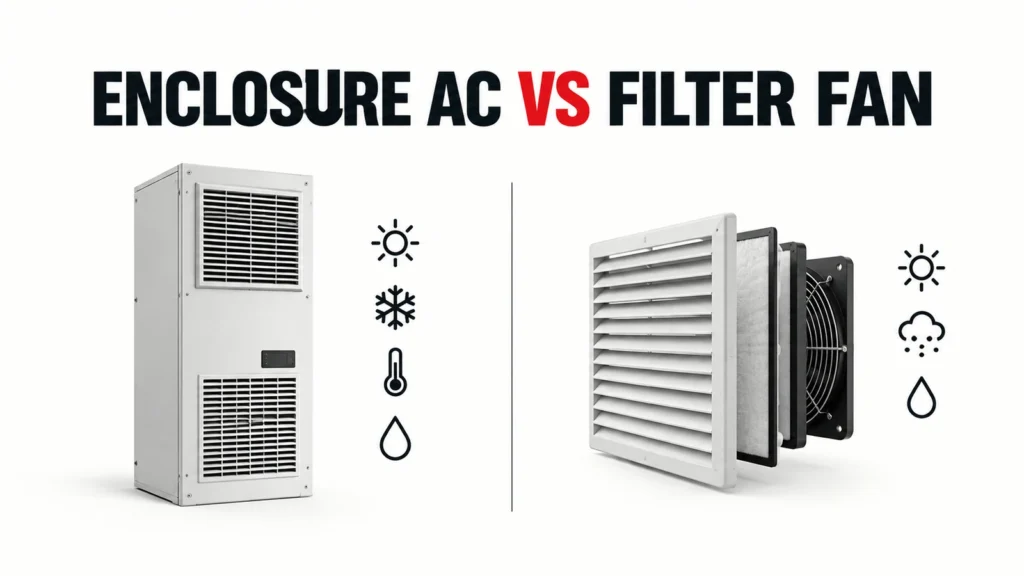
This guide explains the architectural difference between ventilation by filter fan and closed-loop enclosure air conditioning. It does not size a cooling device, promise an enclosure rating after modification, or approve either method without a heat-load and environmental review.
決策輸入要素一覽
| 決策輸入 | 買方必須確認 | 所需證據 |
|---|---|---|
| Heat-transfer path | Outside air passes through the cabinet | Internal and external air circuits remain separated |
| Temperature condition | Useful when ambient air can absorb cabinet heat | Can cool toward a controlled internal target within model limits |
| 污染 | Requires acceptable incoming air and filter maintenance | Supports a closed air boundary but still needs external coil service |
| 濕度 | Introduces ambient humidity with ventilation air | Requires condensate and dew-point review |
| Selection evidence | Airflow and pressure performance in installed system | Capacity at actual internal and external temperatures |
Identify the Heat-Transfer Architecture
A filter-fan system moves external air through the enclosure and discharges warmed air. Its performance depends on the complete path, including inlet restriction, outlet area, filter condition and internal obstructions.
An enclosure air conditioner circulates cabinet air through an internal heat exchanger and rejects heat through a separate external circuit. It is not simply a more powerful fan; it changes the enclosure and moisture strategy.
Compare Ambient and Target Temperatures
Ventilation needs outside air that is sufficiently cooler than the desired cabinet condition. If ambient approaches or exceeds the internal target, adding airflow cannot create a lower supply-air temperature.
Air-conditioner selection must use capacity evidence at the actual internal and external design temperatures. A nominal cooling value at another rating point is not final proof of performance.
Assess Dust, Oil and Other Contaminants
A filtered ventilation path still exchanges air with the room. Filter class, loading, bypass paths and maintenance frequency must match the contamination risk and acceptable cabinet condition.
Closed-loop cooling can reduce direct exchange, but the external heat exchanger remains exposed to its environment. Fouling, clearance and cleaning access still affect field performance.
Treat Humidity and Condensate Explicitly
Ventilation imports ambient moisture whenever air enters. An air conditioner can create cold surfaces and condensate under some conditions, especially after door opening or when humid air reaches the internal circuit.
Define the condensate route, drainage or evaporation provisions and service response. Avoid assuming that “sealed” means moisture cannot enter or that cooling automatically controls humidity.
Preserve the Intended Enclosure Boundary
Every cutout, fan, grille, gasket and cooling-unit interface affects the finished enclosure. Require an installation drawing and verify how the complete assembly meets the project’s environmental requirement.
Do not copy the component’s standalone protection statement directly to the modified enclosure. The delivered assembly and installation method need their own documented assessment.
Compare Life-Cycle Work
Filter systems need routine inspection and replacement based on the environment and pressure loss. Air conditioners require coil cleaning, airflow clearance, condensate attention and checks of controls or alarms.
Choose the architecture with a realistic maintenance plan. A method that performs in a clean calculation but cannot be serviced in the installed location is not a robust selection.
建立精確模型證據檔案
Create one approval record for the proposed Enclosure Air Conditioner order code. Put each project requirement beside the supplier document that answers it. Preserve the exact datasheet, dimensioned drawing, circuit diagram, performance curve or application note used, including its revision or retrieval date. A category page establishes family context but cannot prove an exact rating, terminal arrangement, optional feature or system combination.
請確認每個被接受的陳述皆描述同一項可訂購商品。外觀相似的機殼可能包含不同的電路、端子、材料、韌體或配件。請勿將某個變體的最大值、另一個變體的圖面,以及第三個變體的特徵混合使用。請明確標示尚未解決的欄位,以便在工程審查與商業審查過程中保持其可見性。.
將專案輸入與產品證據分開處理
專案團隊應明確定義應用需求:來源、負載、工況、環境、控制系統、機械限制及所需功能。供應商應指明確切的機櫃空調機型,並提供相應的詳細文件作為佐證。雙方均不應僅憑外觀、相同的產品系列名稱或單一相符的標稱值來推斷並填補資訊缺口。.
在比較報價期間,請暫停申請紀錄。若電路、負載、工作模式、環境、機箱、散熱方式或所需輸出有所變更,請發布修訂後的紀錄,並要求各供應商重新確認候選方案。否則,表面上看似可比的報價,實際上可能針對不同的技術要求所提出。.
常見的採購錯誤
- 僅依據一項主要評級來選購機櫃式空調,而應用情境的資訊尚不完整。.
- 使用鄰近型號的電路、曲線、端子圖或性能聲明。.
- 將家庭相片或產品照片視為確鑿的技術證據。.
- 假設某項配件、系統功能或協調結果已被納入,但未附相關文件。.
- 批准替代方案,無需重複進行電氣、熱力、機械及證據方面的審查。.
在比較價格和交期之前,請先釐清這些缺漏之處。審閱者應能將每一項被採納的陳述,追溯至專案需求或確切的參考文件。一份提案即使在技術上尚不完整,仍可能具有商業吸引力,但缺失的佐證絕不能在報價單中被忽略。.
如何比較供應商的報價
| 比較基準點 | 所需證據 | 請勿接受 |
|---|---|---|
| 精確等式 | 完整的可訂購代碼與款式說明 | 僅姓氏 |
| 應用程式匹配 | 針對被凍結的專案輸入所作的回應 | 通用適用性聲明 |
| 技術證據 | 包含修訂版本的現行精確模型文件 | 螢幕截圖或相鄰型號頁面 |
| 已交付範圍 | 隨附配件、介面及文件 | 未定義的「標準套件」“ |
| 未解之謎 | 可見偏差與說明清單 | 將沉默視為默許 |
| 替補 | 針對每一項要求進行重新審查 | “基於外觀的「等同」 |
將每份機櫃式空調的報價統一歸入同一份應用記錄中。在每個報價值旁註明文件修訂版本、測試條件、隨附配件及待釐清事項。此舉可讓交貨範圍的差異一目瞭然,並避免成本較低但範圍較窄的報價,看似與完整的解決方案相當。.
決策工作流程
- 確定應用程式架構與運作情境。.
- 記錄環境、熱學及機械方面的限制條件。.
- Identify the required Enclosure Air Conditioner function without assuming a model.
- 請索取完整的訂單編號及確切的佐證文件。.
- 請將每項索賠與其相關的條款及定義進行比對。.
- 請在商業批准前解決所有偏差及協調問題。.
- 將已核准的證據與最終的物料清單一併歸檔。.
當關鍵的應用輸入參數未知、引用的型號含糊不清、必備的聲明僅由另一家製造商或另一組訂購代碼所支持,或是安裝情況超出現有證據範圍時,應中止審查。這些屬於工程上的缺失,而非編輯上的細節。.
詢價單(RFQ)準備檢查清單
A useful RFQ for enclosure air conditioner vs filter fan is concise enough to answer and complete enough to prevent silent assumptions. Identify unknown values as questions and require a full orderable code rather than a generic family recommendation.
- 熱負荷
- Ambient relation
- 污染
- Humidity
- Enclosure boundary
- Open-loop path
- Closed-loop path
- Condensate route
- Service access
- Alarm strategy
- 數量、目的地及所需文件語言
請索取最新版本的資料表,並確認任何認證、相容性、協調性或性能聲明的確切範圍。請在技術資訊之後記錄數量與目的地,以免商業條款掩蓋尚未解決的工程問題。.
從工程部門移交至採購部門
Engineering approval should identify the exact Enclosure Air Conditioner code, accepted document revisions, unresolved deviations and the application record used for the decision. Purchasing can then compare commercial offers without silently changing the technical basis. If a supplier proposes another code, different accessory or revised configuration, route it back through the same review instead of treating it as an administrative substitution.
請將經核准的證明文件與採購訂單及最終物料清單一併保存。收貨與生產團隊需要足夠的資訊,才能辨識已驗收的項目,並在標籤、端子配置、配件或文件有差異時及時停止作業。此交接流程亦為維修團隊提供可追溯的起點,作為更換決策的依據,而非僅依賴照片、舊發票上的描述或單一標稱額定值。.
常見問題
Can a larger filter fan cool below ambient temperature?
No. Ventilation uses ambient air and cannot supply air colder than that source.
Does an air conditioner eliminate all maintenance?
No. Air paths, heat exchangers, condensate provisions and controls still require inspection.
Can component protection ratings be applied to the whole cabinet?
Not automatically. Verify the finished enclosure and the approved installation method.
相關 RITOKS 產品與指引
這些連結僅提供已發布產品系列的相關背景資訊。此類背景連結並不表示產品可互換、相容,亦不代表經核准的系統組合。.
Published RITOKS Enclosure Air Conditioner product page
技術參考
以下資料僅用於支持本指南中所述的一般工程概念。其產品規格、電路圖、認證及協調結果均不適用於 RITOKS 產品。.
Rittal, Climate control engineering resources
Supports the distinction between ambient-air cooling and active enclosure climate control; Rittal product data does not transfer to RITOKS models.
申請精確型號審查
請透過 RITOKS 聯絡表單提交申請要求、具體文件相關問題、數量及目的地。詢價單(RFQ)需進行確切型號的審查;本指南不核准任何電路、安裝方式或自動替代方案。.