
Enclosure Air Conditioners for Control Cabinets · Comparison
Enclosure Air Conditioner vs Filter Fan: Cooling Architecture Differences
A filter fan and an enclosure air conditioner solve different thermal problems. A fan exchanges cabinet air with the surrounding environment; an air conditioner transfers heat while keeping internal and external air paths separated. The correct architecture depends on heat load, ambient temperature, contamination, humidity and the enclosure boundary the project must maintain.
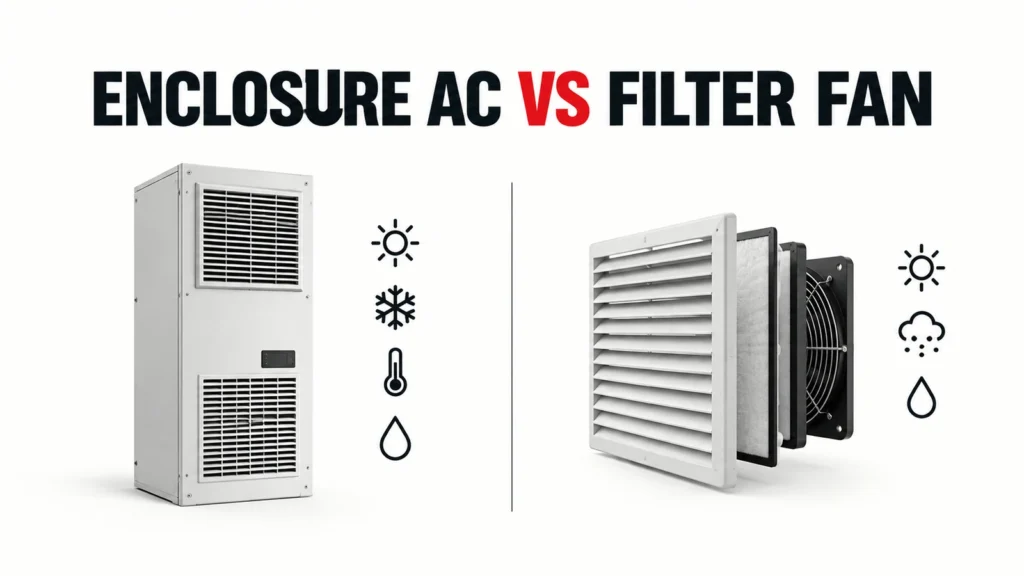
This guide explains the architectural difference between ventilation by filter fan and closed-loop enclosure air conditioning. It does not size a cooling device, promise an enclosure rating after modification, or approve either method without a heat-load and environmental review.
Decision Inputs at a Glance
| Decision input | Buyer must confirm | Evidence required |
|---|---|---|
| Heat-transfer path | Outside air passes through the cabinet | Internal and external air circuits remain separated |
| Temperature condition | Useful when ambient air can absorb cabinet heat | Can cool toward a controlled internal target within model limits |
| Contamination | Requires acceptable incoming air and filter maintenance | Supports a closed air boundary but still needs external coil service |
| Moisture | Introduces ambient humidity with ventilation air | Requires condensate and dew-point review |
| Selection evidence | Airflow and pressure performance in installed system | Capacity at actual internal and external temperatures |
Identify the Heat-Transfer Architecture
A filter-fan system moves external air through the enclosure and discharges warmed air. Its performance depends on the complete path, including inlet restriction, outlet area, filter condition and internal obstructions.
An enclosure air conditioner circulates cabinet air through an internal heat exchanger and rejects heat through a separate external circuit. It is not simply a more powerful fan; it changes the enclosure and moisture strategy.
Compare Ambient and Target Temperatures
Ventilation needs outside air that is sufficiently cooler than the desired cabinet condition. If ambient approaches or exceeds the internal target, adding airflow cannot create a lower supply-air temperature.
Air-conditioner selection must use capacity evidence at the actual internal and external design temperatures. A nominal cooling value at another rating point is not final proof of performance.
Assess Dust, Oil and Other Contaminants
A filtered ventilation path still exchanges air with the room. Filter class, loading, bypass paths and maintenance frequency must match the contamination risk and acceptable cabinet condition.
Closed-loop cooling can reduce direct exchange, but the external heat exchanger remains exposed to its environment. Fouling, clearance and cleaning access still affect field performance.
Treat Humidity and Condensate Explicitly
Ventilation imports ambient moisture whenever air enters. An air conditioner can create cold surfaces and condensate under some conditions, especially after door opening or when humid air reaches the internal circuit.
Define the condensate route, drainage or evaporation provisions and service response. Avoid assuming that “sealed” means moisture cannot enter or that cooling automatically controls humidity.
Preserve the Intended Enclosure Boundary
Every cutout, fan, grille, gasket and cooling-unit interface affects the finished enclosure. Require an installation drawing and verify how the complete assembly meets the project’s environmental requirement.
Do not copy the component’s standalone protection statement directly to the modified enclosure. The delivered assembly and installation method need their own documented assessment.
Compare Life-Cycle Work
Filter systems need routine inspection and replacement based on the environment and pressure loss. Air conditioners require coil cleaning, airflow clearance, condensate attention and checks of controls or alarms.
Choose the architecture with a realistic maintenance plan. A method that performs in a clean calculation but cannot be serviced in the installed location is not a robust selection.
Build an Exact-Model Evidence File
Create one approval record for the proposed Enclosure Air Conditioner order code. Put each project requirement beside the supplier document that answers it. Preserve the exact datasheet, dimensioned drawing, circuit diagram, performance curve or application note used, including its revision or retrieval date. A category page establishes family context but cannot prove an exact rating, terminal arrangement, optional feature or system combination.
Check that every accepted statement describes the same orderable item. Similar housings can contain different circuits, terminals, materials, firmware or accessories. Do not combine a maximum from one variant, a drawing from another and a feature from a third. Mark unresolved fields explicitly so they remain visible during engineering and commercial review.
Keep Project Inputs Separate From Product Evidence
The project team defines the application: source, load, duty, environment, controls, mechanical limits and required functions. The supplier identifies an exact Enclosure Air Conditioner and supports it with exact documents. Neither side should fill a gap by inference from appearance, a shared family name or one matching headline value.
Freeze the application record while quotations are compared. If the circuit, load, duty, environment, enclosure, thermal method or required output changes, issue a revised record and ask each supplier to reconfirm the candidate. Otherwise apparently comparable quotations may be answering different technical requirements.
Common Procurement Errors
- Selecting Enclosure Air Conditioner from one headline rating while the application context remains incomplete.
- Using a circuit, curve, terminal drawing or performance claim from a neighboring model.
- Treating a family page or product photograph as exact technical evidence.
- Assuming an accessory, system function or coordination result is included without documentation.
- Approving a substitute without repeating the electrical, thermal, mechanical and evidence review.
Resolve these gaps before comparing price and lead time. The reviewer should be able to trace every accepted statement either to the project requirement or to the exact candidate document. A proposal may remain commercially interesting while technically incomplete, but missing evidence must not disappear inside the quotation.
How to Compare Supplier Offers
| Comparison point | Required evidence | Do not accept |
|---|---|---|
| Exact identity | Full orderable code and variant description | Family name alone |
| Application match | Response against the frozen project inputs | Generic suitability statement |
| Technical evidence | Current exact-model documents with revision | Screenshot or neighboring-model page |
| Delivered scope | Included accessories, interfaces and documents | Undefined “standard package” |
| Open questions | Visible deviation and clarification list | Silence treated as compliance |
| Substitution | Fresh review against every requirement | “Equivalent” based on appearance |
Normalize every Enclosure Air Conditioner offer to the same application record. Keep document revisions, test conditions, included accessories and open questions beside each value. This makes differences in delivered scope visible and prevents a lower-cost but narrower offer from appearing equivalent to a complete solution.
Decision Workflow
- Freeze the application architecture and operating case.
- Record environmental, thermal and mechanical constraints.
- Identify the required Enclosure Air Conditioner function without assuming a model.
- Request a complete order code and exact supporting documents.
- Compare every claim with its conditions and definitions.
- Resolve deviations and coordination questions before commercial approval.
- Archive the accepted evidence with the final bill of materials.
Stop the review when a critical application input is unknown, the quoted model is ambiguous, a required claim is supported only by another manufacturer or another order code, or the installation falls outside the available evidence. These are engineering gaps, not editorial details.
RFQ Preparation Checklist
A useful RFQ for enclosure air conditioner vs filter fan is concise enough to answer and complete enough to prevent silent assumptions. Identify unknown values as questions and require a full orderable code rather than a generic family recommendation.
- Heat load
- Ambient relation
- Contamination
- Humidity
- Enclosure boundary
- Open-loop path
- Closed-loop path
- Condensate route
- Service access
- Alarm strategy
- Quantity, destination and required document language
Request the current datasheet revision and the exact scope of any certification, compatibility, coordination or performance claim. Record quantity and destination after the technical inputs so commercial terms do not obscure unresolved engineering questions.
Handoff From Engineering to Purchasing
Engineering approval should identify the exact Enclosure Air Conditioner code, accepted document revisions, unresolved deviations and the application record used for the decision. Purchasing can then compare commercial offers without silently changing the technical basis. If a supplier proposes another code, different accessory or revised configuration, route it back through the same review instead of treating it as an administrative substitution.
Keep the approved evidence with the purchase order and final bill of materials. Receiving and production teams need enough information to recognize the accepted item and to stop when labeling, terminal arrangement, accessories or documentation differ. This handoff also gives maintenance teams a traceable starting point for replacement decisions rather than relying on a photograph, an old invoice description or one headline rating.
Frequently Asked Questions
Can a larger filter fan cool below ambient temperature?
No. Ventilation uses ambient air and cannot supply air colder than that source.
Does an air conditioner eliminate all maintenance?
No. Air paths, heat exchangers, condensate provisions and controls still require inspection.
Can component protection ratings be applied to the whole cabinet?
Not automatically. Verify the finished enclosure and the approved installation method.
Related RITOKS Products and Guidance
These links provide published product-family context only. A contextual link does not claim interchangeability, compatibility or an approved system combination.
Enclosure Air Conditioner product category
Published RITOKS Enclosure Air Conditioner product page
Related published RITOKS technical guide
Related published RITOKS technical guide
Technical Reference
The following source supports only the general engineering concept stated in this guide. Its product ratings, circuit diagrams, approvals and coordination results do not transfer to RITOKS products.
Rittal, Climate control engineering resources
Supports the distinction between ambient-air cooling and active enclosure climate control; Rittal product data does not transfer to RITOKS models.
Request an Exact-Model Review
Send the application requirements, exact-document questions, quantity and destination through the RITOKS contact form. An RFQ requests an exact-model review; this guide does not approve a circuit, installation or automatic substitute.