
Thermal Management · Technical Explainer
Electrical Enclosure Cooling Methods: Fan, Heat Exchanger and Air Conditioner Roles
Electrical enclosure cooling methods solve different thermal and environmental problems. Natural convection, filtered ventilation, closed-loop heat exchange and enclosure air conditioning cannot be ranked by cooling capacity alone. The choice starts with heat load, target internal temperature, ambient conditions and whether outside air may enter the cabinet.
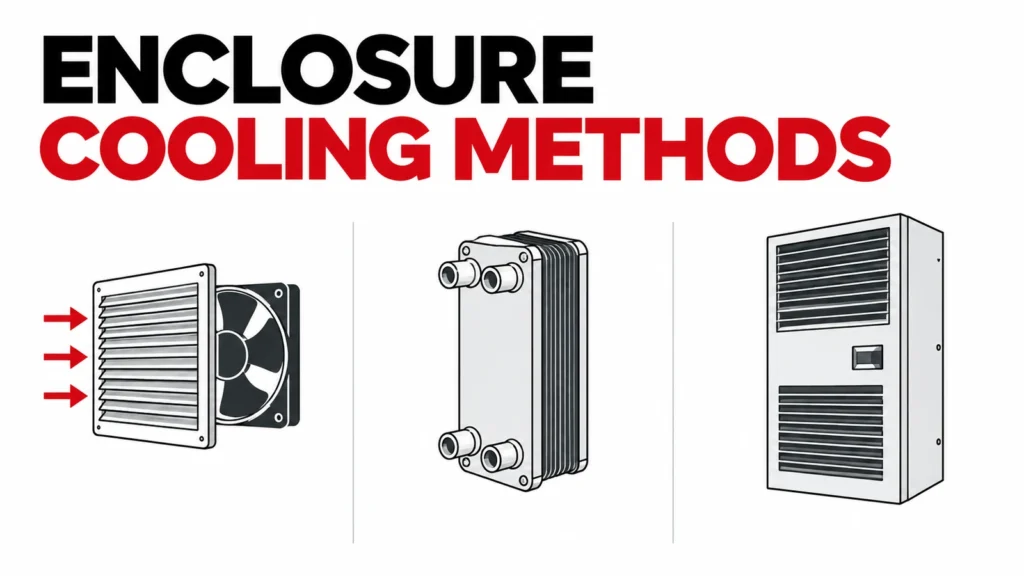
This architecture guide compares method roles and evidence requirements. It does not size equipment for an unknown cabinet, claim that a fan can cool below ambient or state that every heat exchanger or air conditioner provides the same sealing, capacity or environmental performance.
Buying Decision at a Glance
| Decision input | Buyer must confirm | Evidence required |
|---|---|---|
| Heat balance | Internal losses and surface heat transfer | Documented cabinet heat-load case |
| Temperature relationship | Maximum ambient versus target internal temperature | Worst-case site temperatures |
| Contamination boundary | Whether outside air may enter | Dust, moisture and corrosive exposure record |
| Capacity evidence | Performance at the design condition | Curve or calculation with conditions |
| Lifecycle | Filters, coils, drains, fans and service access | Maintenance and installation plan |
Natural Convection and Passive Surface Cooling
An enclosure can reject heat through its surfaces when internal temperature is above ambient. Natural air movement inside and outside the cabinet supports this path without an active cooling device. The result depends on losses, effective surface area, material, installation position and temperature difference.
Passive cooling is attractive when heat load is low and ambient conditions leave enough temperature margin. It cannot make the inside colder than ambient, and a cabinet against a wall or grouped with others may have less effective heat-transfer area than a freestanding cabinet.
Filtered Fans and Open-Loop Ventilation
A filter-fan system exchanges cabinet air with the surrounding environment. It can increase heat removal when ambient air is cool enough, but filters and grilles create resistance. Required airflow should come from heat load and allowable temperature rise, followed by an operating-point check.
This method creates an open environmental boundary. Dust, oil mist, humidity and corrosive gas must be considered, and filter maintenance is part of the cooling capacity. A loaded filter can reduce flow long before the fan stops rotating.
Air-to-Air Heat Exchangers
An air-to-air heat exchanger keeps internal and external air streams separated while transferring heat across a barrier. It can suit contaminated environments when the outside air remains cooler than the desired cabinet temperature and the exact unit provides the required separation.
Capacity varies with temperature difference, airflow and installation. Request exact performance data at the project condition. The separated streams do not remove the need to manage condensate, fouling, fan service or cabinet sealing according to the selected design.
Enclosure Air Conditioners
An enclosure air conditioner uses a refrigeration cycle to provide active cooling and can maintain an internal target below external ambient within its declared operating range. Selection requires internal heat loss, enclosure surface exchange, target temperature, maximum ambient, mounting and a capacity curve at the design point.
Condensate handling, hot-air discharge, clearances, power supply and control behavior belong in the design. A nominal cooling-watt label at another rating point is not proof that the unit will meet the project condition.
Hybrid Controls and Condensation Prevention
Fans, heat exchangers or air conditioners may be controlled by thermostats or a broader cabinet climate strategy. An enclosure heater solves a different problem by keeping surfaces above a condensation-risk condition; it does not remove internal heat. Cooling and anti-condensation heating should not be treated as interchangeable.
Door opening, seasonal ambient changes and shutdown periods can shift humidity risk. Define the operating modes and alarm response. The final architecture should explain both temperature control and environmental protection rather than presenting one device as a complete answer.
Build an Exact-Configuration Evidence File
Create one review sheet for the proposed Enclosure Cooling Strategy order code. Put project inputs in one column and supplier evidence in the other. Preserve the exact datasheets, drawings, curves, tables and manuals used in the decision, including their revision or retrieval date. A category page can establish family context, but an exact rating, setting, protocol or connection claim must trace to the quoted configuration.
Check that every accepted value describes the same orderable item. Similar housings and family names can hide different circuits, supplies, terminals, controls, mounting details or accessories. Do not combine a family maximum from one variant, a drawing from another and an optional feature from a third. Keep unresolved fields visible in the technical comparison.
Control Changes During Sourcing
Freeze the application record while suppliers respond. If the load, voltage, environment, duty, enclosure, control method or required output changes, issue a revised record and ask each supplier to reconfirm the candidate. Otherwise quotations can appear comparable while answering different technical requirements.
A proposed substitute returns to the same evidence gate. Matching dimensions, a similar product photograph or one equal headline rating is not enough. The substitute must satisfy the required functions and conditions using its own exact documentation.
Common Procurement Errors
- Selecting a Enclosure Cooling Strategy from one headline value while leaving the application context undefined.
- Using a curve, setting table, register map or connection diagram from a neighboring model.
- Treating a family maximum or ideal test condition as the application operating point.
- Assuming included accessories, controls and system functions from the product name or photograph.
- Approving a substitution without reopening the technical evidence review.
Do not rank passive cooling, a filter fan, an air-to-air exchanger and an air conditioner by one watt or airflow figure. Ambient temperature, contamination and whether cabinet air may mix with outside air determine which method can be considered.
How to Compare Supplier Offers
| Comparison point | Required evidence | Do not accept |
|---|---|---|
| Method | Environmental boundary | Key limit |
| Passive surface cooling | Closed enclosure | Needs temperature difference and sufficient surface area |
| Filtered ventilation | Outside air enters | Cannot cool below ambient; filter resistance |
| Air-to-air heat exchanger | Separated air streams | Needs useful internal-to-ambient temperature difference |
| Enclosure air conditioner | Closed-loop active cooling | Capacity varies with design temperatures; condensate and power required |
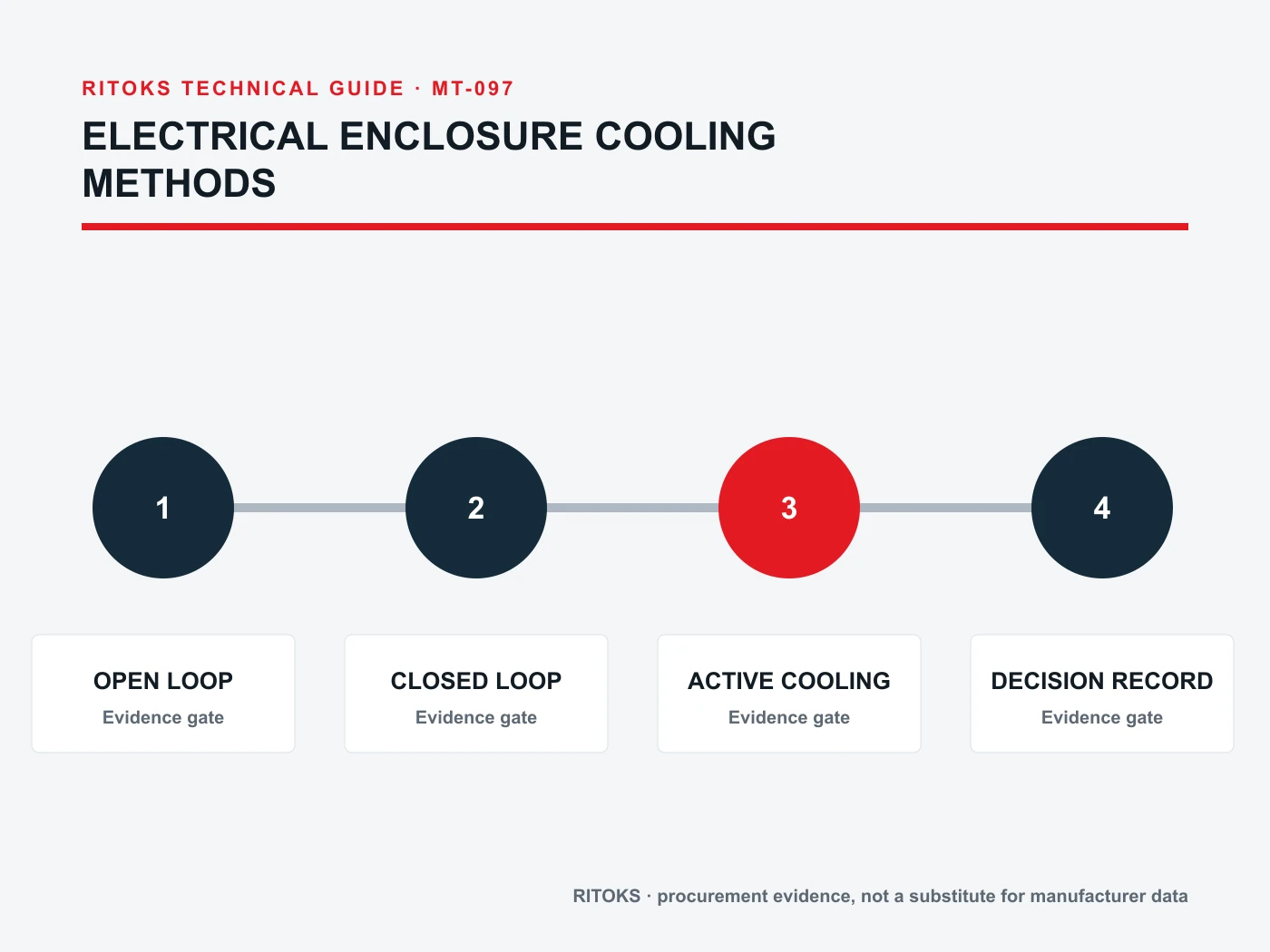
Normalize every Enclosure Cooling Strategy offer to the same application record. Keep document revisions, test conditions and open questions beside each value. A proposal can remain commercially interesting while technically incomplete, but missing evidence should stay visible until resolved.
Decision Workflow
- List internal heat losses and the target internal temperature.
- Record maximum ambient, humidity and contamination.
- Decide whether outside air may enter the cabinet.
- Shortlist cooling architectures that satisfy that boundary.
- Compare exact capacity at the design condition.
- Verify mounting, power, controls, condensate and maintenance access.
Calculate the cabinet heat balance and temperature limit first. Determine whether ambient-air exchange is acceptable, then compare evidence for passive heat loss, filtered airflow, separated heat exchange or active refrigeration at the stated conditions.
RFQ Preparation Checklist
A useful RFQ for electrical enclosure cooling methods is concise enough to answer and complete enough to prevent silent assumptions. Identify unknown values as questions and require an exact orderable code rather than a generic family recommendation.
- Enclosure dimensions, material and installed position
- Equipment list and internal heat loss
- Target internal and maximum ambient temperatures
- Dust, humidity, corrosive gas and washdown exposure
- Open-loop or closed-loop environmental requirement
- Available power, mounting and service clearances
- Capacity evidence, controls, quantity and destination
Request the current datasheet and manual revisions and the scope of any certification, compatibility or performance claim. Record quantity and destination after the technical inputs so commercial terms do not obscure unresolved engineering questions.
Stop Conditions Before Order Release
Do not release the order while a critical application input is unknown, the quoted model is ambiguous, a required claim is supported only by another product document, or installation conditions fall outside the available evidence. These are engineering gaps, not editorial details.
The approval record should state what the selected item does, what remains outside its scope and which exact documents support the decision. If the application or candidate changes, reopen the affected checks rather than carrying the previous conclusion forward.
Frequently Asked Questions
Can a filter fan cool a cabinet below ambient temperature?
No. Open-loop ventilation depends on incoming ambient air and cannot provide refrigeration below that temperature.
When is a heat exchanger different from an air conditioner?
A heat exchanger transfers heat between separated air streams, while an air conditioner provides active refrigeration. Exact product designs still require verification.
Does an enclosure heater count as a cooling method?
No. It is normally used for condensation or low-temperature control, not removal of internal heat.
Related RITOKS Products and Guidance
Use these destinations as separate category, product and guidance records. A contextual link does not claim interchangeability, coordination, compatibility or approval for a particular application.
Enclosure Cooling Strategy product category
EP-A enclosure air conditioners
Enclosure air conditioner selection guide
Technical References
These primary standards or manufacturer sources support only the general concepts identified below. Their product values, diagrams, approvals and tested combinations do not transfer to RITOKS products.
Rittal, Technical System Catalogue: Cooling with Ambient Air
Supports enclosure heat-load, temperature-rise, airflow and ambient-air cooling concepts. Rittal formulas and product values apply only under their stated conditions and do not describe RITOKS products.
Rittal, RiTherm Climate Control Planning
Supports treating enclosure climate control as a system decision based on heat load, environment and installation. It is not an exact-model selection record for RITOKS equipment.
Request an Exact-Model Review
Send the application requirements, exact documentation questions, quantity and destination through the RITOKS contact form. An RFQ requests an exact-model review; this guide does not approve a wiring design, protection setting, installation or automatic substitute.