
Cabinet Cooling Fans · Comparison
Filter Fan vs Axial Fan for Electrical Enclosures
A filter fan is an enclosure ventilation assembly intended to move ambient air through a filtered opening. An axial fan is a fan technology that may be used inside equipment or as part of a larger ventilation design. They can share a rotating airflow element, but they are not the same purchasing scope.

This article compares system roles for electrical enclosures. It does not declare one fan type universally better, provide a final airflow calculation for an unknown cabinet or claim that every FD filter fan and every RITOKS axial fan has the same protection, airflow or mounting data.
Buying Decision at a Glance
| Decision input | Buyer must confirm | Evidence required |
|---|---|---|
| Cooling boundary | Whole-enclosure air exchange or local component airflow | Thermal layout and airflow path |
| Resistance | Filter, grille, outlet and internal obstruction pressure loss | Performance data at operating resistance |
| Contamination | Dust class, filter media and maintenance interval | Declared protection and filter record |
| Mounting | Cabinet cutout assembly or internal bracket/guard | Dimensions and installation drawing |
| Electrical | Supply, frequency, power and control method | Exact nameplate and wiring data |
Compare the Delivered Scope
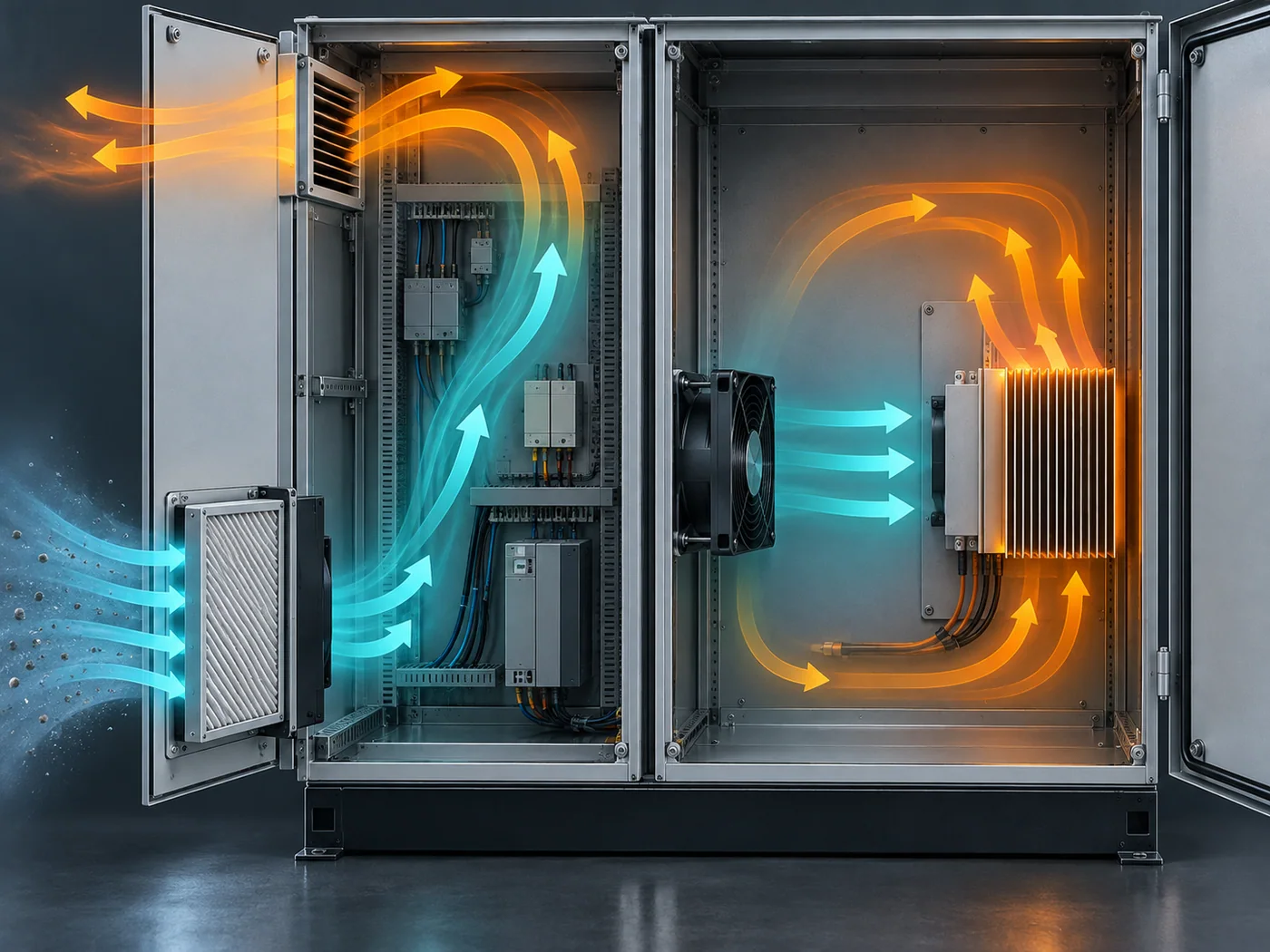
A filter fan normally combines a fan, grille, filter medium and enclosure mounting features. It is selected with an outlet path and a maintenance plan. A standalone axial fan supplies airflow but may require a guard, bracket, grille, filter and sealing design from the panel builder.
This scope difference matters when quotations are compared. A lower-priced fan-only offer is not equivalent to a filtered cabinet ventilation assembly unless the missing components and engineering are included elsewhere.
Calculate Enclosure Airflow From Heat
Required ventilation depends on internal heat loss and the maximum permitted rise above ambient. Rittal publishes a calculation basis that relates heat loss, temperature difference and required fan airflow. Use the applicable project method and its conditions rather than choosing by fan diameter.
Ambient air cooling works only when the incoming air can meet the internal temperature objective. If the external environment is too hot, corrosive, heavily contaminated or humid, an open-loop fan system may be unsuitable regardless of nominal airflow.
Account for System Resistance
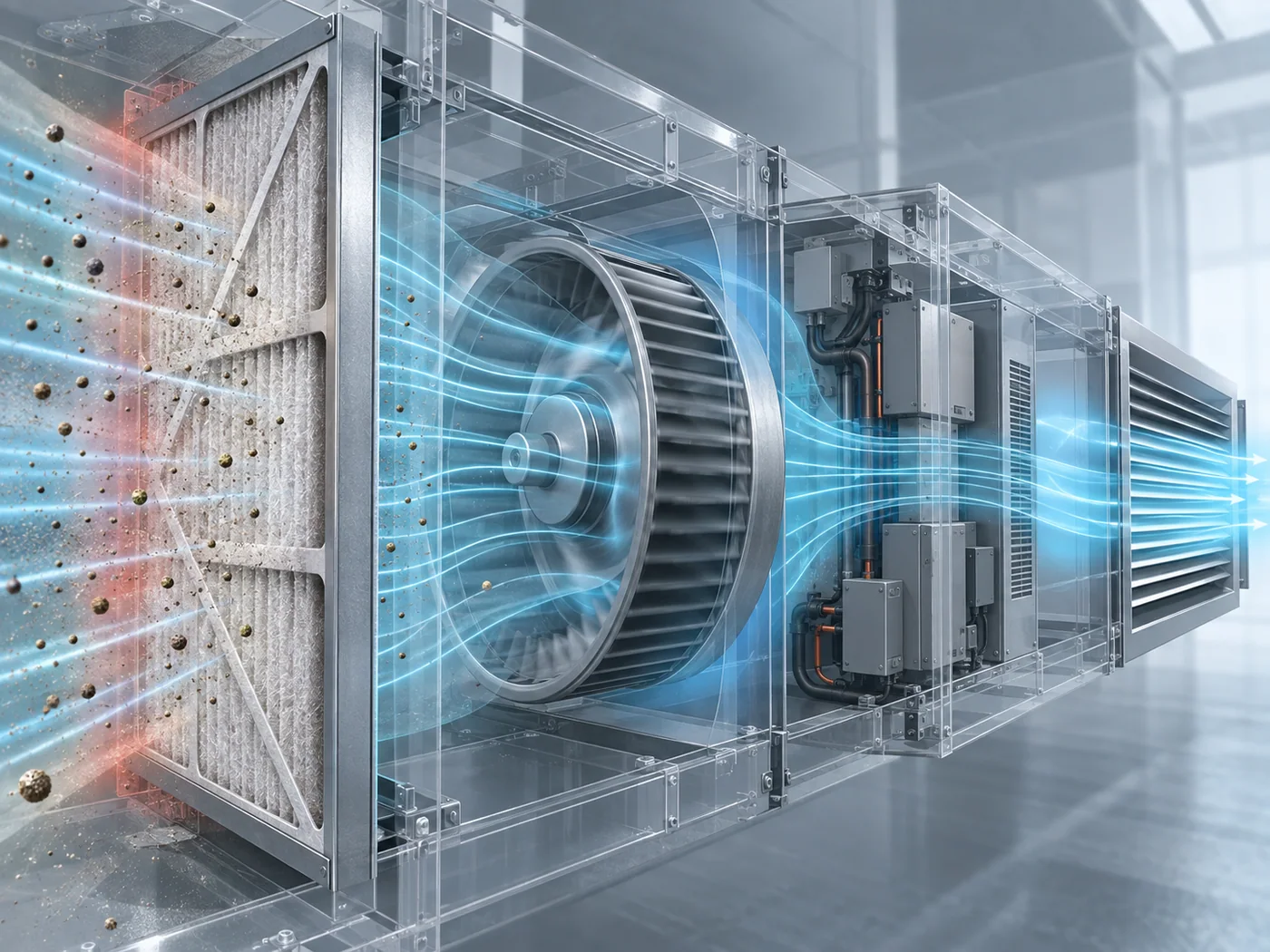
Free-air airflow is measured without the resistance of the real cabinet path. Filters, louvres, outlet grilles, bends, dense wiring and crowded components create pressure loss. Compare performance at the operating point when the manufacturer supplies a curve or filtered-air rating.
Rittal distinguishes filtered fan performance and emphasizes pressure stability in its enclosure product description. The broader lesson is that the assembled airflow path, not the rotor diameter alone, controls delivered ventilation.
Design the Air Path
Place inlet and outlet openings so cool air reaches heat-producing components and warm air leaves without short-circuiting directly back to the inlet. Consider component blockage, cable ducts and the natural rise of warm air.
Positive or negative cabinet pressure affects where unfiltered air can enter through gaps. The direction and filter placement should follow the contamination strategy and exact product instructions. A fan mounted anywhere on the wall does not automatically create effective circulation.
Plan Filter Maintenance and Fan Safety
A loaded filter increases resistance and reduces airflow. Define inspection or replacement based on the environment and consequence of overheating. Maintenance access must allow the filter to be serviced without disturbing unsafe equipment.
For a standalone axial fan, verify guarding, finger protection, terminal protection, mounting, vibration and cable routing as part of the equipment design. These needs may be integrated differently in a purpose-built filter fan assembly.
Build an Evidence File Before Approval
Create one review sheet for the proposed Enclosure Cooling Fan order code. Put project inputs in one column and supplier evidence in the other. Preserve the exact pages, drawings, curves and tables used in the decision, including their revision or retrieval date. A category page can establish product-family context, but an exact rating or connection claim must trace to the quoted configuration.
Check that every accepted value describes the same orderable item. Similar housings can contain different circuits, supplies, terminals, airflow arrangements or accessories. Do not combine a family maximum from one variant, a drawing from another and an optional feature from a third. Mark unresolved fields explicitly instead of allowing them to disappear in the commercial quotation.
Control Changes During Sourcing
Keep the application record frozen while suppliers respond. If the load, voltage, environment, duty, enclosure, cooling method or required output changes, issue a revised record and ask each supplier to reconfirm the candidate. Otherwise two quotations may look comparable while answering different technical requirements.
A proposed substitute returns to the same evidence gate. Matching dimensions, a similar product photograph or one equal headline rating is not enough. The substitute must satisfy the required functions and conditions with its own exact documentation.
Common Procurement Errors
- Selecting Enclosure Cooling Fan from one headline rating while leaving the application context undefined.
- Using a curve, terminal diagram or performance claim from a neighboring model.
- Comparing free-air, nominal or family-maximum data with an application operating point.
- Treating included accessories and system functions as obvious from a product name.
- Approving a substitution without reopening the technical evidence review.
A fan-only price cannot be compared directly with a filtered enclosure assembly. Include guard, grille, filter, outlet path, mounting and maintenance scope, then compare delivered airflow with installed pressure loss rather than free-air flow.
How to Compare Supplier Offers
| Comparison point | Filter fan assembly | Standalone axial fan |
|---|---|---|
| Primary role | Filtered enclosure air exchange | Air mover for a designed local/system path |
| Included parts | Typically grille, media and enclosure mount | Model-specific fan body; other parts separate |
| Airflow evidence | Filtered/system condition should be stated | Free-air figure may require derating for resistance |
| Maintenance | Filter inspection and replacement | Fan inspection plus any separately designed filter |
| Best fit | Cabinet ventilation with defined ambient-air quality | Component cooling or custom ventilation assembly |
Normalize every Enclosure Cooling Fan offer to the same application record. Keep document revisions, test conditions and open questions beside each value. A proposal can remain commercially interesting while technically incomplete, but missing evidence must stay visible until it is resolved.
Decision Workflow
- Calculate internal heat loss and permissible temperature rise.
- Confirm ambient air is suitable for open-loop ventilation.
- Map the inlet, internal flow path and outlet.
- Estimate filter, grille and enclosure resistance.
- Compare exact airflow and pressure evidence.
- Verify cutout, protection, supply, guarding and maintenance access.
Define heat loss and permissible rise above ambient, then draw an inlet-to-outlet path. Compare the exact filter-fan assembly and standalone axial-fan proposal at the expected resistance and contamination conditions before judging cost.
RFQ Preparation Checklist
A useful RFQ for filter fan vs axial fan is concise enough to answer and complete enough to prevent silent assumptions. Identify unknown values as questions and require an exact orderable code rather than a generic family recommendation.
- Enclosure dimensions and internal heat load
- Maximum ambient and permitted internal temperature
- Dust, moisture and contamination conditions
- Required filtered airflow or operating-point data
- Inlet/outlet positions and cutout limitations
- Supply voltage/frequency and control method
- Filter maintenance, quantity and destination
Request the current datasheet revision and the scope of any certification, compatibility or performance claim. Record quantity and destination after the technical inputs so commercial terms do not obscure unresolved engineering questions.
Stop Conditions Before Order Release
Do not release the order while a critical application input is unknown, the quoted model is ambiguous, a required rating is supported only by another manufacturer’s document, or installation conditions fall outside the available evidence. These are engineering gaps, not editorial details.
The approval record should state what the selected item does, what remains outside its scope and which exact documents support the decision. If the application or candidate changes, reopen the affected checks rather than carrying the previous conclusion forward.
Frequently Asked Questions
Is a filter fan simply an axial fan with foam in front?
Not necessarily. It is an enclosure assembly whose grille, filter, sealing, mounting and airflow data must be evaluated together.
Can I compare fans by free-air CFM or m³/h only?
No. System resistance can reduce delivered airflow, so use data relevant to the installed path.
Will a larger fan always cool the cabinet better?
No. Air path, resistance, ambient temperature and heat distribution can matter as much as frame size.
Related RITOKS Products and Guidance
Use these links as separate category and product records. A contextual link does not claim interchangeability, compatibility or an approved system combination.
Enclosure Cooling Fan product category
Industrial AC axial cooling fans
Technical References
These primary manufacturer sources support only the general concepts identified below. Their product values, diagrams and approvals do not transfer to RITOKS products.
Supports the enclosure-level role of a filtered fan unit and the effect of pressure stability and filters on airflow. Rittal values do not describe RITOKS products.
Rittal, Technical System Catalogue: Cooling with Ambient Air
Supports calculating required enclosure airflow from heat loss and permissible temperature rise rather than choosing a fan by frame size alone.
Request an Exact-Model Review
Send the application requirements, exact documentation questions, quantity and destination through the RITOKS contact form. An RFQ requests an exact-model review; this guide does not approve a wiring design, installation or automatic substitute.