
Motor Starters for Industrial Motor Control · Comparison
Enclosed vs Open Motor Starters: Procurement Questions
The difference between an enclosed and open motor starter is mainly the delivered assembly and installation boundary. An open starter component is normally installed inside a suitable panel or machine enclosure. An enclosed starter adds an enclosure and may include operators, terminals or other accessories, but the exact included scope must be documented.
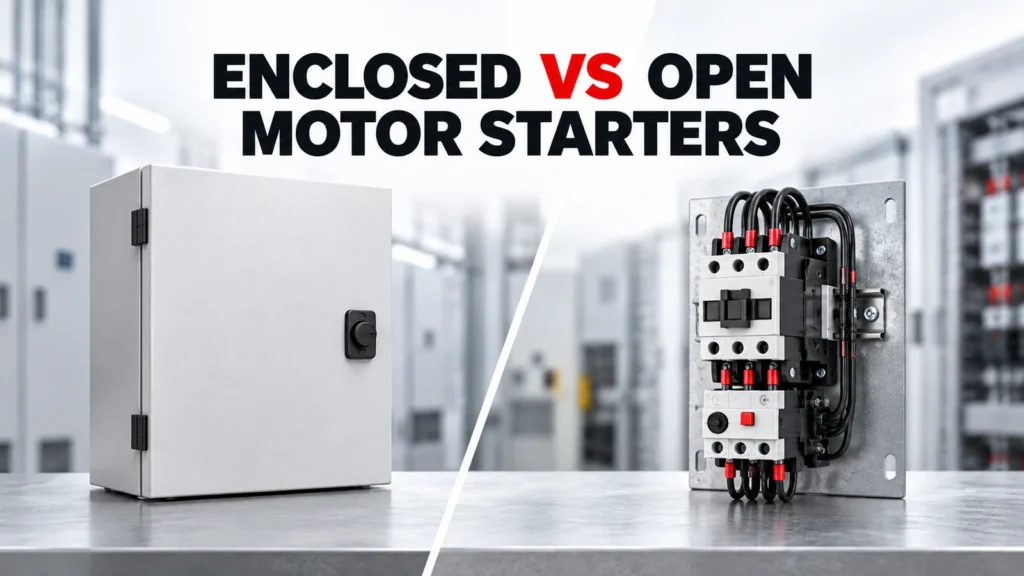
This comparison organizes procurement questions. It does not claim that every enclosed starter has the same protection rating or controls, approve an open starter for exposed installation, or prove a contactor, overload relay and protective device combination without exact coordination evidence.
Buying Decision at a Glance
| Decision input | Buyer must confirm | Evidence required |
|---|---|---|
| Installation boundary | Complete field-mounted enclosure or panel-mounted component | Exact scope drawing |
| Environment | Dust, moisture, impact, corrosion and location | Declared enclosure rating and conditions |
| Controls | Start/stop, reset, indicator and disconnect functions | Exact schematic and bill of material |
| Motor protection | Overload range, trip behavior and upstream fault protection | Exact coordination documentation |
| Connections | Cable entries, terminals, earthing and working space | Installation drawing and instructions |
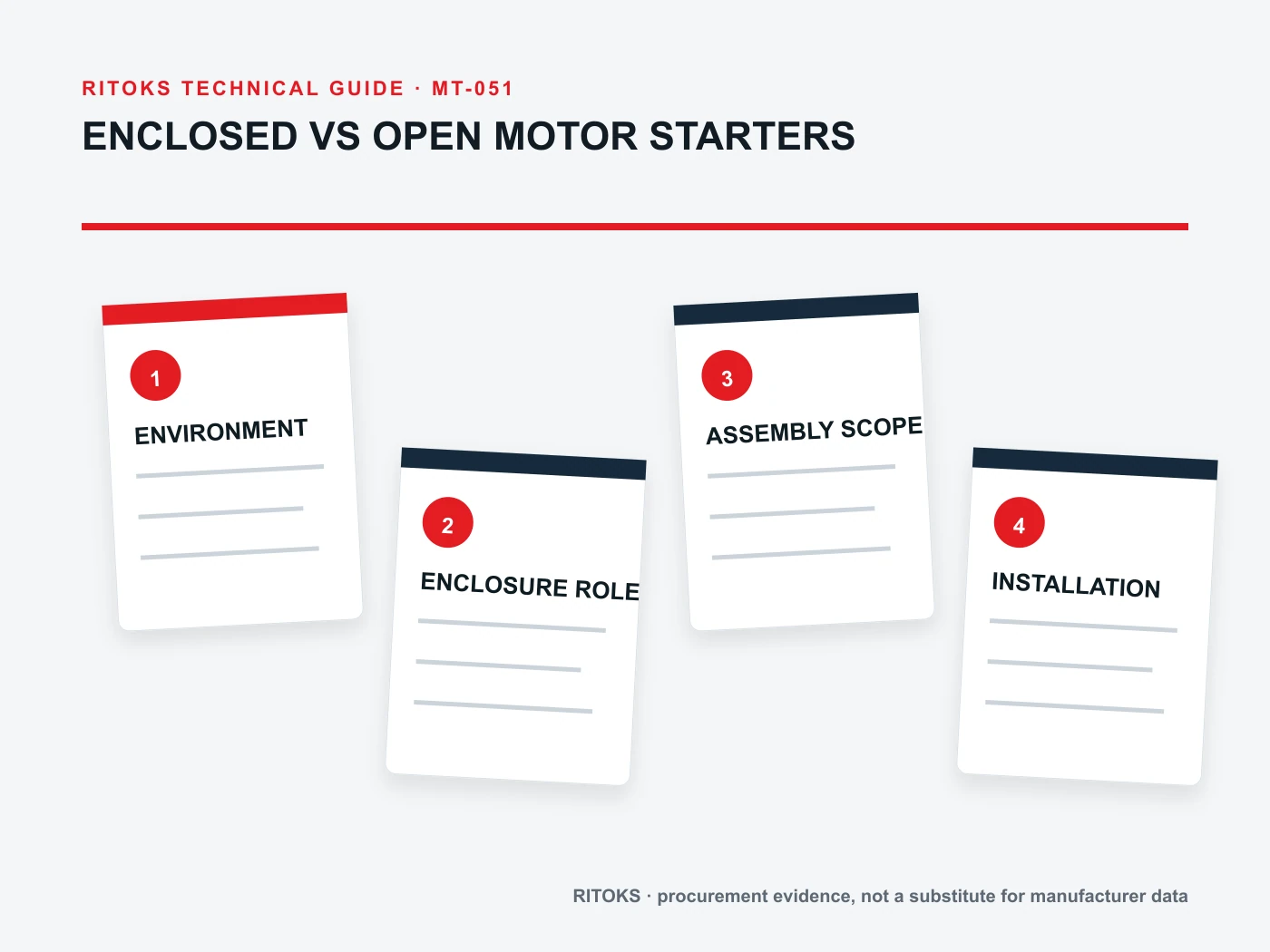
Define What Open and Enclosed Mean in the Quote
An open starter is not necessarily missing functional motor-control parts. It can include a contactor and overload relay intended for integration into a machine or control panel. The panel builder then owns the enclosure, spacing, protection, terminals, operators and installation environment.
An enclosed starter moves some of that scope to the supplier, but the label alone is incomplete. Ask whether the quotation includes the enclosure, start and stop operators, reset mechanism, indicators, control transformer, isolating function, terminals, glands or mounting hardware.
Match the Enclosure to the Environment
Record indoor or outdoor location, dust, water, oil, corrosion, temperature, sunlight, vibration and impact exposure. Request the exact enclosure classification and the conditions under which it applies. An enclosure material or gasket visible in a photograph is not proof of a protection rating.
Cable entries, unused openings, door hardware and field modifications can affect the installed boundary. The procurement record should state who supplies and installs glands or conduit fittings and whether those parts are included in the declared enclosure performance.
Separate Controls From the Power Assembly
Document the control-supply voltage, coil voltage, start and stop logic, local or remote command, emergency-stop interface, reset behavior and indication. A starter can share the same motor-current range while having different control circuits.
If an enclosed unit includes pushbuttons, ask for the exact schematic and contact function. If an open starter is integrated into a panel, the panel designer remains responsible for control-circuit design and machine safety. Neither package type by itself proves a safe control system.
Verify Motor Protection and Coordination
Provide motor nameplate current, starting method, acceleration time, duty and upstream fault level. Confirm the overload-relay range and trip behavior. Identify the upstream fuse or breaker and request exact manufacturer coordination evidence for the proposed combination.
An enclosure does not add short-circuit performance automatically. Likewise, an open starter installed in a high-rated panel does not inherit the panel rating without a valid assembly design and evidence. Keep starter-component ratings and complete-assembly claims separate.
Compare Installation and Lifecycle Scope
An enclosed starter may reduce panel-building work, but it still needs mounting, cable routing, earthing, working clearance and commissioning. An open starter may offer flexible integration but transfers more layout, thermal and wiring responsibility to the panel builder.
Compare maintenance access, spare components, reset access and replacement method. Normalize quotations to the same delivered scope so a low component price is not compared with a finished field enclosure containing controls and connection hardware.
Build an Exact-Configuration Evidence File
Create one review sheet for the proposed Motor Starter order code. Put project inputs in one column and supplier evidence in the other. Preserve the exact datasheets, drawings, curves, tables and manuals used in the decision, including their revision or retrieval date. A category page can establish family context, but an exact rating, setting, protocol or connection claim must trace to the quoted configuration.
Check that every accepted value describes the same orderable item. Similar housings and family names can hide different circuits, supplies, terminals, controls, mounting details or accessories. Do not combine a family maximum from one variant, a drawing from another and an optional feature from a third. Keep unresolved fields visible in the technical comparison.
Control Changes During Sourcing
Freeze the application record while suppliers respond. If the load, voltage, environment, duty, enclosure, control method or required output changes, issue a revised record and ask each supplier to reconfirm the candidate. Otherwise quotations can appear comparable while answering different technical requirements.
A proposed substitute returns to the same evidence gate. Matching dimensions, a similar product photograph or one equal headline rating is not enough. The substitute must satisfy the required functions and conditions using its own exact documentation.
Common Procurement Errors
- Selecting a Motor Starter from one headline value while leaving the application context undefined.
- Using a curve, setting table, register map or connection diagram from a neighboring model.
- Treating a family maximum or ideal test condition as the application operating point.
- Assuming included accessories, controls and system functions from the product name or photograph.
- Approving a substitution without reopening the technical evidence review.
An enclosed-starter label does not tell the buyer whether operators, isolator, control transformer, terminals and cable entries are included. Compare delivered assembly boundaries, not just contactor ratings or box photographs.
How to Compare Supplier Offers
| Comparison point | Required evidence | Do not accept |
|---|---|---|
| Scope | Enclosed starter | Open starter |
| Housing | Supplier-defined enclosure included when documented | Requires a suitable panel or machine enclosure |
| Operators | May include local controls; verify exact bill | Provided by panel/control design unless included |
| Environment | Declared for exact enclosure and entries | Depends on final assembly enclosure |
| Engineering owner | Supplier plus installer boundaries | Panel builder owns more integration |
| Comparison basis | Complete assembly drawing and schematic | Exact component combination and panel plan |
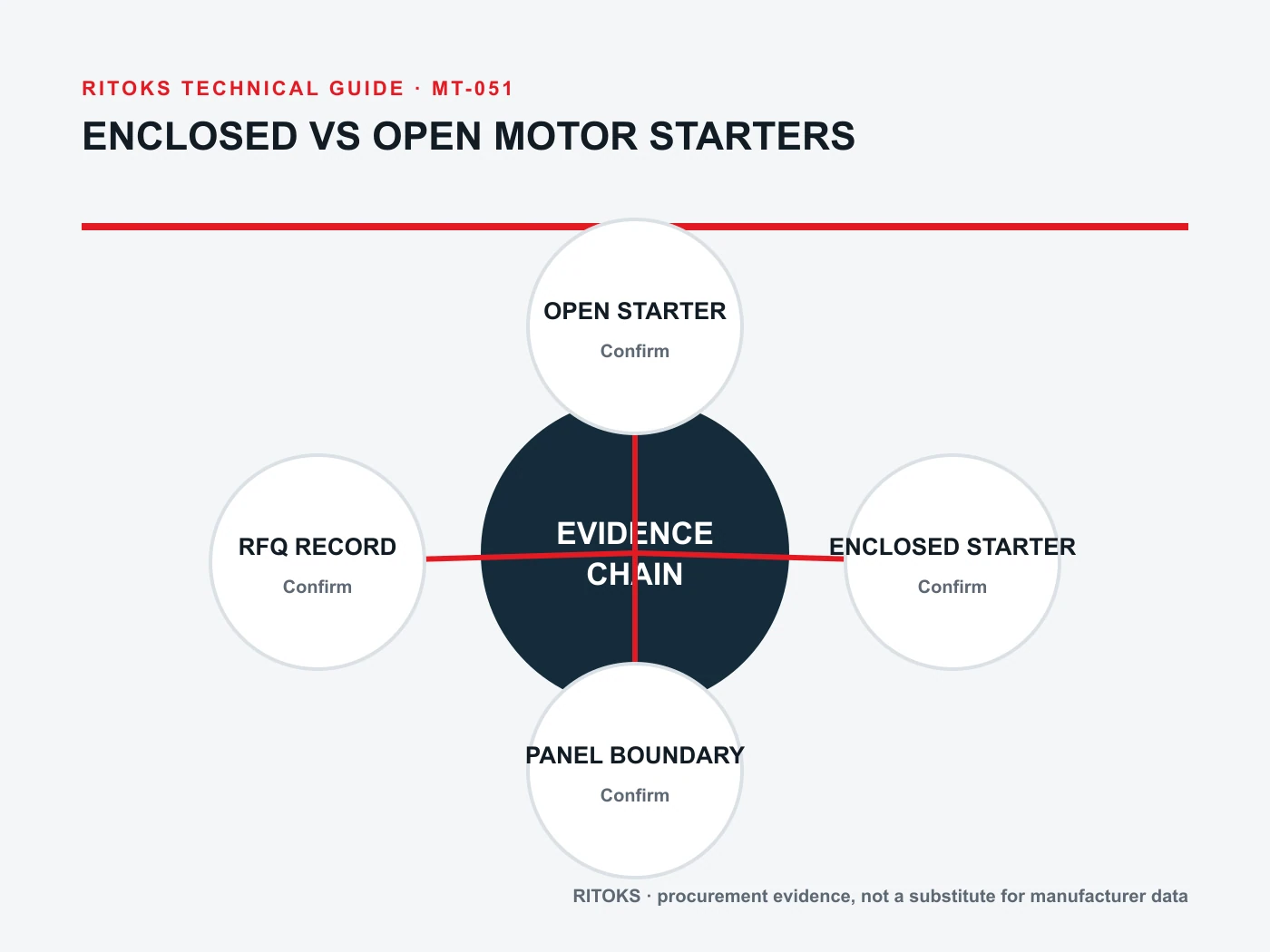
Normalize every Motor Starter offer to the same application record. Keep document revisions, test conditions and open questions beside each value. A proposal can remain commercially interesting while technically incomplete, but missing evidence should stay visible until resolved.
Decision Workflow
- Freeze motor, supply, starting duty and control requirements.
- Define the installation environment and enclosure boundary.
- List every required operator, terminal and accessory.
- Compare exact open and enclosed bills of material.
- Verify overload and short-circuit coordination.
- Review drawings, schematics, entries and maintenance access before order.
List which party supplies the enclosure, controls, terminals and field wiring. Then compare exact motor protection, control supply and environmental rating of the offered assembly; an open starter and a complete enclosed unit are not the same procurement scope.
RFQ Preparation Checklist
A useful RFQ for enclosed vs open motor starter is concise enough to answer and complete enough to prevent silent assumptions. Identify unknown values as questions and require an exact orderable code rather than a generic family recommendation.
- Motor power, nameplate current and starting method
- Main and control supply details
- Indoor/outdoor and contamination conditions
- Required enclosure classification and material
- Local and remote controls, indicators and reset
- Upstream protection and fault-duty context
- Drawings, schematics, quantity and destination
Request the current datasheet and manual revisions and the scope of any certification, compatibility or performance claim. Record quantity and destination after the technical inputs so commercial terms do not obscure unresolved engineering questions.
Stop Conditions Before Order Release
Do not release the order while a critical application input is unknown, the quoted model is ambiguous, a required claim is supported only by another product document, or installation conditions fall outside the available evidence. These are engineering gaps, not editorial details.
The approval record should state what the selected item does, what remains outside its scope and which exact documents support the decision. If the application or candidate changes, reopen the affected checks rather than carrying the previous conclusion forward.
Frequently Asked Questions
Is an enclosed starter always ready to install outdoors?
No. Outdoor suitability depends on the exact enclosure rating, materials, entries and environmental limits.
Does an open starter provide overload protection?
It may include an overload relay, but the exact assembly and documentation must be checked.
Which option costs less?
Compare the same delivered scope. An open component can transfer enclosure, controls and integration costs to the panel builder.
Related RITOKS Products and Guidance
Use these destinations as separate category, product and guidance records. A contextual link does not claim interchangeability, coordination, compatibility or approval for a particular application.
Motor Starter product category
ZSLE1-D enclosed magnetic motor starter
Technical References
These primary standards or manufacturer sources support only the general concepts identified below. Their product values, diagrams, approvals and tested combinations do not transfer to RITOKS products.
Schneider Electric, Information Required to Select a Contactor
Supports recording motor duty, voltage, current, coil and operating context rather than selecting switching equipment from one headline rating. Schneider product data does not transfer to RITOKS products.
ABB, Contactors and Overload Relays Guide
Supports the relationship between motor data, overload-relay selection, trip class, adjustment and starter coordination. ABB combinations and settings do not apply to RITOKS products.
Request an Exact-Model Review
Send the application requirements, exact documentation questions, quantity and destination through the RITOKS contact form. An RFQ requests an exact-model review; this guide does not approve a wiring design, protection setting, installation or automatic substitute.