
DC Miniature Circuit Breakers (MCB) · Comparison
Polarized vs Non-Polarized DC MCBs: What the Datasheet Must Confirm
DC MCB polarity matters because the device must interrupt faults in the circuit arrangement where it is installed. A breaker that looks symmetrical externally may have a required source side, load side or current direction. Conversely, a candidate described as non-polarized still needs exact-model documentation for the voltage and fault conditions of the project.
This guide shows how to compare the two claims without guessing from terminal shape, pole count or marketing copy. It keeps polarity separate from continuous current, breaking capacity and series-pole wiring.
Decision Inputs at a Glance
| Review area | What the buyer records | Evidence to request |
|---|---|---|
| Source and load | Which side can supply fault current | Single-line and operating-state diagram |
| Direction | Expected normal and fault-current directions | Source and storage-system analysis |
| Terminals | Line/load, plus/minus and pole markings | Exact breaker drawing |
| Interrupting duty | DC voltage and prospective fault level | Exact-model breaking data |
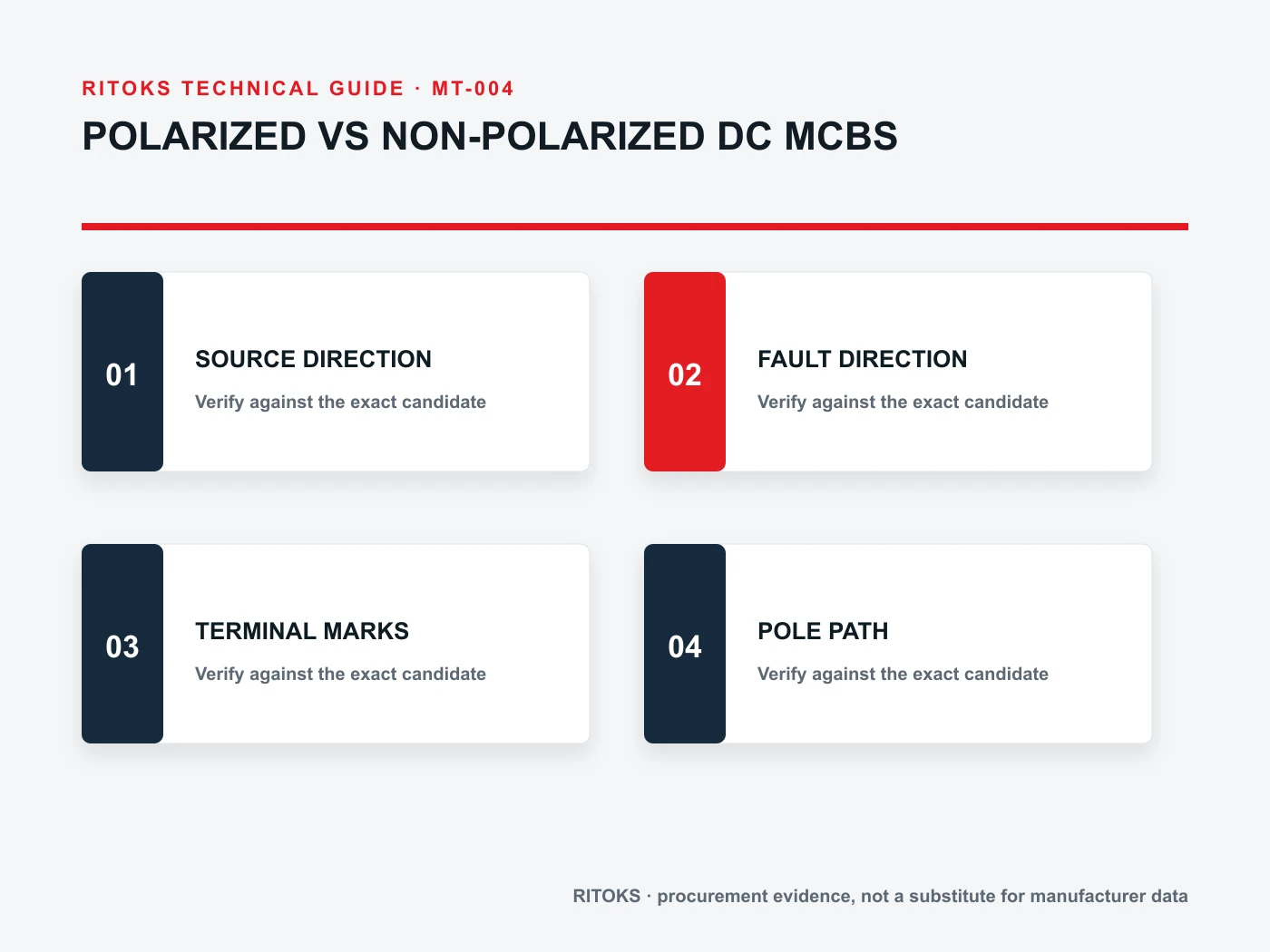
Map every source of fault current
Show the normal source, load and any path that can feed a fault from the other side. Battery systems, parallel sources and interconnected equipment can make current direction less obvious than a simple source-to-load sketch.
The circuit diagram should include switching states relevant to protection. This allows the engineer to ask whether a direction-sensitive device is suitable and where its marked source terminals must be connected.
What a polarized claim requires
A polarized DC MCB may have a required connection orientation. The exact device should state how source, load, positive and negative conductors are connected and under what rating conditions. A symbol on the case is a prompt to read the instructions, not a complete application study.
If the panel wiring or possible fault direction conflicts with the documented orientation, stop selection and ask for an appropriately documented alternative. Do not reverse a breaker in the field based on appearance.
What non-polarized does and does not mean
Non-polarized is often used to describe a breaker without the same installation direction restriction, but its meaning must be verified for the exact order code. It does not imply unlimited bidirectional capability at every DC voltage or fault level.
Request the datasheet, terminal diagram and tested DC interruption data. Confirm that the supplier claim applies to the pole configuration and system voltage proposed, not merely to a related series.
Read markings together with the diagram
Terminal labels, arrows and plus/minus symbols help installers identify the intended path. They should be interpreted alongside the manufacturer diagram and exact model instructions. A photograph or incomplete label crop can miss important constraints.
Put the full diagram in the assembly file and have the designer compare it with the project single-line. Keep the version of the instructions used for approval so later substitutions can be assessed.
Do not lose the breaking-capacity check
Polarity is only one part of selection. The DC voltage, prospective fault current, number of poles and connection scheme must also match the exact interruption evidence. An AC rating or a DC rating at a different connection cannot fill this gap.
Ask for the same evidence package whether the candidate is called polarized or non-polarized. The device must meet the whole circuit duty, not only a favored direction label.
Review series-pole arrangements carefully
Some DC MCB configurations use poles in a specified path to support an application rating. The arrangement must be documented for the exact breaker. A user-created bridge pattern can change current flow and may defeat the intended interruption path.
Check terminal identification and whether the manufacturer permits the proposed orientation. Record the connection drawing with the bill of materials and do not generalize it to another pole count.
Inspect the built panel and substitutions
Before commissioning, compare delivered markings and wiring with the approved diagram. Verify that the source side and conductor paths match the documented orientation and that the order code is the one reviewed.
If a replacement breaker is proposed, repeat the polarity, DC rating, breaking-capacity and pole-connection check. Similar dimensions or trip current do not establish that a substitute interrupts in the same direction.
Build an Exact-Model Evidence File
A category or product-family page helps locate relevant options; it does not by itself approve one variant. For DC MCBs, keep the full proposed order code, current datasheet, terminal or mounting drawing, operating instructions and any project calculation together. Read the conditions attached to each rating or function. If the evidence belongs to a neighboring model, request the correct document instead of carrying the claim across.
The project team owns the system inputs and acceptance criteria. The supplier owns the evidence for the offered item. In the technical review, place each mandatory requirement beside the exact document and revision that answers it. Mark a missing field as open, conditional or unsupported. This creates a traceable decision and prevents a favorable headline value from hiding an incompatible connection or installation condition.
Compare Complete Offers
| Item | Record in the comparison | Reason |
|---|---|---|
| Orderable item | Full code, variant and included accessories | Prevents family-level assumptions |
| Application match | Written response to each project input | Keeps exceptions visible |
| Documentation | Datasheet, drawing, instructions and revisions | Links claims to the offered item |
| Open points | Owner and due date for clarification | Avoids silent acceptance |
Use the same project brief for every quotation. Commercial terms such as price and lead time can be compared once the technical scope is normalized. Do not treat omitted accessories, unsupported ratings or an unresolved wiring assumption as equivalent to a documented offer. If an alternative is proposed, ask which inputs change and repeat the affected review.
Review Installation and Acceptance
Before installation, confirm that the delivered label, complete code and accessories match the approved record. Compare terminals, mounting, conductor access and any stated orientation with the exact instructions. A product that appears physically similar to the approved version may still have a different electrical configuration, control option or test basis.
Plan an as-built check that addresses the project's real risks. This may involve wiring against the approved diagram, functional response, measurements under representative operating states and confirmation of any communication or alarm feature. Record the conditions and results. The acceptance plan should come from the application and supplier evidence, not from a generic article checklist.
Request for Quotation Checklist
- Identify the circuit, equipment and location that DC MCBs must serve.
- Attach the system drawing and operating states that define the application.
- Record source direction and its source document.
- Record fault direction and its source document.
- Record terminal marks and its source document.
- Record pole path and its source document.
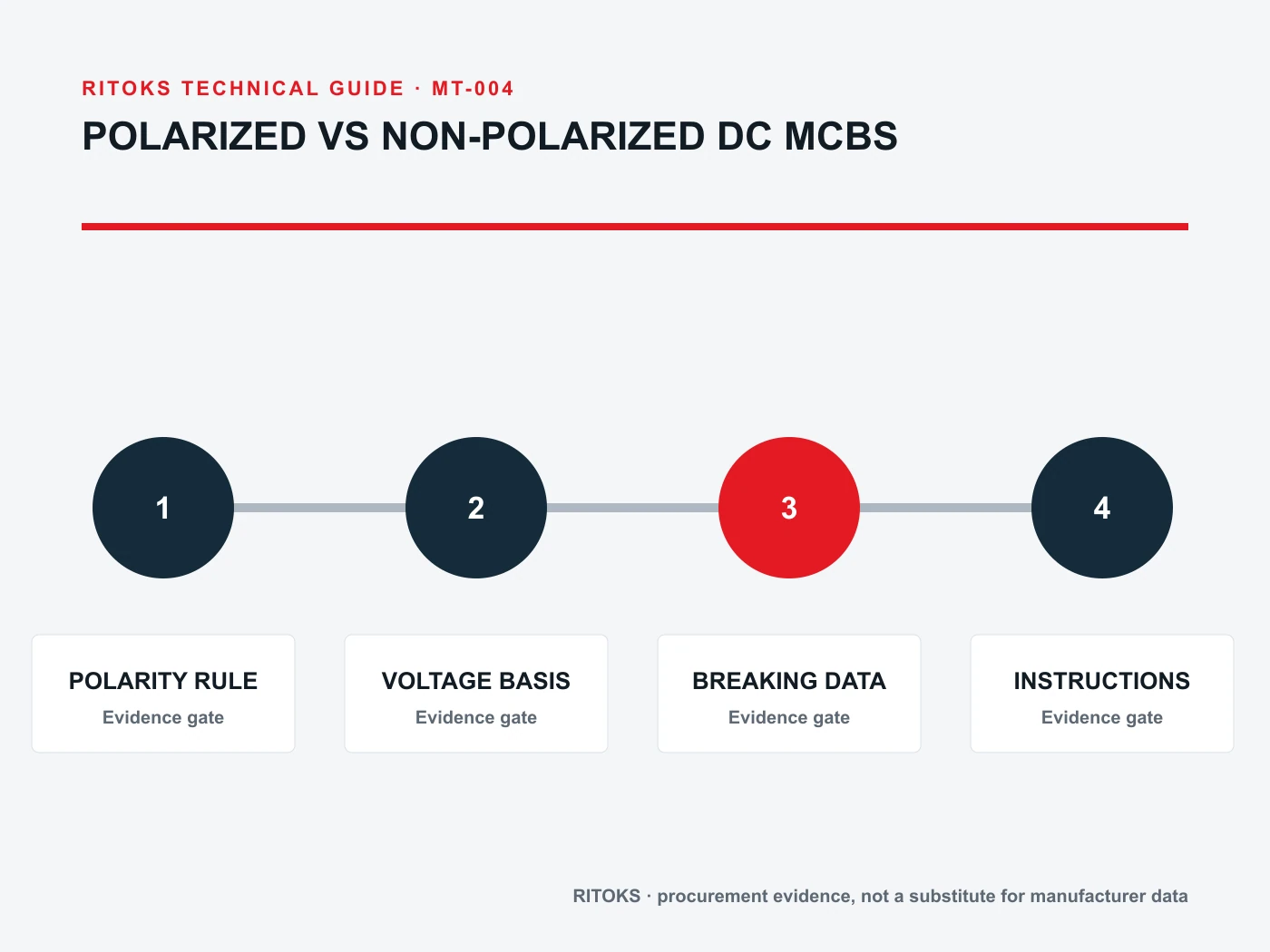
- Confirm the exact-model evidence for polarity rule.
- Confirm the exact-model evidence for voltage basis.
- Confirm the exact-model evidence for breaking data.
- Confirm the exact-model evidence for instructions.
- Request the full order code, accessories, drawings and data-sheet revision.
- Ask for exclusions, assumptions, substitutes and unresolved engineering points.
The RFQ should be specific enough for a supplier to answer without inventing missing project values. If an essential input is not yet known, label it as a question and identify who will determine it. Do not turn an assumption into a rating, a compliance claim or an approved installation method.
What Changes the Decision
A decision can change when the source arrangement, load behavior, environment, installation geometry or required function changes. Revisit the selected DC MCBs whenever one of those inputs moves outside the approved brief. Recheck the order code and the exact evidence affected by the change; do not rely on a previous approval for a circuit that now asks the component to do different work.
Keep a short revision history of the project brief, supplier response and accepted exception list. This record helps engineering, purchasing and commissioning work from the same version. It is especially useful when a quotation is revised, a substitute is offered or the panel design changes after the first comparison.
Questions to Resolve Before Approval
Ask who owns each remaining technical question for the proposed DC MCBs. The buyer should confirm the system inputs and installation constraints; the supplier should confirm the exact item, included options and applicable documentation. Put the answer and document revision beside the question. An unanswered point should remain visible in the comparison rather than being converted into an assumed feature.
When a quotation offers an alternative, ask for a written explanation of the changed circuit, mounting or performance basis. Review any new drawing with the project engineer and record whether the proposed change is acceptable. A substitution is a new technical decision even if it appears commercially equivalent. This is especially important when multiple suppliers use similar family labels for different configurations.
Frequently Asked Questions
Can I identify non-polarized behavior by looking at the case?
No. Read the exact model documentation and relevant DC test basis.
Does a non-polarized claim replace a breaking-capacity check?
No. Voltage, fault level and pole arrangement still need exact-model evidence.
Should a polarized breaker be installed backwards to suit the panel?
Use only the documented connection orientation; change the design or candidate if it does not fit.
Relevant RITOKS Pages
For product-family context, see Circuit Protection. The related published product pages include 2p Dc Miniature Circuit Breaker 500 1000v 6 63a, High Current Dc Miniature Circuit Breaker 12 125v 63 250a. Use their current exact-model documents when comparing a proposed item.
For an application-specific quotation, send the project brief to RITOKS with the diagrams and open questions above.