
DC Fuse Holders · Technical Explainer
PV Fuse Link and Fuse Holder Compatibility Checklist
PV Fuse Link and Fuse Holder Compatibility Checklist begins with a controlled application record, not a catalog headline. Buyers should define the real system, installation and service conditions before comparing candidate products. Every decisive claim then needs support from the exact proposed order code.
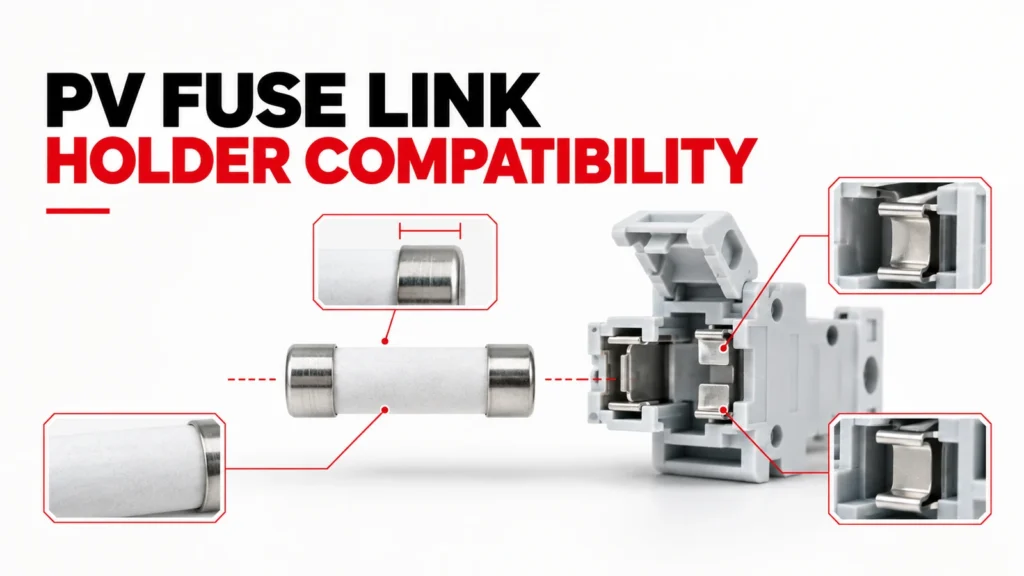
This checklist defines the evidence needed to review a PV fuse link and holder as one assembly. It does not declare same-size parts interchangeable, select a fuse rating, prove coordination, or authorize mixing manufacturers without exact compatibility documentation.
Decision Inputs at a Glance
| Review area | Buyer must define | Evidence required |
|---|---|---|
| Fuse format | Body and contact dimensions plus keying features | Exact link and holder drawings |
| Electrical duty | System voltage, current, fault duty and utilization | Project study and exact device data |
| Holder performance | Permitted fuse type, current, voltage and dissipation context | Exact holder documentation |
| Connections | Terminal type, conductor range and tightening method | Installation instructions |
| Compatibility | Approved link-holder combination and conditions | Manufacturer compatibility statement or tested listing |
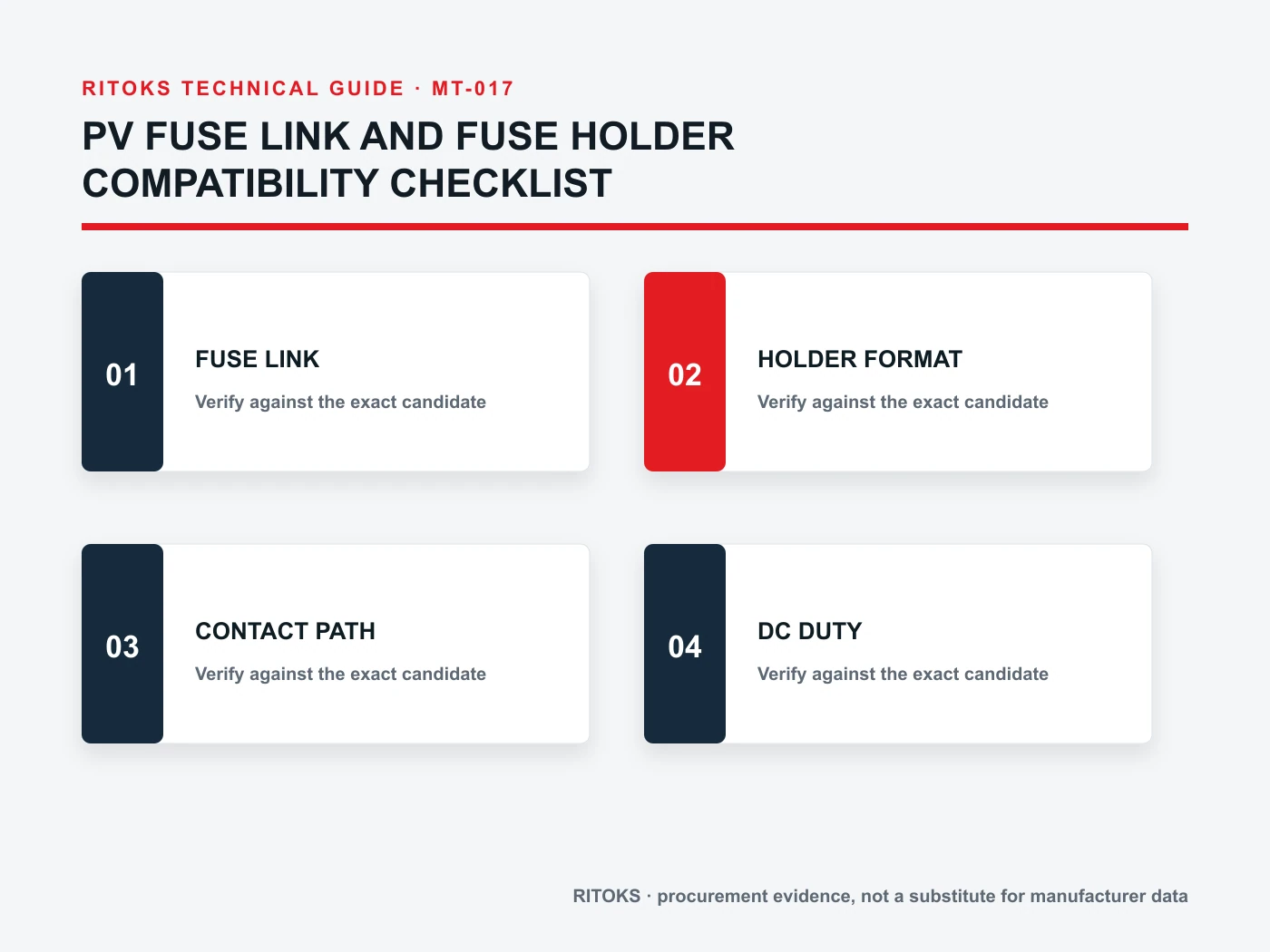
Treat the Fuse Link and Holder as an Assembly
The fuse link performs within a mounting and connection environment. The holder provides contacts, insulation, terminals, mechanical retention and heat dissipation. Selecting each item independently from a headline rating can create an unverified combination.
Freeze the exact fuse-link code and exact holder code in the approval record. Ask which document proves the combination and under what conditions. A product photo or shared cylindrical format does not establish compatibility.
Match More Than the Nominal Fuse Size
Confirm body diameter, length, contact style, end-cap geometry and any rejection or keying feature from controlled drawings. A nominal format describes only part of the mechanical interface.
Check insertion, extraction and service clearance in the installed enclosure. Do not force a link into a holder or modify a holder to accept a neighboring format. If adapters are proposed, require explicit evidence for the complete arrangement.
Verify the Electrical Duty for Both Components
Provide the DC system voltage, current, fault-current basis, source behavior, protection objective and applicable utilization. The link and the holder must each be suitable for the submitted system under the manufacturer’s documented conditions.
Do not transfer the fuse link’s interrupting or utilization data to the holder. Likewise, a holder voltage label does not prove the chosen fuse’s time-current or energy behavior. Keep the evidence for each component distinct.
Account for Heat and Enclosure Conditions
Fuse-link losses, contact resistance, conductor heating, adjacent poles, enclosure temperature and ventilation affect the assembly. Record mounting density, orientation, conductor size and nearby heat sources for the review.
Ask for derating or installation guidance that applies to the exact combination. A successful fit on the bench does not prove acceptable temperature in a populated combiner box. Verify representative assemblies where the application requires it.
Check Terminals and Maintenance Practice
Confirm conductor type and range, strip length, terminal hardware, tightening method and access from the exact holder instructions. Establish how maintenance staff will isolate the circuit and replace the link safely.
Replacement control matters because similar-looking links may have different utilization, ratings or dimensions. The maintenance record should identify the complete approved replacement code rather than only a physical size.
Require Explicit Compatibility Evidence
The strongest evidence names the fuse link, holder and applicable conditions together. If the documents only describe separate families, ask the manufacturer to confirm the exact proposed combination in writing.
Do not infer cross-brand compatibility from matching nominal dimensions. Where a project permits mixed manufacturers, retain the test, listing or engineering evidence that supports the combined assembly.
Build an Exact-Model Evidence File
Create one approval record for the proposed DC Fuse order code. Put each project requirement beside the supplier document that answers it. Preserve the exact datasheet, drawing, curve, table, instruction or selection output used, including its revision or retrieval date. A category page can establish family context, but it cannot prove an exact rating, construction, terminal arrangement or system combination.
Check that every accepted statement describes the same orderable item. Do not combine a family maximum from one variant, a diagram from another and an optional feature from a third. Mark unresolved fields explicitly so they remain visible in technical and commercial review.
Keep Project Inputs Separate From Product Evidence
The project team defines the application: source, load, duty, environment, controls, mounting, service and required functions. The supplier identifies an exact DC Fuse and supports it with exact documents. Neither side should fill a gap by inference from appearance, a shared family name or one matching headline value.
Freeze the application record while quotations are being compared. If the electrical duty, environment, cooling method, enclosure, installation or required function changes, issue a revised record and ask every supplier to reconfirm the candidate.
Define the Acceptance Record Before Ordering
Write the acceptance record before a preferred DC Fuse is chosen. Include the project inputs, proposed order code, included accessories, document revisions, exceptions, assumptions and the person responsible for resolving each open point. This prevents the technical basis from being reconstructed after price negotiations have already narrowed the choice.
Separate mandatory requirements from preferences and future options. A mandatory condition needs direct evidence or a documented engineering decision. A preference can influence comparison but should not be presented as a safety or compliance requirement. Future options should be checked only when the project genuinely expects them, because optional features can change the order code, terminals, dimensions or supporting documents.
Verify the Delivered Item and the Finished Assembly
Incoming inspection should compare the delivered DC Fuse, labels, accessories and documents with the approved record. Do not accept a same-family replacement solely because its appearance or one rating matches. Record any substitution and repeat the affected review before installation.
After assembly, verify the functions and conditions that cannot be proven from component literature alone. The check may include mechanical fit, wiring against the approved diagram, control behavior, temperatures, airflow, alarms or service access as applicable. Define representative operating states and acceptance criteria in the project test plan rather than inventing universal limits in the purchase order.
Common Procurement Errors
- Selecting a DC Fuse from one headline value while the application context remains incomplete.
- Using a curve, circuit, drawing or claim from a neighboring order code.
- Treating a category page, product photograph or nominal size as exact compatibility evidence.
- Assuming an accessory, system function or coordination result is included without documentation.
- Approving a substitute without repeating the electrical, mechanical and evidence review.
Resolve these gaps before comparing price and lead time. A proposal may remain commercially interesting while technically incomplete, but missing evidence must not disappear inside the quotation.
How to Compare Supplier Offers
| Review area | Buyer must define | Evidence required |
|---|---|---|
| Order code | Complete proposed item and included accessories | Exact datasheet and scope |
| Application match | Submitted operating and environmental conditions | Written response to each requirement |
| Mechanical integration | Mounting, terminals, clearances and service | Exact drawings and instructions |
| Electrical evidence | Applicable ratings, curves and topology | Exact-model technical documents |
| Open points | Unknowns, exceptions and assumptions | Dated clarification list |
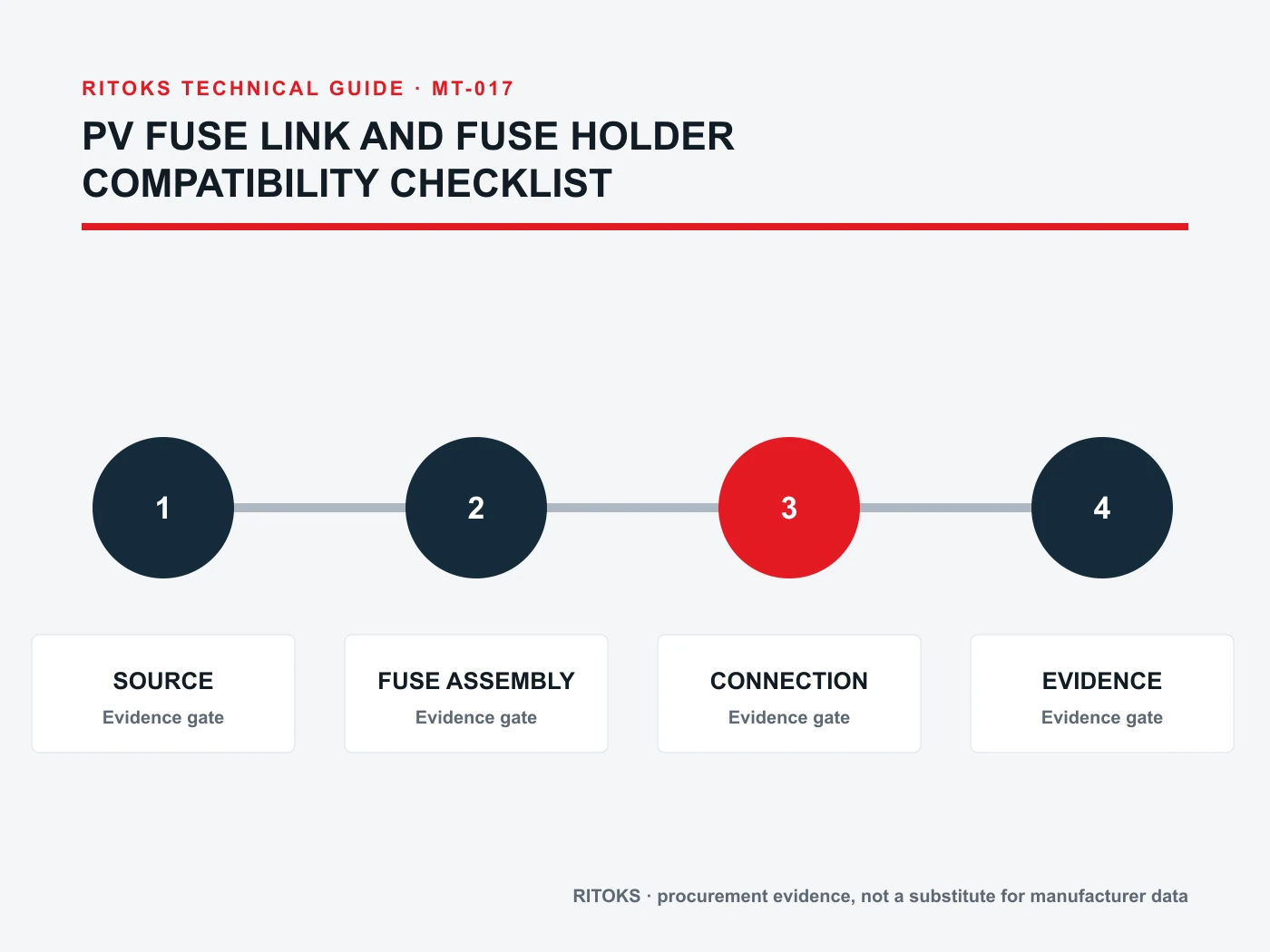
Normalize every DC Fuse offer to the same application record. Keep document revisions, test conditions, included accessories and open questions beside each value. This makes differences in delivered scope visible and prevents a lower-cost but narrower offer from appearing equivalent to a complete proposal.
Decision Workflow
- Freeze the system boundary and operating states.
- Record electrical, mechanical, environmental and service inputs.
- Choose a complete candidate order code for review.
- Verify every critical statement against exact-model evidence.
- Resolve exceptions and assumptions before commercial comparison.
- Validate the finished assembly where application risk requires it.
Stop when a critical input is unknown, the quoted model is ambiguous, a required claim is supported only by another manufacturer or order code, or the installation falls outside available evidence. These are engineering gaps, not editorial details.
RFQ Preparation Checklist
A useful RFQ for pv fuse holder selection is concise enough to answer and complete enough to prevent silent assumptions. Identify unknown values as questions and require a full orderable code rather than a generic family recommendation.
- LINK FORMAT
- HOLDER INTERFACE
- CONTACT GEOMETRY
- SERVICE CLEARANCE
- SYSTEM DUTY
- HEAT PATH
- TERMINALS
- COMPATIBILITY PROOF
- Required documents and revisions
- Quantity, destination and requested delivery scope
Ask the supplier to state exclusions, assumptions and options separately. Record quantity and destination after the technical inputs so commercial terms do not obscure unresolved engineering questions.
Frequently Asked Questions
Can I select a DC Fuse from one rating or size?
No. Selection requires the complete application, exact construction and all applicable electrical, mechanical, thermal, environmental and documentation conditions.
Can I use a family page as approval evidence?
A family page is useful for orientation. Approval should use the exact order-code datasheet, drawing, instructions and project-specific engineering evidence.
Are similar-looking models interchangeable?
Not automatically. Similar housings can contain different circuits, materials, terminals, ratings or accessories. Repeat the review for every substitute.
What should remain open in the quotation?
Any missing project input, unverified exact-model claim, unclear included accessory or unresolved installation condition should be listed as an open point rather than assumed.
Related RITOKS Resources and RFQ
Browse the DC Fuse product category, review the primary related product page, review related product option 2, review related product option 3. These pages provide commercial context; exact suitability still depends on the project record and the quoted order code.
When the technical record is ready, send the application and evidence requirements to RITOKS for a documented quotation. Keep the final selection subject to the project engineer’s approval and the current manufacturer documentation.