
Technical Resources · Selection Guide
DC Isolator Switch Selection Guide: Voltage, Current, Poles and Enclosure
A DC isolator switch is purchased to provide a defined switching or isolation function at a specified point in a DC system. Its current marking, pole count or outdoor-looking enclosure does not by itself prove that it can switch the intended load or withstand the application voltage. The buying problem is to describe the required duty and physical context precisely enough to compare exact, orderable switches.
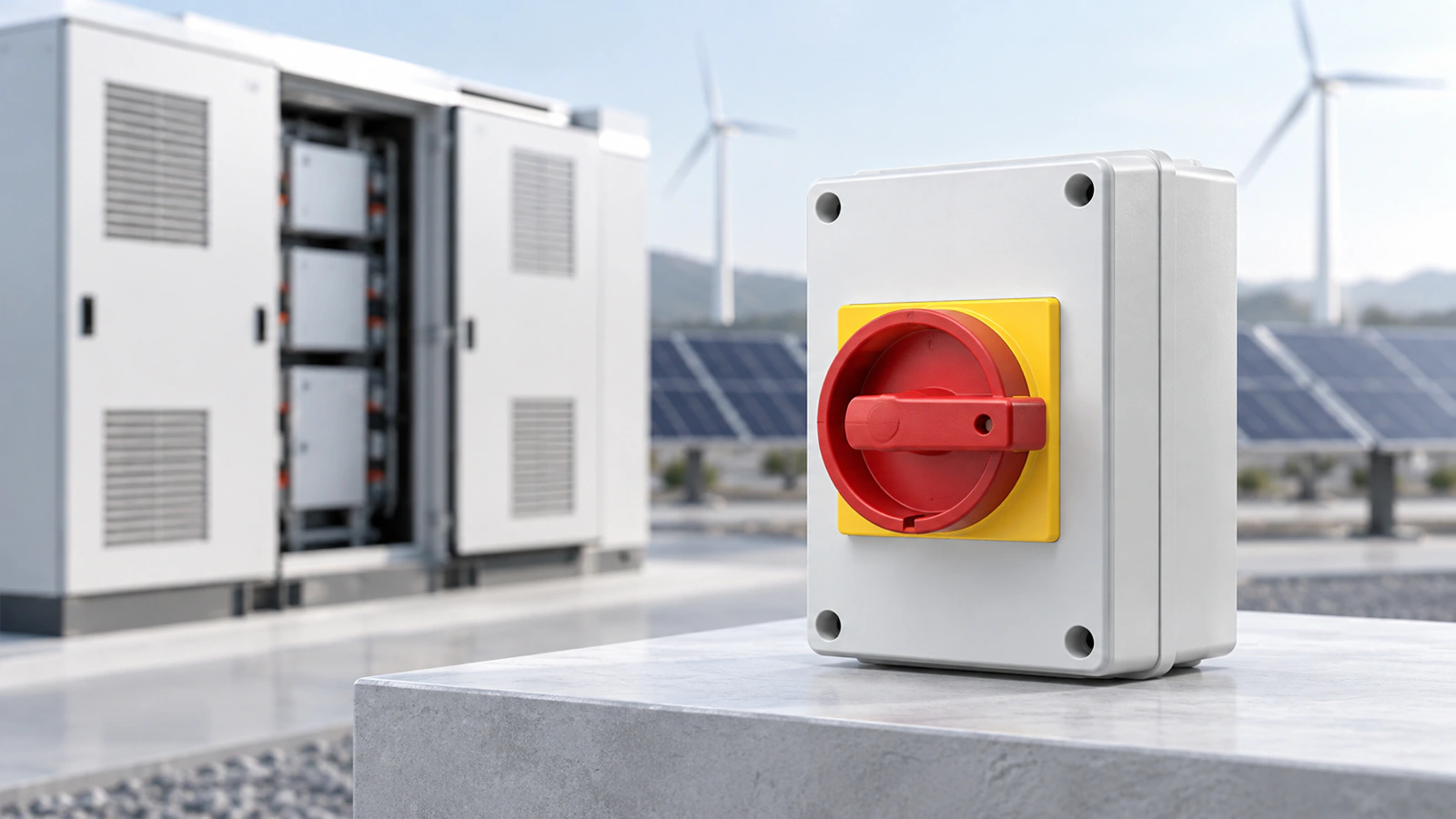
This guide is about selecting an isolator for a known project. It is not a comparison of isolators with circuit breakers and it does not provide a connection diagram. A switch-disconnector is not automatically an overcurrent protective device. The responsible designer must define the circuit and isolation requirement; the supplier must provide exact-model ratings and installation documentation.
Selection Factors at a Glance
| Factor | Buyer record | Exact-model evidence |
|---|---|---|
| System voltage | Source, normal range and maximum DC voltage | Rated voltage at the documented pole arrangement |
| Load and operation | Normal current and whether switching under load is required | Relevant switching duty/utilization rating |
| Poles and circuits | Number of conductors and circuits to be switched | Manufacturer diagram for the selected variant |
| Location | Indoor/outdoor exposure, access and environment | Enclosure rating and operating limits where applicable |
| Mechanical fit | Mounting, operator position, cable entries and space | Dimensions, handle and installation instructions |
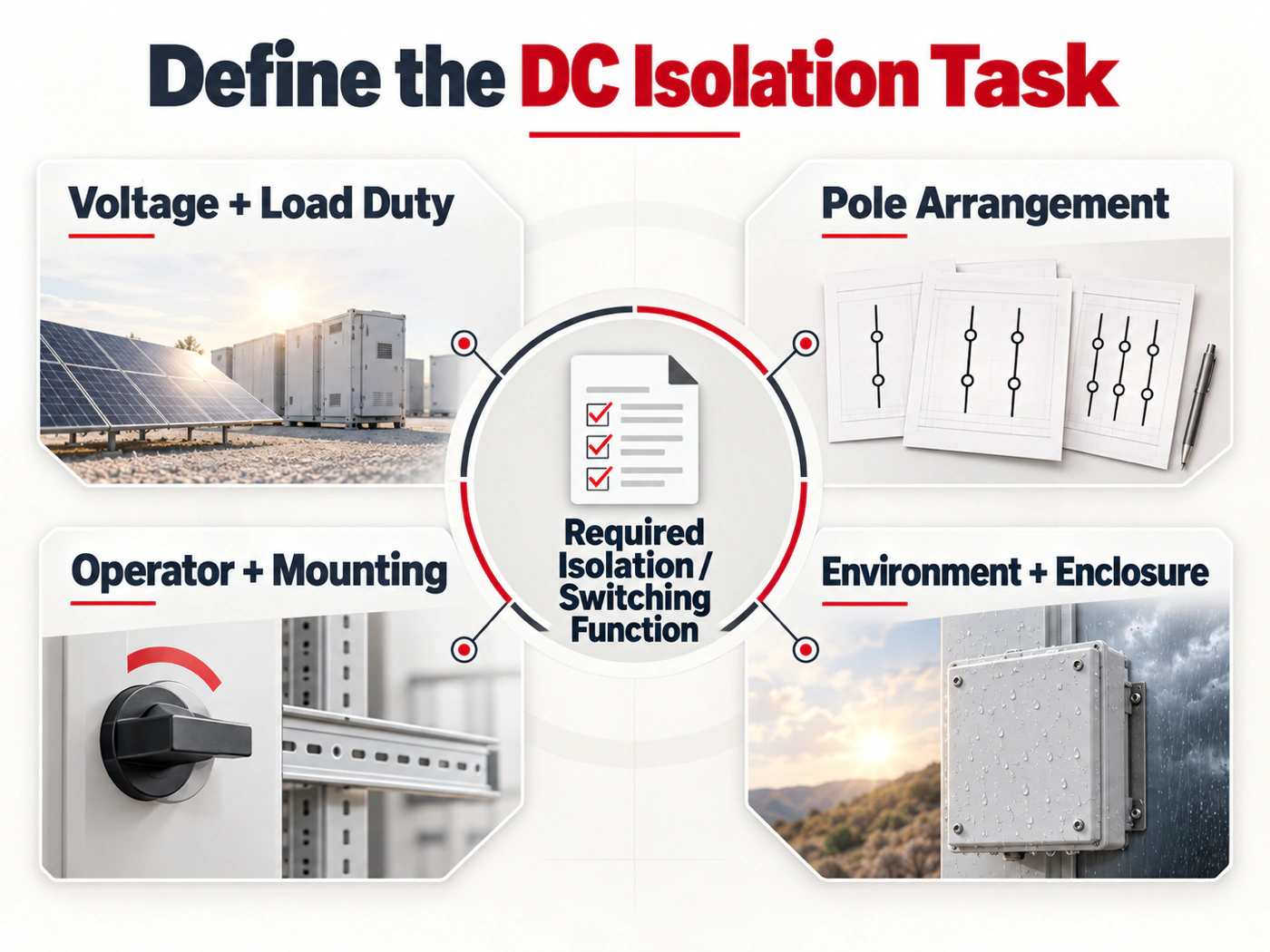
Define the Isolation Task
Start with the purpose: is the device intended as a local service disconnect, a switching point in an enclosure, or another defined function? Record where it sits relative to the source and equipment. A schematic from the project may be needed for engineering review, but this article does not tell a reader where to install or how to wire the switch. Define whether operation under load is expected; an ability to isolate an already de-energized circuit is not the same purchasing requirement as documented load switching.
Do not confuse isolation with fault protection. ABB’s discussion of low-voltage switch-disconnectors and circuit breakers distinguishes the switching/isolation role from the breaker’s short-circuit interruption role. ABB’s own OTDC DC-switch product information further shows that DC switch ratings and utilization categories belong to exact products and applications. Neither source certifies a RITOKS isolator or authorizes any particular installation.
Record the Electrical Conditions
Request the system’s maximum relevant DC voltage, normal current and source type. A PV label alone is not a complete voltage record, and a nominal operating value can be lower than another foreseeable condition. If the designer has not supplied the maximum voltage, leave that entry unresolved. Compare it with the quoted switch’s DC rating at the same pole configuration; never copy a rating across variants.
Ask for the appropriate switching-duty or utilization information when the device will be operated under load. If the offer says “DC isolator” but supplies only a current figure, request the voltage and duty conditions for that exact order code. A switch may have different documented ratings under different configurations. Do not assume an AC duty, a headline current or an enclosure IP marking proves the required DC switching performance.
Poles, Connection and Operator
A 2P or 4P designation states a count, not the full connection or number of independently switchable circuits. Ask the manufacturer to identify the circuit arrangement and diagram for the proposed model. The system designer determines which conductors need to be switched and whether an available pole configuration meets the design. An attractive front-panel handle does not reveal its exact circuit arrangement.
Document whether a door-coupled, external or integrated operator is required, and whether access or locking is part of the procurement brief. Ask for the exact supported operator and mounting parts rather than assuming accessories shown in a catalog photograph are included. These mechanical details are important when comparing a bare switch with an enclosed assembly.
Enclosure and Environment
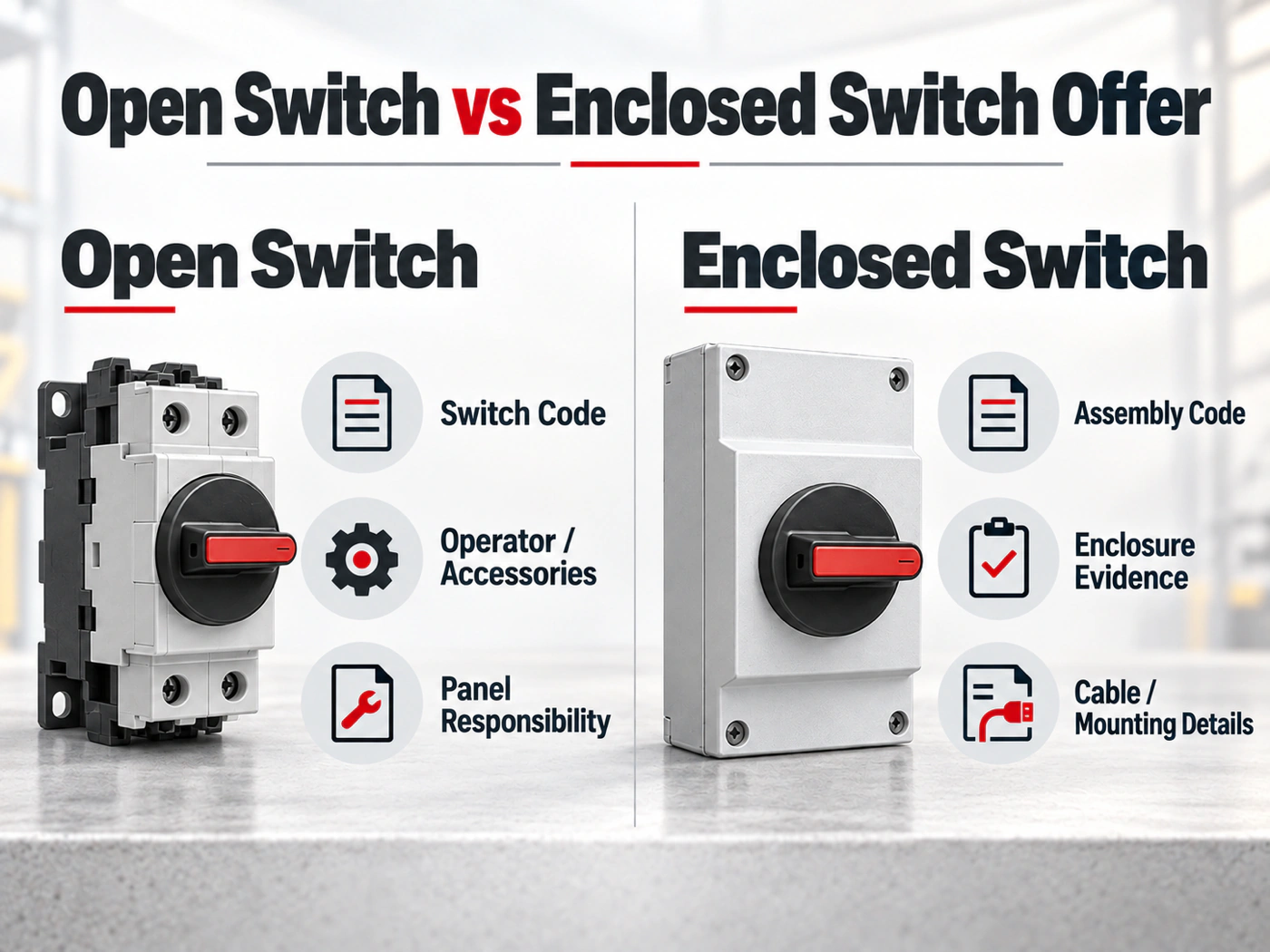
An open-frame switch inside a suitably designed panel and a factory-enclosed switch are different purchases. Record indoor or outdoor exposure, expected temperature conditions, enclosure material or cable-entry requirements and available mounting space. If ingress protection is required, ask for the rating of the exact assembled enclosure and its conditions; do not infer suitability from a product photo or transfer an IP rating from a different variant.
Consider the information needed by the installer without offering installation instructions: dimensions, cable entry locations, terminal capacity, operator access and mounting documentation. If the existing enclosure will be reused, supply its measured constraints and ask the manufacturer to confirm the selected configuration. This can prevent a technically plausible switch from arriving without the required handle or enclosure.
Compare Open and Enclosed Offers
| Question | Open switch offer | Enclosed switch offer |
|---|---|---|
| Electrical duty | Exact DC voltage/current and switching category | Exact DC voltage/current and switching category |
| Poles | Exact diagram and selected code | Exact diagram and selected code |
| Environmental boundary | Project panel provides enclosure | Supplier documents assembled enclosure |
| Completeness | Operator and mounting accessories listed | Cable entries, handle and mounting parts listed |
The table compares evidence, not performance. An enclosed offer is not automatically more suitable; an open switch is not automatically inadequate. Judge each against the same project location and operation requirement. A missing diagram or enclosure record is a clarification request, not a reason to infer equivalence.
Buyer Workflow and RFQ Checklist
- State the source, device location, isolation purpose and whether load switching is expected.
- Record maximum DC voltage, normal current, required circuits/conductors and the designer’s system context.
- Specify indoor/outdoor exposure, enclosure and operator needs, mounting and cable-entry constraints.
- Request exact order code, DC duty table, pole diagram, enclosure record and accessory list.
- Compare candidates at the same electrical and environmental conditions; return missing inputs for review.
- Provide quantity, destination and any required documentation or project approval process.
Published RITOKS Families as Separate Starting Points
RITOKS publishes a compact 2P/4P PV DC isolator family and a separately described IP66 enclosed 4P family. These product records illustrate the difference between a switch configuration and an enclosure-specific offering. The IP66 claim belongs to the exact documented enclosure family, not every PV switch on the site. Do not combine voltage, current, pole and enclosure claims from separate rows into a fictional hybrid model.
Replacement and New-Assembly Records
For a replacement, record the existing switch code, operator, enclosure, pole arrangement and connection document before requesting an alternative. A device that fits the same cutout may differ in DC duty, terminal arrangement or supported handle. Ask the supplier to identify the exact differences and provide the proposed model’s own ratings and installation information. Do not carry an enclosure or IP claim from the old assembly into the substitute without evidence for the complete new assembly.
For a new panel or enclosure, define the mechanical interface as part of the purchasing brief: available space, mounting method, operator location, cable-entry constraints and required access. These details help a panel builder compare open switches, enclosed switches and accessories without implying a wiring design. The electrical designer still owns conductor selection, pole use and circuit approval; the manufacturer documentation defines what the selected switch supports.
Stop Conditions Before Ordering
Pause the purchase when maximum DC voltage, load-switching duty or pole arrangement is unknown. Also stop if the offer states only a current value, if an outdoor claim relies on appearance, or if the connection diagram belongs to another variant. Where short-circuit protection is part of the project, identify it as a separate design requirement rather than assuming the isolator provides it.
A controlled RFQ separates project facts, preferences and open questions. Project facts include the voltage envelope, load and environment. Preferences include operator style and enclosure format. Open questions include exact utilization evidence, connection diagram and supported accessories. Returning those three groups with the quotation allows the buyer to compare delivered scope while preventing a sales description from becoming an unsupported application approval.
Record the selected assembly exactly as quoted, including switch, operator, enclosure and accessory codes. If a later supplier response removes the enclosure or changes the operator, compare the revised delivered scope again. This traceability avoids receiving a technically different package under the same informal description and keeps installation-specific decisions outside the article and sales comparison. Preserve the reviewed document revisions with the order.
Frequently Asked Questions
Does an isolator replace an overcurrent protective device?
Not on the basis of its name. A switch-disconnector’s switching/isolation purpose differs from fault interruption. The project protection design needs separate evidence for its protective devices.
Does a 4P switch always mean four independent circuits?
No. The label alone does not define the permitted connection or independently controlled circuits. Request the exact manufacturer diagram and product description.
Is an IP-rated enclosure enough to approve outdoor use?
No. Confirm the exact enclosure rating and environmental conditions, including the project’s mounting and cable-entry requirements. Electrical duty and enclosure suitability are separate checks.
Related RITOKS Products and Guidance
Use these pages as separate product and family records. A link is not a claim that two devices are interchangeable or coordinated.
PV DC Isolator Switches category
IP66 enclosed 4P PV DC isolator family
Technical References
The following manufacturer sources support the general concepts identified below. Their model ratings, diagrams and approvals do not transfer to RITOKS products.
ABB, Defining short-circuit values for circuit breakers
Supports only the general distinction between breaker fault interruption and switch-disconnector isolation in low-voltage assemblies, not any RITOKS DC switch rating.
Illustrates that PV/ESS DC switch-disconnectors have exact application and utilization ratings; ABB model values do not transfer to RITOKS switches.
Request an Exact-Model Review
Send the recorded application requirements, exact documentation questions, quantity and destination through the RITOKS contact form. An RFQ requests an exact-model review; this guide does not approve a wiring design or recommend an automatic substitute.