
Technical Resources · RFQ Checklist
DC MCB RFQ Checklist for OEM and Panel Buyers
A useful DC MCB inquiry gives the supplier enough circuit information to identify a candidate and enough documentation requirements to make the answer reviewable. A request containing only poles, amperes and quantity invites assumptions about voltage, fault level, polarity and connection.

This article owns the procurement checklist. It does not replace engineering selection, repeat the full DC MCB selection guide or approve an exact breaker for a circuit.
Buying Decision at a Glance
| Decision input | Buyer must confirm | Evidence required |
|---|---|---|
| Circuit identity | Source, load and breaker location | Clear application boundary |
| Voltage | Normal and maximum possible DC voltage | Exact DC rating and pole scheme |
| Current | Normal load and transient behavior | Rated current and trip information |
| Fault duty | Prospective short-circuit current | Breaking capacity at same conditions |
| Documentation | Model, diagram, data revision and approvals required | Complete supplier evidence pack |
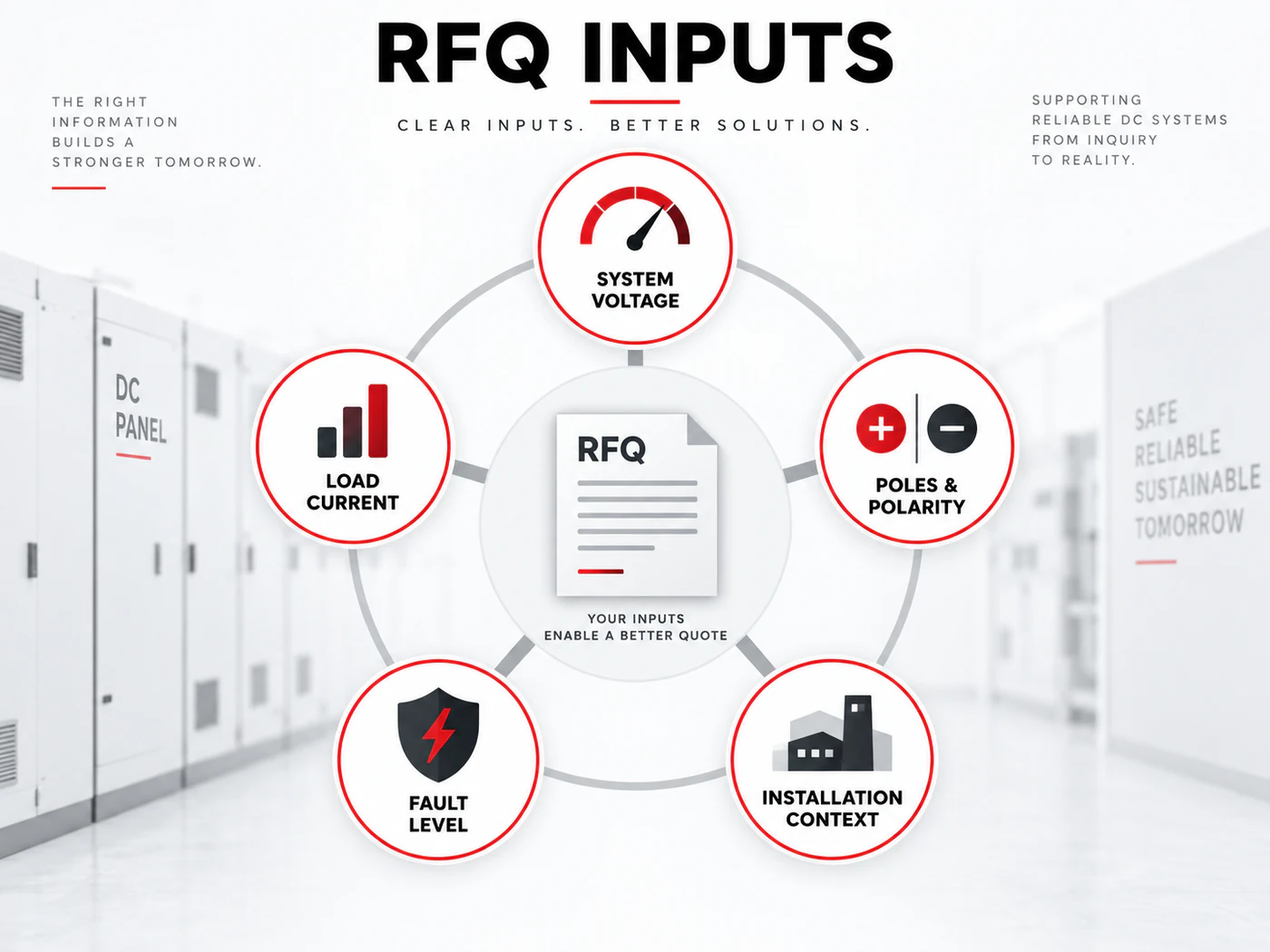
Describe the Circuit Before the Device
State whether the breaker serves PV, battery, control power, vehicle, UPS or another defined DC circuit. Identify its position and load. This context does not select the MCB by itself, but it prevents the supplier from assuming the wrong voltage envelope or duty.
Record the normal operating voltage and the maximum possible voltage at the breaker. Include source conditions that can raise the open-circuit or charging voltage. Do not request a generic 500V or 1000V breaker without explaining which exact system condition that figure represents.
Separate Load Current From Fault Current
Provide the continuous load current and relevant transient or inrush information. If a trip curve or response characteristic is required, name the requirement and request the exact manufacturer evidence rather than selecting from a familiar letter alone.
Provide the prospective short-circuit current at the intended location. It is not the same as the normal current and should come from the project electrical assessment. Ask for the exact DC breaking-capacity row at the specified voltage and pole configuration.
Request the Pole and Polarity Record
State the required number of switched conductors and any isolation objective, then ask for the exact manufacturer DC connection diagram. A 1P, 2P or 4P label is not a wiring instruction. Some DC breaker ratings depend on how poles are connected.
ABB DC MCB guidance demonstrates this model-specific relationship. Its diagrams are evidence for ABB products only. The RITOKS offer must include the relevant diagram and polarity information for the proposed order code.
Make the Supplier Response Comparable
Use a response table requiring exact order code, rated DC voltage, rated current, trip characteristic, breaking capacity, pole/connection diagram, dimensions, terminals, mounting, environmental limits and document revision. Mark unknown fields instead of accepting marketing language.
For a replacement, add the installed code, photographs of markings and available drawings, but do not claim drop-in compatibility until dimensions, terminals and electrical data are checked. For a new panel, identify any required certification or project standard and request exact evidence rather than a generic logo.
Build an Evidence File Before Approval
Create one review sheet for the proposed DC MCB order code. Put the application inputs in the left column and the supplier evidence in the right column. At minimum, preserve the records for circuit identity, voltage, current and fault duty and documentation. This makes it clear which information comes from the project and which statement comes from the manufacturer.
Attach the exact datasheet pages, drawings and tables used in the decision. Record their revision or retrieval date and highlight the row for the quoted model. A sales email can clarify scope, but it should not silently replace a technical document when the decision depends on a rating, connection, trip characteristic, thermal limit or tested combination.
Check that every linked value describes the same orderable configuration. Similar model names often share a housing while differing in control supply, current band, poles, terminals, accessories or environmental limits. If a document covers several variants, mark the selected row rather than treating the broadest range on the page as the capability of every variant.
Control Changes During Sourcing
Keep the application record frozen while suppliers prepare quotations. If voltage, load, duty, fault level, enclosure or operating method changes, issue a revised record and ask each supplier to reconfirm the candidate. Otherwise procurement may compare responses that were prepared for different requirements even though the email subject and product family are unchanged.
Apply the same rule to substitutions. A replacement proposed because of price or availability returns to the technical gate with its own order code and evidence. Do not approve it solely because the nominal current, product shape or mounting method resembles the original candidate. The substitution is complete only when the required functions and conditions are rechecked.
Common Procurement Errors
- Selecting DC MCB from one headline rating while leaving the application context undefined.
- Using a diagram, curve or accessory table from a neighboring model without confirming scope.
- Treating a product-category page or marketing image as exact-model evidence.
- Comparing a device-only quotation with an assembled or accessory-inclusive quotation.
- Allowing an unresolved technical field to disappear when the commercial offer is revised.
Resolve these errors before commercial comparison. The technical reviewer should be able to trace each accepted statement to the project record or to the exact candidate document without relying on memory. Procurement can then compare price, quantity, destination and lead time against a stable technical baseline instead of reopening the selection after order placement.
How to Compare Supplier Offers
Compare every DC MCB offer against one frozen application record. Do not combine the best figures from several variants or accept a family maximum as the rating of the quoted order code. Keep the document revision, test conditions and unresolved fields beside each value so procurement can see whether two offers are genuinely equivalent.
| Comparison point | Required evidence | Do not accept |
|---|---|---|
| RFQ field | Acceptable response | Insufficient response |
| Voltage/poles | Exact DC row and connection diagram | Family maximum only |
| Fault rating | Breaking capacity at stated voltage | Unqualified kA figure |
| Trip | Exact curve/functions for model | Generic “DC MCB” |
| Documents | Datasheet and revision | Catalog image only |
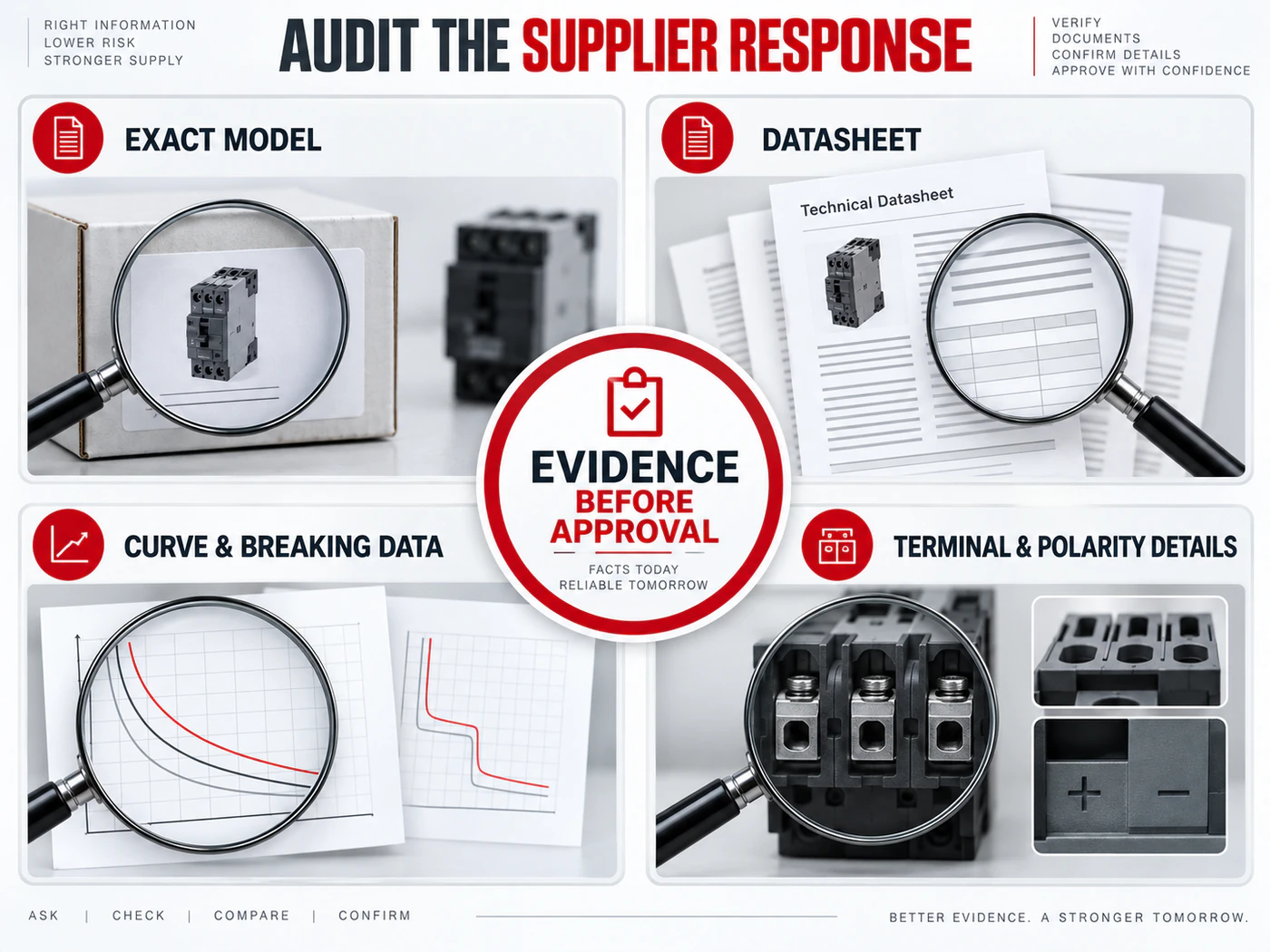
A quotation can remain commercially interesting while technically incomplete. Mark missing data as an open action and ask the supplier for the exact page, drawing or combination table. Price and lead time should be compared only after the technical scope is normalized. This prevents a lower-cost but narrower offer from appearing equivalent to a complete documented solution.
Decision Workflow
- Name the circuit and breaker location.
- Record voltage envelope, load current and transient behavior.
- Obtain the local prospective fault current.
- State pole, isolation and environmental requirements.
- Request exact order code and complete supporting documents.
- Compare responses field by field and return gaps for clarification.
At each step, preserve the boundary between project inputs and supplier evidence. The project team defines the application and required functions; the supplier identifies an exact product and provides its documents. Neither side should fill an evidence gap by inference from appearance, a nearby model or a shared headline rating.
RFQ Preparation Checklist
A useful RFQ for dc mcb rfq checklist should be concise enough to answer but complete enough to prevent silent assumptions. Attach the available project record and identify unknown values as questions. Ask the supplier to answer with an exact orderable code rather than a generic product-family recommendation.
- Application and circuit location
- Normal and maximum DC voltage
- Continuous current and inrush/transient evidence
- Prospective short-circuit current
- Pole and connection requirements
- Mounting, terminals and environment
- Exact model, documents, quantity and destination
Request the current datasheet revision and identify the scope of any certification, coordination or compatibility claim. If the response proposes a substitute, require the same evidence set for that substitute. Record quantity and destination after the technical inputs so commercial terms do not obscure unresolved engineering questions.
Stop Conditions Before Order Release
Do not release the order while a publication-critical input is unknown, the quoted model is ambiguous, or a required rating is supported only by another manufacturer’s document. Stop as well when a combination claim lacks exact component codes or when a diagram is being reused across product families. These are evidence gaps, not editorial details.
The final approval record should state what the selected item does, what remains outside its scope and which exact documents support the decision. If the application, duty, environment or proposed model changes, reopen the relevant checks rather than carrying the previous conclusion forward.
Frequently Asked Questions
Can I send only voltage and current?
That is not enough. Fault level, pole connection, duty and documentation requirements are also needed.
Should I request a specific trip curve?
Only when the load and protection design justify it; request exact manufacturer evidence.
Can a photo prove replacement compatibility?
No. Verify dimensions, terminals, connection, ratings and trip behavior.
Related RITOKS Products and Guidance
Use these links as separate category, product and educational records. A contextual link does not claim interchangeability, compatibility or a coordinated combination.
High-current low-voltage DC MCB family
Technical References
The following authoritative sources support only the general concepts stated below. Their product values, diagrams, combinations and approvals do not transfer to RITOKS products.
ABB, Miniature Circuit Breakers for DC Applications
Supports exact-series verification of DC voltage, poles, polarity and breaking capacity. ABB diagrams and ratings do not apply to RITOKS devices.
Request an Exact-Model Review
Send the recorded application requirements, exact documentation questions, quantity and destination through the RITOKS contact form. An RFQ requests an exact-model review; this guide does not approve a wiring design, installation or automatic substitute.