
DC Molded Case Circuit Breakers (MCCB) · Technical Explainer
DC MCCBs for Battery Energy Storage: Inputs Before Selection
DC MCCBs for Battery Energy Storage: Inputs Before Selection starts with the system question: Which voltage, fault-current and isolation requirements belong in the selection brief? A useful selection brief connects the equipment duty, installation and receiving system to a specific orderable product. The article below separates project inputs from product evidence so that a familiar product name does not quietly become a technical approval.
This application guide identifies information needed before a DC MCCB is selected for battery energy storage. It does not certify a breaker for any BESS, give a fault-current calculation or substitute for system protection engineering.
Decision Inputs at a Glance
| Review area | Project input | Evidence to request |
|---|---|---|
| BATTERY | Define actual operating state and system boundary | Approved system drawing or duty record |
| CONVERTER | Name interface, geometry or control expectation | Exact equipment or product document |
| DC BUS | State environment and installation condition | Site or panel drawing |
| BREAKER | Describe service and acceptance requirement | Exact instructions and test plan |
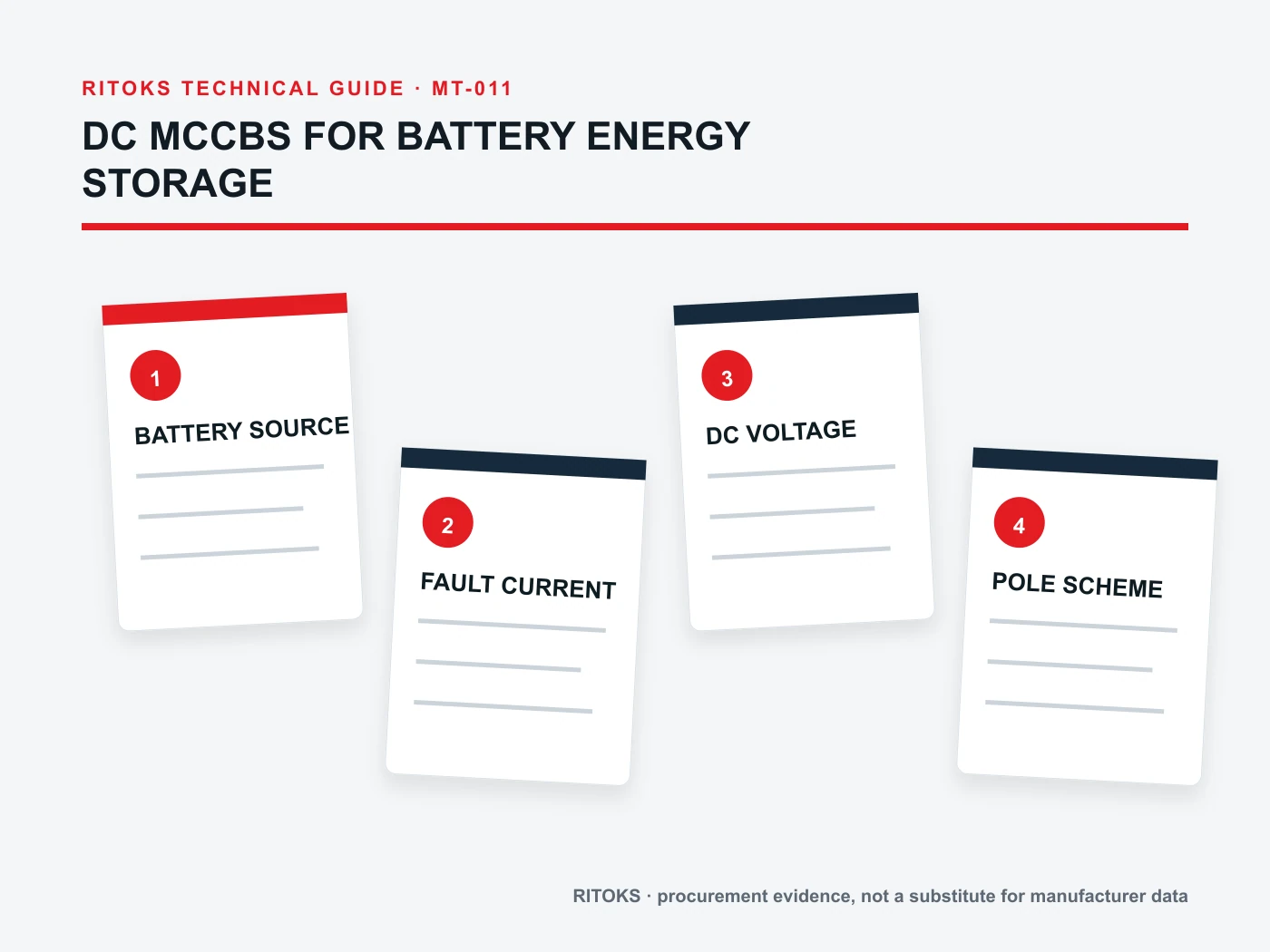
Define the breaker’s system location
A battery energy storage system contains multiple electrical boundaries. A DC molded-case circuit breaker can serve a defined protective and switching role, but the correct device depends on where it is installed relative to battery strings, DC bus, converter and other protective equipment. The same breaker can face different conditions at different locations.
Draw the single-line diagram and mark the proposed breaker position. Identify all sources capable of feeding that point, including possible backfeed or parallel paths. The system designer should state the intended function of the breaker, the required interruption duty and the normal operating sequence.
Establish the voltage envelope
Battery voltage changes with state of charge, temperature and system operating state. The relevant maximum DC voltage at the breaker must come from the battery and system design. Compare it with the exact device rating under the intended pole connection. A generic range in a product title cannot prove suitability for the specified installation.
Record the direction of current flow and whether the device documentation imposes polarity or line/load conditions. Some product configurations rely on a particular internal or external pole path. Require the exact wiring diagram before approving the selection.
Calculate available fault current at the location
A DC MCCB must be reviewed against the prospective fault duty at its installation point. That duty depends on battery architecture, impedance, connected sources and the protection arrangement. The article cannot supply a universal BESS fault number. The engineer responsible for the system should provide the calculation and its assumptions.
Ask for the exact breaker’s DC interrupting data at the relevant voltage and configuration. Do not transfer an AC breaking capacity or a value from another pole count. Keep the source calculation and manufacturer evidence together so reviewers can see that both describe the same operating condition.
Review trip behavior and coordination
The trip unit and settings influence when the breaker operates relative to cables, battery limits and other protective devices. Obtain time-current curves for the exact order code and any selected setting. If coordination or selectivity is required, study the applicable devices together; a single breaker curve does not establish a system result.
Identify whether the proposed trip function is fixed or adjustable and how settings will be documented. Avoid assuming that an adjustable function shown on a family page is included in the quoted part. Record who approves the settings and who verifies them at commissioning.
Separate isolation and interruption duties
A breaker may be used for disconnection under defined conditions, but an energy storage design also needs a safe isolation method and operating procedure. Define whether manual operation, lockout, remote trip or status contacts are required. Verify each function against the exact device and assembled panel rather than inferring it from a molded-case appearance.
The protection scheme may include fuses, contactors, monitoring and controls. State which component is responsible for each action. A DC MCCB should not be asked to perform a function that belongs elsewhere without specific evidence.
Fit the breaker to the panel and environment
Check mounting, terminal orientation, conductors, busbars, ventilation, ambient and service access. Continuous-current capability can depend on installation and thermal conditions. The exact datasheet and instructions should govern conductor range, torque, clearances and any derating; this article does not supply substitute values.
Accessories such as auxiliary contacts or shunt trips should be separately specified and shown on the wiring diagram. A quote that omits them is not equivalent to one that includes them. Record the complete order code and accessory scope before commercial comparison.
Plan evidence for commissioning and change control
Commissioning should compare the installed label, pole connections, settings, accessories and documentation with the approved design. A system test plan should verify the intended control and protection behavior within safe, authorized methods. Keep any field adjustments under controlled records.
If the battery configuration, inverter interface or source impedance changes, revisit the fault and coordination studies. A previous approval does not automatically carry over to a modified BESS. The purchase record should preserve the assumptions under which the breaker was selected.
Build an Exact-Model Evidence File
For the proposed DC MCCB, create one approval record with the complete order code, the exact datasheet, the relevant drawing, installation instructions and any curve or test report used for the decision. Date each file or record its revision. A product-family page is useful for discovery, but it does not prove that a particular configuration includes an optional feature or meets a system condition.
Compare every requirement against evidence for the same orderable item. Do not combine a family maximum from one variant with a circuit diagram, accessory list or thermal curve from another. Put unresolved fields in a visible clarification column. If a supplier proposes a substitute, repeat the affected review before approving its technical equivalence.
Keep Project Inputs Separate From Supplier Claims
The project team owns the application record: source and load, operating states, environment, mounting, controls, service and acceptance criteria. The supplier owns the proposed order code and supporting device evidence. Neither side should fill a gap by inference from appearance or a familiar family name. A useful answer can be “data not yet available,” provided that the missing item has an owner and a closure date.
Freeze that record while offers are compared. If the operating duty, cabinet, source, meter, motor or protective architecture changes, issue a revised input sheet and ask each supplier to reconfirm its candidate. This prevents an early quotation from being treated as approval for a later design.
How to Compare Supplier Offers
| Offer item | What to compare | Approval evidence |
|---|---|---|
| Orderable scope | Full code and included accessories | Exact quotation and bill of materials |
| Electrical fit | All applicable operating states | Exact rating, circuit or curve document |
| Mechanical fit | Mounting, terminals and access | Drawing and installation instructions |
| Service plan | Inspection and replacement method | Maintenance instructions |
| Open items | Assumptions, exclusions and exceptions | Written clarification register |
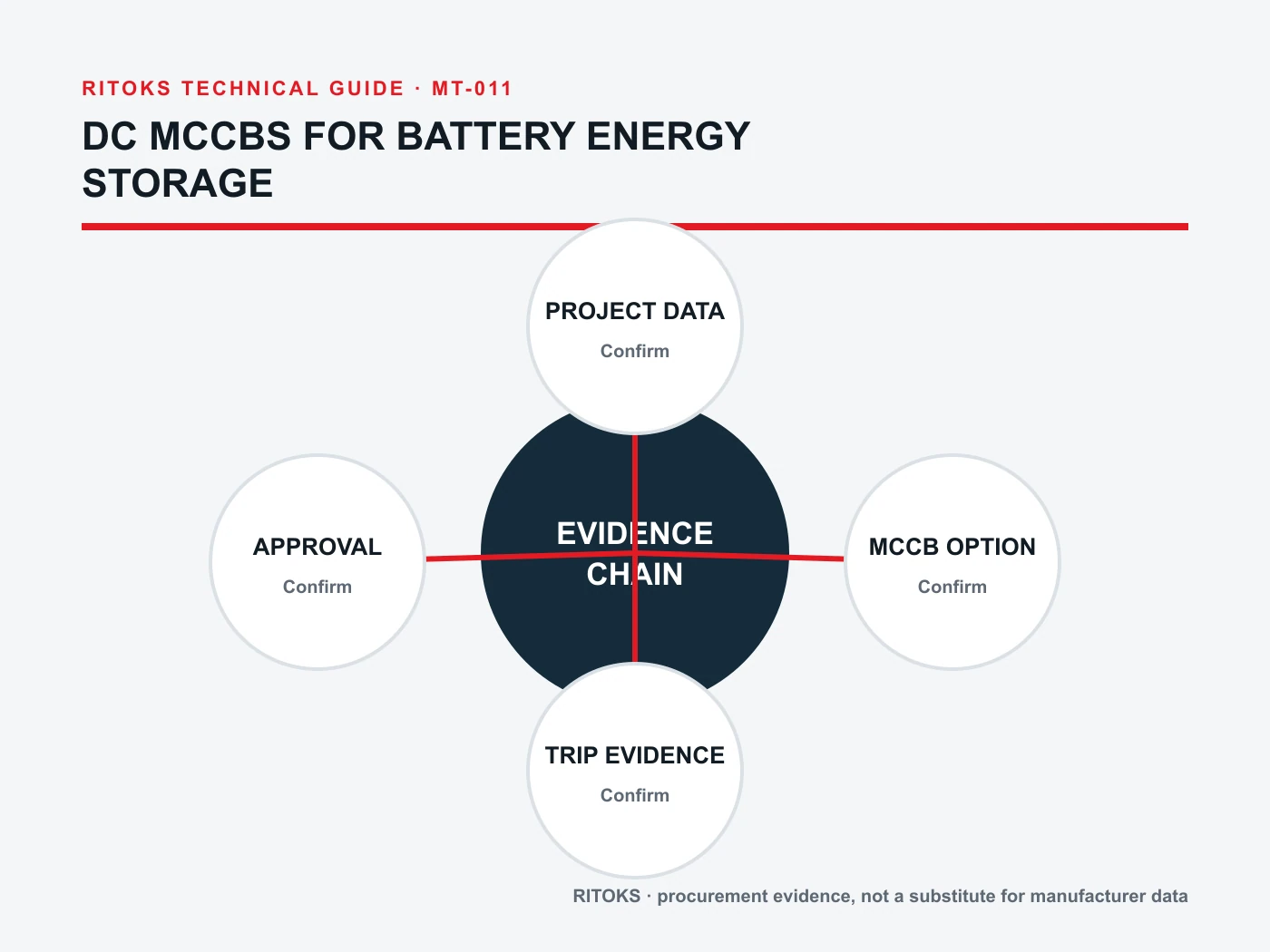
Normalize each DC MCCB offer to the same application record. A shorter lead time or lower price is meaningful only after the technical scope is comparable. Record whether each supplier included the required accessories, documents and support for commissioning. Keep exceptions explicit, especially when the candidate needs a change to the panel or control design.
Procurement and Commissioning Checkpoints
- Confirm the system boundary, operating states and acceptance criteria.
- Review one complete order code against exact-model documents.
- Resolve electrical, mechanical, environmental and service exceptions.
- Compare delivered scope and document revisions across offers.
- Inspect the received item against the approved record.
- Test the finished assembly under the project’s authorized procedure.
Incoming inspection should check the delivered label, terminals, included accessories and documents against the approved order. A same-family replacement is not automatically acceptable. At commissioning, verify the application-dependent functions that component literature alone cannot establish. The test plan should name representative states and acceptance criteria without inventing universal limits.
RFQ Preparation Checklist
A useful request for quotation on dc mccb for battery storage is concise but complete. Ask for the exact orderable configuration and list unknown values as questions. Do not let the sales description silently answer a technical question that belongs to a calculation, a drawing or a test.
- BATTERY
- CONVERTER
- DC BUS
- BREAKER
- VOLTAGE
- FAULT LEVEL
- POLES
- TRIP CURVE
- Applicable document revisions
- Quantity, destination and delivery scope
Request that the supplier state exclusions, assumptions and optional items separately. Keep the technical clarification record with the quotation so procurement and engineering review the same scope. If a critical input is still missing, the candidate may remain commercially interesting, but its technical approval stays open.
Frequently Asked Questions
Can a DC MCCB be chosen from one headline rating?
No. The application, exact configuration and relevant electrical, mechanical, thermal and environmental conditions must be reviewed together. A catalog title is a starting point for discovery, not a complete approval record.
Does a family page prove an exact connection or accessory?
No. Use the proposed order code and its current drawing, datasheet and installation instructions. Optional features or alternate terminal arrangements may differ within a family.
What if the supplier cannot provide one required value?
Mark the value unresolved, identify who will obtain it and pause the affected decision. Do not convert an assumption into a verified claim simply because a purchase date is approaching.
Where to Continue the Review
Browse the DC MCCB category for the available product family, then review the related product page as a candidate starting point. These pages identify the commercial destination; the exact model documents decide application suitability. For a project-specific comparison, send the system inputs and open questions through the RITOKS inquiry page.
If another device or method appears more suitable after reviewing the evidence, revise the design brief before asking for a substitution. Keep the record tied to the final circuit and installation, not just to the product family that first attracted attention.