
Diode Rectifier Modules · RFQ Checklist
Diode Module RFQ Checklist: Topology, Ratings and Package
Diode Module RFQ Checklist: Topology, Ratings and Package starts with the system question: What exact information should buyers send for quotation? A useful selection brief connects the equipment duty, installation and receiving system to a specific orderable product. The article below separates project inputs from product evidence so that a familiar product name does not quietly become a technical approval.
This RFQ checklist requests application data and exact-device evidence. It does not certify a diode module, assign a terminal map or recommend a rating without the buyer’s circuit and the supplier’s current model documents.
Decision Inputs at a Glance
| Review area | Project input | Evidence to request |
|---|---|---|
| CIRCUIT | Define actual operating state and system boundary | Approved system drawing or duty record |
| WAVEFORM | Name interface, geometry or control expectation | Exact equipment or product document |
| VOLTAGE | State environment and installation condition | Site or panel drawing |
| COOLING | Describe service and acceptance requirement | Exact instructions and test plan |
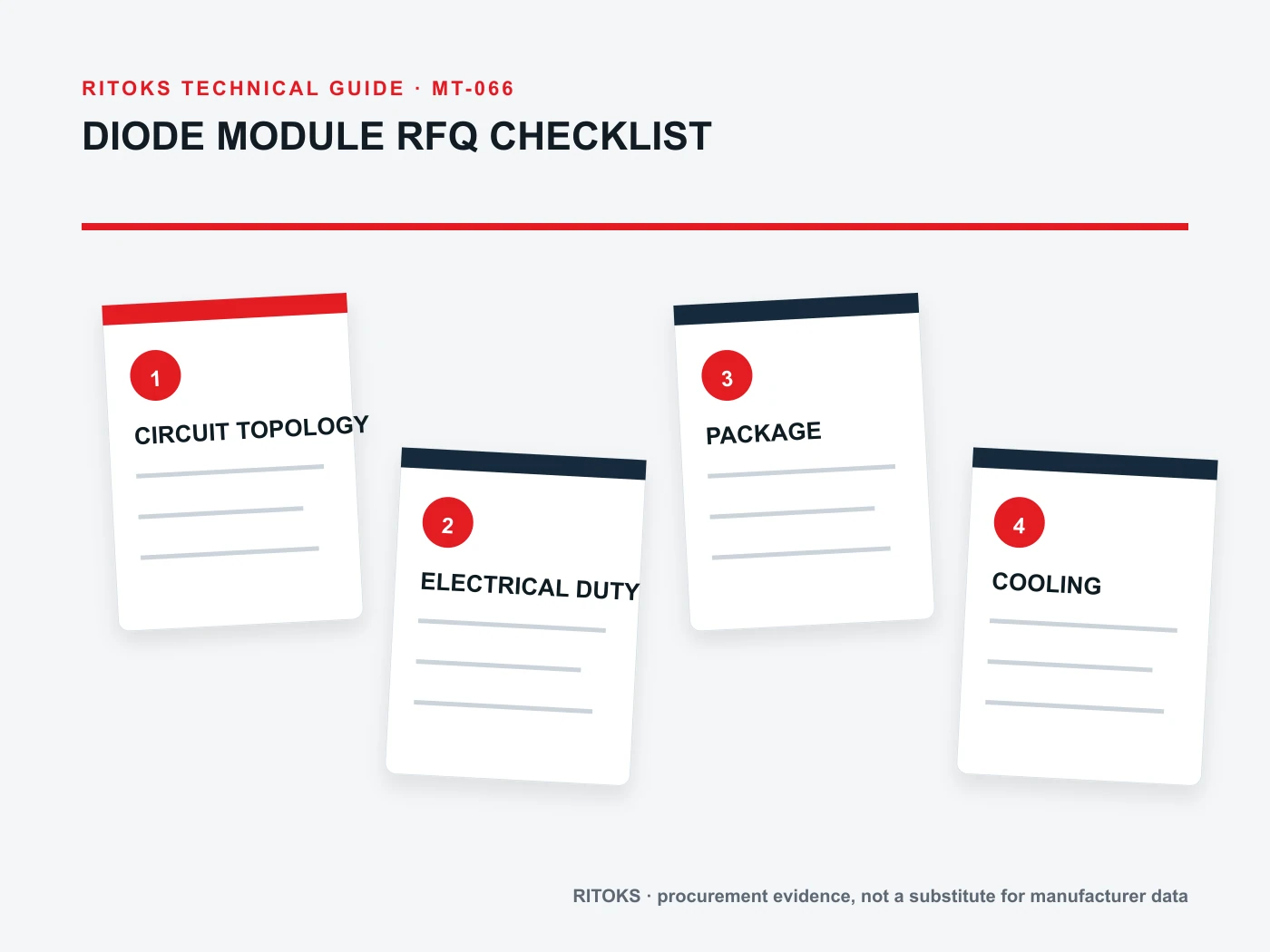
Send the circuit purpose first
A useful diode module quotation begins with the circuit, not a package photograph. Tell the supplier whether the device is intended for rectification, blocking, freewheeling or another function. Attach a simplified schematic showing the source, load and intended current paths.
Name the project stage and identify which values are firm and which remain provisional. This helps the supplier respond with an exact order code and a list of assumptions rather than a broad series recommendation that is hard to approve.
Specify internal topology and terminal mapping
State the required arrangement of the diode paths. If the design calls for a common-anode or common-cathode node, say so explicitly and provide the schematic context. Request the exact internal circuit diagram and numbered terminal drawing in return.
Do not assume that two modules with matching footprints have interchangeable pinouts. Ask the supplier to identify any connection bridges, optional terminals or orientation constraints. A technical quote should make the path from source to load traceable without guesswork.
Provide voltage and current duty
Send the expected operating-voltage envelope and the credible reverse-voltage condition at the device. Describe the current waveform, average operation, repetitive peaks and the surge event that the project requires the module to withstand. If these are still being calculated, state the uncertainty rather than assigning a convenient number.
Ask the supplier to cite the applicable exact-model data and conditions for each rating. Avoid comparing a headline current from one family with a surge value from another order code. The quote should identify whether any proposed derating or parallel arrangement depends on additional evidence.
Include thermal and mechanical conditions
Describe heatsink or baseplate arrangement, cooling method, local ambient, mounting orientation, allowed envelope and service clearance. The supplier should provide loss characteristics, thermal data, mounting instructions and an outline drawing for the complete order code.
If an existing module is being replaced, include the approved drawing and electrical duty. Do not request a “drop-in equivalent” based only on bolt spacing. Terminal position, insulation, thermal contact and internal circuit may differ.
Ask for package and connection details
A quotation should state the housing dimensions, terminal type, mounting hardware, recommended connection method and accessories included. The panel design may have constraints on cable lugs, busbars, creepage space and access. These are project inputs for engineering review, not properties to assume from a small catalog image.
Request a drawing that distinguishes the module body from required external clearances. If the supplier offers an alternate package, ask for a marked comparison against the original interface so mechanical changes remain visible.
Define documentation and approval deliverables
Request an exact datasheet, internal circuit, terminal map, mechanical drawing, mounting instructions and any test or application note used to support a claim. Record document revisions with the quote. If compliance evidence is required by the project, ask for the specific certificate or report and verify that it covers the quoted item.
Do not let an unsupported certification claim enter the RFQ as a fact. Procurement can ask for evidence; engineering decides whether that evidence satisfies the project. List missing documents as open items with a response owner.
Compare responses on one technical baseline
Send the same input sheet to each supplier. Put proposed order code, topology, ratings, thermal assumptions, drawing revision, included accessories and exceptions in adjacent columns. Separate mandatory requirements from preferences and future options.
A lower-priced offer may exclude a heatsink, busbar or document that another supplier includes. Normalize delivered scope before commercial comparison. Keep the technical review outcome with the purchase order so incoming inspection can check the exact approved item.
Build an Exact-Model Evidence File
For the proposed Diode Module, create one approval record with the complete order code, the exact datasheet, the relevant drawing, installation instructions and any curve or test report used for the decision. Date each file or record its revision. A product-family page is useful for discovery, but it does not prove that a particular configuration includes an optional feature or meets a system condition.
Compare every requirement against evidence for the same orderable item. Do not combine a family maximum from one variant with a circuit diagram, accessory list or thermal curve from another. Put unresolved fields in a visible clarification column. If a supplier proposes a substitute, repeat the affected review before approving its technical equivalence.
Keep Project Inputs Separate From Supplier Claims
The project team owns the application record: source and load, operating states, environment, mounting, controls, service and acceptance criteria. The supplier owns the proposed order code and supporting device evidence. Neither side should fill a gap by inference from appearance or a familiar family name. A useful answer can be “data not yet available,” provided that the missing item has an owner and a closure date.
Freeze that record while offers are compared. If the operating duty, cabinet, source, meter, motor or protective architecture changes, issue a revised input sheet and ask each supplier to reconfirm its candidate. This prevents an early quotation from being treated as approval for a later design.
How to Compare Supplier Offers
| Offer item | What to compare | Approval evidence |
|---|---|---|
| Orderable scope | Full code and included accessories | Exact quotation and bill of materials |
| Electrical fit | All applicable operating states | Exact rating, circuit or curve document |
| Mechanical fit | Mounting, terminals and access | Drawing and installation instructions |
| Service plan | Inspection and replacement method | Maintenance instructions |
| Open items | Assumptions, exclusions and exceptions | Written clarification register |
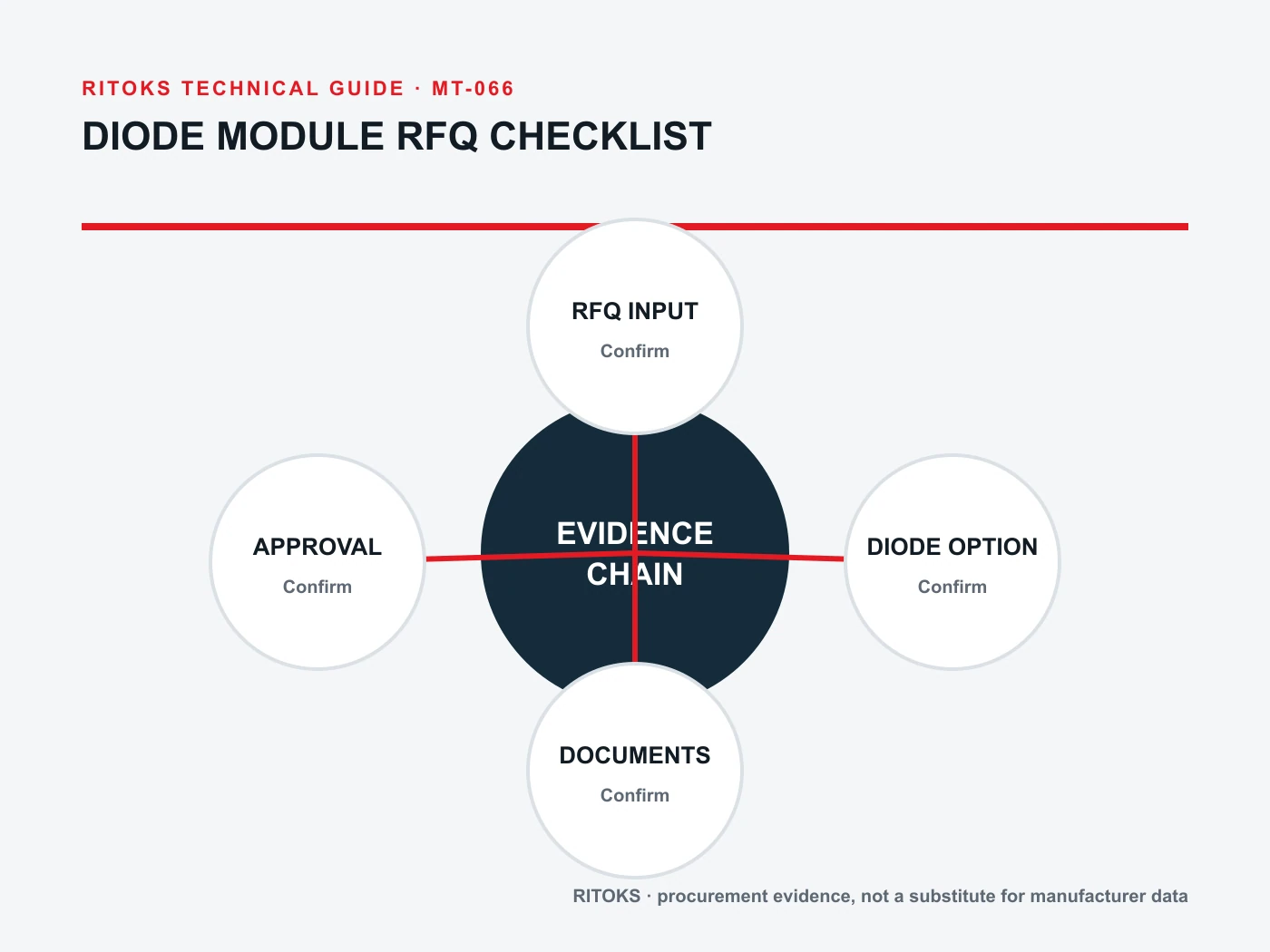
Normalize each Diode Module offer to the same application record. A shorter lead time or lower price is meaningful only after the technical scope is comparable. Record whether each supplier included the required accessories, documents and support for commissioning. Keep exceptions explicit, especially when the candidate needs a change to the panel or control design.
Procurement and Commissioning Checkpoints
- Confirm the system boundary, operating states and acceptance criteria.
- Review one complete order code against exact-model documents.
- Resolve electrical, mechanical, environmental and service exceptions.
- Compare delivered scope and document revisions across offers.
- Inspect the received item against the approved record.
- Test the finished assembly under the project’s authorized procedure.
Incoming inspection should check the delivered label, terminals, included accessories and documents against the approved order. A same-family replacement is not automatically acceptable. At commissioning, verify the application-dependent functions that component literature alone cannot establish. The test plan should name representative states and acceptance criteria without inventing universal limits.
RFQ Preparation Checklist
A useful request for quotation on diode module rfq checklist is concise but complete. Ask for the exact orderable configuration and list unknown values as questions. Do not let the sales description silently answer a technical question that belongs to a calculation, a drawing or a test.
- CIRCUIT
- WAVEFORM
- VOLTAGE
- COOLING
- ORDER CODE
- PINOUT
- RATINGS
- DRAWING
- Applicable document revisions
- Quantity, destination and delivery scope
Request that the supplier state exclusions, assumptions and optional items separately. Keep the technical clarification record with the quotation so procurement and engineering review the same scope. If a critical input is still missing, the candidate may remain commercially interesting, but its technical approval stays open.
Frequently Asked Questions
Can a Diode Module be chosen from one headline rating?
No. The application, exact configuration and relevant electrical, mechanical, thermal and environmental conditions must be reviewed together. A catalog title is a starting point for discovery, not a complete approval record.
Does a family page prove an exact connection or accessory?
No. Use the proposed order code and its current drawing, datasheet and installation instructions. Optional features or alternate terminal arrangements may differ within a family.
What if the supplier cannot provide one required value?
Mark the value unresolved, identify who will obtain it and pause the affected decision. Do not convert an assumption into a verified claim simply because a purchase date is approaching.
Where to Continue the Review
Browse the Diode Module category for the available product family, then review the related product page as a candidate starting point. These pages identify the commercial destination; the exact model documents decide application suitability. For a project-specific comparison, send the system inputs and open questions through the RITOKS inquiry page.
If another device or method appears more suitable after reviewing the evidence, revise the design brief before asking for a substitution. Keep the record tied to the final circuit and installation, not just to the product family that first attracted attention.