
Enclosure Air Conditioners for Control Cabinets · Comparison
Enclosure Air Conditioner vs Filter Fan: Cooling Architecture Differences
A filter fan and an enclosure air conditioner solve different thermal problems. A fan exchanges cabinet air with the surrounding environment; an air conditioner transfers heat while keeping internal and external air paths separated. The correct architecture depends on heat load, ambient temperature, contamination, humidity and the enclosure boundary the project must maintain.
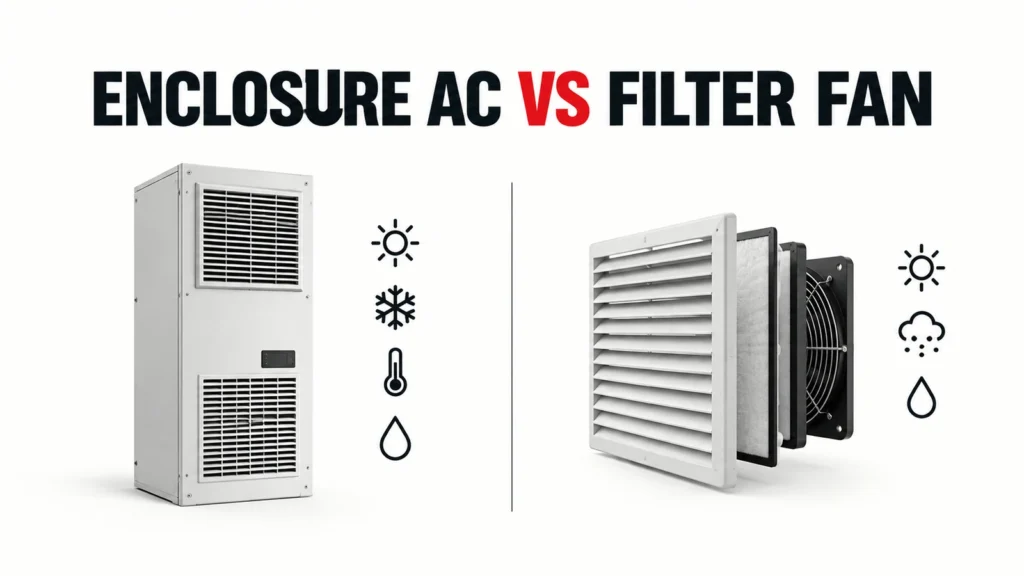
This guide explains the architectural difference between ventilation by filter fan and closed-loop enclosure air conditioning. It does not size a cooling device, promise an enclosure rating after modification, or approve either method without a heat-load and environmental review.
의사결정 입력 요소 요약
| 결정 입력 | 구매자는 다음 사항을 확인해야 합니다. | 필요한 증거 |
|---|---|---|
| Heat-transfer path | Outside air passes through the cabinet | Internal and external air circuits remain separated |
| Temperature condition | Useful when ambient air can absorb cabinet heat | Can cool toward a controlled internal target within model limits |
| 오염 | Requires acceptable incoming air and filter maintenance | Supports a closed air boundary but still needs external coil service |
| 수분 | Introduces ambient humidity with ventilation air | Requires condensate and dew-point review |
| Selection evidence | Airflow and pressure performance in installed system | Capacity at actual internal and external temperatures |
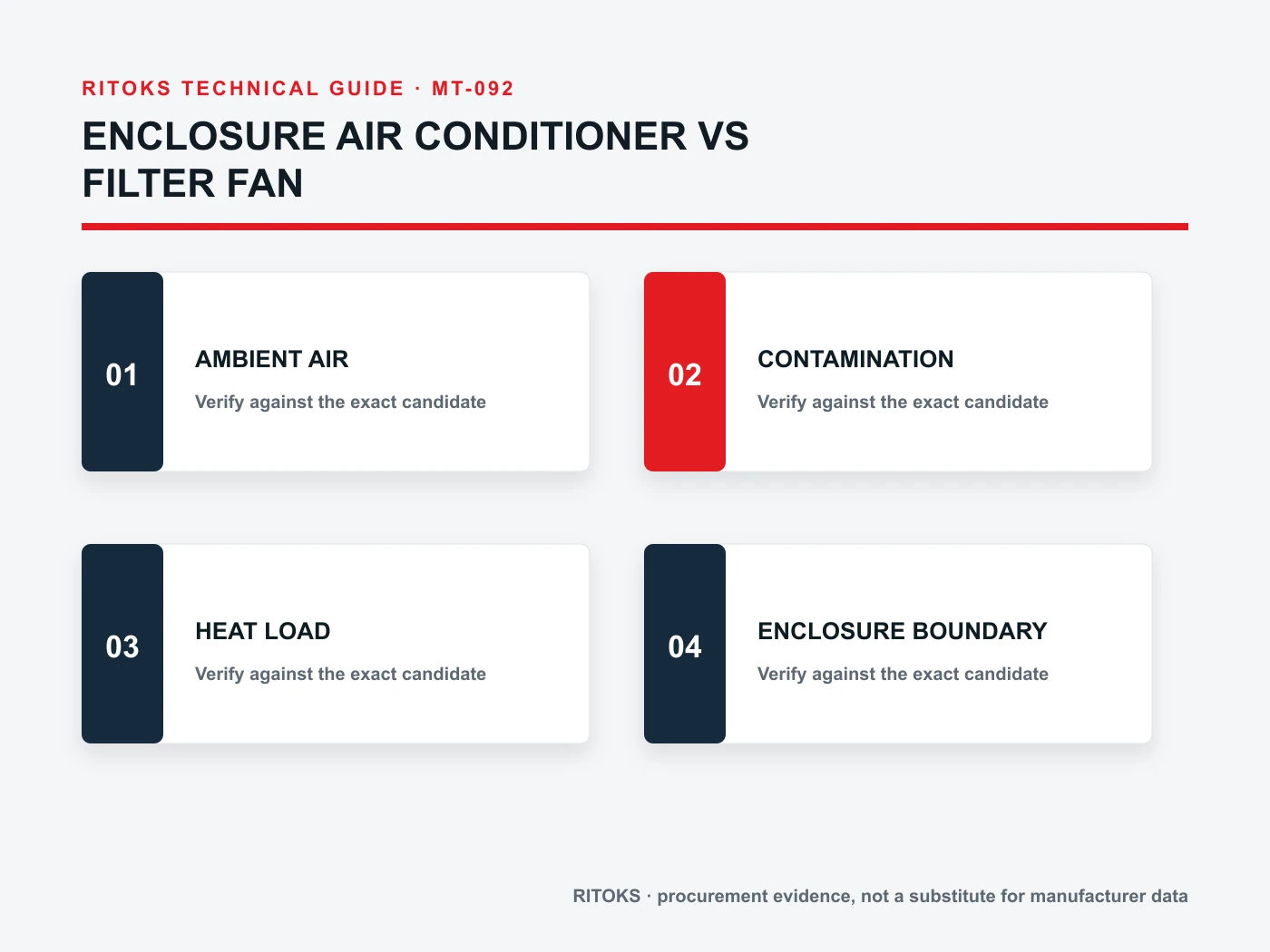
Identify the Heat-Transfer Architecture
A filter-fan system moves external air through the enclosure and discharges warmed air. Its performance depends on the complete path, including inlet restriction, outlet area, filter condition and internal obstructions.
An enclosure air conditioner circulates cabinet air through an internal heat exchanger and rejects heat through a separate external circuit. It is not simply a more powerful fan; it changes the enclosure and moisture strategy.
Compare Ambient and Target Temperatures
Ventilation needs outside air that is sufficiently cooler than the desired cabinet condition. If ambient approaches or exceeds the internal target, adding airflow cannot create a lower supply-air temperature.
Air-conditioner selection must use capacity evidence at the actual internal and external design temperatures. A nominal cooling value at another rating point is not final proof of performance.
Assess Dust, Oil and Other Contaminants
A filtered ventilation path still exchanges air with the room. Filter class, loading, bypass paths and maintenance frequency must match the contamination risk and acceptable cabinet condition.
Closed-loop cooling can reduce direct exchange, but the external heat exchanger remains exposed to its environment. Fouling, clearance and cleaning access still affect field performance.
Treat Humidity and Condensate Explicitly
Ventilation imports ambient moisture whenever air enters. An air conditioner can create cold surfaces and condensate under some conditions, especially after door opening or when humid air reaches the internal circuit.
Define the condensate route, drainage or evaporation provisions and service response. Avoid assuming that “sealed” means moisture cannot enter or that cooling automatically controls humidity.
Preserve the Intended Enclosure Boundary
Every cutout, fan, grille, gasket and cooling-unit interface affects the finished enclosure. Require an installation drawing and verify how the complete assembly meets the project’s environmental requirement.
Do not copy the component’s standalone protection statement directly to the modified enclosure. The delivered assembly and installation method need their own documented assessment.
Compare Life-Cycle Work
Filter systems need routine inspection and replacement based on the environment and pressure loss. Air conditioners require coil cleaning, airflow clearance, condensate attention and checks of controls or alarms.
Choose the architecture with a realistic maintenance plan. A method that performs in a clean calculation but cannot be serviced in the installed location is not a robust selection.
정확한 모델 증거 파일 생성하기
Create one approval record for the proposed Enclosure Air Conditioner order code. Put each project requirement beside the supplier document that answers it. Preserve the exact datasheet, dimensioned drawing, circuit diagram, performance curve or application note used, including its revision or retrieval date. A category page establishes family context but cannot prove an exact rating, terminal arrangement, optional feature or system combination.
승인된 모든 명세서가 동일한 주문 가능한 품목을 설명하는지 확인하십시오. 유사한 하우징이라도 회로, 단자, 재질, 펌웨어 또는 부속품이 다를 수 있습니다. 한 변형의 최대값, 다른 변형의 도면, 또 다른 변형의 특징을 혼합하여 사용해서는 안 됩니다. 해결되지 않은 항목은 엔지니어링 및 상업적 검토 과정에서 계속 표시되도록 명확하게 표시하십시오.
프로젝트 입력 사항과 제품 증거를 별도로 관리하십시오
프로젝트 팀은 애플리케이션의 사양, 즉 공급원, 부하, 작동 조건, 환경, 제어 시스템, 기계적 한계 및 요구 기능을 정의합니다. 공급업체는 정확한 인클로저형 에어컨 모델을 선정하고, 이에 대한 정확한 문서를 제시해야 합니다. 어느 쪽도 외관, 동일한 제품군 이름, 또는 일치하는 표면상의 수치만을 근거로 추측하여 부족한 정보를 보완해서는 안 됩니다.
견적서를 비교하는 동안 신청 기록을 일시 정지하십시오. 회로, 부하, 작동 조건, 환경, 인클로저, 열 관리 방식 또는 요구 출력이 변경될 경우, 수정된 기록을 발행하고 각 공급업체에 후보 제품을 재확인하도록 요청하십시오. 그렇지 않으면 겉보기에는 비슷해 보이는 견적서들이 실제로는 서로 다른 기술적 요구 사항에 대한 답변일 수 있습니다.
조달 과정에서 흔히 발생하는 오류
- 사용 용도가 명확하지 않은 상태에서 단일 종합 평가만을 바탕으로 실내형 에어컨을 선택하는 것.
- 인접한 모델의 회로, 곡선, 단자 도면 또는 성능 주장을 사용하는 것.
- 가족 사진이나 제품 사진을 정확한 기술적 증거로 취급하는 것.
- 관련 문서 없이 액세서리, 시스템 기능 또는 조정 결과가 포함된 것으로 가정합니다.
- 전기, 열, 기계적 및 증거 검토를 반복하지 않고 대체품을 승인하는 것.
가격과 납기일을 비교하기 전에 이러한 미비점을 해결해야 합니다. 검토자는 승인된 모든 진술이 프로젝트 요구사항이나 정확한 후보 문서로 거슬러 올라갈 수 있도록 해야 합니다. 제안서는 기술적으로 불완전하더라도 상업적으로는 여전히 매력적일 수 있지만, 누락된 근거 자료가 견적서 속에 묻혀서는 안 됩니다.
공급업체 제안서 비교 방법
| 비교 기준 | 필수 증거 | 수락하지 마십시오 |
|---|---|---|
| 정확한 동일성 | 주문 가능한 전체 코드 및 변형 설명 | 성만 |
| 응용 프로그램 일치 | 동결된 프로젝트 투입 요소에 대한 대응 | 일반적 적합성 진술서 |
| 기술적 증거 | 수정 내역이 포함된 최신 정확한 모델 문서 | 스크린샷 또는 유사 모델 페이지 |
| 제공된 범위 | 포함된 액세서리, 인터페이스 및 설명서 | 정의되지 않은 “표준 패키지” |
| 미해결 질문 | 명백한 편차 및 설명 목록 | 침묵을 동의로 간주함 |
| 치환 | 모든 요구 사항에 대한 새로운 검토 | “외관상 ”동등한” |
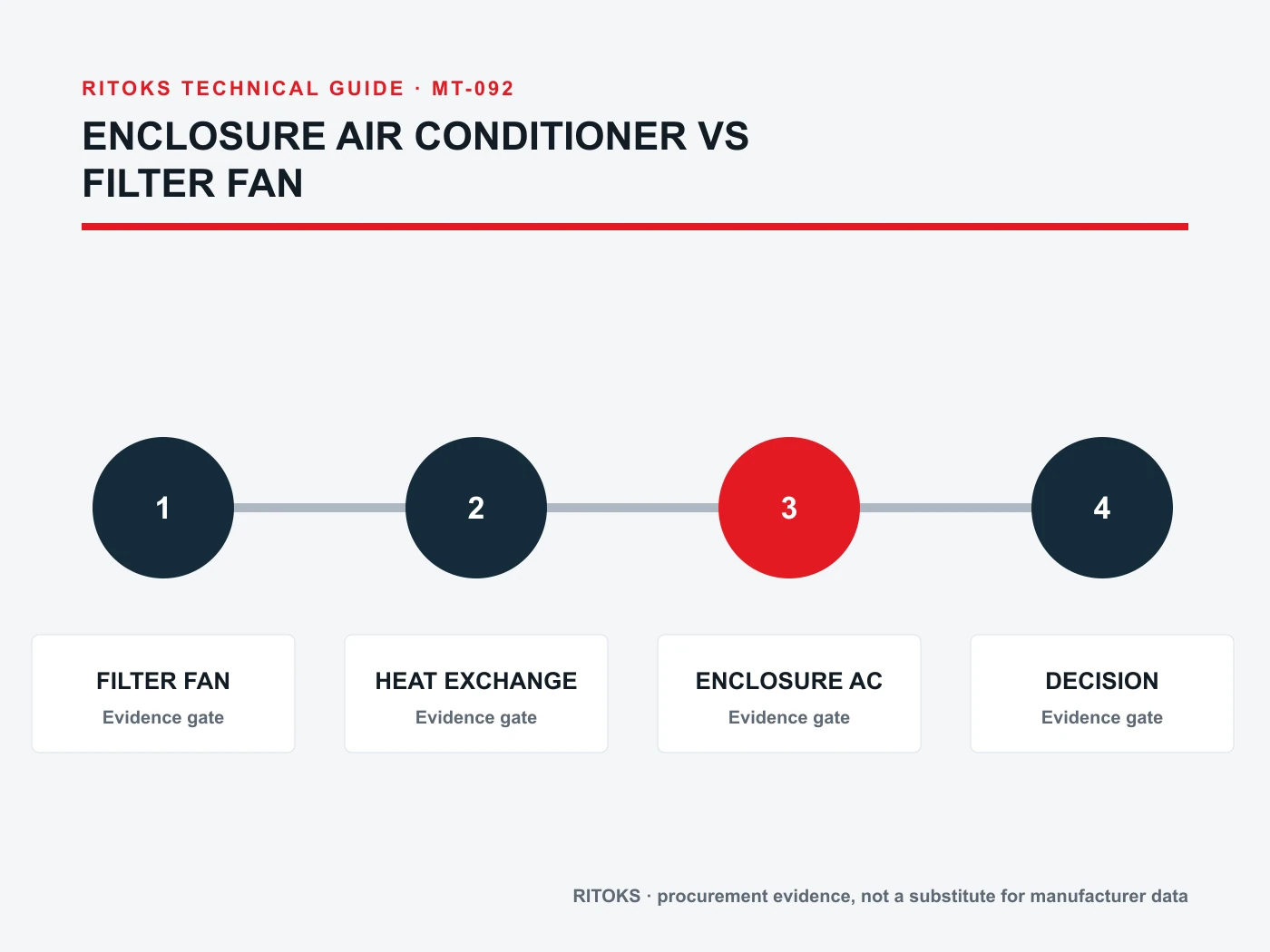
모든 인클로저형 에어컨 제안서를 동일한 적용 사례 기록에 맞춰 표준화하십시오. 각 값 옆에는 문서 개정 내역, 테스트 조건, 포함된 부속품 및 미해결 사항을 기재하십시오. 이를 통해 납품 범위의 차이를 명확히 파악할 수 있으며, 비용은 저렴하지만 제공 범위가 좁은 제안서가 완전한 솔루션과 동등한 것으로 오인되는 것을 방지할 수 있습니다.
의사결정 워크플로우
- 애플리케이션 아키텍처와 운영 시나리오를 확정하십시오.
- 환경적, 열적, 기계적 제약 조건을 기록하십시오.
- Identify the required Enclosure Air Conditioner function without assuming a model.
- 전체 주문 코드와 정확한 증빙 서류를 요청해 주십시오.
- 각 청구항을 해당 조건 및 정의와 대조해 보십시오.
- 상업적 승인 전에 편차 사항 및 조정 관련 문제를 해결하십시오.
- 승인된 증거 자료를 최종 자재 명세서와 함께 보관하십시오.
중요한 애플리케이션 입력값이 불분명하거나, 인용된 모델이 모호하거나, 필수 청구항이 다른 제조업체나 다른 주문 코드에 의해서만 뒷받침되거나, 설치 내용이 이용 가능한 증거의 범위를 벗어날 경우 심사를 중단해야 합니다. 이는 편집상의 세부 사항이 아닌 기술적 누락입니다.
견적 요청서(RFQ) 작성 체크리스트
A useful RFQ for enclosure air conditioner vs filter fan is concise enough to answer and complete enough to prevent silent assumptions. Identify unknown values as questions and require a full orderable code rather than a generic family recommendation.
- 열 부하
- Ambient relation
- 오염
- Humidity
- Enclosure boundary
- Open-loop path
- Closed-loop path
- Condensate route
- Service access
- Alarm strategy
- 수량, 목적지 및 필요 서류 언어
최신 데이터시트 개정판과 인증, 호환성, 연계성 또는 성능 관련 주장의 정확한 범위를 요청하십시오. 기술적 사항 기재 후 수량과 목적지를 기록하여, 상업적 조건이 해결되지 않은 기술적 문제를 가리지 않도록 하십시오.
엔지니어링 부서에서 구매 부서로 업무 인계
Engineering approval should identify the exact Enclosure Air Conditioner code, accepted document revisions, unresolved deviations and the application record used for the decision. Purchasing can then compare commercial offers without silently changing the technical basis. If a supplier proposes another code, different accessory or revised configuration, route it back through the same review instead of treating it as an administrative substitution.
승인된 증빙 자료를 구매 주문서 및 최종 자재 명세서와 함께 보관하십시오. 입고 및 생산 팀은 승인된 품목을 식별하고, 라벨, 단자 배열, 부속품 또는 문서가 상이할 경우 작업을 중단할 수 있도록 충분한 정보를 확보해야 합니다. 또한 이러한 인계 절차를 통해 유지보수 팀은 사진, 오래된 청구서 설명 또는 단일 등급 정보에만 의존하지 않고, 교체 결정을 내릴 때 추적 가능한 근거를 확보할 수 있습니다.
자주 묻는 질문
Can a larger filter fan cool below ambient temperature?
No. Ventilation uses ambient air and cannot supply air colder than that source.
Does an air conditioner eliminate all maintenance?
No. Air paths, heat exchangers, condensate provisions and controls still require inspection.
Can component protection ratings be applied to the whole cabinet?
Not automatically. Verify the finished enclosure and the approved installation method.
관련 RITOKS 제품 및 지침
이 링크들은 해당 제품군의 배경 정보만을 제공합니다. 이러한 배경 정보 링크는 상호 호환성, 호환성 또는 승인된 시스템 조합을 보장하지 않습니다.
Published RITOKS Enclosure Air Conditioner product page
기술 참고 자료
다음 출처는 본 가이드에 명시된 일반적인 공학적 개념만을 뒷받침합니다. 해당 출처의 제품 사양, 회로도, 인증 및 조정 결과는 RITOKS 제품에 적용되지 않습니다.
Rittal, Climate control engineering resources
Supports the distinction between ambient-air cooling and active enclosure climate control; Rittal product data does not transfer to RITOKS models.
정확한 모델 검토 요청
RITOKS 문의 양식을 통해 신청 요건, 구체적인 문서 관련 문의 사항, 수량 및 배송지를 보내주십시오. RFQ는 정확한 모델 검토를 요청하는 것이며, 본 안내서는 회로, 설치 또는 자동 대체품에 대한 승인을 의미하지 않습니다.