
Industrial Motor Starters for Motor Control · RFQ Checklist
Motor Starter RFQ Checklist: Motor, Coil, Overload and Enclosure
A motor starter RFQ checklist should tell the supplier what motor is being started, how the control circuit works and what is included in the assembly. A request for a starter by power rating alone leaves coil supply, overload range, enclosure and auxiliary functions open to assumption.
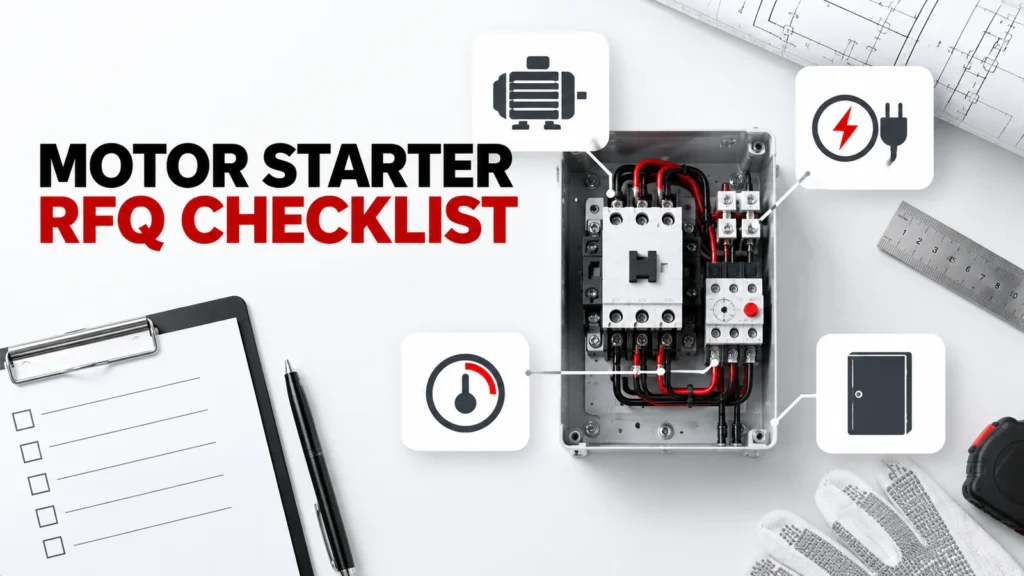
The aim is a comparable quotation for an exact orderable starter. This guide separates project inputs from supplier evidence and gives panel builders a clear way to record exceptions before purchasing.
Decision Inputs at a Glance
| Review area | What the buyer records | Evidence to request |
|---|---|---|
| Motor | Nameplate and starting duty | Motor data and load description |
| Power circuit | Supply and protection architecture | Single-line diagram |
| Control circuit | Coil supply, logic and interlocks | Control schematic |
| Package | Overload, enclosure, accessories and terminals | Starter bill of materials and drawing |
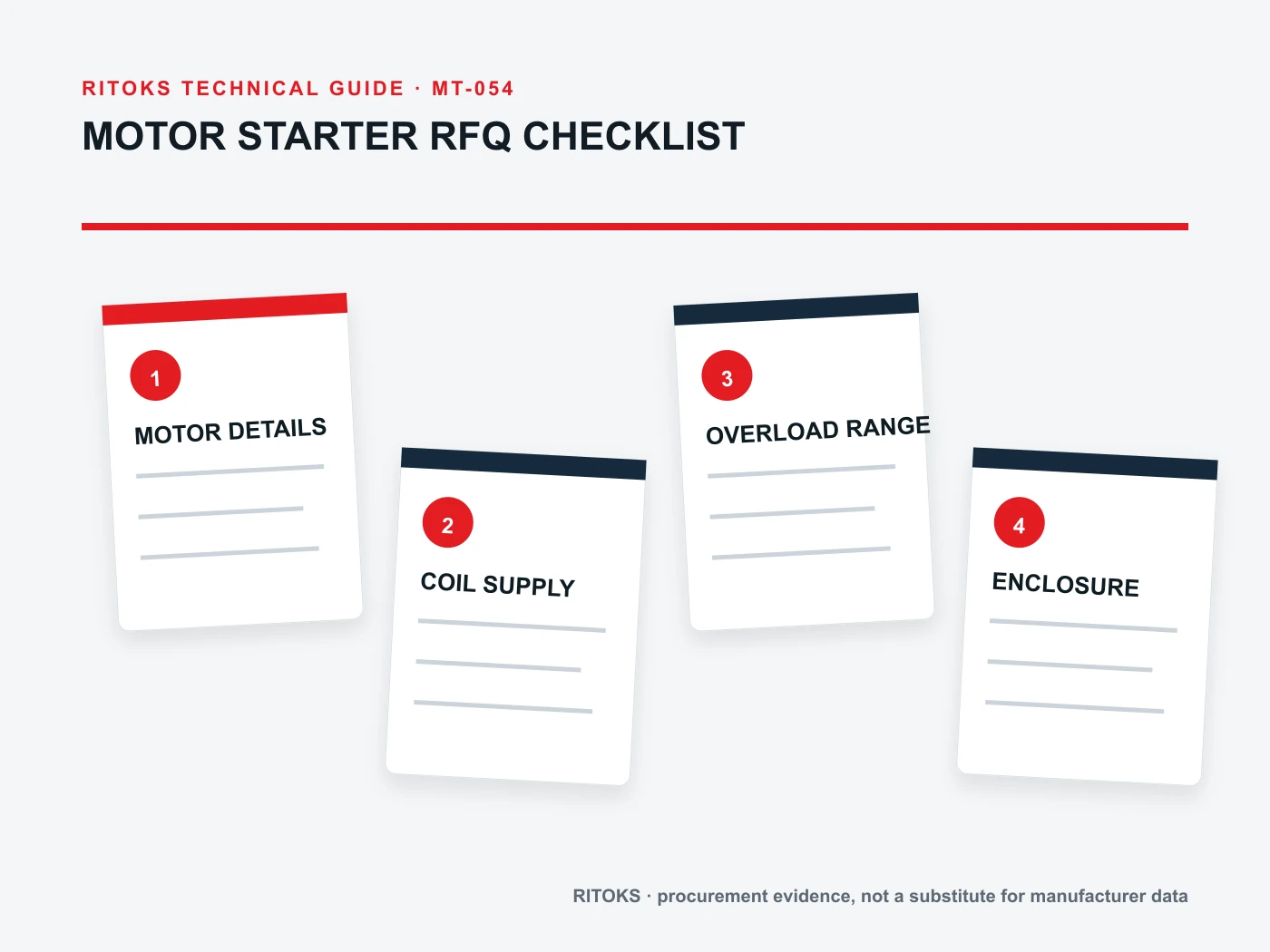
Provide motor and load data
Send the motor nameplate, intended load and operating pattern. State whether the motor starts frequently, reverses, cycles or runs under another demanding duty. The load behavior matters because a starter that closes contacts once in a simple duty is not automatically suitable for every start sequence.
If the machine has a known starting profile or special acceleration requirement, include it. Mark unknowns explicitly instead of asking the supplier to infer them from motor power alone.
Define the power circuit
Show supply type, system voltage, feeder protection and the starter location on the single-line diagram. State which upstream device and downstream motor are in scope.
A starter assembly may include only a contactor and overload, or additional devices, depending on the offering. Request a bill of materials so the power circuit can be reviewed against the project design.
Specify control-supply and coil details
The contactor coil must suit the available control supply and the operating sequence. Document the supply source, voltage type, control logic, stop function and any interlocks.
Do not assume that a product-family name implies a particular coil. Ask for the exact coil variant and terminal diagram, including any suppression or auxiliary contact options needed by the control system.
Describe overload protection requirements
The overload relay must be selected against motor data and the intended protection scheme. Ask the supplier to identify the exact relay and adjustable range, reset mode and connection to the control circuit.
Do not request a universal setting in the RFQ. The final setting and tests must follow the motor data, relay instructions and project engineering approval.
Clarify enclosure and installation
If an enclosed starter is required, describe indoor or outdoor conditions, contamination, mounting space, cable entries, operator access and service clearance. A bare open starter and a completed enclosure are materially different delivered scopes.
Ask for the enclosure drawing and a list of included controls, indicators and terminals. Do not assume an enclosure classification or accessory is supplied without exact documentation.
List required control and feedback functions
State whether the machine needs start/stop buttons, remote control, run feedback, trip indication, reset access or an emergency-stop interface. These functions may be located in different parts of the overall machine control system.
Separate starter-supplied devices from functions provided elsewhere in the panel. A clear boundary prevents duplicated or missing components in competing offers.
Compare offers against the same checklist
Require a complete order code, motor and coil assumptions, overload range, enclosure scope, drawings and exclusions. Ask suppliers to respond to each line rather than quoting only a family.
Keep the control schematic and accepted bill of materials with the purchase order. At incoming inspection, compare delivered labels and accessories with that approved record before the starter is installed.
Plan testing of the assembled starter
The delivered components and the finished control assembly answer different questions. Review the wired control circuit, stop and reset behavior, feedback contacts, overload trip response and machine interlocks against the approved schematic. The test plan should state who performs each check and what evidence is retained.
Do not assume that the correct catalog parts guarantee the intended machine sequence. Wiring, settings and the surrounding control system can change actual behavior. Record accepted settings and drawing revisions so service teams know what was approved.
Build an Exact-Model Evidence File
A category or product-family page helps locate relevant options; it does not by itself approve one variant. For motor starters, keep the full proposed order code, current datasheet, terminal or mounting drawing, operating instructions and any project calculation together. Read the conditions attached to each rating or function. If the evidence belongs to a neighboring model, request the correct document instead of carrying the claim across.
The project team owns the system inputs and acceptance criteria. The supplier owns the evidence for the offered item. In the technical review, place each mandatory requirement beside the exact document and revision that answers it. Mark a missing field as open, conditional or unsupported. This creates a traceable decision and prevents a favorable headline value from hiding an incompatible connection or installation condition.
Compare Complete Offers
| Item | Record in the comparison | Reason |
|---|---|---|
| Orderable item | Full code, variant and included accessories | Prevents family-level assumptions |
| Application match | Written response to each project input | Keeps exceptions visible |
| Documentation | Datasheet, drawing, instructions and revisions | Links claims to the offered item |
| Open points | Owner and due date for clarification | Avoids silent acceptance |
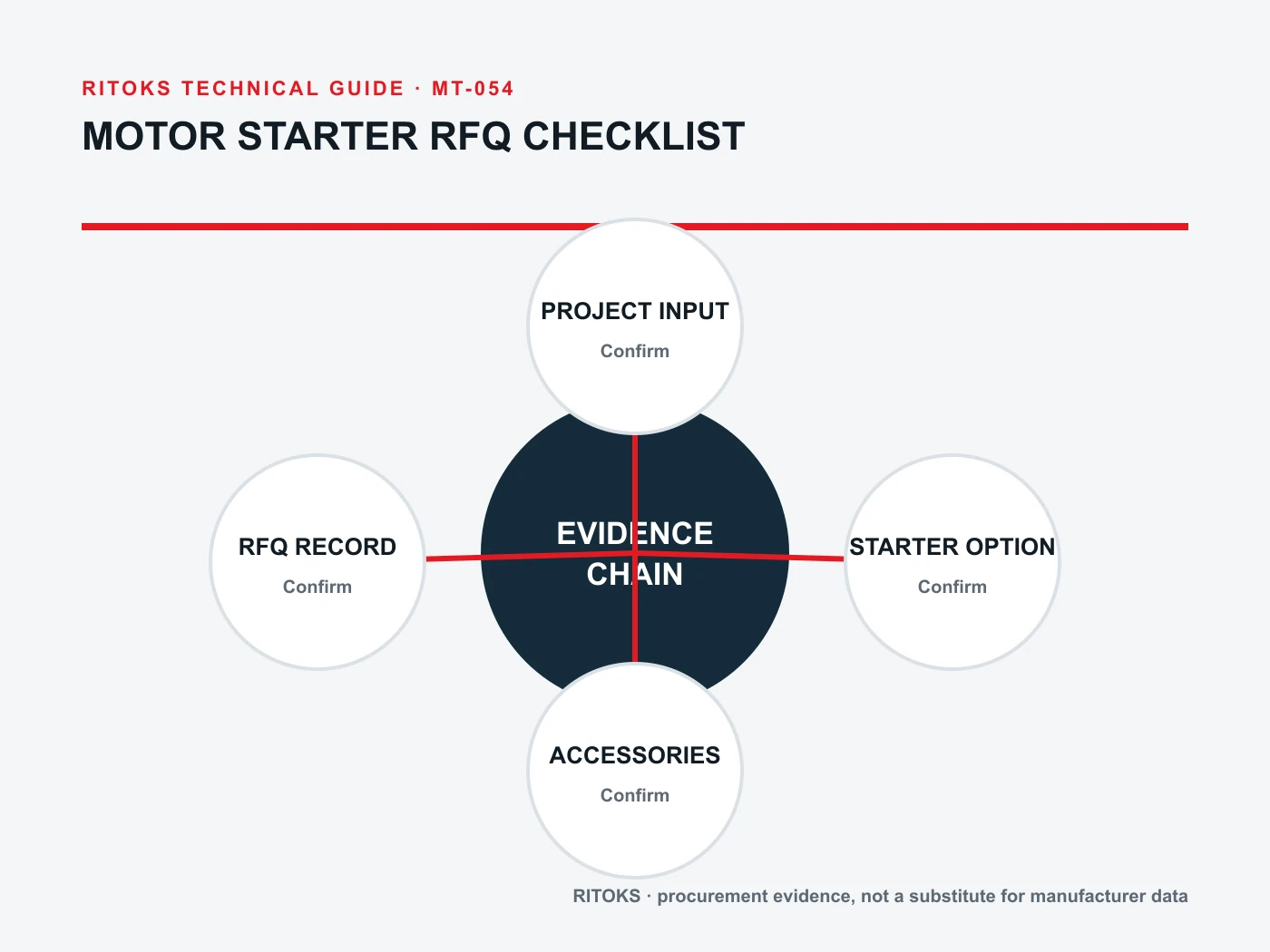
Use the same project brief for every quotation. Commercial terms such as price and lead time can be compared once the technical scope is normalized. Do not treat omitted accessories, unsupported ratings or an unresolved wiring assumption as equivalent to a documented offer. If an alternative is proposed, ask which inputs change and repeat the affected review.
Review Installation and Acceptance
Before installation, confirm that the delivered label, complete code and accessories match the approved record. Compare terminals, mounting, conductor access and any stated orientation with the exact instructions. A product that appears physically similar to the approved version may still have a different electrical configuration, control option or test basis.
Plan an as-built check that addresses the project's real risks. This may involve wiring against the approved diagram, functional response, measurements under representative operating states and confirmation of any communication or alarm feature. Record the conditions and results. The acceptance plan should come from the application and supplier evidence, not from a generic article checklist.
Request for Quotation Checklist
- Identify the circuit, equipment and location that motor starters must serve.
- Attach the system drawing and operating states that define the application.
- Record motor nameplate and its source document.
- Record supply and its source document.
- Record start method and its source document.
- Record duty and its source document.
- Confirm the exact-model evidence for coil.
- Confirm the exact-model evidence for overload.
- Confirm the exact-model evidence for enclosure.
- Confirm the exact-model evidence for control.
- Request the full order code, accessories, drawings and data-sheet revision.
- Ask for exclusions, assumptions, substitutes and unresolved engineering points.
The RFQ should be specific enough for a supplier to answer without inventing missing project values. If an essential input is not yet known, label it as a question and identify who will determine it. Do not turn an assumption into a rating, a compliance claim or an approved installation method.
What Changes the Decision
A decision can change when the source arrangement, load behavior, environment, installation geometry or required function changes. Revisit the selected motor starters whenever one of those inputs moves outside the approved brief. Recheck the order code and the exact evidence affected by the change; do not rely on a previous approval for a circuit that now asks the component to do different work.
Keep a short revision history of the project brief, supplier response and accepted exception list. This record helps engineering, purchasing and commissioning work from the same version. It is especially useful when a quotation is revised, a substitute is offered or the panel design changes after the first comparison.
Questions to Resolve Before Approval
Ask who owns each remaining technical question for the proposed motor starters. The buyer should confirm the system inputs and installation constraints; the supplier should confirm the exact item, included options and applicable documentation. Put the answer and document revision beside the question. An unanswered point should remain visible in the comparison rather than being converted into an assumed feature.
When a quotation offers an alternative, ask for a written explanation of the changed circuit, mounting or performance basis. Review any new drawing with the project engineer and record whether the proposed change is acceptable. A substitution is a new technical decision even if it appears commercially equivalent. This is especially important when multiple suppliers use similar family labels for different configurations.
Frequently Asked Questions
Is motor power enough for a starter quotation?
No. Provide the motor and load duty, supply, control coil, overload, enclosure and required functions.
Can I set the overload from the starter catalog alone?
No. Use the motor data, exact relay instructions and project approval.
Does an enclosed starter always include the same controls?
No. Request the exact bill of materials and front-panel drawing.
Start with the motor starter control-panel application inputs. If the required architecture is a star-delta assembly, review the LK1 star-delta starter family; if a soft-start function with internal bypass is in scope, review the CMC-MX soft-starter family. Confirm the exact orderable model and included scope before approval.
Relevant RITOKS Pages
For product-family context, see Motor Control & Protection. The related published product pages include Zsle1 D Enclosed Magnetic Motor Starter. Use their current exact-model documents when comparing a proposed item.
For an application-specific quotation, send the project brief to RITOKS with the diagrams and open questions above.