
Power Module Heatsinks · RFQ Checklist
Power Module Heatsink RFQ Checklist
A power module heatsink RFQ should connect one exact semiconductor module to one defined thermal and mechanical application. An extrusion photograph, module current rating or requested heatsink length cannot replace the device loss, allowable temperatures, ambient condition, airflow, mounting footprint and interface information needed for a defensible proposal.

This checklist organizes buyer inputs and supplier evidence. It does not calculate a final heatsink, prescribe mounting torque or claim that any RITOKS extrusion or forced-air assembly is suitable for an unspecified SCR, diode, rectifier or power module.
Buying Decision at a Glance
| Decision input | Buyer must confirm | Evidence required |
|---|---|---|
| Module identity | Exact manufacturer code, footprint and base construction | Current module drawing and datasheet |
| Heat input | Worst credible dissipation and duty | Loss calculation or curve with conditions |
| Temperature boundary | Maximum internal ambient and allowable case or junction temperature | Exact device limit and design margin |
| Cooling condition | Natural or forced air, orientation and available flow | Defined test condition or fan data |
| Assembly | Interface, isolation, flatness, fasteners and space | Mechanical drawing and installation requirements |
Identify the Exact Heat Source
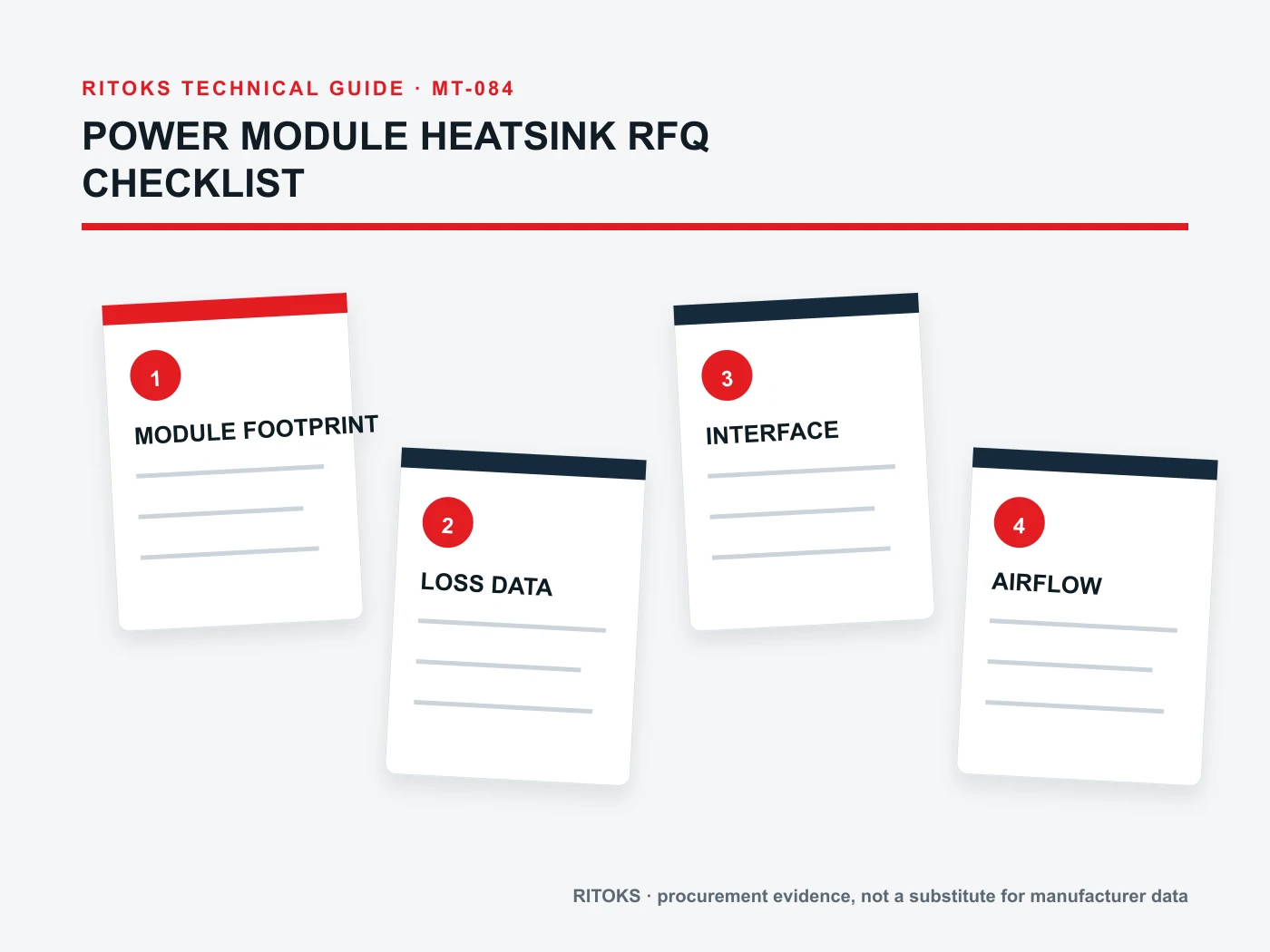
Provide the exact semiconductor order code and drawing. Record the baseplate dimensions, mounting-hole pattern, keep-out areas, electrical isolation needs and which surface transfers heat. Devices with similar current labels can have different packages, loss behavior and mounting rules.
State whether one module or several devices share the sink. If devices switch at different times, explain the duty rather than adding or averaging losses without a method. The supplier needs a defined heat source arrangement to assess spreading through the base and fin field.
Translate Electrical Duty Into Heat Loss
Give the worst credible power dissipation at the intended current, voltage, switching pattern and duty cycle. Use the exact manufacturer loss method. A module current rating is not heat input, and electrical input power is not automatically equal to the heat that enters the sink.
If the loss is uncertain, supply the operating cases and ask the module manufacturer or responsible engineer to confirm it. Mark estimates as estimates. A heatsink supplier can respond to a defined thermal load, but should not be expected to reconstruct an unknown power-converter design from a product name.
Define the Temperature Chain
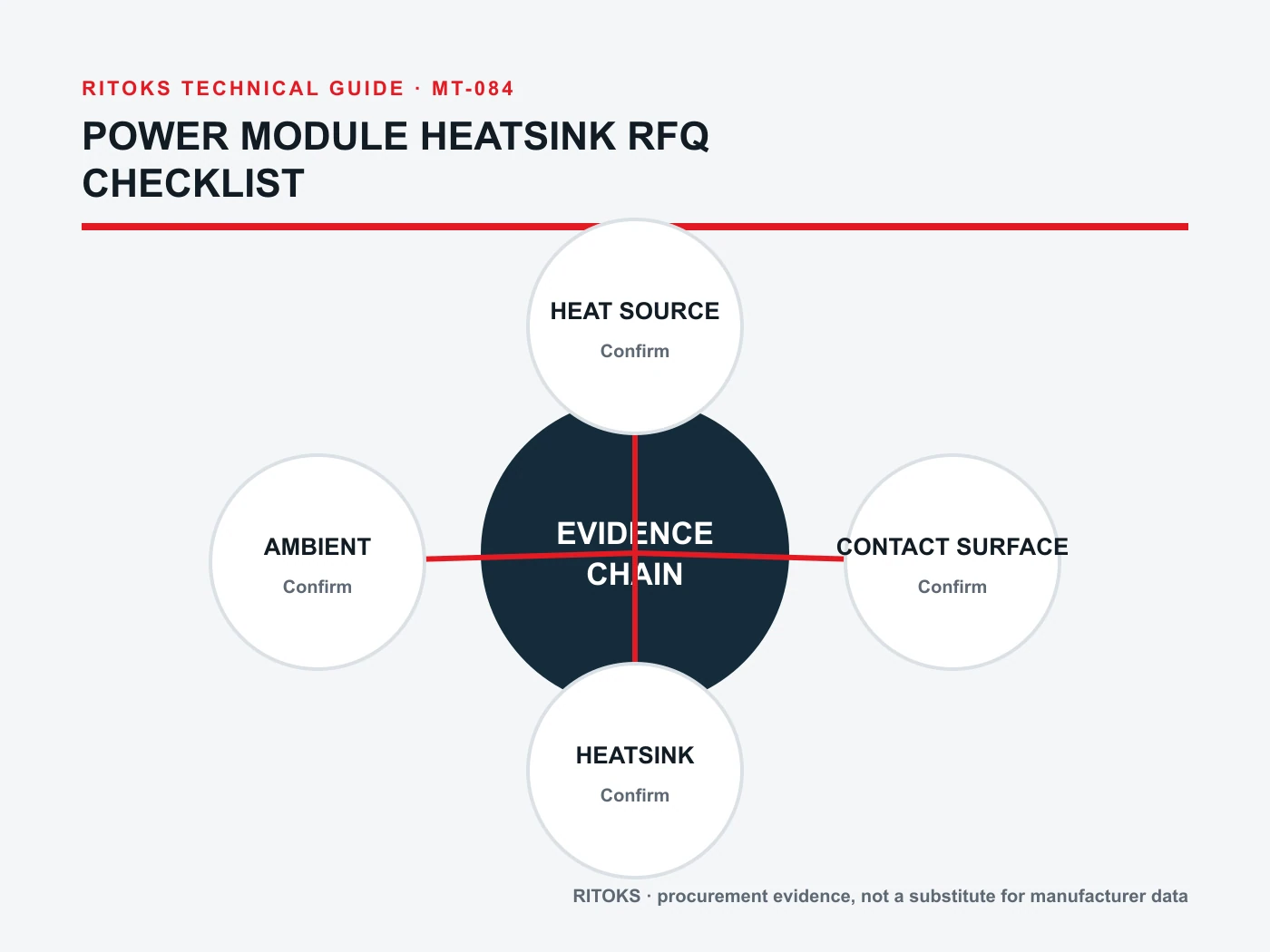
Record maximum internal ambient at the heatsink air inlet, not only room temperature. State the permitted module case or junction temperature and the design margin. Identify the thermal-resistance segments included in the calculation so junction-to-case, interface and sink-to-ambient values are not double-counted or omitted.
For forced air, define inlet-air temperature and the airflow available through the fins. A fan free-air rating is not the same as flow through a filter, duct or dense sink. For natural convection, state orientation and clearance so warm air can rise through the channels.
Specify the Mechanical and Interface Boundary
Attach the envelope drawing, mounting orientation and available space. Include nearby walls, adjacent sinks, ducting and service clearance. Confirm whether the supplier is quoting an extrusion, a cut and machined sink, an assembled fan-sink unit or another scope.
State the intended interface material and electrical-isolation requirement, but do not invent a torque or compound thickness. Ask for exact instructions covering flatness, surface preparation, fasteners and mounting pressure. The interface and machining record should remain part of the approved bill of material.
Define Verification Before Quotation Approval
Ask the supplier to state the thermal rating, reference points, airflow or natural-convection condition, orientation and test method used for the proposal. Request a drawing tied to the exact quoted code. If a fan is included, record supply, airflow evidence, connection and replacement access.
Plan assembly verification at the defined load and environment. Record measurement locations, stabilization criterion and pass limit. The test result applies to that configuration; changing the module, interface, fan, enclosure or orientation can reopen the review.
Build an Exact-Configuration Evidence File
Create one review sheet for the proposed Power Module Heatsink order code. Put project inputs in one column and supplier evidence in the other. Preserve the exact datasheets, drawings, curves, tables and manuals used in the decision, including their revision or retrieval date. A category page can establish family context, but an exact rating, setting, protocol or connection claim must trace to the quoted configuration.
Check that every accepted value describes the same orderable item. Similar housings and family names can hide different circuits, supplies, terminals, controls, mounting details or accessories. Do not combine a family maximum from one variant, a drawing from another and an optional feature from a third. Keep unresolved fields visible in the technical comparison.
Control Changes During Sourcing
Freeze the application record while suppliers respond. If the load, voltage, environment, duty, enclosure, control method or required output changes, issue a revised record and ask each supplier to reconfirm the candidate. Otherwise quotations can appear comparable while answering different technical requirements.
A proposed substitute returns to the same evidence gate. Matching dimensions, a similar product photograph or one equal headline rating is not enough. The substitute must satisfy the required functions and conditions using its own exact documentation.
Common Procurement Errors
- Selecting a Power Module Heatsink from one headline value while leaving the application context undefined.
- Using a curve, setting table, register map or connection diagram from a neighboring model.
- Treating a family maximum or ideal test condition as the application operating point.
- Assuming included accessories, controls and system functions from the product name or photograph.
- Approving a substitution without reopening the technical evidence review.
A module current rating or heat-sink extrusion length is not a heat-load value. Without the semiconductor loss method, mounting footprint and allowable temperature, a low-cost sink quotation may not be thermally comparable.
How to Compare Supplier Offers
| Comparison point | Required evidence | Do not accept |
|---|---|---|
| Module | Exact code, drawing and footprint | Generic “SCR module” |
| Loss | Worst-case dissipation with method | Current rating used as watts |
| Temperature | Inlet ambient and device limit | Room temperature only |
| Airflow | Defined flow through fin path | Fan free-air figure |
| Mechanical | Machined drawing and interface scope | Extrusion photo and length only |
Normalize every Power Module Heatsink offer to the same application record. Keep document revisions, test conditions and open questions beside each value. A proposal can remain commercially interesting while technically incomplete, but missing evidence should stay visible until resolved.
Decision Workflow
- Attach the exact module datasheet and mechanical drawing.
- Confirm heat loss for each operating case.
- Set ambient, device temperature limit and design margin.
- Define natural or forced airflow and orientation.
- Specify machining, interface, isolation and mounting scope.
- Request exact thermal evidence and an assembly verification plan.
Provide the exact power-module order code and loss at duty. Set case or junction and inlet-air limits, then ask for the proposed sink's interface, mounting and airflow evidence; compare quotations only when those inputs describe the same assembly.
RFQ Preparation Checklist
Identify unknown values as questions and require an exact orderable code rather than a generic family recommendation.
- Exact semiconductor manufacturer and order code
- Module drawing, footprint and mounting pattern
- Worst-case heat loss and duty cycle
- Maximum inlet ambient and allowable device temperature
- Natural or forced airflow with orientation
- Available envelope, machining and interface requirements
- Required drawings, test data, quantity and destination
Request the current datasheet and manual revisions and the scope of any certification, compatibility or performance claim. Record quantity and destination after the technical inputs so commercial terms do not obscure unresolved engineering questions.
Stop Conditions Before Order Release
Do not release the order while a critical application input is unknown, the quoted model is ambiguous, a required claim is supported only by another product document, or installation conditions fall outside the available evidence. These are engineering gaps, not editorial details.
The approval record should state what the selected item does, what remains outside its scope and which exact documents support the decision. If the application or candidate changes, reopen the affected checks rather than carrying the previous conclusion forward.
Frequently Asked Questions
Can I request a heatsink from the module current rating alone?
No. The supplier needs device loss, temperature limits and cooling conditions in addition to the module identity.
Is fan airflow on the label enough?
No. The relevant value is airflow through the installed resistance and fin path under the defined condition.
Should the RFQ include interface material?
Yes. The interface and any electrical isolation affect the thermal path and mounting scope.
Related RITOKS Products and Guidance
Use these destinations as separate category, product and guidance records. A contextual link does not claim interchangeability, coordination, compatibility or approval for a particular application.
Power Module Heatsink product category
Aluminum power module heatsinks
SF forced-air heatsinks for power modules
Heatsink thermal resistance explained
Technical References
These primary standards or manufacturer sources support only the general concepts identified below. Their product values, diagrams, approvals and tested combinations do not transfer to RITOKS products.
OMRON, Further Information of Solid-state Relays
Supports the need to connect semiconductor loss, thermal resistance, mounting and ambient conditions. OMRON values do not transfer to RITOKS heat sinks.
OMRON, Solid-state Relay Safety Precautions
Supports attention to heat-sink mounting surfaces, interfaces, airflow and surrounding temperature. It does not approve a RITOKS assembly.
Request an Exact-Model Review
Send the application requirements, exact documentation questions, quantity and destination through the RITOKS contact form. An RFQ requests an exact-model review; this guide does not approve a wiring design, protection setting, installation or automatic substitute.