
DC Surge Protective Devices · Comparison
2-Pole vs 3-Pole DC SPD: Topology Questions for Buyers
Compare 2-pole and 3-pole DC SPD arrangements through system topology, conductor relationships and exact connection evidence. A useful buyer review connects the project requirement to one exact orderable product and preserves the evidence used for approval.
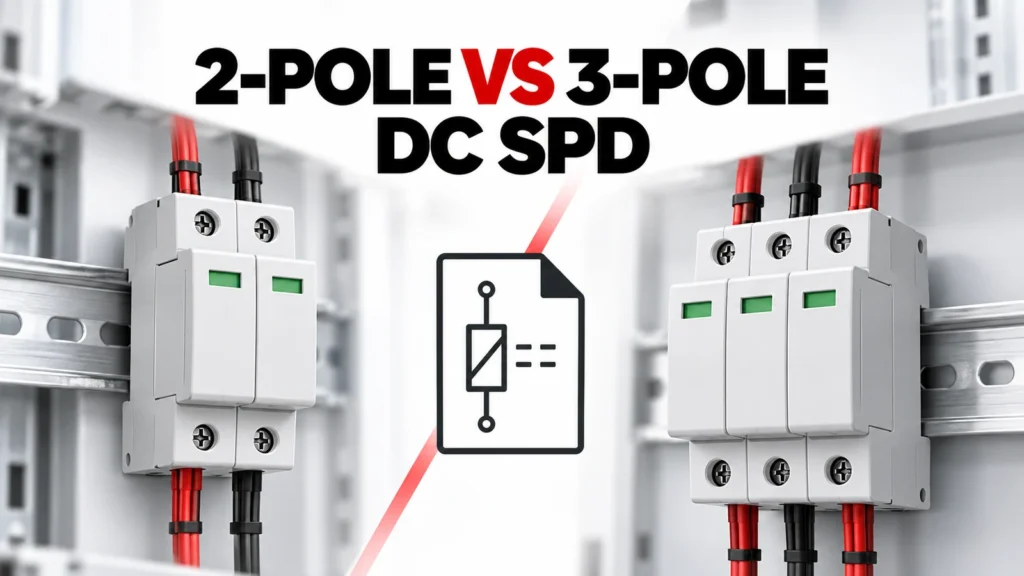
This guide explains why pole count follows the DC system topology and the exact manufacturer connection diagram. It does not provide a wiring design, approve a grounding arrangement or claim that any 2-pole and 3-pole devices are interchangeable.
Decision Inputs at a Glance
| Review field | Buyer must define | Evidence to request |
|---|---|---|
| System topology | Defined DC source, conductor arrangement and earth relationship | Approved project diagram |
| Pole arrangement | Protected paths required by the documented topology | Exact manufacturer connection diagram |
| Voltage role | Continuous operating voltage for the complete arrangement | Exact model row and stated test conditions |
| Coordination | Backup protection and upstream/downstream relationships | Manufacturer coordination instructions |
| Installation | Lead routing, enclosure, indication and replacement access | Installation manual and project review |
Pole Count Is an Outcome, Not a Starting Point
A buyer should not choose a 2-pole or 3-pole DC SPD from a product photograph or a rule borrowed from another installation. Pole count is the visible result of a deeper decision about which conductors require protective paths and how the DC source relates to earth. The project topology must therefore come before the catalog choice.
Begin with the approved single-line diagram and source architecture. Identify every current-carrying conductor, any intentionally grounded point and the location of the proposed SPD. Then ask the supplier to map the exact device arrangement to that record. If either document is missing, the pole-count decision remains open.
Document the DC Source and Earth Relationship
PV strings, battery systems and industrial DC supplies can use different conductor and grounding arrangements. The same nominal voltage does not prove that the same SPD topology applies. Record whether the system is floating, referenced or otherwise configured, but do not infer the protection path without the responsible designer and manufacturer documentation.
The topology record should also show where the SPD is located relative to source, conversion equipment, isolation and distribution. These locations can change the required review. This article deliberately stops short of prescribing a connection because a generic diagram could be unsafe when detached from the actual system.
Read the Manufacturer Diagram as Exact-Model Evidence
Request the connection diagram for the complete order code, including any base, plug-in module or remote-indication variant. A family brochure may show several arrangements on one page. The buyer must identify which drawing belongs to the quoted assembly and whether every conductor path is represented.
Do not rebuild a 3-pole function by combining unrelated single modules unless the manufacturer explicitly documents that assembly. Likewise, do not remove one module from a wider assembly because the remaining hardware appears to fit. Mechanical modularity is not electrical approval.
Keep Pole Count Separate From Surge Ratings
Pole count does not replace the review of continuous operating voltage, protection level, discharge-current classifications or other declared SPD parameters. Those values describe different aspects of the protective device. Compare them within one exact model row and under the stated conditions.
A wider assembly is not automatically stronger, and a narrower assembly is not automatically more suitable. The engineering question is whether the complete arrangement matches the topology and documented protection requirement. Procurement comparisons should preserve that distinction.
Review Backup Protection and End-of-Life Indication
Ask how the exact SPD is coordinated with the project protective architecture and what manufacturer instructions govern backup protection. Record local status indication, optional remote contacts and the maintenance method as separate functions. None of these can be assumed from pole count.
If replaceable cartridges are offered, confirm the matching base and cartridge order codes. A cartridge that looks identical may carry different voltage or surge declarations. Maintenance records should prevent mixed variants from entering the same assembly.
Compare Offers Without Flattening Topology Differences
Normalize each quotation against the same project topology, location and evidence list. A 2-pole offer and a 3-pole offer may represent different assumptions rather than competing prices for the same requirement. Ask every supplier to state its assumption instead of hiding it in a part number.
Escalate any disagreement between the project diagram and the supplier connection document. The resolution belongs with qualified system design and exact manufacturer evidence. Price comparison should resume only after the proposed arrangements answer the same technical question.
Build an Exact-Model Evidence File
Create one approval record for the proposed DC SPD order code. Put each project requirement beside the supplier document that answers it. Preserve the exact datasheet, drawing, table, instruction or selection output used, including its revision or retrieval date. A category page can establish family context, but it cannot prove an exact rating, terminal arrangement or system combination.
Check that every accepted statement describes the same orderable item. Similar housings can contain different circuits, supplies, terminals, accessories or functions. Do not combine a family maximum from one variant, a diagram from another and an optional feature from a third. Mark unresolved fields explicitly so they remain visible in the commercial review.
Keep Project Inputs Separate From Product Evidence
The project team defines the application: source, load, duty, environment, controls, mechanical limits and required functions. The supplier identifies an exact DC SPD and supports it with exact documents. Neither side should fill a gap by inference from appearance, a shared family name or one matching headline value.
Freeze the application record while quotations are being compared. If the topology, source, load, environment, enclosure or required output changes, issue a revised record and ask each supplier to reconfirm the candidate. Otherwise apparently comparable quotations may be answering different technical requirements.
Common Procurement Errors
Avoid selecting a DC SPD from one headline value while the application context remains incomplete. Do not use a circuit, curve, terminal drawing or performance claim from a neighboring model. A product photograph and a family page can support discovery, but neither is exact technical evidence.
Also avoid assuming that an accessory, communication function, protection role or coordinated result is included unless it appears in the quotation and exact-model documents. A substitute requires the same topology, rating, mounting and evidence review as the original candidate.
How to Compare Supplier Offers
Normalize every DC SPD offer to the same application record. Keep document revisions, stated conditions, included accessories and open questions beside each value. This makes differences in delivered scope visible and prevents a lower-cost but narrower offer from appearing equivalent to a complete solution.
Stop the comparison when a critical application input is unknown, the quoted model is ambiguous, a required claim is supported only by another manufacturer or order code, or the installation falls outside the available evidence. These are engineering gaps, not editorial details.
Control Revisions and Substitutions
Give the approved DC SPD record a revision identifier and keep it with the project file. If the supplier changes the order code, accessory, firmware, drawing or stated operating condition, identify the change before accepting it. A substitution is a new technical proposal even when its price, housing or product-family name looks familiar.
Repeat only the affected checks, but do not waive them. Confirm that the revised candidate still answers the frozen application, that every referenced document belongs to it and that all open exceptions have an owner. This small change-control step prevents a technically reviewed selection from being replaced by an unreviewed commercial equivalent.
Decision Workflow
- Freeze the application and system record before choosing a catalog code.
- Identify the exact function and every interface that requires evidence.
- Request one complete order code with its current datasheet and drawings.
- Map each project requirement to a specific manufacturer statement.
- Record deviations, accessories, document revisions and unresolved questions.
- Repeat the review whenever the application or proposed product changes.
Use this workflow as a procurement and evidence discipline. It does not replace qualified design, installation instructions or the responsible engineer's approval for the DC SPD application.
RFQ Preparation Checklist
A practical 2 pole vs 3 pole dc spd should be concise enough for a supplier to answer and complete enough to prevent silent assumptions. Identify unknown values as questions rather than allowing them to become undocumented selections.
- System topology: Defined DC source, conductor arrangement and earth relationship.
- Pole arrangement: Protected paths required by the documented topology.
- Voltage role: Continuous operating voltage for the complete arrangement.
- Coordination: Backup protection and upstream/downstream relationships.
- Installation: Lead routing, enclosure, indication and replacement access.
- Exact product code, included accessories and documentation revision
- Quantity, destination, required approvals and commercial scope
Request the exact scope of any classification, compatibility, coordination or performance claim. Record quantity and destination after the technical inputs so commercial terms do not obscure unresolved engineering questions.
Frequently Asked Questions
Is a 3-pole DC SPD always better than a 2-pole SPD?
No. Suitability depends on the documented system topology and exact manufacturer arrangement.
Can pole count be selected from voltage alone?
No. Voltage is one input; conductor and earth relationships also require review.
Can I copy an AC SPD connection diagram?
No. Use the exact DC-system design and the exact DC SPD documentation.
Related RITOKS Products and Guidance
These links provide product-family context only. A contextual link does not claim interchangeability, compatibility or an approved system combination.
Technical References
These manufacturer sources support only the general engineering concepts described below. Their product ratings, circuit diagrams, approvals and coordination results do not transfer to RITOKS products.
Schneider Electric, Surge Protection Devices: Electrical Installation Guide
Supports the distinction between SPD classification, continuous-voltage, protection-level and discharge-current roles. Schneider values and diagrams do not transfer to RITOKS products.
Phoenix Contact, Surge Protection for Photovoltaic Systems
Supports treating PV DC surge protection as a system-location and topology question. Phoenix Contact ratings and arrangements are not RITOKS evidence.
Request an Exact-Model Review
Send the application requirements, exact-document questions, quantity and destination through the RITOKS contact form. An RFQ requests an exact-model review; this guide does not approve a circuit, installation or automatic substitute.